Bitcoin Pioneer Adam Back Addresses Mention In Epstein Files

bitcoinistPublished on 2026-02-02Last updated on 2026-02-02

Abstract

Bitcoin pioneer Adam Back addressed allegations linking him and Blockstream to Jeffrey Epstein, following the circulation of excerpts from the "Epstein files." Back stated that during Blockstream's 2014 seed funding round, they were introduced to Epstein through MIT Media Lab's former director Joi Ito, who described Epstein as a limited partner in his fund. This fund later invested a minority stake in Blockstream. However, Back emphasized that the connection was brief and indirect, with Ito's fund divesting its shares months later due to potential conflicts of interest. He asserted that Blockstream has no financial ties to Epstein or his estate. The allegations resurfaced due to emails and screenshots showing Epstein's involvement in Blockstream's early fundraising, including a tenfold increase in his investment and travel coordination involving Back. A viral social media thread attempted to connect Epstein's investment to later disputes over Bitcoin's scaling decisions, suggesting financial ties to key Bitcoin Core developers. At the time of reporting, BTC was trading at $77,750.

Bitcoin veteran Adam Back moved to shut down a fresh round of allegations after newly circulated “Epstein files” excerpts and screenshots reignited claims that Jeffrey Epstein intersected with Blockstream during the company’s earliest fundraising.

Back’s response on X framed the episode as a brief, indirect touchpoint routed through MIT Media Lab and its former director, Joi Ito, rather than a direct relationship with Epstein. “In 2014, during Blockstream’s seed-round investor roadshow, the company was introduced to then MIT Media Lab director Joi Ito. Subsequently Blockstream met with Jeffrey Epstein, who was described at the time as a limited partner in Ito’s fund,” Back wrote. “That fund later invested a minority stake in Blockstream.”

Back emphasized that the link did not persist. “A few months later, Ito’s fund divested its Blockstream shares due to a potential conflict of interest, and other concerns. Blockstream has no direct nor indirect financial connection with Jeffrey Epstein, or his estate,” he added.

Why Bitcoin OG Back Is Inside The Epstein Files

Notably, Epstein surfaced in Blockstream’s early fundraising. In a 2014 email, Blockstream co-founder Austin Hill told Epstein his seed-round allocation was being increased tenfold, from $50,000 to $500,000.
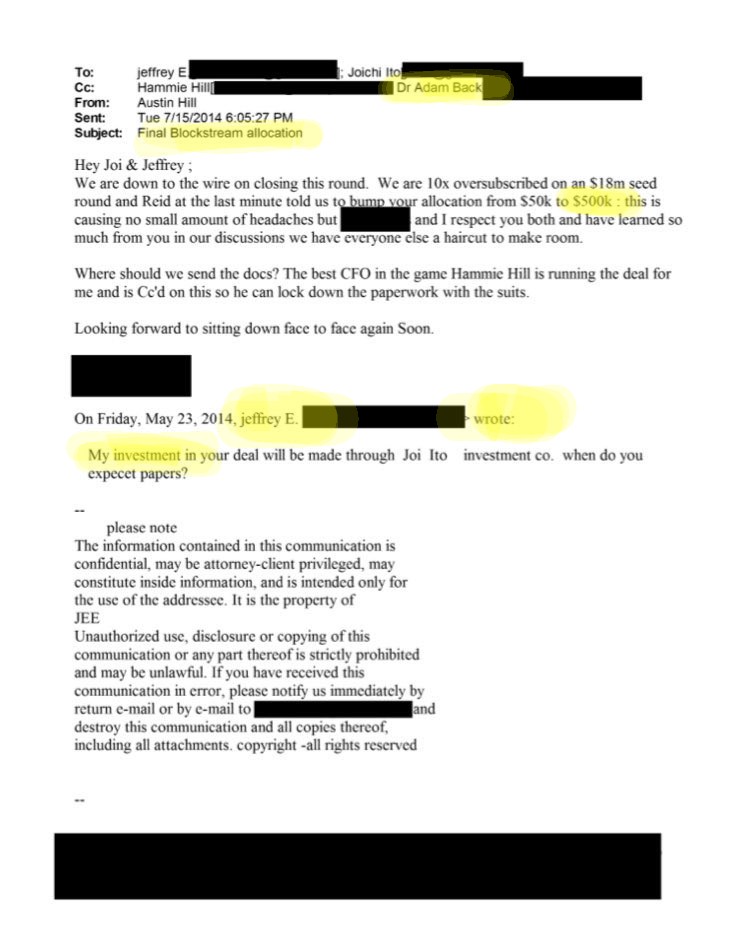
Epstein files: Blockstream | Source: X @wilkins_jo52699

Separately, a travel-coordination email screenshot dated April 2014 includes Back’s name in a list of travelers and describes hotel-room needs for a St. Thomas trip. “Nice to ‘meet’ you. So we will be a party of 5 (Austin, Adam, Myself, Kelly, Ellaina).” The screenshot shows the message as part of a scheduling chain involving hotel arrangements, and it is one of the documents driving the current round of viral reposts.
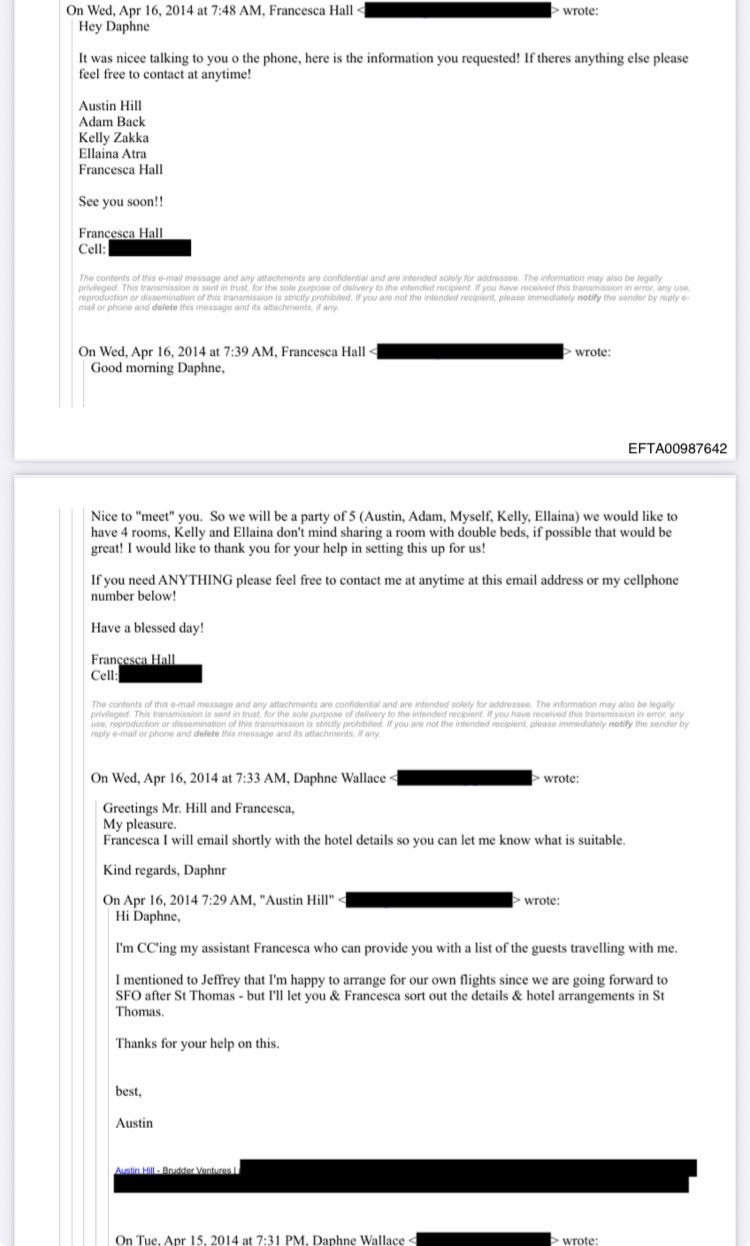
Source: X @CatoTheElder17

Moreover, Epstein said that he “liked him” (Back).
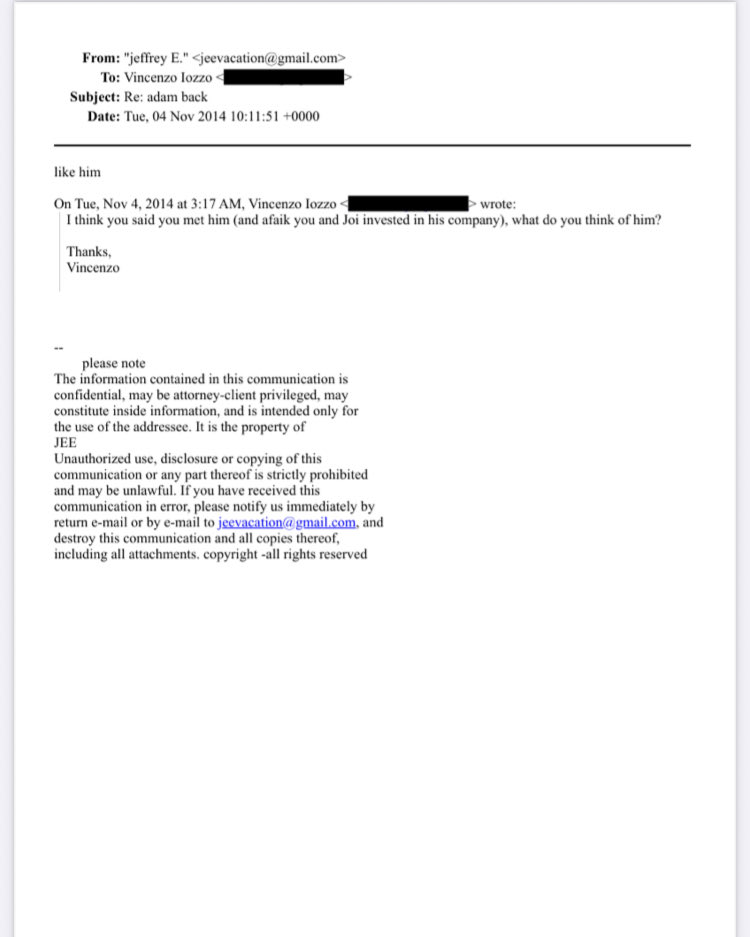
Source: X @CatoTheElder17

A X thread posted Feb. 2, 2026 by “pigeon man” attempts to lay out what it calls an “EPSTEIN AND BITCOIN” timeline, tying early Blockstream meetings and investment claims to later disputes over Bitcoin’s scaling path.

According to that thread, Epstein “meets with Adam Back and Austin Hill” in April 2014, describing the context as a meeting with executives of a new layer-2 company, Blockstream. The thread then claims that in July 2014, Epstein invested “at least $500,001” into Blockstream with Ito, and argues this created a financial tie to a company associated with influential Bitcoin Core developers.

The same thread highlights Blockstream’s October 2014 whitepaper release and names several developers it says were co-founders or co-authors, including Gregory Maxwell, Luke Dashjr, Pieter Wuille, and Matt Corallo. It also alleges that in 2015 Epstein had “encrypted conversations” with Austin Hill and others, claiming participants avoided email because “I don’t think the NSA deserves to hear what we say.”

The thread’s framing is designed to connect the social scandal to a much older technical and governance fault line: the 2016–2017 blocksize era. It argues that “keeping the block size limit” preserved demand for layer-2 systems and later claims “Bitcoin Core developers decide small blocks are what’s best for Bitcoin,” leading to a split.

At press time, BTC traded at $77,750.
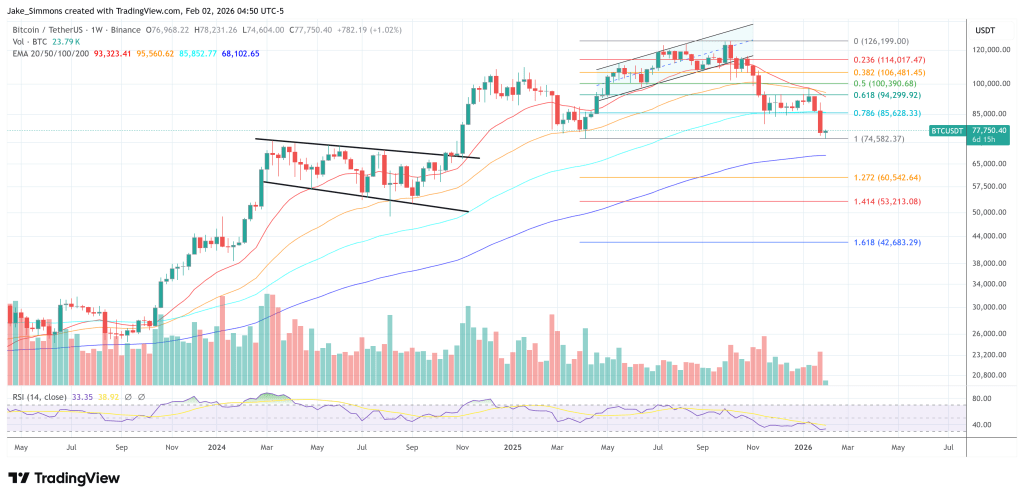
Bitcoin crash stall at the 1.0 Fib for now, 1-week chart | Source: BTCUSDT on TradingView.com

Related Questions

QWhat is the core allegation that Adam Back is responding to in the article?

AThe allegation is that Jeffrey Epstein had a direct financial and personal connection with Adam Back and Blockstream during the company's early fundraising, based on newly circulated excerpts from the 'Epstein files'.

QHow did Adam Back describe the nature of Blockstream's connection to Jeffrey Epstein?

AAdam Back described it as a brief, indirect touchpoint. He stated that Blockstream was introduced to Epstein through then MIT Media Lab director Joi Ito, who described Epstein as a limited partner in his fund. That fund later invested a minority stake in Blockstream, but divested its shares a few months later.

QWhat specific piece of communication from 2014 is cited as evidence of Epstein's involvement with Blockstream?

AA 2014 email from Blockstream co-founder Austin Hill to Jeffrey Epstein, in which Hill informs Epstein that his seed-round allocation was being increased from $50,000 to $500,000.

QAccording to the 'pigeon man' thread, what later Bitcoin controversy is the alleged Epstein connection tied to?

AThe thread ties the alleged Epstein connection to the 2016–2017 blocksize debate, arguing that keeping the block size limit preserved demand for layer-2 systems like Blockstream's and influenced the scaling path of Bitcoin.

QWhat was the stated reason for Joi Ito's fund divesting its Blockstream shares?

AThe fund divested its Blockstream shares due to a potential conflict of interest and other concerns, as stated by Adam Back.

Related Reads

Trading

Spot
Futures

Hot Articles

What is $BITCOIN

DIGITAL GOLD ($BITCOIN): A Comprehensive Analysis Introduction to DIGITAL GOLD ($BITCOIN) DIGITAL GOLD ($BITCOIN) is a blockchain-based project operating on the Solana network, which aims to combine the characteristics of traditional precious metals with the innovation of decentralized technologies. While it shares a name with Bitcoin, often referred to as “digital gold” due to its perception as a store of value, DIGITAL GOLD is a separate token designed to create a unique ecosystem within the Web3 landscape. Its goal is to position itself as a viable alternative digital asset, although specifics regarding its applications and functionalities are still developing. What is DIGITAL GOLD ($BITCOIN)? DIGITAL GOLD ($BITCOIN) is a cryptocurrency token explicitly designed for use on the Solana blockchain. In contrast to Bitcoin, which provides a widely recognized value storage role, this token appears to focus on broader applications and characteristics. Notable aspects include: Blockchain Infrastructure: The token is built on the Solana blockchain, known for its capacity to handle high-speed and low-cost transactions. Supply Dynamics: DIGITAL GOLD has a maximum supply capped at 100 quadrillion tokens (100P $BITCOIN), although details regarding its circulating supply are currently undisclosed. Utility: While precise functionalities are not explicitly outlined, there are indications that the token could be utilized for various applications, potentially involving decentralized applications (dApps) or asset tokenization strategies. Who is the Creator of DIGITAL GOLD ($BITCOIN)? At present, the identity of the creators and development team behind DIGITAL GOLD ($BITCOIN) remains unknown. This situation is typical among many innovative projects within the blockchain space, particularly those aligning with decentralized finance and meme coin phenomena. While such anonymity may foster a community-driven culture, it intensifies concerns about governance and accountability. Who are the Investors of DIGITAL GOLD ($BITCOIN)? The available information indicates that DIGITAL GOLD ($BITCOIN) does not have any known institutional backers or prominent venture capital investments. The project seems to operate on a peer-to-peer model focused on community support and adoption rather than traditional funding routes. Its activity and liquidity are primarily situated on decentralized exchanges (DEXs), such as PumpSwap, rather than established centralized trading platforms, further highlighting its grassroots approach. How DIGITAL GOLD ($BITCOIN) Works The operational mechanics of DIGITAL GOLD ($BITCOIN) can be elaborated on based on its blockchain design and network attributes: Consensus Mechanism: By leveraging Solana’s unique proof-of-history (PoH) combined with a proof-of-stake (PoS) model, the project ensures efficient transaction validation contributing to the network's high performance. Tokenomics: While specific deflationary mechanisms have not been extensively detailed, the vast maximum token supply implies that it may cater to microtransactions or niche use cases that are still to be defined. Interoperability: There exists the potential for integration with Solana’s broader ecosystem, including various decentralized finance (DeFi) platforms. However, the details regarding specific integrations remain unspecified. Timeline of Key Events Here is a timeline that highlights significant milestones concerning DIGITAL GOLD ($BITCOIN): 2023: The initial deployment of the token occurs on the Solana blockchain, marked by its contract address. 2024: DIGITAL GOLD gains visibility as it becomes available for trading on decentralized exchanges like PumpSwap, allowing users to trade it against SOL. 2025: The project witnesses sporadic trading activity and potential interest in community-led engagements, although no noteworthy partnerships or technical advancements have been documented as of yet. Critical Analysis Strengths Scalability: The underlying Solana infrastructure supports high transaction volumes, which could enhance the utility of $BITCOIN in various transaction scenarios. Accessibility: The potential low trading price per token could attract retail investors, facilitating wider participation due to fractional ownership opportunities. Risks Lack of Transparency: The absence of publicly known backers, developers, or an audit process may yield skepticism regarding the project's sustainability and trustworthiness. Market Volatility: The trading activity is heavily reliant on speculative behavior, which can result in significant price volatility and uncertainty for investors. Conclusion DIGITAL GOLD ($BITCOIN) emerges as an intriguing yet ambiguous project within the rapidly evolving Solana ecosystem. While it attempts to leverage the “digital gold” narrative, its departure from Bitcoin's established role as a store of value underscores the need for a clearer differentiation of its intended utility and governance structure. Future acceptance and adoption will likely depend on addressing the current opacity and defining its operational and economic strategies more explicitly. Note: This report encompasses synthesised information available as of October 2023, and developments may have transpired beyond the research period.

363 Total ViewsPublished 2025.05.13Updated 2025.05.13

What is $BITCOIN

Discussions

Welcome to the HTX Community. Here, you can stay informed about the latest platform developments and gain access to professional market insights. Users' opinions on the price of BTC (BTC) are presented below.

活动图片















