Bitcoin News: ETFs Under Pressure – Record Losses for Investors

bitcoinistPublished on 2026-02-05Last updated on 2026-02-05

Abstract

Bitcoin ETFs are facing significant pressure as the cryptocurrency market experiences one of its toughest tests since the launch of US spot ETFs. Bitcoin's price has fallen sharply to around $76,140, well below the average net cost basis of $82,405 for ETF investors. This has resulted in aggregate unrealized losses of approximately $7.31 billion—the largest since the ETFs began trading in January 2024. The decline marks a dramatic shift from mid-2025 when investors held over $80 billion in paper profits. Analysts are watching whether the $82,400 level will act as strong resistance during any recovery, as many may try to exit breakeven. Meanwhile, attention is shifting to Bitcoin Layer-2 solutions like Bitcoin Hyper, which aims to enhance network utility and scalability while offering staking yields up to 38% APY, positioning itself as a potential catalyst for the next market cycle.

The cryptocurrency market is experiencing one of its toughest tests of resilience this week since the launch of the US spot ETFs. After Bitcoin reached new all-time highs for much of the past year, a massive price drop has triggered a chain reaction that is hitting institutional products particularly hard. What was considered an unstoppable price driver for months is now turning into a burden for the entire market structure. As capital flows out of the funds, many market participants are asking the fundamental question of how resilient the cryptocurrency's new investor base really is.

Current data now reveals for the first time the precise extent of the financial imbalance in which many ETF investors currently find themselves.

Bitcoin ETFs: Price Drop Below Cost Basis Forces Rethink

Market dynamics have deteriorated drastically, with US Bitcoin ETFs at the center of the storm. A key indicator of the current panic is the so-called "Cost Basis," i.e., the average purchase price of the ETF shares. Current chart data from Bloomberg Intelligence shows that the Bitcoin price, at around $76,140, has fallen significantly below the Net Cost Basis of $82,405. The discrepancy is even clearer with the Gross Cost Basis, which only considers purchases and is currently at $83,655. This means the leading cryptocurrency is trading significantly below the level at which the bulk of institutional money flowed into the market.

This circumstance is immediately reflected in investor profitability. According to the available data from Bloomberg Intelligence, aggregate Bitcoin ETF holders are in the deepest loss zone since the products launched in January 2024. The average unrealized loss currently amounts to approximately $7.31 billion. This marks a dramatic turning point compared to the summer of 2025, when investors were sitting on paper profits of over $80 billion at times.

Bloomberg analyst James Seyffart emphasizes in this context that Bitcoin ETF holders are collectively facing the biggest losses since the launch, which massively increases the psychological pressure on the market.

The current correction is being interpreted more as a stress test for the long-term conviction of ETF buyers. While the Bitcoin price reached peak values of over $120,000 in October 2025, the recent downward movement has sustainably dampened the euphoria. Nevertheless, the data shows that, despite the billions in losses, there has been no uncontrolled mass capitulation so far. Analysts are now closely watching whether the net cost basis of around $82,400 will act as a massive resistance level in a recovery, as many investors might try to close their positions there without a loss.

Bitcoin L2: New Narratives for 2026?

The current market situation illustrates that the dependence on institutional ETF inflows has brought a new form of volatility into the ecosystem, posing challenges for many investors. As the dust settles around the record outflows, many market participants are already looking towards technological innovations that could create intrinsic value for the network independent of exchange-traded products. In particular, the segment of Bitcoin Layer-2 solutions is coming into focus as a potential catalyst for the next market cycle, as it directly expands the fundamental utility of the leading cryptocurrency.

In this dynamic environment, the project Bitcoin Hyper is currently generating significant attention as it addresses a technological gap that has remained unfulfilled by Bitcoin's pure store-of-value function. The project aims to massively increase the efficiency and scalability of the network through a specialized Layer-2 structure to make Bitcoin usable for a broader range of applications in the decentralized finance (DeFi) space.

Go Directly to the Bitcoin Hyper Presale
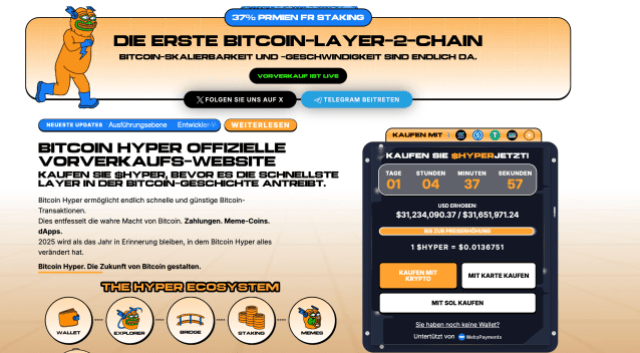
The narrative behind Bitcoin Hyper is closely linked to the community's desire to underpin Bitcoin's dominance with real utility, rather than relying solely on spot market price dynamics. The project is currently showing significant momentum, reflected in an above-average demand during its ongoing funding phase. A key driver for the growing interest is the integrated staking model, which currently promises an annual percentage yield (APY) of 38 percent.

Compared to the broad market average, this figure signals a strong attraction for investors seeking productive yield opportunities within the Bitcoin ecosystem. By combining technical scaling with economic incentives, Bitcoin Hyper distinguishes itself from purely speculative approaches and attempts to establish a sustainable infrastructure for the future Bitcoin network. Interested observers currently have the opportunity to benefit from planned price increases within the presale structure through early participation, which could lead to paper gains.

Go Directly to the Bitcoin Hyper Presale

Trending Cryptos

Related Questions

QWhat is the main reason for the current pressure on Bitcoin ETF investors according to the article?

AThe main reason is that Bitcoin's price has fallen significantly below the net cost basis of $82,405 and the gross cost basis of $83,655, meaning most institutional money entered the market at a higher price, putting investors in a loss position.

QWhat is the current aggregate unrealized loss for Bitcoin ETF holders as reported by Bloomberg Intelligence?

AThe current aggregate unrealized loss for Bitcoin ETF holders is approximately $7.31 billion.

QWhat potential role does the net cost basis of $82,400 play in a market recovery, as mentioned in the article?

AAnalysts are watching to see if the net cost basis of $82,400 will act as a major resistance level during a recovery, as many investors might try to close their positions at break-even to avoid losses.

QWhat new technological area is gaining focus as a potential catalyst for the next market cycle, independent of ETFs?

AThe segment of Bitcoin Layer-2 solutions is gaining focus as a potential catalyst, as they aim to expand the fundamental utility of Bitcoin, for example in decentralized finance (DeFi).

QWhat specific feature of the 'Bitcoin Hyper' project is highlighted as a major driver for investor interest?

AA major driver for interest in the 'Bitcoin Hyper' project is its integrated staking model, which currently offers a prospective annual yield (APY) of 38%.

Related Reads

Qualcomm: AI Hype Subsides, When Will Smartphones Emerge from the Gloom?

Qualcomm reported its Q3 FY2026 results (ending June 2026), with revenue of $9.95B, down 4% YoY but above expectations. Gross margin declined to 53.1%, pressured by rising costs across manufacturing and memory. Key business segments showed mixed performance: Handset revenue fell 19.6% YoY to $5.09B, dragged by an 11% decline in non-Apple Android shipments and weaker high-end mix. Conversely, Automotive revenue surged 61% to $1.59B, and IoT grew 9% to $1.83B. Core operating profit dropped 41% YoY due to margin compression and higher expenses. Management's Q4 FY2026 guidance projects revenue of $9.7B-$10.5B, in line with consensus, but Non-GAAP EPS guidance of $2.05-$2.25 fell short of expectations. Amidst persistent weakness in its core handset market, Qualcomm is pursuing growth in AI, focusing on Edge AI (smartphones, PCs, automotive) and Data Center AI. Its data center strategy includes four pillars: AI accelerators (e.g., AI200), commercial CPUs (Dragonfly C1000), custom silicon, and connectivity solutions. While these initiatives initially boosted its stock, concerns over AI capital expenditure sustainability have since erased those gains. The company targets $5B in data center revenue for FY2027 and $15B for FY2029. The report concludes that with the traditional handset business still under pressure, the data center opportunity is currently viewed as a longer-term option, and a more conservative valuation based on core operations may be warranted until AI contributions materialize.

marsbit5m ago

Qualcomm: AI Hype Subsides, When Will Smartphones Emerge from the Gloom?

marsbit5m ago

From TPU to Self-Evolving Agents: How Jeff Dean Predicts the Next Step in AI

At the 2026 YC Startup School, Jeff Dean outlined his vision for AI's next phase, shifting focus from simply scaling models to building intelligent, autonomous systems. He believes AI's progress is no longer just about creating smarter models, but about integrating them into systems capable of long-term, iterative work, automated experimentation, and continuous learning. This evolution moves the competition from "who has the bigger model" to "who can best organize intelligence." Dean suggests AI capabilities are now comparable to a junior engineer, enabling the automation of complex workflows. However, the true challenge and opportunity lie in managing these AI "workers" at scale. He emphasizes the importance of **context engineering**—structuring tools, memory, and feedback loops—over raw model power. For startups, this means building deep expertise in niche domains where general models currently fail (near 0-1% success rates), leveraging proprietary data, specialized tools, and domain-specific evaluators. A recurring theme is re-examining fundamental constraints. Dean's past work, like moving Google's search index to memory or creating the TPU, stemmed from questioning outdated assumptions about hardware and cost. He sees similar inflection points today, particularly in **specialized inference hardware** to drastically reduce latency and energy consumption for real-time Agent operation. Notably, he points out that in modern AI systems, the dominant cost is often not computation but **data movement**. Reliable, long-running Agents require robust system design, borrowing concepts from distributed computing like checkpointing, state management, and parallel exploration to handle failures and maintain progress over days or weeks. As AI automates execution, the scarcest human skills will shift to **defining clear specifications**, **judging what problems are worth solving** (taste), and designing effective feedback loops. Ultimately, Dean's framework prioritizes understanding the problem deeply, identifying the true bottlenecks, and systematically building closed-loop systems where AI can not only perform tasks but also improve AI itself.

marsbit6m ago

From TPU to Self-Evolving Agents: How Jeff Dean Predicts the Next Step in AI

marsbit6m ago

Trading

Spot

Hot Articles

How to Buy ONE

Welcome to HTX.com! We've made purchasing Harmony (ONE) simple and convenient. Follow our step-by-step guide to embark on your crypto journey.Step 1: Create Your HTX AccountUse your email or phone number to sign up for a free account on HTX. Experience a hassle-free registration journey and unlock all features.Get My AccountStep 2: Go to Buy Crypto and Choose Your Payment MethodCredit/Debit Card: Use your Visa or Mastercard to buy Harmony (ONE) instantly.Balance: Use funds from your HTX account balance to trade seamlessly.Third Parties: We've added popular payment methods such as Google Pay and Apple Pay to enhance convenience.P2P: Trade directly with other users on HTX.Over-the-Counter (OTC): We offer tailor-made services and competitive exchange rates for traders.Step 3: Store Your Harmony (ONE)After purchasing your Harmony (ONE), store it in your HTX account. Alternatively, you can send it elsewhere via blockchain transfer or use it to trade other cryptocurrencies.Step 4: Trade Harmony (ONE)Easily trade Harmony (ONE) on HTX's spot market. Simply access your account, select your trading pair, execute your trades, and monitor in real-time. We offer a user-friendly experience for both beginners and seasoned traders.

4.7k Total ViewsPublished 2024.03.29Updated 2026.06.02

How to Buy ONE

Discussions

Welcome to the HTX Community. Here, you can stay informed about the latest platform developments and gain access to professional market insights. Users' opinions on the price of ONE (ONE) are presented below.

活动图片