Bitcoin Miner Riot Transfers Out Another 500 BTC Amid AI Push

bitcoinistPublished on 2026-04-03Last updated on 2026-04-03

Abstract

Bitcoin mining firm Riot Platforms has transferred 500 BTC, valued at $34.13 million, to an unknown wallet, suggesting a potential sale. This follows a previous $200 million Bitcoin sale in late 2025. Riot, one of the world's largest public miners with 38.50 EH/s, holds Bitcoin as a treasury asset and is expanding into AI and high-performance computing, which may be linked to the sale. Prior to the transfer, Riot held 18,005 BTC, ranking seventh among public Bitcoin treasury firms. Meanwhile, Bitcoin's mining difficulty is expected to increase by 4.17% due to a faster average block time of 9.60 minutes. Bitcoin's price hovers around $66,100 after recent sideways movement.

Another outflow from Riot Platforms has been spotted on the Bitcoin network, a sign that the mining company may be participating in further selling.

Bitcoin Mining Company Riot Has Moved Another 500 BTC

As shared by on-chain sleuth Lookonchain in an X post, Riot Platforms has made a transfer away from its Bitcoin wallet during the past day. In total, this transaction involved 500 BTC, worth $34.13 million at the time that the move took place.
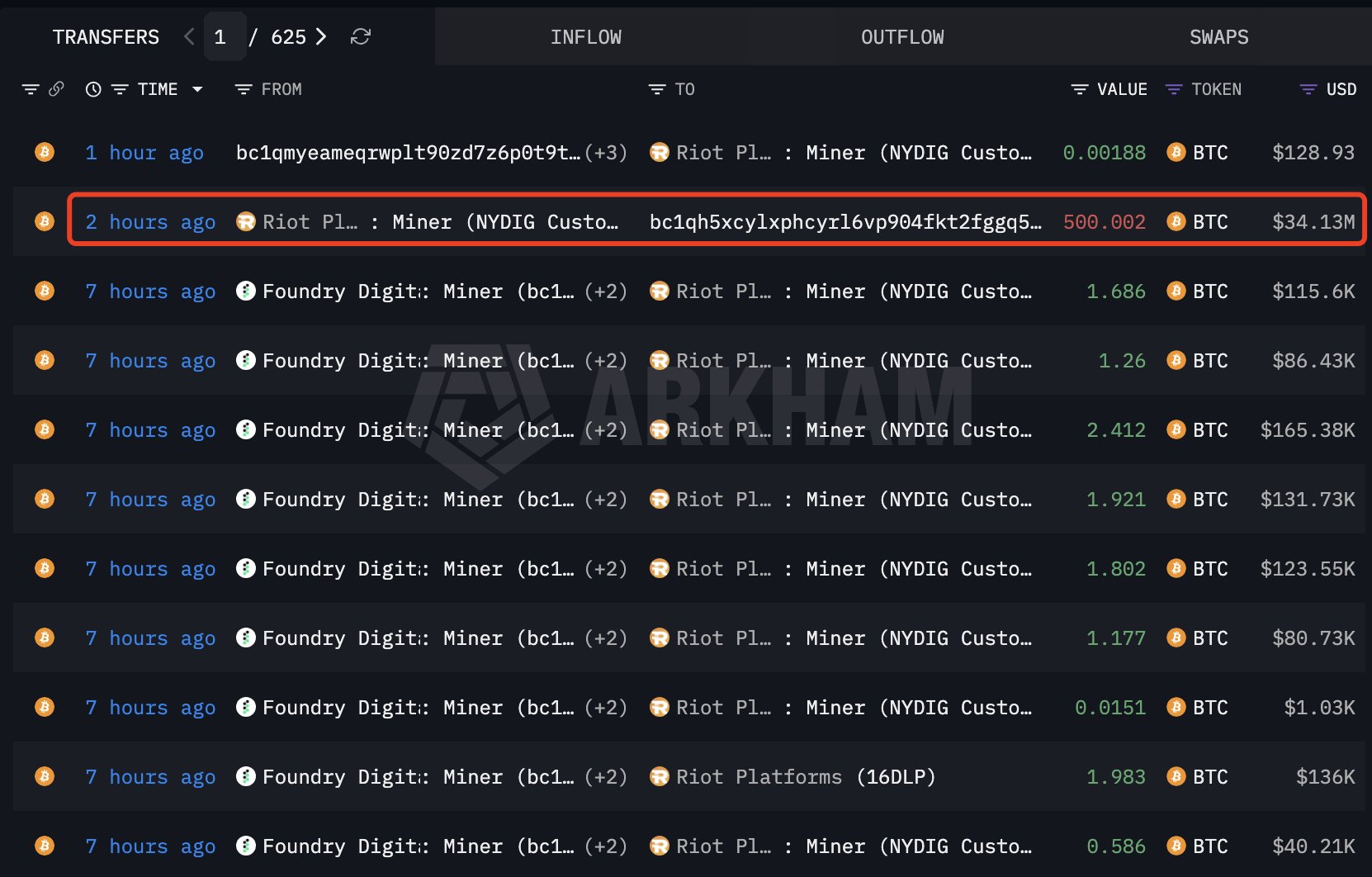
The recent transaction history of Riot Platforms | Source: @lookonchain on X

The destination of the move was an unknown wallet, so it’s not possible to say for sure what the intent behind it was, but it’s likely that it was for selling the tokens. Previously, the company offloaded $200 million worth of Bitcoin during the final months of 2025.

Riot is a public Bitcoin mining company based in the United States that holds the BTC that it mines as a treasury asset. In terms of computing power or Hashrate, the firm is among the largest miners in the world, according to data from BitcoinMiningStock.
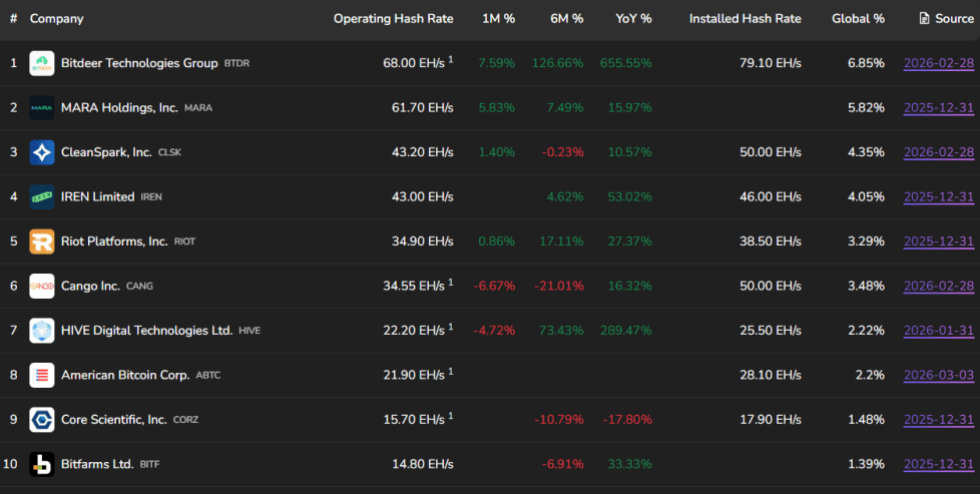
The top 10 public BTC miners based on operating Hashrate | Source: BitcoinMiningStock

From the table, it’s visible that Riot Platforms has a total installed Hashrate of 38.50 exahashes per second (EH/s), putting it number five on the list of the largest public mining companies.

Like other big miners, Riot has also been exploring the AI/high-performance computing (HPC) business. As such, it’s possible that the new Bitcoin sale is linked to this expansion.

Before the outflow transaction, Riot Platforms held a total of 18,005 BTC in its treasury, but if the sale is confirmed, that figure would reduce to 17,505 BTC. The miner is currently ranked seventh among the public Bitcoin treasury firms.

BTC Mining Difficulty Is Set To Jump On Friday

The Bitcoin network is approaching its next mining Difficulty adjustment and according to data from CoinWarz, the change is expected to be a green one. The “Difficulty” refers to a feature built into the BTC blockchain that controls how hard miners would find it to mine blocks on the network.

This metric automatically changes its value about every two weeks depending on blockchain conditions since the last adjustment. The BTC network targets a block time of 10 minutes, so if miners mine a block in an average interval faster/slower than this, the chain raises/eases its Difficulty just enough to counteract the change.

Since the previous adjustment, BTC has seen an average block time of 9.60 minutes, which is faster than expected. Therefore, the network will increase its Difficulty by about 4.17% to slow the miners back down to the intended rate.
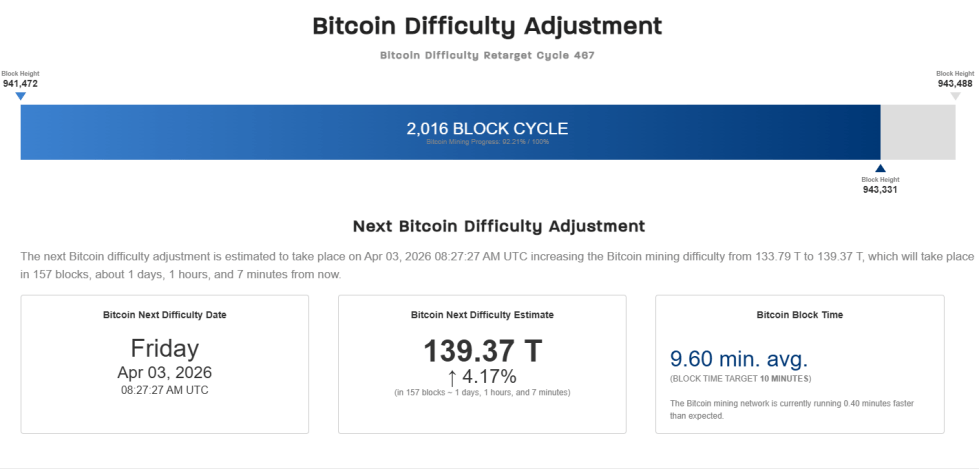
The details related to the upcoming Difficulty adjustment | Source: CoinWarz

BTC Price

Bitcoin made some recovery earlier in the week, but the coin has declined again as its price is floating around $66,100.

The price of the asset seems to have overall moved sideways recently | Source: BTCUSDT on TradingView


Related Questions

QHow much Bitcoin did Riot Platforms transfer out and what was its value at the time?

ARiot Platforms transferred out 500 BTC, which was worth $34.13 million at the time of the transaction.

QWhat is the primary reason suspected behind Riot's recent Bitcoin transfer to an unknown wallet?

AThe primary reason is suspected to be for selling the tokens, as the company previously offloaded $200 million worth of Bitcoin in late 2025.

QWhere does Riot Platforms rank among the top public Bitcoin mining companies based on operating hashrate?

ARiot Platforms ranks number five among the top public Bitcoin mining companies with a total installed hashrate of 38.50 exahashes per second (EH/s).

QWhat is the expected change in Bitcoin's mining difficulty in the upcoming adjustment and why?

AThe Bitcoin mining difficulty is expected to increase by about 4.17% because the average block time since the last adjustment was 9.60 minutes, which is faster than the target of 10 minutes.

QWhat is Riot Platforms exploring besides Bitcoin mining, which might be linked to their recent BTC sale?

ARiot Platforms has been exploring the AI/high-performance computing (HPC) business, and the recent Bitcoin sale is possibly linked to this expansion.

Related Reads

The Value Distribution of Stablecoins

**Summary: The Value Distribution of Stablecoins** The article argues that stablecoins are evolving from mere trading tools into broader channels for dollar access. It divides the stablecoin ecosystem into four layers to analyze how value is distributed: 1. **Issuance Layer:** Mints stablecoins, holds reserve assets, and captures the spread between reserve yield and user costs (e.g., Tether, Circle). This layer currently earns the largest profit margin. 2. **Infrastructure Layer:** Connects stablecoins to the traditional financial system, handling fiat on/off-ramps, banking integration, compliance (KYC/AML), and asset management (e.g., Bridge, BVNK). This is the "unglamorous" but critical work, building the essential bridges between crypto and real-world finance. 3. **Acquiring/Distribution Layer:** Integrates stablecoins into merchant systems, manages payment flows, and provides enterprise financial software (e.g., Stripe, Coinbase). They act as the access point for businesses. 4. **Application Layer:** The end-users and businesses that ultimately use stablecoins for payments, settlements, or as a store of value. They benefit from convenience but have little pricing power. The core thesis is that while the issuance layer currently dominates profits, the often-overlooked **infrastructure layer holds significant long-term potential**. The real challenge and barrier to mass adoption is not the on-chain transfer of stablecoins (which is simple), but the complex "last mile" integration into existing business workflows, banking systems, and regulatory frameworks across different countries. Companies in this layer are currently in a "land grab" phase, investing heavily to build networks, secure bank partnerships, and establish compliance pathways. While their position is currently pressured by the profitable issuers above and distribution platforms below, the article suggests that if stablecoins become a default financial rail for businesses, the infrastructure providers who have done the hard work of integration will ultimately gain strong pricing power and become entrenched, essential players.

marsbit5h ago

The Value Distribution of Stablecoins

marsbit5h ago

The Value Distribution of Stablecoins

The Value Distribution of Stablecoins The article argues that stablecoins are evolving from a mere trading tool into a broad "dollar channel." It analyzes the industry's value chain through four layers: 1. **Issuance Layer (e.g., Tether, Circle):** The top layer that mints stablecoins, holds reserve assets, and captures the thickest interest rate spread. 2. **Infrastructure Layer (e.g., Bridge, BVNK):** Connects stablecoins to the traditional financial system, handling critical but complex "dirty work" like fiat on/off-ramps, banking integration, compliance (KYC/AML), and cross-border settlement. 3. **Acquiring/Distribution Layer (e.g., Stripe, Coinbase):** Embeds stablecoins into merchant systems, manages payment flows, and integrates with enterprise software. 4. **Application Layer:** End-users and businesses that ultimately use stablecoins for payments, settlement, or storing value. The author posits that while the issuance layer currently captures the most profit, the most overlooked and potentially critical layer is infrastructure. The core challenge for stablecoin adoption isn't the on-chain transfer (which is simple), but bridging the gap between blockchain and the real-world financial system. This involves solving practical problems for businesses: fiat conversion, reconciliation, tax handling, and user onboarding. Infrastructure companies are currently in a difficult "land-grab" phase—building networks, securing banking relationships, and achieving compliance country-by-country. They face pressure from both the profitable issuance layer above and distribution platforms below. However, the author suggests this layer is building a crucial moat. Once stablecoins become a default business rail, the infrastructure players who have done the hard work of integration may gain significant, durable value and pricing power.

链捕手5h ago

The Value Distribution of Stablecoins

链捕手5h ago

Trading

Spot
Futures

Hot Articles

How to Buy PUSH

Welcome to HTX.com! We've made purchasing Push Protocol (PUSH) simple and convenient. Follow our step-by-step guide to embark on your crypto journey.Step 1: Create Your HTX AccountUse your email or phone number to sign up for a free account on HTX. Experience a hassle-free registration journey and unlock all features.Get My AccountStep 2: Go to Buy Crypto and Choose Your Payment MethodCredit/Debit Card: Use your Visa or Mastercard to buy Push Protocol (PUSH) instantly.Balance: Use funds from your HTX account balance to trade seamlessly.Third Parties: We've added popular payment methods such as Google Pay and Apple Pay to enhance convenience.P2P: Trade directly with other users on HTX.Over-the-Counter (OTC): We offer tailor-made services and competitive exchange rates for traders.Step 3: Store Your Push Protocol (PUSH)After purchasing your Push Protocol (PUSH), store it in your HTX account. Alternatively, you can send it elsewhere via blockchain transfer or use it to trade other cryptocurrencies.Step 4: Trade Push Protocol (PUSH)Easily trade Push Protocol (PUSH) on HTX's spot market. Simply access your account, select your trading pair, execute your trades, and monitor in real-time. We offer a user-friendly experience for both beginners and seasoned traders.

3.7k Total ViewsPublished 2024.03.29Updated 2026.06.02

How to Buy PUSH

Discussions

Welcome to the HTX Community. Here, you can stay informed about the latest platform developments and gain access to professional market insights. Users' opinions on the price of PUSH (PUSH) are presented below.

活动图片












