Bitcoin Market Moves Into A Lower-Leverage Environment – What This Means

bitcoinistPublished on 2026-06-10Last updated on 2026-06-10

Abstract

Bitcoin's price remains below $65,000 amid high volatility, but a significant shift is occurring: the market is moving into a lower-leverage environment. Analysis indicates Bitcoin has exited an extreme leverage phase, entering moderate and slight leverage zones. This reduces the immediate risk of large-scale liquidations seen in highly leveraged conditions, suggesting a potential move toward a healthier market structure based more on spot demand than speculation. However, analysts caution the market has not yet reached an extreme deleveraging phase, which would offer greater safety for entry. Simultaneously, small whales (addresses holding 100-1,000 BTC) have fallen into a loss position due to recent price declines. For this group to return to profitability, Bitcoin's price needs to recover to approximately $64,000. Currently trading around $63,370, Bitcoin shows slight daily gains, but trading volume has decreased. The overall picture points to increased trader caution, with leverage drying up and key investor cohorts feeling pressure, setting the stage for Bitcoin's next directional move.

Despite a brief bounce, Bitcoin is still struggling with heightened volatility, capping every upward attempt and keeping its price below the $65,000 mark. In this unfavorable market environment, the flagship asset may be entering a crucial phase as leverage steadily dries up across the market.

Moderate Leverage Turning Up On The Bitcoin Market

Bitcoin is seeing persistent bearish pressure, but a report shows that the market just made a major shift that could play a role in its short-term trajectory. As volatility builds, the BTC market seems to be moving into a lower-leverage phase as traders become more cautious and speculative excesses start to calm.

A recent analysis of the Bitcoin Leverage Pressure Zone by Joao Wedson, the founder of Alphractal and verified author at CryptoQuant, shows that BTC has left the extreme leverage phase and moved into moderate and slight leverage. This implies that the risk of large-scale liquidations, which frequently accompany highly leveraged conditions, has decreased as aggressive positioning in derivatives markets has subsided.

Since many traders were liquidated last week, the risk of forced liquidations is dropping significantly. However, Wedson highlights that the market has not yet reached the blue/purple zone indicated on the chart, which marks extreme deleveraging.
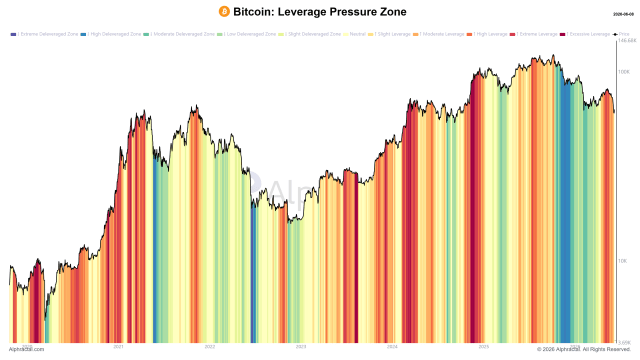
Source: Chart from Joao Wedson on X

In the past, this region was considered an ideal one to gain exposure with greater safety. The expert claims that the market has not yet gotten to that phase, but it will likely take a few more weeks or months before we reach that stage.

Even though it might occasionally indicate a declining risk appetite, lower leverage may indicate a healthier market structure based on higher spot demand rather than speculative momentum. Despite this shift into moderate and slight leverage, Wedson has urged investors to approach the derivatives market with caution. “If you do not understand its health, you can be liquidated at any moment, “ he added.

Small BTC Whales Are Now In Losses

With the Bitcoin market deeply in a volatile state, investors are beginning to feel the pressure of this downward action, even big investors. CW, a data analyst and investor, reported on X that small whales are now underwater as bearish performance mounts.

Here, small whales represent wallet addresses holding between 100 BTC and 1,000 BTC, and these investors have now returned to a loss position. This shift in profitability is attributed to the recent decline in BTC’s price to the $60,000 threshold.

In order for the group to return to profit territory, the expert stated that BTC’s price must bounce back to the $64,000 mark. CW added that the brief uptrend of Bitcoin started as these investors slowly approached the profit zone. In the meantime, recovering the $64,000 level is the first condition for the rise to kick off.

At the time of writing, Bitcoin’s price was trading at $63,370, and was showing a nearly 1% rise within the past day. While prices are slowly turning bullish, BTC’s trading volume within the same time frame has dropped by over 5%.

BTC trading at $63,376 on the 1D chart | Source: BTCUSDT on Tradingview.com

Trending Cryptos

Related Questions

QAccording to the article, what is the current trend in Bitcoin market leverage and what does it indicate?

AThe Bitcoin market is moving into a lower-leverage phase, characterized by moderate and slight leverage, as traders become more cautious. This indicates a decrease in the risk of large-scale liquidations and suggests a potentially healthier market structure based more on spot demand than on speculative momentum.

QWhat does the analysis by Joao Wedson suggest about the market's current position relative to 'extreme deleveraging'?

AJoao Wedson's analysis indicates that while the market has moved out of an extreme leverage phase, it has not yet reached the blue/purple zone on his chart, which marks a state of extreme deleveraging. He states it will likely take a few more weeks or months to reach that stage.

QWhich group of Bitcoin investors is reported to be in a loss position, and what is the price level needed for them to return to profit?

ASmall whales, defined as wallet addresses holding between 100 and 1,000 BTC, are now in a loss position. According to the analyst CW, Bitcoin's price needs to bounce back to the $64,000 mark for this group to return to profit territory.

QWhat caution does Joao Wedson advise regarding the derivatives market, despite the shift to lower leverage?

ADespite the shift to moderate and slight leverage, Joao Wedson urges investors to approach the derivatives market with caution, warning that "If you do not understand its health, you can be liquidated at any moment."

QWhat was Bitcoin's price and trading volume trend at the time of the article's writing?

AAt the time of writing, Bitcoin's price was trading at $63,370, showing a nearly 1% rise over the past day. However, its trading volume within the same timeframe had dropped by over 5%.

Related Reads

Podcast Notes | Conversation with GSR Asset Management Head: To Determine if This Crypto Rally is Real, Just Watch the Lending Rates on Aave

Podcast Summary: Dialogue with GSR's Head of Asset Management: To Determine if This Crypto Rally is Real, Just Check Lending Rates on Aave Andy Baehr, Managing Director of Asset Management at GSR, discusses the current crypto market, characterizing it as stuck in a state of "ambivalence" with short-lived, unsustainable rallies. He outlines a simple framework: the market moves between "ambivalence" and "conviction" (sustained upward momentum). Currently, every rally resembles a single-stage rocket booster that quickly fizzles out. Baehr identifies three key signals to watch: 1) DeFi lending rates, 2) the potential passage of the CLARITY Act, and 3) the market forming a consensus on the "Fed hawkish peak." He emphasizes that the most immediate indicator for the sustainability of the recent CPI-triggered rally is the USDC borrowing rate on Aave, currently around 3.75%—close to U.S. Treasury yields. The absence of a credit spread indicates low leverage demand and a lack of market energy. He explains that a healthy, sustained rally requires layered buying pressure. Last year's rally progressed from an ETH short squeeze to crypto-native trader influx and finally to ETF inflows. Currently, this structure is missing. Other potential structural buyers like Digital Asset Treasury (DAT) companies are absent, and ETF flows have proven transient. Baehr notes that while small-cap crypto tokens outperformed large caps in Q2—a potential sign of capitation in major assets—capital is also flowing to more exciting opportunities like AI stocks and tech IPOs, leaving crypto sidelined. Regarding DeFi, he highlights that platforms like Aave provide a clear, real-time signal of leverage demand through their supply/demand-driven interest rates. A significant, sustained rate increase would signal genuine market conviction. He also observes the quiet emergence of fixed-income-like products and vaults in DeFi. On regulation, the probability of the CLARITY Act passing before the August 7th deadline has dropped linearly from 75% to below 40% on Polymarket. Baehr suggests its passage would be treated as a bullish surprise, a potent driver for price movement. However, political hurdles, including ethical clause debates and disclosures about the First Family's crypto profits, remain significant obstacles. Ultimately, the market awaits clarity on the Fed's terminal rate under Chair Warsh. Until the "Fed Solstice"—the point where the market collectively understands the peak of hawkish policy—sustained conviction will be difficult to achieve.

marsbit27m ago

Podcast Notes | Conversation with GSR Asset Management Head: To Determine if This Crypto Rally is Real, Just Watch the Lending Rates on Aave

marsbit27m ago

7 Months After the Collapse of Huiwang, Southeast Asia's Escrow Platforms Undergo a Major Reshuffle

Following the collapse of Huione Pay—dubbed the "Alipay of Southeast Asia"—seven months ago, the region's underground financial guarantee platform sector is undergoing a significant reshuffle. This power vacuum has been swiftly filled by emerging platforms such as XinBi, Tiger/Navigator, JinBei (renamed JinBo), Dali/Tiancheng, and FullyLight. These platforms, operating largely via Telegram and offering services like escrow for illicit transactions, have absorbed the vast user base and markets left behind by Huione. While positioning themselves as "trust intermediaries," their primary clientele consists of networks involved in online scams, money laundering, illegal gambling, and even human trafficking. For instance, the Tiger/Navigator platform explicitly provides "escrow" services for kidnapping-for-ransom operations ("强押车交易"). Data underscores the immense scale: Huione alone processed over $103 billion in cryptocurrency payments and facilitated over $31 billion through its escrow market before its downfall, linking it to Cambodia's notorious Prince Group. Since its collapse, competitors have seen explosive growth. For example, the XinBi platform has accumulated over $1.6 billion in total USDT revenue, while platforms like NewPay, OkPay (under Dali), and FullyLight Wallet collectively processed over $4.8 billion in USDT in a single year. This ecosystem thrives in regions like Cambodia and Myanmar, where regulatory gaps allow these platforms to act as critical financial infrastructure for sprawling cybercrime industries, from scam compounds to online casinos. The article concludes that the moniker "Southeast Asian Alipay" is a misnomer, obscuring the platforms' fundamental role in enabling serious criminal enterprises rather than representing legitimate financial innovation.

Odaily星球日报1h ago

7 Months After the Collapse of Huiwang, Southeast Asia's Escrow Platforms Undergo a Major Reshuffle

Odaily星球日报1h ago

Trading

Spot

Hot Articles

What is $BITCOIN

DIGITAL GOLD ($BITCOIN): A Comprehensive Analysis Introduction to DIGITAL GOLD ($BITCOIN) DIGITAL GOLD ($BITCOIN) is a blockchain-based project operating on the Solana network, which aims to combine the characteristics of traditional precious metals with the innovation of decentralized technologies. While it shares a name with Bitcoin, often referred to as “digital gold” due to its perception as a store of value, DIGITAL GOLD is a separate token designed to create a unique ecosystem within the Web3 landscape. Its goal is to position itself as a viable alternative digital asset, although specifics regarding its applications and functionalities are still developing. What is DIGITAL GOLD ($BITCOIN)? DIGITAL GOLD ($BITCOIN) is a cryptocurrency token explicitly designed for use on the Solana blockchain. In contrast to Bitcoin, which provides a widely recognized value storage role, this token appears to focus on broader applications and characteristics. Notable aspects include: Blockchain Infrastructure: The token is built on the Solana blockchain, known for its capacity to handle high-speed and low-cost transactions. Supply Dynamics: DIGITAL GOLD has a maximum supply capped at 100 quadrillion tokens (100P $BITCOIN), although details regarding its circulating supply are currently undisclosed. Utility: While precise functionalities are not explicitly outlined, there are indications that the token could be utilized for various applications, potentially involving decentralized applications (dApps) or asset tokenization strategies. Who is the Creator of DIGITAL GOLD ($BITCOIN)? At present, the identity of the creators and development team behind DIGITAL GOLD ($BITCOIN) remains unknown. This situation is typical among many innovative projects within the blockchain space, particularly those aligning with decentralized finance and meme coin phenomena. While such anonymity may foster a community-driven culture, it intensifies concerns about governance and accountability. Who are the Investors of DIGITAL GOLD ($BITCOIN)? The available information indicates that DIGITAL GOLD ($BITCOIN) does not have any known institutional backers or prominent venture capital investments. The project seems to operate on a peer-to-peer model focused on community support and adoption rather than traditional funding routes. Its activity and liquidity are primarily situated on decentralized exchanges (DEXs), such as PumpSwap, rather than established centralized trading platforms, further highlighting its grassroots approach. How DIGITAL GOLD ($BITCOIN) Works The operational mechanics of DIGITAL GOLD ($BITCOIN) can be elaborated on based on its blockchain design and network attributes: Consensus Mechanism: By leveraging Solana’s unique proof-of-history (PoH) combined with a proof-of-stake (PoS) model, the project ensures efficient transaction validation contributing to the network's high performance. Tokenomics: While specific deflationary mechanisms have not been extensively detailed, the vast maximum token supply implies that it may cater to microtransactions or niche use cases that are still to be defined. Interoperability: There exists the potential for integration with Solana’s broader ecosystem, including various decentralized finance (DeFi) platforms. However, the details regarding specific integrations remain unspecified. Timeline of Key Events Here is a timeline that highlights significant milestones concerning DIGITAL GOLD ($BITCOIN): 2023: The initial deployment of the token occurs on the Solana blockchain, marked by its contract address. 2024: DIGITAL GOLD gains visibility as it becomes available for trading on decentralized exchanges like PumpSwap, allowing users to trade it against SOL. 2025: The project witnesses sporadic trading activity and potential interest in community-led engagements, although no noteworthy partnerships or technical advancements have been documented as of yet. Critical Analysis Strengths Scalability: The underlying Solana infrastructure supports high transaction volumes, which could enhance the utility of $BITCOIN in various transaction scenarios. Accessibility: The potential low trading price per token could attract retail investors, facilitating wider participation due to fractional ownership opportunities. Risks Lack of Transparency: The absence of publicly known backers, developers, or an audit process may yield skepticism regarding the project's sustainability and trustworthiness. Market Volatility: The trading activity is heavily reliant on speculative behavior, which can result in significant price volatility and uncertainty for investors. Conclusion DIGITAL GOLD ($BITCOIN) emerges as an intriguing yet ambiguous project within the rapidly evolving Solana ecosystem. While it attempts to leverage the “digital gold” narrative, its departure from Bitcoin's established role as a store of value underscores the need for a clearer differentiation of its intended utility and governance structure. Future acceptance and adoption will likely depend on addressing the current opacity and defining its operational and economic strategies more explicitly. Note: This report encompasses synthesised information available as of October 2023, and developments may have transpired beyond the research period.

973 Total ViewsPublished 2025.05.13Updated 2025.05.13

What is $BITCOIN

Discussions

Welcome to the HTX Community. Here, you can stay informed about the latest platform developments and gain access to professional market insights. Users' opinions on the price of BTC (BTC) are presented below.

活动图片














