Bitcoin Gets Rejected At This Level For The First Time In 5 Years, Here Are The Targets

bitcoinistPublished on 2026-05-27Last updated on 2026-05-27

Abstract

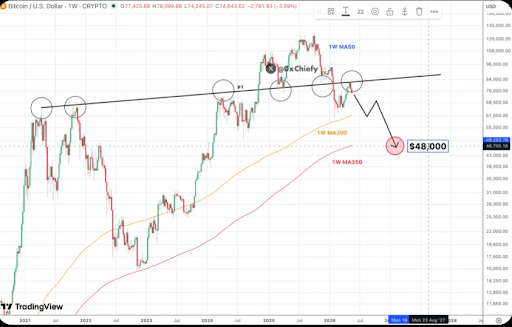
Bitcoin has been rejected at a crucial long-term resistance level around $83,000, marking its first failure at this macro price point in five years. According to analyst Chiefy, this trendline has defined major cycle tops since 2021 and acted as a key support in early 2025. The recent rejection saw Bitcoin drop to $74,000 before a slight recovery to $76,580, aligning with a significant moving average historically linked to major market turns. If the current support around $74,000 breaks, the analyst projects three potential downside targets: $68,000, $61,000, and an extreme target near $48,000, which aligns with the weekly 350 MA. Market sentiment has shifted to fear, with the Crypto Fear & Greed Index at 39, indicating growing caution among investors.

Bitcoin’s price action has been rejected at a price level that has acted as resistance and support in the past five years. This macro resistance level that has defined Bitcoin’s price ceiling for nearly five years has once again turned back the bulls, and the consequences could be far more severe than the price action is currently pricing in.

Bitcoin Rejection At Macro Resistance

Bitcoin has run into a resistance level that has not mattered this much in years, in reference to the most recent rejection at $83,000 on May 6. According to a crypto analyst that goes by the name Chiefy on the social media platform X, that rejection is not just another failed rally but a reaction from a five-year macro resistance line that has touched some of Bitcoin’s most important turning points since the last major cycle.

The analyst believes Bitcoin has now followed the structure he previously warned about, moving into a bull trap near $83,000 before rejecting and falling to as low as $74,000. The trendline behind that rejection is important because it connects the early 2021 and mid-2021 cycle tops, stretches through Bitcoin’s first breakout above it in 2024, later acted as support in early 2025, and has now returned as resistance around the $83,000 zone.
Source: Chart from Chiefy on X

Interestingly, the rejection zone also lines up with the 200MA. Rejections from this moving average have appeared around major cycle turning points in the past, including the 2014, 2018, and 2022 market phases.

The Levels That Now Matter

Now with the initial phase of Chiefy’s projection already confirmed, the next important thing is what comes next. Notably, there are three downside targets if Bitcoin continues to follow the pattern: $68,000, $61,000, and $48,000.

These levels fit the path drawn on the chart above, which shows Bitcoin first breaking lower below $76,000, then forming a brief relief bounce, before falling deeper into the red-circled $48,000 area. The most extreme bottom target of $48,000 is close to the weekly 350 moving average shown in pink and would be the final reset from the recent $83,000 bull-trap zone.

Bitcoin’s reaction around $74,000 now matters most because it could determine whether Chiefy’s bearish map will be feasible. The drop into that region came immediately after the rejection, but it has recovered back above $76,000 and is trading at $76,580 at the time of writing.

Even with that rebound, Bitcoin is still close to a support area that looks fragile. Sentiment shows that the market is no longer in a strong risk-on phase, with CoinMarketCap’s Crypto Fear & Greed Index now at 39, placing the market in a fear mood. A break below $74,000 would put $68,000 in focus as the next logical downside target.

BTC trading at $77,300 on the 1D chart | Source: BTCUSDT on Tradingview.com

Related Questions

QAccording to the analyst Chiefy, at what key macro price level did Bitcoin face rejection for the first time in five years?

ABitcoin faced rejection at the $83,000 zone, which represents a five-year macro resistance trendline.

QWhat are the three potential downside price targets for Bitcoin mentioned in the article if it continues its bearish pattern?

AThe three potential downside targets mentioned are $68,000, $61,000, and $48,000.

QWhat other technical indicator does the $83,000 rejection zone align with, which has been significant at past cycle turning points?

AThe rejection zone at $83,000 also aligns with the 200-period moving average (200MA), which has marked major cycle turning points in the past.

QWhat does the article suggest is the significance of Bitcoin's price action around the $74,000 level?

ABitcoin's price action around $74,000 is crucial as a break below this level would shift the focus to $68,000 as the next downside target, confirming the analyst's bearish projection.

QWhat is the current market sentiment according to the Crypto Fear & Greed Index, as stated in the article?

AAccording to the article, the Crypto Fear & Greed Index is at 39, indicating that the market is in a 'fear' phase.

Related Reads

CPU, Quietly Returning to the Center of the AI Computing Power Stage

Over the past three years, AI computing power narratives have been dominated by GPUs. However, starting in 2026, this story began to shift. While training large models remains GPU-intensive, the rapid growth of inference and AI agent workloads, which require high levels of task orchestration, concurrency, and data flow management, has highlighted a renewed critical role for CPUs. These are tasks GPUs are not designed to handle. Intel's recent launch of the Xeon 6+ processor, built on its Intel 18A process and featuring up to 288 efficiency cores (E-cores), exemplifies this strategic pivot. It is positioned not as a mere companion to GPUs but as the essential "control plane" for AI infrastructure, optimized for high-density, energy-efficient, and high-throughput workloads characteristic of AI agents and inference. This "CPU resurgence" is not about CPUs outperforming GPUs in raw computation. It reflects a systemic bottleneck: as AI scales from training single models to deploying countless intelligent agents, the demand for coordination and data handling surges. Major cloud providers are also developing their own high-density ARM-based server CPUs for similar workloads. However, Intel's success with this strategy faces significant challenges. Competition includes NVIDIA's integrated CPU-GPU solutions, the expanding adoption of cloud vendors' in-house ARM CPUs, and the crucial market test of Intel's 18A manufacturing process against rivals like TSMC's N2. In conclusion, CPUs are indeed reclaiming a central, though redefined, role in AI compute—managing the complex orchestration that enables massive-scale AI deployment. While the trend is clear, which company will ultimately lead this CPU resurgence remains an open question to be decided in the data centers of 2027 and beyond.

marsbit12m ago

CPU, Quietly Returning to the Center of the AI Computing Power Stage

marsbit12m ago

After Collaborating with 35+ DeFi Projects, Pink Brains Discovers the New 2026 KOL Marketing Rules

After collaborating with over 35 leading DeFi projects on marketing over three years, Pink Brains identifies a key shift for effective marketing in 2026: prioritizing the user journey over traditional campaign tactics. The most effective marketing mirrors how users actually behave—starting with discovery on social platforms like X (formerly Twitter), followed by data-driven verification on sites like DefiLlama, and finally, participation with small test funds. Success hinges on genuine, verifiable mechanisms, not just marketing hype. Current user interest centers on several key themes: new DeFi trends (RWA, perps, crypto x AI), meaningful airdrops requiring real contributions, real yield from protocol revenue, and tokens with value capture mechanisms directly tied to product usage. Case studies like Hyperliquid's HYPE (with its aggressive buyback program) and Venice's VVV (linking demand to AI compute) exemplify how strong tokenomics foster user retention. New trading venues like prediction markets, collectibles platforms, and GambleFi are also gaining traction, driven by verifiable activity. The article outlines common mistakes in DeFi KOL marketing, such as using creators unfamiliar with the product, generic messaging, or relying on a few top-tier KOLs. Instead, effective strategies align with different KOL types—educators, content creators, airdrop hunters, and niche experts—for various stages of the user journey. Ultimately, long-term user retention depends on a combination of a genuinely useful product, responsive support, community-aligned tokenomics, and strategic community building. The core takeaway is that sustainable growth stems from products whose value is validated by data and real-world utility, not just promotional efforts.

marsbit30m ago

After Collaborating with 35+ DeFi Projects, Pink Brains Discovers the New 2026 KOL Marketing Rules

marsbit30m ago

Trading

Spot
Futures

Hot Articles

What is $BITCOIN

DIGITAL GOLD ($BITCOIN): A Comprehensive Analysis Introduction to DIGITAL GOLD ($BITCOIN) DIGITAL GOLD ($BITCOIN) is a blockchain-based project operating on the Solana network, which aims to combine the characteristics of traditional precious metals with the innovation of decentralized technologies. While it shares a name with Bitcoin, often referred to as “digital gold” due to its perception as a store of value, DIGITAL GOLD is a separate token designed to create a unique ecosystem within the Web3 landscape. Its goal is to position itself as a viable alternative digital asset, although specifics regarding its applications and functionalities are still developing. What is DIGITAL GOLD ($BITCOIN)? DIGITAL GOLD ($BITCOIN) is a cryptocurrency token explicitly designed for use on the Solana blockchain. In contrast to Bitcoin, which provides a widely recognized value storage role, this token appears to focus on broader applications and characteristics. Notable aspects include: Blockchain Infrastructure: The token is built on the Solana blockchain, known for its capacity to handle high-speed and low-cost transactions. Supply Dynamics: DIGITAL GOLD has a maximum supply capped at 100 quadrillion tokens (100P $BITCOIN), although details regarding its circulating supply are currently undisclosed. Utility: While precise functionalities are not explicitly outlined, there are indications that the token could be utilized for various applications, potentially involving decentralized applications (dApps) or asset tokenization strategies. Who is the Creator of DIGITAL GOLD ($BITCOIN)? At present, the identity of the creators and development team behind DIGITAL GOLD ($BITCOIN) remains unknown. This situation is typical among many innovative projects within the blockchain space, particularly those aligning with decentralized finance and meme coin phenomena. While such anonymity may foster a community-driven culture, it intensifies concerns about governance and accountability. Who are the Investors of DIGITAL GOLD ($BITCOIN)? The available information indicates that DIGITAL GOLD ($BITCOIN) does not have any known institutional backers or prominent venture capital investments. The project seems to operate on a peer-to-peer model focused on community support and adoption rather than traditional funding routes. Its activity and liquidity are primarily situated on decentralized exchanges (DEXs), such as PumpSwap, rather than established centralized trading platforms, further highlighting its grassroots approach. How DIGITAL GOLD ($BITCOIN) Works The operational mechanics of DIGITAL GOLD ($BITCOIN) can be elaborated on based on its blockchain design and network attributes: Consensus Mechanism: By leveraging Solana’s unique proof-of-history (PoH) combined with a proof-of-stake (PoS) model, the project ensures efficient transaction validation contributing to the network's high performance. Tokenomics: While specific deflationary mechanisms have not been extensively detailed, the vast maximum token supply implies that it may cater to microtransactions or niche use cases that are still to be defined. Interoperability: There exists the potential for integration with Solana’s broader ecosystem, including various decentralized finance (DeFi) platforms. However, the details regarding specific integrations remain unspecified. Timeline of Key Events Here is a timeline that highlights significant milestones concerning DIGITAL GOLD ($BITCOIN): 2023: The initial deployment of the token occurs on the Solana blockchain, marked by its contract address. 2024: DIGITAL GOLD gains visibility as it becomes available for trading on decentralized exchanges like PumpSwap, allowing users to trade it against SOL. 2025: The project witnesses sporadic trading activity and potential interest in community-led engagements, although no noteworthy partnerships or technical advancements have been documented as of yet. Critical Analysis Strengths Scalability: The underlying Solana infrastructure supports high transaction volumes, which could enhance the utility of $BITCOIN in various transaction scenarios. Accessibility: The potential low trading price per token could attract retail investors, facilitating wider participation due to fractional ownership opportunities. Risks Lack of Transparency: The absence of publicly known backers, developers, or an audit process may yield skepticism regarding the project's sustainability and trustworthiness. Market Volatility: The trading activity is heavily reliant on speculative behavior, which can result in significant price volatility and uncertainty for investors. Conclusion DIGITAL GOLD ($BITCOIN) emerges as an intriguing yet ambiguous project within the rapidly evolving Solana ecosystem. While it attempts to leverage the “digital gold” narrative, its departure from Bitcoin's established role as a store of value underscores the need for a clearer differentiation of its intended utility and governance structure. Future acceptance and adoption will likely depend on addressing the current opacity and defining its operational and economic strategies more explicitly. Note: This report encompasses synthesised information available as of October 2023, and developments may have transpired beyond the research period.

363 Total ViewsPublished 2025.05.13Updated 2025.05.13

What is $BITCOIN

Discussions

Welcome to the HTX Community. Here, you can stay informed about the latest platform developments and gain access to professional market insights. Users' opinions on the price of BTC (BTC) are presented below.

活动图片















