Bitcoin Funding Rate Hits Three-Month Low: What Did the Shorts Already Know?

marsbitPublished on 2026-03-09Last updated on 2026-03-09

Abstract

Bitcoin's derivatives market signaled significant downside pressure ahead of key macro data, as funding rates turned deeply negative — hitting around -6% on February 28, a three-month low — while open interest (in BTC terms) continued to rise. This combination indicated that traders were aggressively shorting or hedging, using high leverage, even before the U.S. employment report was released. When the jobs data came in softer than expected, it triggered a macro repricing event. The negative funding rates reflected a crowded speculative position favoring shorts, meaning sellers were paying buyers to maintain their bearish bets. Such conditions can persist if hedging demand is genuine or if trend-following behavior continues, rather than simply indicating an imminent reversal. The real signal occurs when negative funding rates coincide with stable or rising open interest — suggesting new short positions are still entering — while price fails to make new lows. Liquidations then act as a scoreboard: cascading long or short squeezes confirm whether volatility has forced positions to unwind. In summary, derivatives metrics — funding rates, open interest, and liquidations — provided a clear, early warning of building risk and leveraged positioning prior to the macro catalyst. The market’s reaction was ultimately a function of crowded positions meeting a macroeconomic trigger.

Author: CryptoSlate

Compiled by: Deep Tide TechFlow

Deep Tide Guide: This article explains an important market mechanism: Before macroeconomic data was announced, the Bitcoin derivatives market had already clearly signaled risks through three dimensions—funding rates, open interest, and liquidations. Understanding this logic allows one to see the real market pressures earlier than chasing any narrative.

Full Text Below:

The Bitcoin derivatives market provides the best explanation for this week's macro pressures.

Funding rates turned sharply negative, open interest remained high, and then the U.S. jobs report landed. These three events together indicate that the market had heavily positioned for downside hedging before the actual macro catalyst arrived.

This sequence is worth understanding because it explains how macro volatility enters the crypto market.

It usually appears first in perpetual contracts—where hedging is fastest and leverage usage is highest.

Funding rates tell you which side is paying to maintain positions, open interest tells you how many positions remain in the system, and liquidation data tells you when these positions start to break.

On February 28, Bitcoin perpetual funding rates fell to approximately -6%, one of the most negative readings in nearly three months. BTC-denominated open interest rose from about 113,380 BTC at the beginning of the year to 120,260 BTC.
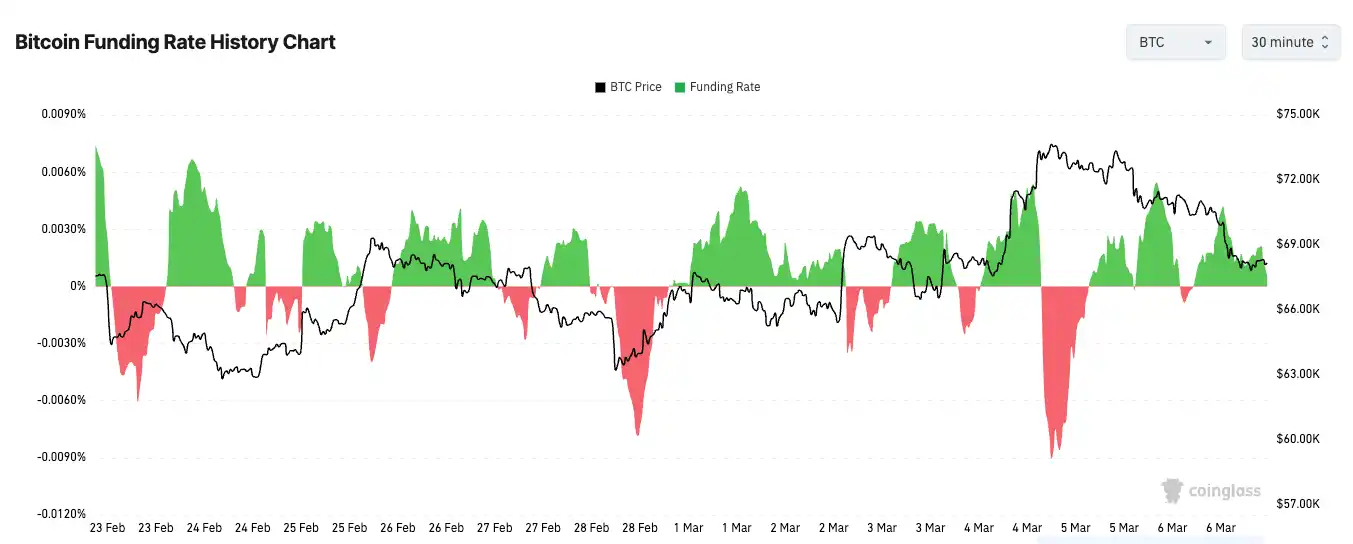
This combination is important because it points to two things simultaneously: Traders are aggressively betting on the downside, and they are doing so with more leverage entering the market. The market is both very tense and very crowded.

This is the simplest way to understand how macro pressure enters the crypto market.

It appears in the derivatives ledger, not as a neatly packaged X narrative or a tidy economist report. Traders act there first because perpetual contracts are liquid, low-cost, and always available.

When they worry about growth, interest rates, or broader risk-off sentiment, they short perpetual contracts; these contracts fall below spot, and funding rates turn negative because shorts must pay longs to maintain their positions.

Why Negative Funding Rates Persist

But negative funding rates alone are not a bottom signal; they only tell you which way the market is leaning.

This distinction is important because traders like to turn every extreme reading into a prediction.

Extremely negative funding rates can signal short covering, and last week's setup clearly created that possibility. But when hedging demand is real, it can also persist longer than expected.

Extreme spikes and drops in funding rates reflect one-sided positioning, which can persist during strong directional moves.

This persistence usually comes from two places.

Some traders are hedging real spot exposure, meaning they are not precisely predicting the next move but simply protecting their portfolios. Others are simple trend followers, willing to pay funding rates as long as the market continues moving in their direction. Both types can keep funding rates negative even after the initial panic has passed.

That's why the real signal isn't whether funding rates are negative. A more interesting pattern emerges when funding rates remain significantly negative while prices stop making new lows. Then, pressure begins to build beneath the surface. Shorts are still paying to maintain positions, but the market is no longer rewarding them in the same way. This is how short-covering conditions form.

The Jobs Report Brought Real Macro Input to the Market

This week's macro catalyst came from the U.S. labor market. On March 6, the Bureau of Labor Statistics reported a loss of 92,000 non-farm jobs in February, with an unemployment rate of 4.4%.

Such reports trigger broad repricing because they touch on multiple market themes. A weaker labor market could lower yields if traders believe the Fed may need a more dovish path. It could also hit risk appetite if traders interpret the data as a sign of real economic weakness.

The crypto market typically feels this debate more intensely because leverage turns macro issues into positioning events.

If traders are heavily short and macro data even briefly eases financial conditions, prices can surge rapidly as shorts are forced to cover.

If the data deepens risk-off sentiment, the same crowded positioning can continue to pressure downward as shorts remain comfortable and longs start to capitulate.

Funding rates are the pressure gauge, open interest is the fuel, and liquidations are the moment pressure starts to break through the system.

Liquidation Data Is the Scoreboard

Liquidation data tells you whether the move is orderly or forced.

Short liquidations usually confirm a covering event, while long liquidations usually confirm a washout to the downside. When both longs and shorts are liquidated in a short time, the market is telling you that volatility has taken over, and neither side has much room to hold positions.

That's why liquidation data is best used as a confirmation layer. Funding rates set the conditions, but liquidations tell you whether those conditions are actually forced into price.

Open interest is equally important here. If participation shrinks synchronously, falling prices and negative funding rates don't say much.

This may only mean traders are stepping back to wait and see. But when open interest rises alongside negative funding rates, it means new positions are being built with a bearish or defensive bias.

Tracking open interest in BTC terms removes some distortions from price fluctuations, so a rise in BTC-denominated open interest during price declines more clearly reflects market participation.

From this perspective, the past week wasn't really about Bitcoin's strength or weakness but about where pressure was building.

The derivatives market showed heavy shorting or hedging before the jobs data landed.

The jobs report then provided a real macro input for global markets to process.

When these two things met, the crypto market did what it usually does: It expressed the same macro uncertainty everyone was facing with larger candles, faster reversals, and more violent position liquidations.

Funding rates don't predict price; they only tell you where leverage is leaning. Open interest doesn't tell you who is right, only how many positions are still on the field. Liquidation data doesn't explain the entire move, only when the move becomes involuntary.

That's why derivatives ultimately became the best macro explainer this week. Before the narrative dust settled, the ledger had already painted the risks clearly. Traders were shorting, leverage was still in the system, and the jobs report gave the market a real object to react to.

What happened afterward was simply price discovering how crowded the room was.

Related Questions

QWhat does a negative funding rate in Bitcoin perpetual contracts indicate about market sentiment?

AA negative funding rate indicates that traders are heavily betting on the downside, as shorts are paying longs to maintain their positions, reflecting bearish sentiment and hedging activity.

QHow did the US employment report on March 6 impact the crypto market?

AThe US employment report, which reported a loss of 92,000 non-farm jobs and a 4.4% unemployment rate, served as a macro catalyst that triggered broad repricing, affecting risk appetite and potentially influencing Federal Reserve policy, leading to increased volatility and liquidations in the crypto market.

QWhy is the combination of negative funding rates and high open interest significant?

AThe combination of negative funding rates and high open interest signals that traders are aggressively shorting or hedging while more leverage is entering the market, indicating both high tension and crowded positioning, which can amplify market moves when macro catalysts occur.

QWhat role do liquidation data play in confirming market conditions?

ALiquidation data acts as a scoreboard, confirming whether market moves are orderly or forced. Short liquidations indicate covering, while long liquidations confirm a sell-off; simultaneous liquidations of both sides show volatility has taken control, with little room for either side to hold positions.

QHow do Bitcoin derivatives provide insight into macro pressure before traditional narratives?

ABitcoin derivatives, through funding rates, open interest, and liquidations, reveal risk and hedging activity in real-time, often ahead of macro events. They show where pressure is building in the market, offering a clearer picture of sentiment and leverage dynamics before economic data or narratives are fully absorbed.

Related Reads

From South Korea to the United States: Blue-Collar Jobs Are Becoming Increasingly Popular, Thanks to AI

AI is reshaping the labor market's value proposition. The traditional four-year college degree is losing its appeal as a guaranteed career path, while skilled blue-collar trades like electricians, welders, and plumbers are experiencing historic demand and wage premiums. This shift is driven by dual pressures: AI's displacement of certain white-collar roles and a booming need for physical infrastructure and data center construction. Data confirms the trend. In the U.S., vocational school revenue surged, and a significant portion of recent layoffs are AI-related. Surveys show a majority of Gen Z adults plan to pursue blue-collar work, citing better job security against AI automation. Vocational education interest has exploded recently. Experts cite a psychological shift as younger generations seek tangible, AI-resistant careers and avoid high student debt. In many cases, salaries for skilled trades now match or exceed those requiring a bachelor's degree. In South Korea, semiconductor vocational high schools boast near-total employment, with graduates securing high-paying roles at companies like Samsung. The shortage is structural, exacerbated by a retiring baby boomer workforce and massive infrastructure projects. Companies like JPMorgan Chase, Meta, and Lowe's are investing heavily in training programs. However, overcoming historical stigma and a "perception gap" around trade careers remains a key challenge to closing the talent gap.

marsbit1h ago

From South Korea to the United States: Blue-Collar Jobs Are Becoming Increasingly Popular, Thanks to AI

marsbit1h ago

Qualcomm: AI Hype Subsides, When Will Smartphones Emerge from the Gloom?

Qualcomm reported its Q3 FY2026 results (ending June 2026), with revenue of $9.95B, down 4% YoY but above expectations. Gross margin declined to 53.1%, pressured by rising costs across manufacturing and memory. Key business segments showed mixed performance: Handset revenue fell 19.6% YoY to $5.09B, dragged by an 11% decline in non-Apple Android shipments and weaker high-end mix. Conversely, Automotive revenue surged 61% to $1.59B, and IoT grew 9% to $1.83B. Core operating profit dropped 41% YoY due to margin compression and higher expenses. Management's Q4 FY2026 guidance projects revenue of $9.7B-$10.5B, in line with consensus, but Non-GAAP EPS guidance of $2.05-$2.25 fell short of expectations. Amidst persistent weakness in its core handset market, Qualcomm is pursuing growth in AI, focusing on Edge AI (smartphones, PCs, automotive) and Data Center AI. Its data center strategy includes four pillars: AI accelerators (e.g., AI200), commercial CPUs (Dragonfly C1000), custom silicon, and connectivity solutions. While these initiatives initially boosted its stock, concerns over AI capital expenditure sustainability have since erased those gains. The company targets $5B in data center revenue for FY2027 and $15B for FY2029. The report concludes that with the traditional handset business still under pressure, the data center opportunity is currently viewed as a longer-term option, and a more conservative valuation based on core operations may be warranted until AI contributions materialize.

marsbit1h ago

Qualcomm: AI Hype Subsides, When Will Smartphones Emerge from the Gloom?

marsbit1h ago

From TPU to Self-Evolving Agents: How Jeff Dean Predicts the Next Step in AI

At the 2026 YC Startup School, Jeff Dean outlined his vision for AI's next phase, shifting focus from simply scaling models to building intelligent, autonomous systems. He believes AI's progress is no longer just about creating smarter models, but about integrating them into systems capable of long-term, iterative work, automated experimentation, and continuous learning. This evolution moves the competition from "who has the bigger model" to "who can best organize intelligence." Dean suggests AI capabilities are now comparable to a junior engineer, enabling the automation of complex workflows. However, the true challenge and opportunity lie in managing these AI "workers" at scale. He emphasizes the importance of **context engineering**—structuring tools, memory, and feedback loops—over raw model power. For startups, this means building deep expertise in niche domains where general models currently fail (near 0-1% success rates), leveraging proprietary data, specialized tools, and domain-specific evaluators. A recurring theme is re-examining fundamental constraints. Dean's past work, like moving Google's search index to memory or creating the TPU, stemmed from questioning outdated assumptions about hardware and cost. He sees similar inflection points today, particularly in **specialized inference hardware** to drastically reduce latency and energy consumption for real-time Agent operation. Notably, he points out that in modern AI systems, the dominant cost is often not computation but **data movement**. Reliable, long-running Agents require robust system design, borrowing concepts from distributed computing like checkpointing, state management, and parallel exploration to handle failures and maintain progress over days or weeks. As AI automates execution, the scarcest human skills will shift to **defining clear specifications**, **judging what problems are worth solving** (taste), and designing effective feedback loops. Ultimately, Dean's framework prioritizes understanding the problem deeply, identifying the true bottlenecks, and systematically building closed-loop systems where AI can not only perform tasks but also improve AI itself.

marsbit1h ago

From TPU to Self-Evolving Agents: How Jeff Dean Predicts the Next Step in AI

marsbit1h ago

Trading

Spot
活动图片





