Bitcoin Erases May Gains in 2 Days, Ending 6-Week ETF Inflow Streak: A Washout or Turning Signal?

marsbitPublished on 2026-05-19Last updated on 2026-05-19

Abstract

Bitcoin plummeted below $77,000, erasing all gains made since the beginning of May within 48 hours. The sell-off was triggered by a combination of factors: soaring U.S. PPI data, which reduced rate cut expectations, and a shift in institutional flows. U.S. spot Bitcoin ETFs saw over $1 billion in net outflows for the week, ending a six-week inflow streak, contributing to a market-wide liquidation of $657 million, predominantly from long positions. Amidst the panic, notable institutional moves signaled a strategic consolidation. Michael Saylor's Strategy (formerly MicroStrategy) doubled down, purchasing nearly 25,000 BTC for approximately $2 billion. Meanwhile, Goldman Sachs's Q1 13F filing revealed a clear pivot towards Bitcoin, completely exiting its XRP and Solana ETF holdings, drastically reducing its Ethereum exposure by ~70%, and maintaining its ~$700 million Bitcoin ETF position. The actions highlight a growing institutional dichotomy: either avoiding crypto entirely or concentrating exposure solely on Bitcoin.

Author: Claude, Deep Chao TechFlow

Deep Chao Insight: Bitcoin fell below $77,000 on Monday, retreating to its opening level from May 1st, wiping out half a month's gains within 48 hours. The triggers overlapped densely: U.S. April PPI surged 6% year-over-year, hitting a three-year high; Bitcoin spot ETFs recorded a weekly net outflow exceeding $1 billion, ending six consecutive weeks of inflows; the crypto market saw $657 million in liquidations within 24 hours. While retail investors fled in panic, Strategy Group bucked the trend, spending $2 billion to add nearly 25,000 BTC. Meanwhile, Goldman Sachs liquidated all its XRP and Solana ETF holdings in Q1, slashed its Ethereum exposure by 70%, and retained only $700 million in Bitcoin ETFs. Institutional choices are becoming increasingly clear: either avoid crypto entirely, or only touch Bitcoin.

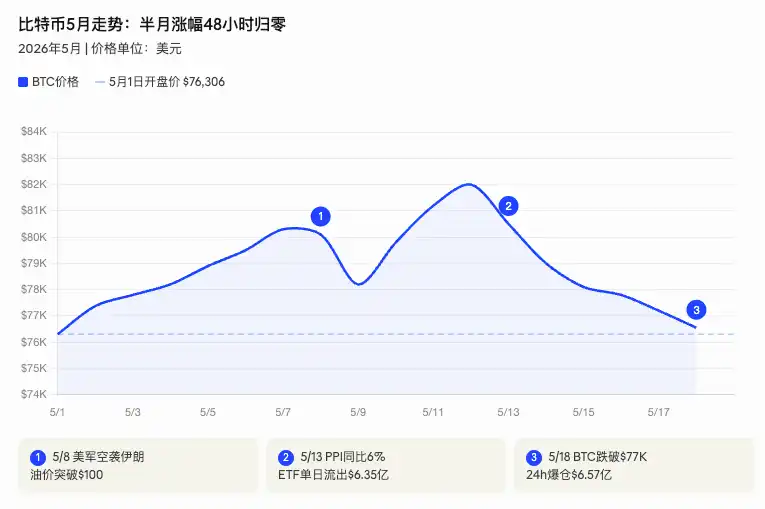
Bitcoin briefly dropped to $76,551 during Monday's Asian trading session, its lowest level since May 1st. According to a Bloomberg report on May 18th, widespread risk aversion triggered by Middle East tensions prompted traders to slash positions significantly, with the crypto market seeing nearly $500 million in liquidations within 15 minutes.

What does this price signify? On May 1st, Bitcoin opened around $76,306. Over the following two weeks, it climbed to above $82,000, then declined for four consecutive trading days, erasing all of May's gains. For traders who chased the rally mid-month, turning from floating profits to floating losses within 48 hours happened too fast to react.
PPI Soars 6% Year-Over-Year, Hitting Three-Year High, Rate Hike Probability Rises to 39%

The fuse that ignited this round of selling was the U.S. April Producer Price Index (PPI) released on May 13th. According to data from the U.S. Bureau of Labor Statistics, PPI rose 1.4% month-over-month, the largest monthly increase since March 2022; it surged 6% year-over-year, the highest level since December 2022, far exceeding market expectations of 4.9%.

Energy prices were the main driver. Gasoline prices jumped 15.6% month-over-month in April, diesel prices rose 12.6%, and the impact of the Iran conflict on the energy complex is transmitting down the supply chain. Even excluding food and energy, the core PPI still rose 1% month-over-month and reached 5.2% year-over-year, indicating price pressure is no longer confined to the pump.

High Frequency Economics Chief Economist Carl Weinberg warned after the PPI report that the data would sound alarms at both the Federal Reserve and financial markets. The CME FedWatch tool shows the market's pricing for a 25 basis point rate hike this year has risen to about 39%, with expectations for a rate cut this year largely eliminated.

Just one day before the PPI data, April CPI rose to 3.8% year-over-year, the highest since May 2023. According to CNN, several economists raised their forecasts for May CPI after the PPI release, expecting it to exceed 4%. The transmission of wholesale prices to the consumer end is accelerating.

ETF Six-Week Inflow Streak Ends, Weekly Net Outflow Exceeds $1 Billion

Macro pressures quickly transmitted to the institutional capital level. According to SoSoValue data, for the week ending May 15th, U.S. Bitcoin spot ETFs recorded a net outflow of approximately $1 billion, ending six consecutive weeks of net inflows. A CoinShares report on May 18th showed digital asset investment products overall saw a net outflow of $1.07 billion, the third-largest weekly outflow of 2026.

James Butterfill, Head of Research at CoinShares, stated this shift "may reflect geopolitical risk aversion triggered by developments related to Iran."

The total net inflow over the previous six weeks was about $3.4 billion, averaging about $568 million per week, with April alone seeing inflows of $1.97 billion, the strongest monthly performance of 2026. This accumulation was reversed intensively this week. May 13th saw a single-day net outflow of $635 million, the largest daily decline of the week; on May 15th, none of the 11 Bitcoin ETFs recorded positive inflows, with another $290 million outflow.

Ethereum spot ETFs also suffered five consecutive days of outflows, with a weekly net outflow of $255 million. By the weekend, Bitcoin ETF cumulative net inflows still stood at $58.34 billion, with total assets under management around $104.29 billion.

$657 Million in Liquidations, 89% Long Positions

As ETF capital fled, the derivatives market experienced a brutal long squeeze. According to Coinglass data, total crypto market liquidations within 24 hours reached $657 million, with long positions accounting for about 89%. According to bitcoin.com, $584 million came from long positions. The Fear & Greed Index plummeted from a neutral 50 a few days earlier to 29, entering the fear zone.

The domino effect of leveraged liquidations accelerated the decline. Bitcoin triggered a large number of stop-loss and forced liquidation orders after breaking below key support, forming a "liquidation → selling → more liquidation" spiral. LMAX crypto strategist Joel Kruger described this process as "forced position closures and position washouts" pushing Bitcoin below key technical support.

Bitcoin is currently hovering in the $76,000 to $76,800 range, with the 50-day moving average around $76,716 providing short-term support, and the 200-day moving average around $83,513 acting as resistance above.

Strategy Group Adds 20,000 BTC Against the Trend, Saylor Not Reading the Same Sentiment Report

While retail investors were liquidated and ETFs bled, Strategy Group (formerly MicroStrategy) operated in the opposite direction during the same period.

According to an 8-K filing with the SEC on May 18th, the company purchased 24,869 Bitcoin for approximately $2.01 billion between May 11th and 17th, at an average price of $80,985. This transaction brought Strategy's total holdings to 843,738 BTC, with a total cost of about $63.87 billion and an average price of around $75,700. This purchase was primarily funded through the sale of STRC preferred stock.

Strategy also disclosed that its "BTC yield" for the year-to-date 2026 (a metric measuring Bitcoin holdings relative to diluted share count growth) reached 12.6%.

This isn't the first time Saylor has added during market panic. Throughout 2026, Strategy has maintained a near-weekly or bi-weekly purchase rhythm, regardless of market ups and downs. From January to May, the company increased its holdings from about 560,000 BTC to over 840,000, adding nearly 60,000 new BTC per month on average. In the same week everyone was watching PPI data and ETF outflow data, he spent another $2 billion buying.

Goldman Sachs Liquidates XRP and Solana ETFs in Q1, Keeps Only Bitcoin

If Strategy's actions represent the "Bitcoin maximalist" stance, Goldman Sachs' Q1 13F holdings report presents a more representative institutional choice.

According to Goldman's latest Q1 2026 13F report, the bank completely liquidated all its XRP and Solana ETF holdings in the first quarter. At the end of the previous quarter, Goldman held about $154 million in XRP-related ETFs (distributed across issuers like Bitwise, Franklin Templeton, Grayscale, and 21Shares), and over $100 million in Solana-related ETFs. Now both positions are zero.

Ethereum ETF exposure was cut by about 70%, reduced from previous levels to around $114 million. The Bitcoin ETF position remained largely unchanged at around $700-720 million, with only a slight reduction of about 10%.
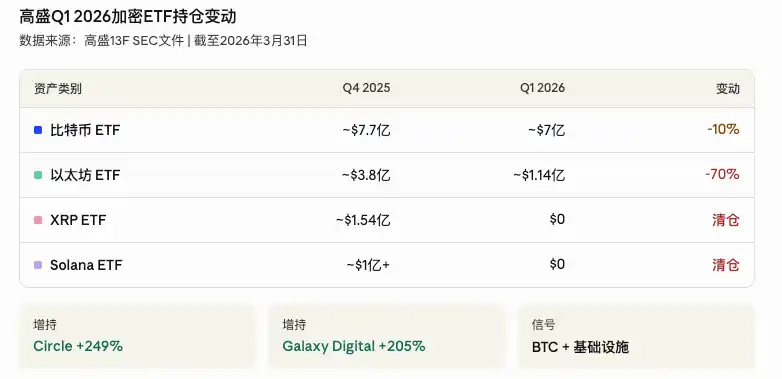
At the same time, Goldman increased its holdings in crypto infrastructure stocks: Circle holdings increased 249%, Galaxy Digital holdings increased 205%, and Coinbase also saw an increase. The signal from this set of actions is clear: Goldman hasn't exited crypto, but is narrowing its bets—shifting from "casting a wide net" back to "BTC-only."

According to a CCN report, the Harvard University Endowment also reduced its Bitcoin ETF holdings by 43% during the same period and completely exited Ethereum ETFs. Institutions are synchronizing a concentration of their crypto exposure by asset type.


Related Questions

QWhat are the main factors cited as triggers for the recent sharp decline in Bitcoin's price?

AThe main triggers are the higher-than-expected US Producer Price Index (PPI) report showing a 6% year-over-year increase, leading to heightened expectations of potential Federal Reserve rate hikes. This macroeconomic pressure coincided with a shift in institutional fund flows, marked by US spot Bitcoin ETFs seeing their first net outflow in six weeks, exceeding $1 billion. Additionally, significant liquidations in the derivatives market, with $657 million in positions forcibly closed, accelerated the downward price movement.

QHow did the investment behavior of Strategy (formerly MicroStrategy) contrast with the general market trend during the sell-off?

AStrategy engaged in significant contrarian buying during the market sell-off. According to its SEC filing, the company purchased 24,869 BTC for approximately $2.01 billion between May 11 and May 17, at an average price of $80,985 per Bitcoin. This increased its total holdings to 843,738 BTC. This action demonstrates a consistent strategy of accumulating Bitcoin regardless of short-term price volatility, directly opposing the trend of retail panic selling and ETF outflows.

QWhat significant change did Goldman Sachs make to its cryptocurrency portfolio in Q1 2026, according to its 13F report?

AAccording to its Q1 2026 13F report, Goldman Sachs made a significant shift towards concentrating its crypto exposure primarily on Bitcoin. The bank completely liquidated its entire holdings of XRP and Solana ETFs. It also reduced its Ethereum ETF exposure by approximately 70%. Meanwhile, it largely maintained its Bitcoin ETF holdings at around $700-$720 million, making only a minor ~10% reduction. The report indicates a strategic move from a diversified crypto portfolio to a more focused 'BTC-only' stance among cryptocurrency investments.

QWhat was the impact of the recent market downturn on leveraged traders in the cryptocurrency market?

AThe market downturn led to massive liquidations for leveraged traders. Within 24 hours, total liquidations across the crypto market reached $657 million. A vast majority of these, approximately 89% or $584 million, were long positions that were forcibly closed. This created a cascading effect where initial liquidations triggered further selling, leading to more stop-losses and liquidations, which accelerated the price decline and pushed the market fear and greed index from a neutral 50 into the 'fear' territory at 29.

QWhat does the article suggest is the emerging institutional consensus regarding cryptocurrency investment, based on the actions of firms like Goldman Sachs?

AThe article suggests an emerging institutional consensus of strategic concentration on Bitcoin. The actions of Goldman Sachs—exiting other major altcoins like XRP and Solana while maintaining core Bitcoin exposure—are presented as a representative example. The trend indicates that major institutions are moving away from a 'broad exposure' approach to a more selective one. The implied consensus is: if institutions are to engage with crypto assets at all, they are increasingly choosing to focus their bets primarily or exclusively on Bitcoin, viewing it as the core, foundational asset in the space.

Related Reads

Musk Posted a Recruitment Ad for SpaceX, and After Reading the Comments Section, I Understood

On May 20th, SpaceX filed for a landmark IPO with a $1.75 trillion valuation. Shortly after, Elon Musk posted a recruitment call on X, seeking "world-class engineers and physicists" for SpaceX. The application process was starkly simple: email with three bullet points proving "exceptional ability," with real, complex projects as a plus. Musk promised to review qualifying emails himself. The post garnered millions of views and thousands of replies, revealing a spectrum of responses. Most comments, including a highly-upvoted humorous one listing absurd "skills," merely listed credentials or experiences in a conventional, non-differentiating way. This highlighted a key insight: a traditional resume listing degrees and skills often fails to demonstrate true exceptionalism. Effective self-presentation requires "performance efficiency." A standout reply came from an OpenAI engineering lead, who simply stated "codex." This demonstrated that for those who have built significant, recognized products, the product itself becomes the ultimate resume. The article argues that in the AI era, any tangible, shareable output—a tool, research, or online project—serves as a living, self-evident credential more powerful than a list of attributes. However, a twist emerged when applicants found the provided email address non-functional, leading to speculation that the post might also serve as an IPO publicity stunt, projecting an image of aggressive talent acquisition to investors. Ultimately, the episode served as a microcosm: some participate through performance, others through proof of work, while some question the reality of the stage itself. It underscores the enduring challenge of defining and demonstrating value in an age of abundant, yet often superficial, content.

marsbit8m ago

Musk Posted a Recruitment Ad for SpaceX, and After Reading the Comments Section, I Understood

marsbit8m ago

Cutting Off OpenAI, Anthropic Acquires the Tool Provider Used by a Quarter of Global Developers

Anthropic has acquired Stainless, a developer tool company that automatically generated official SDKs (Software Development Kits) for AI giants including OpenAI, Anthropic, Meta, and Cloudflare. The deal, reportedly valued at around $300 million, marks a strategic shift for Anthropic as it builds its "AI agent" infrastructure. Stainless acted as a "translator," converting complex API specifications into ready-to-use code libraries for developers. Its tools indirectly reached about a quarter of professional software developers globally. Following the acquisition, Stainless will shut down its public products and its team will join Anthropic to focus on internal platform development, notably for the Claude Platform. Existing SDKs remain with their respective client companies but will no longer receive updates from Stainless. This move is part of Anthropic's broader 18-month strategy to assemble a complete "agent stack." The stack consists of the Claude model at its core, the newly acquired Stainless for standardized API interfaces, and the Model Context Protocol (MCP), an open standard for connecting agents to external tools and data. This contrasts with OpenAI's focus on model generations and consumer-scale compute. Anthropic believes an agent's ultimate utility depends on its ability to connect to external systems. By internalizing the SDK layer and promoting MCP as a connection standard, Anthropic aims to lock in long-term ecosystem advantages and create path dependency, moving beyond the transient lead provided by any single model generation.

marsbit10m ago

Cutting Off OpenAI, Anthropic Acquires the Tool Provider Used by a Quarter of Global Developers

marsbit10m ago

Bankless Founder Sells Off ETH, Collective Collapse of Ethereum Faith

Ethereum faces a "crisis of faith" as David Hoffman, co-founder of the prominent pro-Ethereum media outlet Bankless, announces he has sold all his ETH. This move, coupled with reports of major layoffs at Bankless, signals a potential retreat of Ethereum's staunchest supporters. Hoffman and co-founder Ryan Sean Adams confirm Bankless is entering a "second era," with Adams stepping back and Hoffman exploring new frontiers. Hoffman sharply criticizes the Ethereum Foundation, stating that ETH's poor price performance cannot be separated from its leadership. He has a history of public dissatisfaction, citing the Foundation's failure to drive market growth and its "endless manifestos." His frustration coincides with ETH/BTC hitting multi-month lows and a significant exodus of senior researchers and executives from the Ethereum Foundation, partly attributed to controversial "loyalty oaths." The article contrasts Ethereum's current predicament—with its Layer-2 narrative discredited and ecosystem stagnant—against what should have been a highlight year in 2026 amid tokenization trends. While a previous surge to near $5,000 was driven by corporate buybacks (DAT热潮), ETH has since fallen over 50%. The core question remains: with fading faith and intense competition, what is Ethereum's next solution? Hoffman's divestment symbolizes a growing disconnect between the community and the ecosystem's direction.

Odaily星球日报33m ago

Bankless Founder Sells Off ETH, Collective Collapse of Ethereum Faith

Odaily星球日报33m ago

a16z Invests Heavily with $356 Million in HYPE, Surpassing Paradigm to Become the Largest External Holder

On May 21st, HYPE surged past $59, reaching a new high since September 2025, with a market cap nearing $150 billion. Analysts attribute the rally to a short squeeze and significant ETF inflows. The launch of two U.S. spot ETFs for Hyperliquid has driven substantial capital, with their inflows at times surpassing those of Bitcoin and Ethereum ETFs. Major institutions are actively accumulating HYPE. Venture firm a16z has become the largest external holder with a $356 million position, surpassing Paradigm. Other firms like Goldman Sachs, Grayscale, and Galaxy Digital have also made large purchases, with Goldman reportedly selling portions of its XRP, ETH, and BTC holdings to buy HYPE. Bitwise CIO Matt Hougan calls HYPE one of the most "mispriced" assets, arguing its valuation should reflect Hyperliquid's broader platform beyond just a perpetual DEX token. The protocol generates substantial real revenue, using 97% of fees to buy back and burn HYPE. Its expansion into RWA commodities and prediction markets has driven user growth and transaction volume, now commanding about 70% of the on-chain perpetual DEX market. However, this rapid growth faces challenges. Traditional exchanges CME and ICE are pressuring the CFTC to regulate Hyperliquid, citing concerns over its impact on global commodity benchmarks. Concurrently, some major market makers have withdrawn significant liquidity from the platform. With HYPE up over 125% year-to-date, operational risks are rising. Large holders are reportedly hedging with sizable short positions. The regulatory outlook from the CFTC remains a key uncertainty, adding another layer to the ongoing battle over the future of on-chain finance.

链捕手34m ago

a16z Invests Heavily with $356 Million in HYPE, Surpassing Paradigm to Become the Largest External Holder

链捕手34m ago

Trading

Spot
Futures

Hot Articles

What is $BITCOIN

DIGITAL GOLD ($BITCOIN): A Comprehensive Analysis Introduction to DIGITAL GOLD ($BITCOIN) DIGITAL GOLD ($BITCOIN) is a blockchain-based project operating on the Solana network, which aims to combine the characteristics of traditional precious metals with the innovation of decentralized technologies. While it shares a name with Bitcoin, often referred to as “digital gold” due to its perception as a store of value, DIGITAL GOLD is a separate token designed to create a unique ecosystem within the Web3 landscape. Its goal is to position itself as a viable alternative digital asset, although specifics regarding its applications and functionalities are still developing. What is DIGITAL GOLD ($BITCOIN)? DIGITAL GOLD ($BITCOIN) is a cryptocurrency token explicitly designed for use on the Solana blockchain. In contrast to Bitcoin, which provides a widely recognized value storage role, this token appears to focus on broader applications and characteristics. Notable aspects include: Blockchain Infrastructure: The token is built on the Solana blockchain, known for its capacity to handle high-speed and low-cost transactions. Supply Dynamics: DIGITAL GOLD has a maximum supply capped at 100 quadrillion tokens (100P $BITCOIN), although details regarding its circulating supply are currently undisclosed. Utility: While precise functionalities are not explicitly outlined, there are indications that the token could be utilized for various applications, potentially involving decentralized applications (dApps) or asset tokenization strategies. Who is the Creator of DIGITAL GOLD ($BITCOIN)? At present, the identity of the creators and development team behind DIGITAL GOLD ($BITCOIN) remains unknown. This situation is typical among many innovative projects within the blockchain space, particularly those aligning with decentralized finance and meme coin phenomena. While such anonymity may foster a community-driven culture, it intensifies concerns about governance and accountability. Who are the Investors of DIGITAL GOLD ($BITCOIN)? The available information indicates that DIGITAL GOLD ($BITCOIN) does not have any known institutional backers or prominent venture capital investments. The project seems to operate on a peer-to-peer model focused on community support and adoption rather than traditional funding routes. Its activity and liquidity are primarily situated on decentralized exchanges (DEXs), such as PumpSwap, rather than established centralized trading platforms, further highlighting its grassroots approach. How DIGITAL GOLD ($BITCOIN) Works The operational mechanics of DIGITAL GOLD ($BITCOIN) can be elaborated on based on its blockchain design and network attributes: Consensus Mechanism: By leveraging Solana’s unique proof-of-history (PoH) combined with a proof-of-stake (PoS) model, the project ensures efficient transaction validation contributing to the network's high performance. Tokenomics: While specific deflationary mechanisms have not been extensively detailed, the vast maximum token supply implies that it may cater to microtransactions or niche use cases that are still to be defined. Interoperability: There exists the potential for integration with Solana’s broader ecosystem, including various decentralized finance (DeFi) platforms. However, the details regarding specific integrations remain unspecified. Timeline of Key Events Here is a timeline that highlights significant milestones concerning DIGITAL GOLD ($BITCOIN): 2023: The initial deployment of the token occurs on the Solana blockchain, marked by its contract address. 2024: DIGITAL GOLD gains visibility as it becomes available for trading on decentralized exchanges like PumpSwap, allowing users to trade it against SOL. 2025: The project witnesses sporadic trading activity and potential interest in community-led engagements, although no noteworthy partnerships or technical advancements have been documented as of yet. Critical Analysis Strengths Scalability: The underlying Solana infrastructure supports high transaction volumes, which could enhance the utility of $BITCOIN in various transaction scenarios. Accessibility: The potential low trading price per token could attract retail investors, facilitating wider participation due to fractional ownership opportunities. Risks Lack of Transparency: The absence of publicly known backers, developers, or an audit process may yield skepticism regarding the project's sustainability and trustworthiness. Market Volatility: The trading activity is heavily reliant on speculative behavior, which can result in significant price volatility and uncertainty for investors. Conclusion DIGITAL GOLD ($BITCOIN) emerges as an intriguing yet ambiguous project within the rapidly evolving Solana ecosystem. While it attempts to leverage the “digital gold” narrative, its departure from Bitcoin's established role as a store of value underscores the need for a clearer differentiation of its intended utility and governance structure. Future acceptance and adoption will likely depend on addressing the current opacity and defining its operational and economic strategies more explicitly. Note: This report encompasses synthesised information available as of October 2023, and developments may have transpired beyond the research period.

363 Total ViewsPublished 2025.05.13Updated 2025.05.13

What is $BITCOIN

Discussions

Welcome to the HTX Community. Here, you can stay informed about the latest platform developments and gain access to professional market insights. Users' opinions on the price of BTC (BTC) are presented below.

活动图片