Bitcoin Demand Growing For First Time Since November, Data Shows

bitcoinistPublished on 2026-02-27Last updated on 2026-02-27

Abstract

On-chain data indicates Bitcoin's spot demand is growing for the first time since late November, as shown by the Apparent Demand metric. This indicator, which estimates current network demand by comparing mining issuance and changes in long-dormant supply, recently turned positive after months of negative readings. The shift suggests decreasing inventory outweighs new supply, reflecting renewed investor interest. Additionally, the Coinbase Premium Index has flipped positive, signaling strong buying activity from U.S. institutions. Bitcoin's price has responded positively, rising 4% to around $68,000, indicating a potential recovery from recent declines.

On-chain data shows spot demand for Bitcoin is returning as the Apparent Demand metric has started to grow for the first time since late November.

Bitcoin Apparent Demand Has Seen Its 30-Day Sum Turn Green

In a new post on X, CryptoQuant head of research Julio Moreno has discussed the latest trend in the Apparent Demand of Bitcoin. This on-chain indicator provides an estimate for the spot demand for the cryptocurrency that’s present on the network right now. It does so by comparing two metrics: the mining issuance and change in the 1-year inactive supply.

The mining issuance is the amount of the asset that miners are ‘minting’ on the blockchain every day through their mining activities. It can be considered as a measure of the asset’s total production. In contrast, the 1-year inactive supply, corresponding to coins dormant since more than one year ago, represents the cryptocurrency’s inventory.

When the value of the Apparent Demand is positive, it means the decrease in the inventory exceeds the production. Such a trend suggests demand for BTC is going up. On the other hand, the indicator being negative implies coins are being stashed away in inventory, potentially because of a lack of fresh activity.

Now, here is the chart shared by Moreno that shows the trend in the 30-day sum of the Bitcoin Apparent Demand over the last few months:
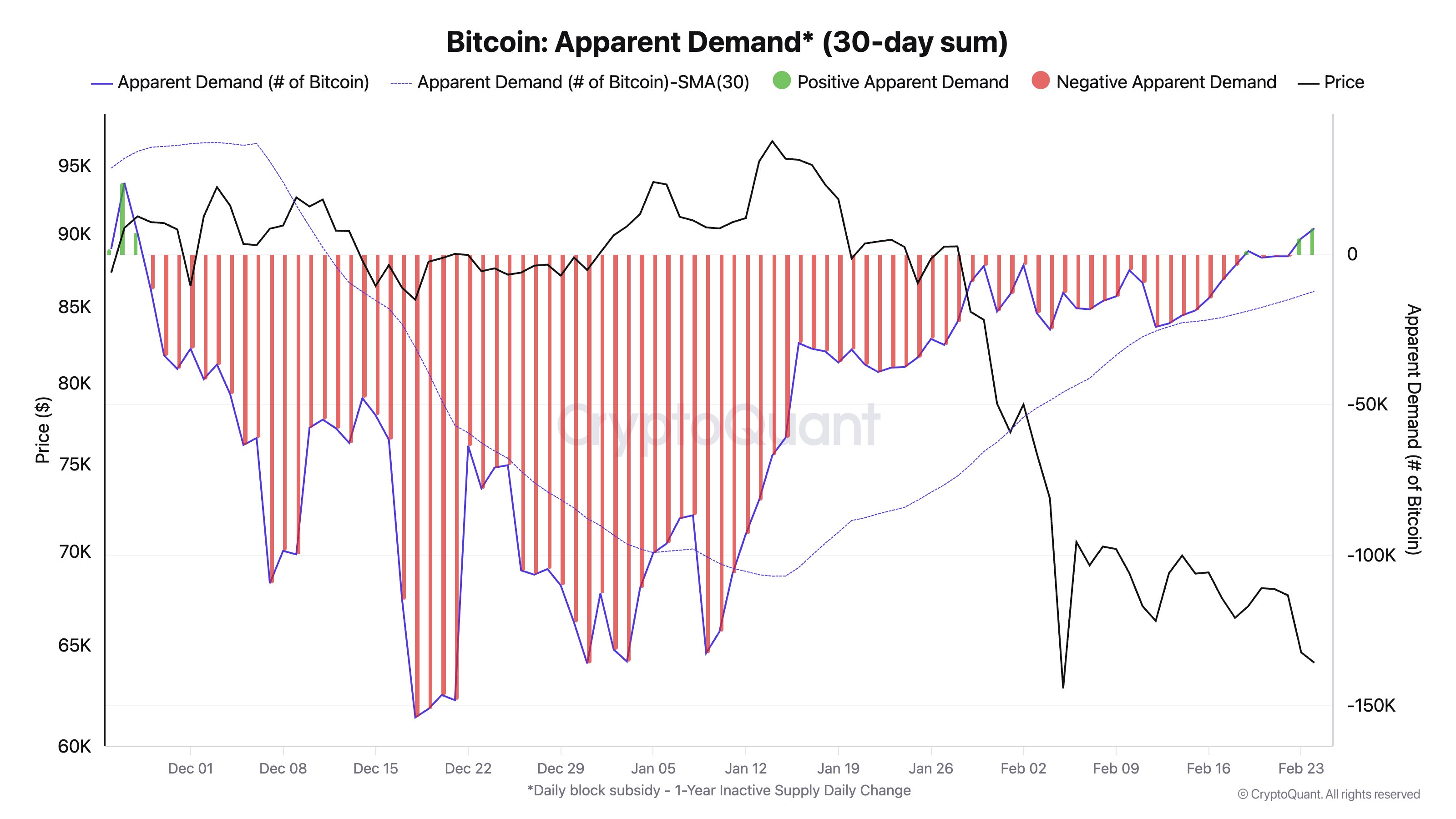
The value of the metric seems to have turned positive in recent days | Source: @jjcmoreno on X

As displayed in the above graph, the Bitcoin Apparent Demand saw its 30-day sum plummet deep into the red zone during December, implying demand for the cryptocurrency was muted. The metric persisted at these lows during the first half of January, but things started to reverse in the month’s second half.

The Apparent Demand remained at slight negative levels for much of February, but recently, a reversal into the positive territory has finally taken place. “Bitcoin spot demand is growing for the first time since late November,” noted the analyst. For now, the metric’s green level is still relatively small, so it only remains to be seen whether it will go up further in the near future.

In related news, the Coinbase Premium Index has also flipped green for Bitcoin recently, as CryptoQuant founder Ki Young Ju has pointed out in an X post.
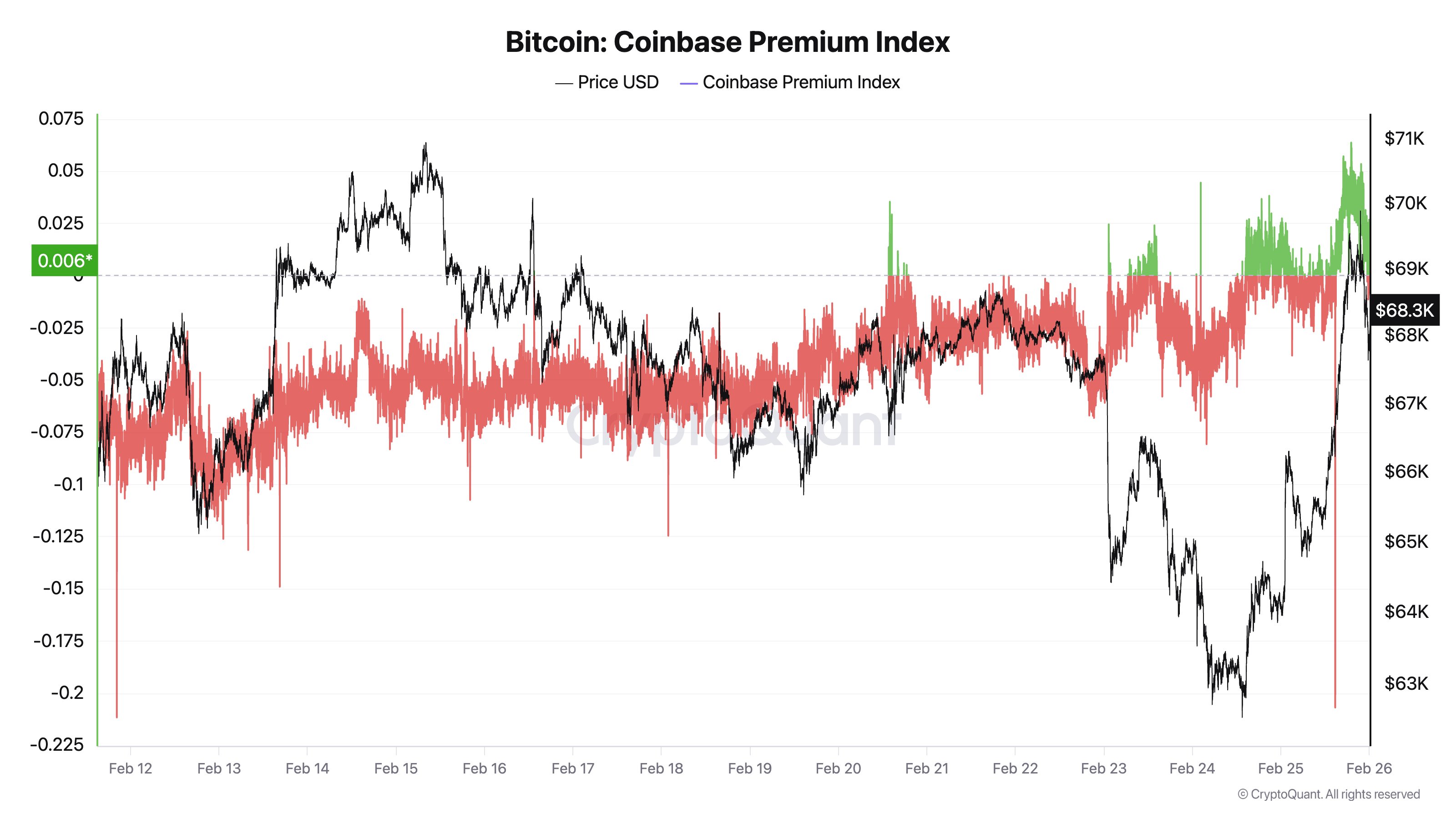
The trend in the BTC Coinbase Premium Index over the last couple of weeks | Source: @ki_young_ju on X

The Coinbase Premium Index tracks the percentage difference between the BTC price on Coinbase (USD pair) and that on Binance (USDT pair). In other words, it reflects how Coinbase’s US-centric traffic differs in behavior from Binance’s global userbase.

From the chart, it’s visible that the metric shot up into the positive territory alongside the latest price surge, a potential sign that accumulation from American institutions backed the rally.

BTC Price

At the time of writing, Bitcoin is floating around $68,000, up 4% in the last 24 hours.

Looks like the price of the coin saw a fast rebound from its recent drop | Source: BTCUSDT on TradingView


Related Questions

QWhat does the Apparent Demand metric for Bitcoin indicate, and why is its recent positive value significant?

AThe Apparent Demand metric estimates current spot demand for Bitcoin by comparing mining issuance (daily production) to the change in 1-year inactive supply (inventory). A positive value means the decrease in inventory exceeds production, indicating growing demand. Its recent shift to positive is significant because it's the first time demand has grown since late November, suggesting a potential reversal in market sentiment.

QAccording to the data, when did the 30-day sum of Bitcoin's Apparent Demand start to reverse its negative trajectory?

AThe 30-day sum of Bitcoin's Apparent Demand started to reverse from its deep negative levels in the second half of January, after persisting at lows during the first half of the month and throughout December.

QWhat is the Coinbase Premium Index, and what does its recent positive flip suggest about the market?

AThe Coinbase Premium Index measures the percentage difference between Bitcoin's price on Coinbase (USD pair) and Binance (USDT pair). Its recent flip to positive alongside the price surge suggests increased buying pressure or accumulation from U.S.-based institutions and investors on Coinbase, indicating strong institutional demand backing the rally.

QHow does the article define 'mining issuance' and '1-year inactive supply' in the context of calculating Apparent Demand?

AMining issuance refers to the amount of Bitcoin miners produce daily through blockchain activities, representing the asset's total production. The 1-year inactive supply consists of coins that haven't moved in over a year, representing Bitcoin's inventory. Apparent Demand compares these two to estimate spot demand.

QWhat was Bitcoin's price at the time of writing, and how did it perform in the last 24 hours?

AAt the time of writing, Bitcoin was trading around $68,000, reflecting a 4% increase over the last 24 hours, indicating a fast rebound from recent price drops.

Related Reads

Uncovering the Truth About Agent Commerce, Payments, and Infrastructure

Decoding Agent Commerce, Payments, and Infrastructure: The Reality Over the past year, I've been building infrastructure for the Agent economy, engaging with major players like Stripe, Visa, Coinbase, Google, and dozens of startups. A clear conclusion emerges: true, large-scale demand does not yet exist. Startups face structural challenges. Data points illustrate this gap. Stripe's Agent commerce platform has over 1,000 merchants but only single-digit transacting agents. Visa's Agent payment token requires 9-month KYC and a $250M revenue threshold, accessible only to giants like Amazon. On-chain analysis reveals actual daily Agent transaction volume is around $17k, half of which are test transactions. The article analyzes four potential markets: **1. Agent-to-Merchant (A2M):** Current AI shopping UX is often inferior to traditional e-commerce for visual, comparison-heavy purchases (clothing, electronics). Chat interfaces are a step back. Real merchant interest is defensive "Agent Engine Optimization," fearing future obsolescence, not current demand. Potential exists in high-frequency, low-decision purchases (e.g., food delivery) or simplifying terrible UX (complex checkouts, non-native shoppers), but these require massive consumer distribution channels dominated by giants like DoorDash and Amazon. **2. Agent-to-API (A2A):** Developers already have subscriptions and billing for core APIs (compute, data). The argument for micro-payments via crypto for sub-dollar API calls is addressed by pre-paid balances today. The deeper issue is supplier resistance; major SaaS firms rely on enterprise contracts, not fractional cent pricing. Opportunity lies in the long tail of niche services, but this is a smaller market catering to developers, a historically low-paying group. **3. Agent-to-Agent (A2A):** This remains a theoretical long-term vision with near-zero current transaction volume. It involves unique challenges: discovery, trust, negotiation, dispute resolution. When it materializes, it will require a fundamentally new settlement infrastructure for high-speed, variable-value, multi-party transactions. It's a real long-term bet, but not the current market. **4. Agent-to-Finance (A2F):** This is the only category with existing, paying demand. Integrating AI into financial workflows (trading, portfolio management) is a natural evolution and enables new capabilities like autonomous rebalancing. However, competition favors incumbents with regulatory licenses, compliance infrastructure, and existing client relationships. **The Real Issue:** Why is infrastructure still being built? Incumbents can afford long-term bets, and payment companies see every problem as a nail for their payment hammer. However, payment is just one piece. The core challenge is *coordination*—orchestrating work between Agents and humans, verifying outcomes, and settling results. Payment is part of settlement, which is part of coordination. Companies that solve the coordination problem will subsume payments, not the other way around. Startups lack the infinite runway of giants and must find today's real market, which, after a year of exploration, lies outside these four categories—in an area with real, growing, and underserved activity.

marsbit1h ago

Uncovering the Truth About Agent Commerce, Payments, and Infrastructure

marsbit1h ago

Kalshi, MTS, and a16z's Ambition

The article "Kalshi, MTS, and a16z's Ambition" explores prediction markets as a focal point of excitement in 2025 for investors, crypto enthusiasts, and media. It traces their intellectual lineage from Friedrich Hayek's ideas on dispersed knowledge and market coordination to Robin Hanson's Logarithmic Market Scoring Rule (LMSR), which incentivizes truthful information sharing. The piece argues that a16z's significant investment in prediction market platform Kalshi (valued at $220B) transcends mere financial speculation. a16z frames prediction markets as a new form of "media" that provides "presence"—a way for individuals to actively engage with and influence world events through financial stakes, countering postmodern detachment. By wagering on outcomes, users become "super observers," and the market's aggregated probabilities gain authoritative power to define event truth and importance. The article uses media company MTS ("Monitoring The Situation") as a case study of a16z's "new media" strategy: rapidly producing high-intensity, multi-format content to "take over the timeline." However, prediction markets like Kalshi are presented as the ultimate piece in this media empire. Their real-money, crowd-sourced probabilities possess a unique "reality distortion field" and perceived objectivity, potentially swaying public opinion and granting a private company unprecedented interpretive power over reality. Ultimately, Kalshi's immense valuation is attributed not just to its exchange model, but to its role as a foundational component in a16z's envisioned new media landscape, where prediction markets define narrative and truth.

链捕手1h ago

Kalshi, MTS, and a16z's Ambition

链捕手1h ago

Trading

Spot
Futures

Hot Articles

What is $BITCOIN

DIGITAL GOLD ($BITCOIN): A Comprehensive Analysis Introduction to DIGITAL GOLD ($BITCOIN) DIGITAL GOLD ($BITCOIN) is a blockchain-based project operating on the Solana network, which aims to combine the characteristics of traditional precious metals with the innovation of decentralized technologies. While it shares a name with Bitcoin, often referred to as “digital gold” due to its perception as a store of value, DIGITAL GOLD is a separate token designed to create a unique ecosystem within the Web3 landscape. Its goal is to position itself as a viable alternative digital asset, although specifics regarding its applications and functionalities are still developing. What is DIGITAL GOLD ($BITCOIN)? DIGITAL GOLD ($BITCOIN) is a cryptocurrency token explicitly designed for use on the Solana blockchain. In contrast to Bitcoin, which provides a widely recognized value storage role, this token appears to focus on broader applications and characteristics. Notable aspects include: Blockchain Infrastructure: The token is built on the Solana blockchain, known for its capacity to handle high-speed and low-cost transactions. Supply Dynamics: DIGITAL GOLD has a maximum supply capped at 100 quadrillion tokens (100P $BITCOIN), although details regarding its circulating supply are currently undisclosed. Utility: While precise functionalities are not explicitly outlined, there are indications that the token could be utilized for various applications, potentially involving decentralized applications (dApps) or asset tokenization strategies. Who is the Creator of DIGITAL GOLD ($BITCOIN)? At present, the identity of the creators and development team behind DIGITAL GOLD ($BITCOIN) remains unknown. This situation is typical among many innovative projects within the blockchain space, particularly those aligning with decentralized finance and meme coin phenomena. While such anonymity may foster a community-driven culture, it intensifies concerns about governance and accountability. Who are the Investors of DIGITAL GOLD ($BITCOIN)? The available information indicates that DIGITAL GOLD ($BITCOIN) does not have any known institutional backers or prominent venture capital investments. The project seems to operate on a peer-to-peer model focused on community support and adoption rather than traditional funding routes. Its activity and liquidity are primarily situated on decentralized exchanges (DEXs), such as PumpSwap, rather than established centralized trading platforms, further highlighting its grassroots approach. How DIGITAL GOLD ($BITCOIN) Works The operational mechanics of DIGITAL GOLD ($BITCOIN) can be elaborated on based on its blockchain design and network attributes: Consensus Mechanism: By leveraging Solana’s unique proof-of-history (PoH) combined with a proof-of-stake (PoS) model, the project ensures efficient transaction validation contributing to the network's high performance. Tokenomics: While specific deflationary mechanisms have not been extensively detailed, the vast maximum token supply implies that it may cater to microtransactions or niche use cases that are still to be defined. Interoperability: There exists the potential for integration with Solana’s broader ecosystem, including various decentralized finance (DeFi) platforms. However, the details regarding specific integrations remain unspecified. Timeline of Key Events Here is a timeline that highlights significant milestones concerning DIGITAL GOLD ($BITCOIN): 2023: The initial deployment of the token occurs on the Solana blockchain, marked by its contract address. 2024: DIGITAL GOLD gains visibility as it becomes available for trading on decentralized exchanges like PumpSwap, allowing users to trade it against SOL. 2025: The project witnesses sporadic trading activity and potential interest in community-led engagements, although no noteworthy partnerships or technical advancements have been documented as of yet. Critical Analysis Strengths Scalability: The underlying Solana infrastructure supports high transaction volumes, which could enhance the utility of $BITCOIN in various transaction scenarios. Accessibility: The potential low trading price per token could attract retail investors, facilitating wider participation due to fractional ownership opportunities. Risks Lack of Transparency: The absence of publicly known backers, developers, or an audit process may yield skepticism regarding the project's sustainability and trustworthiness. Market Volatility: The trading activity is heavily reliant on speculative behavior, which can result in significant price volatility and uncertainty for investors. Conclusion DIGITAL GOLD ($BITCOIN) emerges as an intriguing yet ambiguous project within the rapidly evolving Solana ecosystem. While it attempts to leverage the “digital gold” narrative, its departure from Bitcoin's established role as a store of value underscores the need for a clearer differentiation of its intended utility and governance structure. Future acceptance and adoption will likely depend on addressing the current opacity and defining its operational and economic strategies more explicitly. Note: This report encompasses synthesised information available as of October 2023, and developments may have transpired beyond the research period.

363 Total ViewsPublished 2025.05.13Updated 2025.05.13

What is $BITCOIN

Discussions

Welcome to the HTX Community. Here, you can stay informed about the latest platform developments and gain access to professional market insights. Users' opinions on the price of BTC (BTC) are presented below.

活动图片














