Bitcoin Core V30 Bug Risks Total Wallet Loss For Legacy Users

bitcoinistPublished on 2026-01-07Last updated on 2026-01-07

Abstract

Bitcoin Core developers issued an urgent warning regarding a critical bug in versions 30.0 and 30.1 that, in rare cases, can delete all wallet files on a node during legacy (BDB) wallet migration, potentially leading to fund loss for users without backups. A fix is expected in version 30.2, and users are advised to avoid migrating legacy wallets until then. The disclosure sparked debate within the community, with some arguing the risk is understated since v30 forces migration for legacy wallet users, while others noted limited real-world impact with only one user reportedly affected. All agree on the precaution: back up wallets and delay migration until the patch is released.

Bitcoin Core developers issued an urgent notice after discovering a wallet migration bug in versions 30.0 and 30.1 that can, in rare cases, delete wallet files on the same node, turning a routine upgrade step into a potential funds-loss event for users without backups.

In a Jan. 5 statement, the Bitcoin Core Project warned on X that “under rare circumstances, migrating a legacy (BDB) wallet can delete all wallet files on the same node. If those wallets aren’t backed up, this can result in a loss of funds.”

The team said a fix is slated for Bitcoin Core 30.2 and advised users not to migrate legacy wallets using 30.0 or 30.1 until that release is available. “Only the legacy wallet migration process is affected. All other uses are unaffected. You can continue using Bitcoin Core normally, including existing wallets and running a node without wallets.”

Bitcoin Community Divided Over Severity

The disclosure caps a simmering thread of reports and frustration among users tracking the issue on GitHub. One X user, posting under the handle @B__T__C, claimed “several users had been reporting it for over two weeks” and argued the bug proved difficult for maintainers to reproduce, linking to a public issue thread.

Another account, Greg Tonoski (@GregTonoski), pointed to earlier warnings ahead of the v30 release and suggested the episode reflects a broader disconnect between developers and users. “Users had warned @bitcoincoreorg (@achow101) a month before the v30 release,” he wrote, adding: “I am starting to doubt if Bitcoin is still catering to the Bitcoin user’s needs.”

The sharpest debate, however, has been over how “rare” translates into real-world risk, especially given the migration path that v30 users may face. @barackomaba argued the impact is being understated because Bitcoin Core v30.0 “explicitly stopped loading or creating BDB legacy wallets,” leaving affected users with a practical next step: migrate.

“People are acting like legacy wallet migration is some obscure edge case,” the account wrote. “But v30.0 explicitly stopped loading or creating BDB legacy wallets, so anyone who upgraded to v30 and still had a legacy wallet in Bitcoin Core effectively had only one path forward: migrate.”

‘Legacy wallets’ were the default wallet type until April 2022 (before 23.0, new wallets were ‘legacy’ by default). Also, the migration needs to fail. This won’t be the majority of migrations obviously, but there are many plausible ways to trigger this.”

He then described one such scenario: a user pruning their node while the wallet wasn’t loaded, which can cause the migrated wallet load step to fail, sending the process down a “cleanup path” that deletes the entire wallet directory and “everything in it,” including other wallets and even rollback backups created during migration.

Not everyone agreed the incident merits alarm. @w_s_bitcoin pushed back by emphasizing adoption and observed impact, arguing that Core v30 “currently” accounts for “1/5th of all the Bitcoin nodes” and that “reportedly only one single user was affected by this bug.” Wicked characterized it as “a shitty bug,” but added that it “didn’t result in any known bitcoin losses,” and said the fix is welcome.

What is not in dispute, based on Bitcoin Core’s own notice, is the practical guidance: users running 30.0 or 30.1 should avoid migrating legacy (BDB) wallets until 30.2 ships, and ensure wallet files are backed up before attempting any migration at all.

At press time, Bitcoin traded at $91,717.
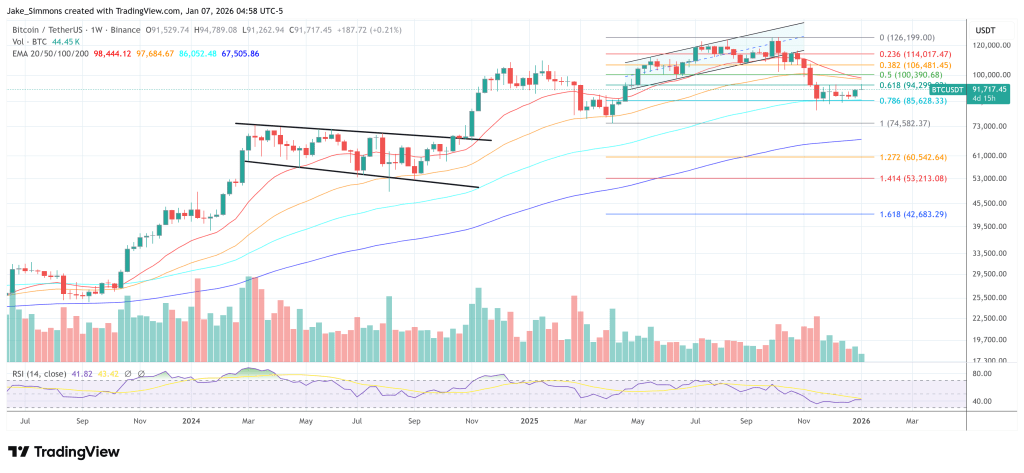
Bitcoin remains below the 0.618 Fib, 1-week chart | Source: BTCUSDT on TradingView.com

Trending Cryptos

Related Questions

QWhat is the specific risk associated with the Bitcoin Core v30.0 and v30.1 bug?

AThe bug can, in rare circumstances, cause the migration of a legacy (BDB) wallet to delete ALL wallet files on the same node, potentially leading to a total loss of funds for users who do not have backups.

QWhat is the Bitcoin Core Project's main advice for users currently running versions 30.0 or 30.1?

AThe main advice is to avoid migrating any legacy (BDB) wallets until the fixed version, Bitcoin Core 30.2, is released. Users should also ensure all wallet files are backed up before attempting any migration.

QAccording to the debate on X, why did one user argue that the 'legacy wallet migration' is not an obscure edge case?

ABecause Bitcoin Core v30.0 explicitly stopped loading or creating the older BDB legacy wallets. Therefore, any user who upgraded to v30 and still had a legacy wallet effectively had only one path forward: to migrate it, making the migration process a necessary step for many.

QWhat was one specific scenario described that could trigger the wallet-deletion bug?

AOne scenario is if a user prunes their node while the wallet is not loaded. This can cause the step to load the newly migrated wallet to fail, sending the process down a 'cleanup path' that deletes the entire wallet directory and everything in it, including other wallets and backups.

QWhat counter-argument was presented to suggest the bug's severity was being overblown?

AOne user argued that while it was a 'shitty bug,' it reportedly only affected a single user and did not result in any known bitcoin losses. They also noted that Core v30 currently accounts for a significant portion (1/5th) of all Bitcoin nodes, implying the impact has been limited despite widespread adoption.

Related Reads

Research Report Analysis: Is Intel Making a Comeback with Apple? Bernstein's Calculations Show the Right Direction, but the Price Is Already Overvalued

Bernstein analyst Stacy A. Rasgon published a report on June 18 regarding Intel, assessing the potential impact of recent political support for a US-based PC chip design and manufacturing collaboration between Apple and Intel. The report views this as a significant signal for the foundry landscape shift but concludes the initial financial contribution would be minimal. Key conclusions: 1) An Apple deal is seen as a small-scale "proof of concept." Even if Intel wins 40% of Apple's premium notebook chip orders (~5 million units/year), Bernstein estimates it would generate only about $500M in annual revenue and ~$0.03 EPS, negligible against Intel's ~$55B revenue. 2) Political encouragement is not equivalent to enforceable mandates. Winning orders ultimately depends on Intel demonstrating competitive technology (like its 18A node), cost, and reliable supply. 3) The path from validation to large-scale production involves significant challenges, capital investment, and time. Due to these uncertainties, Bernstein maintains a Market-Perform (Hold) rating with a $100 price target, implying potential downside from the ~$121.10 price at the report date. The analysis highlights the tension between near-term validation value—serving as a crucial trust signal for Intel's foundry ambitions and US supply chain resilience—and the long-term opportunity to attract larger cloud and AI chip customers. The investment thesis hinges on successful 18A execution and sustained policy support, not on immediate financial gains from Apple.

marsbit18m ago

Research Report Analysis: Is Intel Making a Comeback with Apple? Bernstein's Calculations Show the Right Direction, but the Price Is Already Overvalued

marsbit18m ago

27-Year Reign Ends: SK Hynix Market Cap Surpasses Samsung for First Time, an AI-Driven Reshuffle of Korean Chip Power

On June 22, 2026, SK Hynix made history by surpassing Samsung Electronics in market capitalization, ending Samsung's 27-year reign as South Korea's most valuable company. This dramatic reversal is powered by the AI boom and SK Hynix's dominant position in High Bandwidth Memory (HBM), a critical component for AI model training. Once a heavily indebted firm on the brink of bankruptcy, SK Hynix bet early on HBM, which has evolved from a niche product to essential AI infrastructure. It now commands a 59% share of the global HBM market. Its financial performance is staggering, with Q1 2026 net profit soaring nearly fourfold year-over-year to KRW 40.35 trillion, translating to over 2 billion RMB in daily net profit. HBM now drives roughly 40% of its revenue with exceptionally high margins. In contrast, Samsung, with its broad portfolio spanning memory chips, smartphones, and foundry services, has lagged in the HBM race while facing headwinds in other divisions. This shift signifies a deeper restructuring of South Korea's economy, moving from consumer electronics to AI-driven growth. However, the future remains competitive. With major capacity expansions planned industry-wide by 2028 and Samsung aiming to catch up in HBM technology, the new market leader cannot afford complacency. This event marks a pivotal moment in the global semiconductor industry's ongoing power realignment.

marsbit29m ago

27-Year Reign Ends: SK Hynix Market Cap Surpasses Samsung for First Time, an AI-Driven Reshuffle of Korean Chip Power

marsbit29m ago

Why Does 'AGI Godfather' Ben Goertzel Believe the Future of AI Relies on Blockchain?

Ben Goertzel, known as the "AGI Godfather," argues that the future of Artificial General Intelligence (AGI) must be built on blockchain to prevent its control by a few corporations or venture capital firms. He believes the core AGI code should be free and open-source, but that this alone is insufficient without a decentralized infrastructure to run it affordably. His blockchain project, SingularityNET, and the broader Artificial Superintelligence Alliance aim to create a user-owned, decentralized network for hosting and deploying AGI, contrasting with the closed models of companies like OpenAI and Anthropic. Goertzel criticizes the shift of other labs from open to closed development. He argues that while a closed path is simpler, an open, decentralized model—akin to Linux and the internet—is both possible and ultimately better for humanity. He envisions an "Agent economy" where individuals orchestrate teams of AI agents to perform tasks, including transactions, on an open network rather than corporate clouds. While his current model relies on cryptocurrency, plans include offering paid AI services to businesses with the decentralized blockchain as the backend. Goertzel predicts human-level AGI could arrive by 2029 and warns that a gap in understanding and access to AGI could drastically worsen inequality. The first test of his decentralized approach will be the upcoming release of the Agent Omega Claw.

Foresight News1h ago

Why Does 'AGI Godfather' Ben Goertzel Believe the Future of AI Relies on Blockchain?

Foresight News1h ago

Trading

Spot
Futures

Hot Articles

What is $BITCOIN

DIGITAL GOLD ($BITCOIN): A Comprehensive Analysis Introduction to DIGITAL GOLD ($BITCOIN) DIGITAL GOLD ($BITCOIN) is a blockchain-based project operating on the Solana network, which aims to combine the characteristics of traditional precious metals with the innovation of decentralized technologies. While it shares a name with Bitcoin, often referred to as “digital gold” due to its perception as a store of value, DIGITAL GOLD is a separate token designed to create a unique ecosystem within the Web3 landscape. Its goal is to position itself as a viable alternative digital asset, although specifics regarding its applications and functionalities are still developing. What is DIGITAL GOLD ($BITCOIN)? DIGITAL GOLD ($BITCOIN) is a cryptocurrency token explicitly designed for use on the Solana blockchain. In contrast to Bitcoin, which provides a widely recognized value storage role, this token appears to focus on broader applications and characteristics. Notable aspects include: Blockchain Infrastructure: The token is built on the Solana blockchain, known for its capacity to handle high-speed and low-cost transactions. Supply Dynamics: DIGITAL GOLD has a maximum supply capped at 100 quadrillion tokens (100P $BITCOIN), although details regarding its circulating supply are currently undisclosed. Utility: While precise functionalities are not explicitly outlined, there are indications that the token could be utilized for various applications, potentially involving decentralized applications (dApps) or asset tokenization strategies. Who is the Creator of DIGITAL GOLD ($BITCOIN)? At present, the identity of the creators and development team behind DIGITAL GOLD ($BITCOIN) remains unknown. This situation is typical among many innovative projects within the blockchain space, particularly those aligning with decentralized finance and meme coin phenomena. While such anonymity may foster a community-driven culture, it intensifies concerns about governance and accountability. Who are the Investors of DIGITAL GOLD ($BITCOIN)? The available information indicates that DIGITAL GOLD ($BITCOIN) does not have any known institutional backers or prominent venture capital investments. The project seems to operate on a peer-to-peer model focused on community support and adoption rather than traditional funding routes. Its activity and liquidity are primarily situated on decentralized exchanges (DEXs), such as PumpSwap, rather than established centralized trading platforms, further highlighting its grassroots approach. How DIGITAL GOLD ($BITCOIN) Works The operational mechanics of DIGITAL GOLD ($BITCOIN) can be elaborated on based on its blockchain design and network attributes: Consensus Mechanism: By leveraging Solana’s unique proof-of-history (PoH) combined with a proof-of-stake (PoS) model, the project ensures efficient transaction validation contributing to the network's high performance. Tokenomics: While specific deflationary mechanisms have not been extensively detailed, the vast maximum token supply implies that it may cater to microtransactions or niche use cases that are still to be defined. Interoperability: There exists the potential for integration with Solana’s broader ecosystem, including various decentralized finance (DeFi) platforms. However, the details regarding specific integrations remain unspecified. Timeline of Key Events Here is a timeline that highlights significant milestones concerning DIGITAL GOLD ($BITCOIN): 2023: The initial deployment of the token occurs on the Solana blockchain, marked by its contract address. 2024: DIGITAL GOLD gains visibility as it becomes available for trading on decentralized exchanges like PumpSwap, allowing users to trade it against SOL. 2025: The project witnesses sporadic trading activity and potential interest in community-led engagements, although no noteworthy partnerships or technical advancements have been documented as of yet. Critical Analysis Strengths Scalability: The underlying Solana infrastructure supports high transaction volumes, which could enhance the utility of $BITCOIN in various transaction scenarios. Accessibility: The potential low trading price per token could attract retail investors, facilitating wider participation due to fractional ownership opportunities. Risks Lack of Transparency: The absence of publicly known backers, developers, or an audit process may yield skepticism regarding the project's sustainability and trustworthiness. Market Volatility: The trading activity is heavily reliant on speculative behavior, which can result in significant price volatility and uncertainty for investors. Conclusion DIGITAL GOLD ($BITCOIN) emerges as an intriguing yet ambiguous project within the rapidly evolving Solana ecosystem. While it attempts to leverage the “digital gold” narrative, its departure from Bitcoin's established role as a store of value underscores the need for a clearer differentiation of its intended utility and governance structure. Future acceptance and adoption will likely depend on addressing the current opacity and defining its operational and economic strategies more explicitly. Note: This report encompasses synthesised information available as of October 2023, and developments may have transpired beyond the research period.

421 Total ViewsPublished 2025.05.13Updated 2025.05.13

What is $BITCOIN

Discussions

Welcome to the HTX Community. Here, you can stay informed about the latest platform developments and gain access to professional market insights. Users' opinions on the price of BTC (BTC) are presented below.

活动图片