Bitcoin Bull Turn Hinges On US Debt Wall, Real Vision Says

bitcoinistPublished on 2026-06-09Last updated on 2026-06-09

Abstract

Real Vision crypto analyst Jamie Coutts says Bitcoin's long-term technical setup is approaching attractive, accumulation-zone levels, suggesting a potential cycle bottom in Q2/Q3. However, he cautions that a major macroeconomic obstacle could delay a sustained bullish reversal: a looming US Treasury refinancing wall. In 2027, $3.67 trillion of government debt matures and must be refinanced at significantly higher interest rates. Coutts argues current market liquidity is insufficient to absorb this issuance smoothly, especially as capital continues rotating out of crypto and into AI-related equities and commodities since late 2025. This liquidity constraint, combined with a potential contraction of the Federal Reserve's balance sheet, poses a risk to all risk assets, including Bitcoin. While Bitcoin may be the first to detect a future shift toward increased Fed liquidity, Coutts believes such a shift may only come after stress emerges in the Treasury market. Therefore, despite a positive technical structure, Bitcoin's next durable bull phase may hinge on navigating this significant macro refinancing challenge.

Real Vision Chief Crypto Analyst Jamie Coutts says Bitcoin is moving into a more attractive long-term setup, but a major US Treasury refinancing wall may still stand between the market and a durable bullish reversal.

In a post on X, Coutts said Bitcoin’s long-term technical backdrop is beginning to resemble the kind of structure that can precede a cycle bottom. “I’ll be the first to turn bullish on Bitcoin when the long-term technicals hit exhaustion and the trend turns,” he wrote. “I’ve argued Q2/Q3 would mark the bottom based on historical bear-market structures. Its playing out that way. The relative setup is approaching very attractive levels. The asset is in the long-term accumulation zone, imo.”

US Debt Refinancing Wall May Pressure Bitcoin

The issue, in Coutts’ view, is not simply Bitcoin’s chart. It is the macro plumbing around it.

He pointed to 2027, when the US faces $3.67 trillion in coupon maturities, a figure he said is 36% above the 2020–2025 average. The refinancing burden reflects the repricing of Covid-era debt issued when rates were near zero into a market where rates are now in the 4% to 5% range.
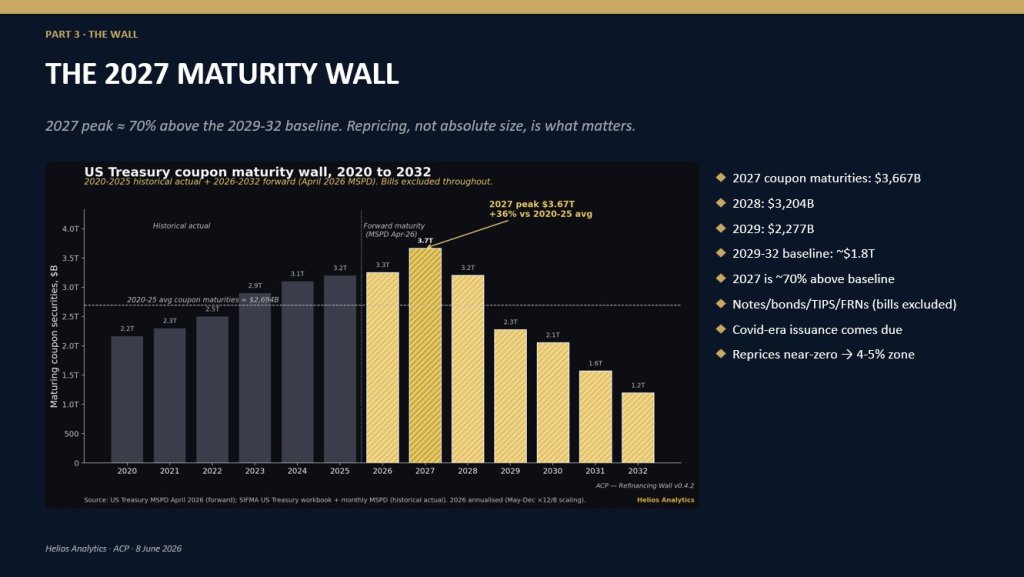
Source: X @Jamie1Coutts

For Bitcoin and other risk assets, the concern is whether current liquidity conditions can absorb that level of issuance without stress in the Treasury market. Coutts argued that liquidity remains a constraint, particularly as capital has continued to rotate away from crypto since late 2025.

“Retail and insto flows have been rotating out of Bitcoin and crypto since Q4 2025,” he said. “Every marginal unit of liquidity has flowed into AI buildout assets. That makes sense. Capital flows to where it’s treated best. Right now, the capital allocation argument sits with AI equities and commodities. On-chain activity is back at multi-year lows.”

That rotation matters because Bitcoin’s bull phases have historically depended not only on internal crypto positioning, but also on broader liquidity expansion and risk appetite. Coutts’ point is that Bitcoin may be entering a structurally attractive zone at the same time liquidity remains scarce and competing asset classes are absorbing the available capital.

He also pushed back against the market’s focus on IPO issuance, arguing that the larger issue is the government refinancing burden and the ability of the financial system to intermediate it. “While the market fixates on IPO issuance,” he wrote, “what concerns me about all risk assets is that markets ex-crypto don’t seem bothered by the fact that current liquidity levels can’t easily absorb this refi supply.”

The complication is the Fed’s balance sheet. Coutts noted that Kevin Warsh wants a smaller balance sheet, adding another potential constraint if policymakers try to roll a large maturity wall through a system with reduced central bank liquidity.

“Yes, they will continue to stuff the short end and monetise through the banks,” Coutts said, adding that stablecoins are likely to play an “increasingly important role.” But he warned that rolling $3.67 trillion of maturities through a contracting Fed balance sheet “without a bond market accident would be among the most impressive acts of fiscal/monetary policy management in a generation.”

The implication for Bitcoin is nuanced. Coutts is not dismissing the bottoming case. He is arguing that the market may still need a macro trigger before the next sustained advance can take hold. In his framework, Bitcoin is likely to sense a shift in Fed-side liquidity before other assets, but that shift may not arrive until stress appears in Treasuries.

“I don’t see how they do it without far more Fed-side liquidity,” he wrote. “Bitcoin will detect it first. But there’s still an uncomfortable distance to travel. Treasuries will need to start misbehaving before the policy needle moves. That’s the tricky part.”

At press time, BTC traded at $63,196.
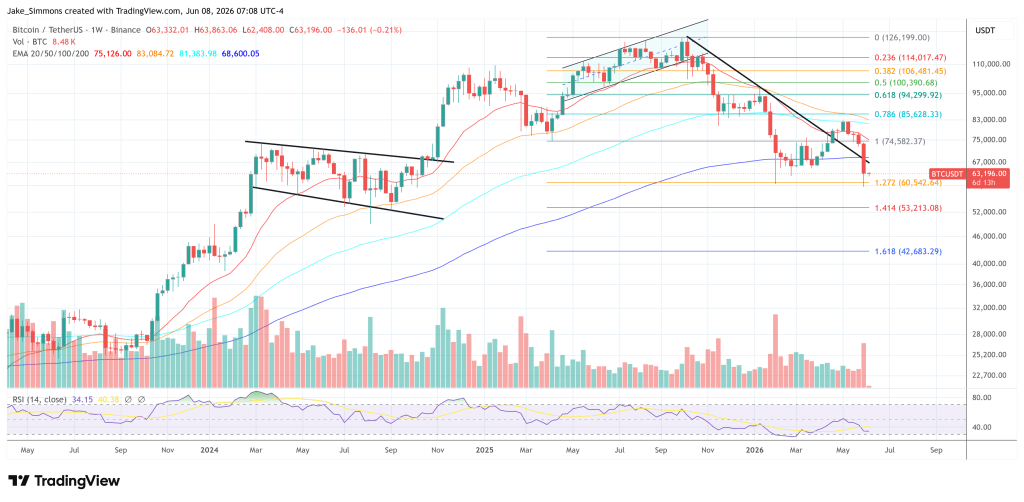
Bitcoin trades below the 200-week EMA, 1-week chart | Source: BTCUSDT on TradingView.com

Trending Cryptos

Related Questions

QAccording to Jamie Coutts, what is the key macroeconomic event that could prevent a sustained Bitcoin bull run?

AThe key macroeconomic event is the US Treasury's massive refinancing wall in 2027, involving $3.67 trillion in coupon maturities. The concern is whether current liquidity can absorb this issuance without stress in the Treasury market, potentially constraining capital flow to risk assets like Bitcoin.

QWhat does Jamie Coutts mean when he says Bitcoin is in a 'long-term accumulation zone'?

AHe means that Bitcoin's long-term technical setup is approaching very attractive levels, resembling structures that have historically preceded a cycle bottom. This suggests the asset is at a price level where long-term investors might consider accumulating positions.

QWhere has capital been rotating since Q4 2025, according to the article?

ACapital has been rotating away from Bitcoin and crypto and flowing into AI buildout assets (AI equities and commodities), as capital flows to where it is 'treated best' based on the current capital allocation argument.

QWhy does Jamie Coutts believe Bitcoin might sense a macro shift before other assets?

AHe believes Bitcoin is likely to detect a shift in Fed-side liquidity (potentially increased liquidity in response to Treasury market stress) before other assets, given its sensitivity to such monetary and liquidity conditions.

QWhat potential role does Coutts see for stablecoins in the context of the US debt refinancing challenge?

AHe suggests that stablecoins are likely to play an 'increasingly important role' as the financial system intermediates the large refinancing burden, potentially as part of the mechanisms to manage liquidity.

Related Reads

Kraken Sets Its Sights on Aave: Why is CeFi Starting to 'Buy the Dip' in Core DeFi Assets?

Recent market rumors suggest Kraken is planning a strategic investment in Aave, sparking widespread interest. Although Aave's co-founder clarified some inaccurate details in the reports, this event highlights a significant trend: centralized exchanges are accelerating their entry into the core areas of on-chain finance. Kraken's interest in Aave reflects its strategic expansion beyond simple trading into more profitable, higher-barrier financial services like DeFi asset management. Aave, a leading DeFi lending protocol, offers a mature lending model, deep liquidity, and a growing ecosystem, making it a key gateway to future on-chain finance. Despite a major security incident in April that caused significant withdrawals, Aave's core architecture, governance, and market trust remained intact. The protocol's strong fundamentals are underscored by its $134 million in annual revenue, suggesting its valuation may be undervalued. Aave is also designing a new tokenomics model (Aavenomics 3.0) featuring an automated token buyback mechanism to better capture value for token holders, signaling DeFi's evolution towards sustainable value models. Ultimately, this potential move signals accelerated convergence between CeFi and DeFi. Kraken's target is not just an asset but a strategic position in the future of on-chain financial infrastructure, while Aave aims to prove DeFi can evolve into a cash-flow-generating, global financial system.

marsbit4m ago

Kraken Sets Its Sights on Aave: Why is CeFi Starting to 'Buy the Dip' in Core DeFi Assets?

marsbit4m ago

Trading

Spot

Hot Articles

What is $BITCOIN

DIGITAL GOLD ($BITCOIN): A Comprehensive Analysis Introduction to DIGITAL GOLD ($BITCOIN) DIGITAL GOLD ($BITCOIN) is a blockchain-based project operating on the Solana network, which aims to combine the characteristics of traditional precious metals with the innovation of decentralized technologies. While it shares a name with Bitcoin, often referred to as “digital gold” due to its perception as a store of value, DIGITAL GOLD is a separate token designed to create a unique ecosystem within the Web3 landscape. Its goal is to position itself as a viable alternative digital asset, although specifics regarding its applications and functionalities are still developing. What is DIGITAL GOLD ($BITCOIN)? DIGITAL GOLD ($BITCOIN) is a cryptocurrency token explicitly designed for use on the Solana blockchain. In contrast to Bitcoin, which provides a widely recognized value storage role, this token appears to focus on broader applications and characteristics. Notable aspects include: Blockchain Infrastructure: The token is built on the Solana blockchain, known for its capacity to handle high-speed and low-cost transactions. Supply Dynamics: DIGITAL GOLD has a maximum supply capped at 100 quadrillion tokens (100P $BITCOIN), although details regarding its circulating supply are currently undisclosed. Utility: While precise functionalities are not explicitly outlined, there are indications that the token could be utilized for various applications, potentially involving decentralized applications (dApps) or asset tokenization strategies. Who is the Creator of DIGITAL GOLD ($BITCOIN)? At present, the identity of the creators and development team behind DIGITAL GOLD ($BITCOIN) remains unknown. This situation is typical among many innovative projects within the blockchain space, particularly those aligning with decentralized finance and meme coin phenomena. While such anonymity may foster a community-driven culture, it intensifies concerns about governance and accountability. Who are the Investors of DIGITAL GOLD ($BITCOIN)? The available information indicates that DIGITAL GOLD ($BITCOIN) does not have any known institutional backers or prominent venture capital investments. The project seems to operate on a peer-to-peer model focused on community support and adoption rather than traditional funding routes. Its activity and liquidity are primarily situated on decentralized exchanges (DEXs), such as PumpSwap, rather than established centralized trading platforms, further highlighting its grassroots approach. How DIGITAL GOLD ($BITCOIN) Works The operational mechanics of DIGITAL GOLD ($BITCOIN) can be elaborated on based on its blockchain design and network attributes: Consensus Mechanism: By leveraging Solana’s unique proof-of-history (PoH) combined with a proof-of-stake (PoS) model, the project ensures efficient transaction validation contributing to the network's high performance. Tokenomics: While specific deflationary mechanisms have not been extensively detailed, the vast maximum token supply implies that it may cater to microtransactions or niche use cases that are still to be defined. Interoperability: There exists the potential for integration with Solana’s broader ecosystem, including various decentralized finance (DeFi) platforms. However, the details regarding specific integrations remain unspecified. Timeline of Key Events Here is a timeline that highlights significant milestones concerning DIGITAL GOLD ($BITCOIN): 2023: The initial deployment of the token occurs on the Solana blockchain, marked by its contract address. 2024: DIGITAL GOLD gains visibility as it becomes available for trading on decentralized exchanges like PumpSwap, allowing users to trade it against SOL. 2025: The project witnesses sporadic trading activity and potential interest in community-led engagements, although no noteworthy partnerships or technical advancements have been documented as of yet. Critical Analysis Strengths Scalability: The underlying Solana infrastructure supports high transaction volumes, which could enhance the utility of $BITCOIN in various transaction scenarios. Accessibility: The potential low trading price per token could attract retail investors, facilitating wider participation due to fractional ownership opportunities. Risks Lack of Transparency: The absence of publicly known backers, developers, or an audit process may yield skepticism regarding the project's sustainability and trustworthiness. Market Volatility: The trading activity is heavily reliant on speculative behavior, which can result in significant price volatility and uncertainty for investors. Conclusion DIGITAL GOLD ($BITCOIN) emerges as an intriguing yet ambiguous project within the rapidly evolving Solana ecosystem. While it attempts to leverage the “digital gold” narrative, its departure from Bitcoin's established role as a store of value underscores the need for a clearer differentiation of its intended utility and governance structure. Future acceptance and adoption will likely depend on addressing the current opacity and defining its operational and economic strategies more explicitly. Note: This report encompasses synthesised information available as of October 2023, and developments may have transpired beyond the research period.

468 Total ViewsPublished 2025.05.13Updated 2025.05.13

What is $BITCOIN

Discussions

Welcome to the HTX Community. Here, you can stay informed about the latest platform developments and gain access to professional market insights. Users' opinions on the price of BTC (BTC) are presented below.

活动图片