Bitcoin Briefly Falls Below $71,000 as Market Confidence is Repriced

比推Published on 2026-02-05Last updated on 2026-02-05

Abstract

Bitcoin has fallen below the $71,000 mark, reaching its lowest level since November 2024, with a year-to-date decline of approximately 17%. The drop is part of a broader market sell-off, as global risk aversion intensified, pulling down the Nasdaq 100 by over 2% and pressuring rate-sensitive tech sectors. Unlike previous declines driven by crypto-specific liquidations, this downturn reflects wider cross-asset stress, challenging Bitcoin’s narrative as a safe-haven asset. Market sentiment has shifted toward "extreme fear," with analysts warning that losing the $72,000 support could lead to further declines toward $68,000 or even lower. Prediction markets now indicate an 83% probability that Bitcoin falls to $65,000 this year. The crypto market has lost over $460 billion in just one week, with total capitalization down $1.7 trillion from its peak. Despite a brief inflow into U.S. spot Bitcoin ETFs, fund flows have turned volatile, adding to uncertainty. The current environment suggests Bitcoin is increasingly perceived as a high-risk, volatile asset rather than a reliable store of value during market stress.

Bitcoin fell below the $72,000 mark (Note: Bitcoin has now fallen below $71,000), bringing the issue of 'faith' in the crypto market to the forefront. Against the backdrop of a sharp decline in global risk appetite, investors are reassessing Bitcoin's position during market turbulence, and the safe-haven narrative of crypto assets is being questioned.

According to Bloomberg, Bitcoin fell to $71,739 in late trading in New York on Wednesday, marking the first time it dropped below $72,000 in about 15 months. Compared to its peak in October of last year, Bitcoin has experienced a cumulative pullback of over 42%, with a year-to-date decline of about 17%, sliding to its lowest level since November 6, 2024.
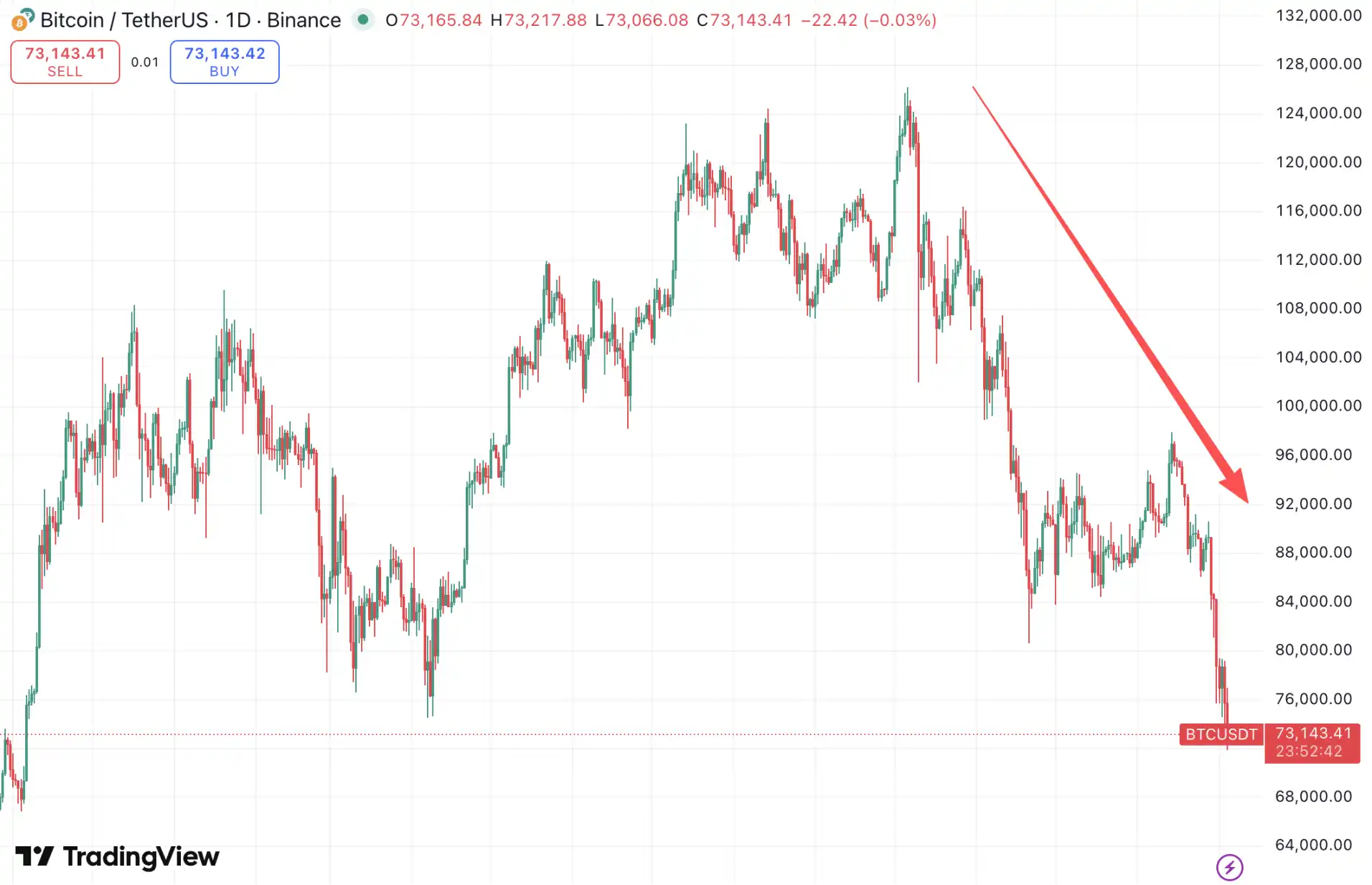
This round of decline is no longer just a continuation of internal deleveraging in the crypto market but is driven by broader cross-asset pressures. Global markets saw synchronized selling on Wednesday, with the Nasdaq 100 index falling over 2%. Sectors more sensitive to interest rates, such as software and chips, were generally under pressure, and Bitcoin weakened accordingly.

On the sentiment front, a 'crisis of faith' is forming. Shiliang Tang, Managing Partner of Monarq Asset Management, stated that the market is experiencing a 'crisis of faith.'

Andrew Tu, Head of Business Development at Efficient Frontier, added that crypto market sentiment is already in 'extreme fear.' If the $72,000 level is lost, Bitcoin could fall to $68,000 or even return to the low range seen before the initial rebound in early 2024.

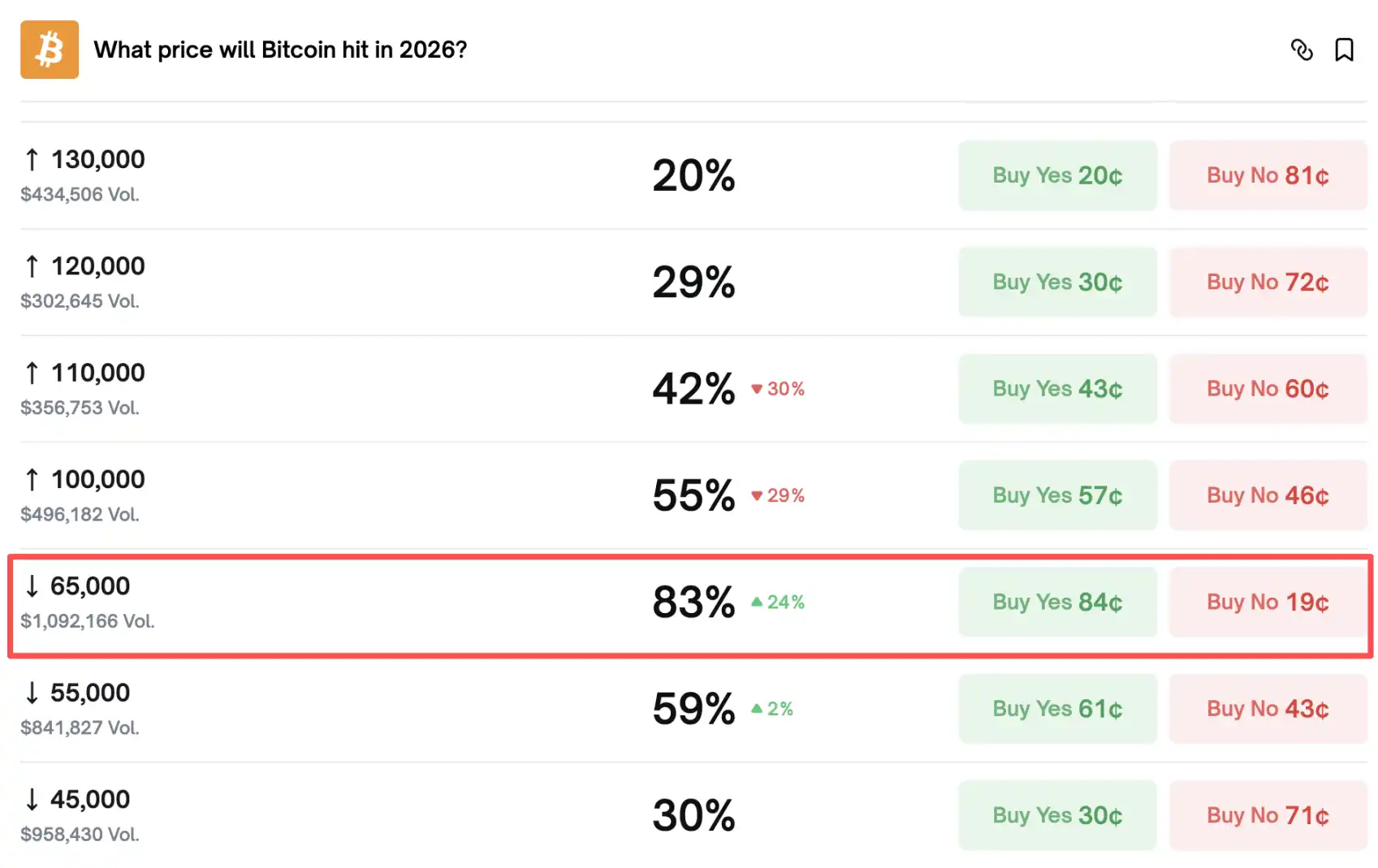
According to Polymarket, there is an 83% probability that Bitcoin will fall to $65,000 this year, while the probability of breaking below $55,000 has climbed to about 59%.
Risk appetite shifts sharply, Bitcoin treated as a 'high-volatility risk asset'

According to Bloomberg, the selling pressure on Bitcoin on Wednesday was related to broader cross-asset tensions rather than being solely driven by internal crypto asset liquidations. This point is clear to investors: during synchronized selling phases, Bitcoin has not demonstrated resilience independent of risk assets but instead behaves more like a high-volatility, long-tail risk asset.

The Nasdaq 100 index fell over 2% on the same day, with losses spreading to sectors such as software and chips. Bitcoin broke below key integer levels during the same trading session, reinforcing the market's perception of its correlation with risk appetite.

42% pullback from peak, crypto market loses over $460 billion in a week

The price pullback is quickly translating into market cap contraction. According to CoinGecko data, the total market capitalization of crypto assets has shrunk by approximately $1.7 trillion since the peak in October last year. In the past week alone, the crypto market cap decreased by over $460 billion.

As the largest cryptocurrency, the extent and speed of Bitcoin's decline have an 'anchoring effect' on market sentiment. When Bitcoin's year-to-date losses expand to about 17%, risk control, margin management, and redemption pressures often rise simultaneously, further exacerbating overall volatility.

How the 'crisis of faith' emerged: From liquidation shocks to emotional collapse

Statements from market participants indicate that sentiment changes are becoming a core variable. The 'crisis of faith' mentioned by Shiliang Tang refers to investors' simultaneous wavering in both the long-term narrative of crypto assets and their short-term pricing mechanisms.

More critically, the driver of the decline has changed. According to Bloomberg, previous decline phases were more driven by crypto-specific liquidations, while Wednesday's pressure came from broader cross-market tensions.

This means that even if internal leverage unwinding in the crypto market concludes, Bitcoin may still lack independent catalysts for a rebound as long as external risk assets remain under pressure.

$72,000 becomes short-term watershed, prediction markets bet on drop to $65,000 within the year

Several traders view the $72,000 level as a key short-term price point. Andrew Tu pointed out that if this level cannot be held, Bitcoin is 'very likely' to test $68,000 and may return to the low range seen before the initial rebound in early 2024.

According to Polymarket, there is an 83% probability that Bitcoin will fall to $65,000 this year, while the probability of breaking below $55,000 has climbed to about 59%.

The funding side is also sending mixed signals. According to data compiled by Bloomberg, U.S.-listed spot Bitcoin ETFs recorded approximately $562 million in net inflows on Monday but turned to net outflows of $272 million on Tuesday, indicating that incremental capital is not stable.

Amid the price decline and反复的资金流 (repeated fund flow fluctuations), market skepticism about Bitcoin's role as a 'safe-haven asset during periods of pressure' is rising.


Twitter:https://twitter.com/BitpushNewsCN

Bitpush TG Discussion Group:https://t.me/BitPushCommunity

Bitpush TG Subscription: https://t.me/bitpush

Original link:https://www.bitpush.news/articles/7608941

Related Questions

QWhat key price level did Bitcoin fall below, according to the article?

ABitcoin fell below the $72,000 level, and later dropped below $71,000.

QWhat is the main reason cited for the recent sell-off in Bitcoin, distinguishing it from previous declines?

AThe recent sell-off was driven by broader cross-asset pressure and a global decline in risk appetite, rather than being solely driven by internal crypto market liquidations.

QAccording to market participants, what is the significant psychological term used to describe the current market sentiment?

AMarket participants describe the current sentiment as a 'crisis of faith' or being in a state of 'extreme fear'.

QWhat is the probability, according to Polymarket, that Bitcoin will drop to $65,000 this year?

AAccording to Polymarket, there is an 83% probability that Bitcoin will drop to $65,000 this year.

QWhat does the recent flow data for US-listed spot Bitcoin ETFs indicate about investor behavior?

AThe flow data indicates unstable investor behavior, with the ETFs seeing a net inflow of approximately $562 million on Monday, followed by a net outflow of $272 million on Tuesday.

Related Reads

Jensen Huang's CMU Speech: In the AI Era, Don't Just Watch, Build

Jensen Huang, CEO of NVIDIA and a first-generation immigrant, delivered the commencement address to Carnegie Mellon University's class of 2026. He shared his personal journey from a humble background to founding NVIDIA, emphasizing resilience, learning from failure, and the responsibility that comes with leadership. Huang framed the present moment as the dawn of the AI revolution, a shift he believes is more profound than previous computing waves. He described AI as fundamentally resetting computing—moving from human-written software to machines that understand, reason, and use tools. This will create a new industry for generating intelligence and transform every sector. While acknowledging AI's potential to automate tasks and displace some jobs, Huang distinguished between the *tasks* of a job and its core *purpose*. He argued AI will augment human capability, not replace humans. The real risk, he stated, is not AI itself, but people being left behind by those who effectively use AI. He presented AI as a generational opportunity for massive infrastructure investment—in chip factories, data centers, energy grids, and advanced manufacturing—that could re-industrialize nations like the U.S. and bridge the digital divide by making computing and intelligent tools accessible to all. Huang called for a balanced approach: advancing AI safely and responsibly, establishing prudent policies, ensuring broad access, and encouraging universal participation. He urged the graduates not to fear the future but to engage with optimism and ambition, reminding them of CMU's motto, "My heart is in the work." His core message was clear: this is their moment to actively build and shape the AI-powered future, not merely observe it.

marsbit22m ago

Jensen Huang's CMU Speech: In the AI Era, Don't Just Watch, Build

marsbit22m ago

The Era Has Arrived Where Human Writers Must Prove They Are Not Machines

The article describes an era where AI-generated content is flooding the market, forcing human authors to prove they are not machines. It begins with the example of dozens of AI-written, error-ridden biographies of Henry Kissinger appearing on Amazon within hours of his death, a pattern repeated for other deceased celebrities and even living experts who find fraudulent books under their names. This spam content has exploded, with monthly new book releases on platforms like Amazon reaching 300,000 by late 2025. The issue spans genres, from suspiciously high proportions of AI-written teen romance and self-help books to dangerous, AI-generated foraging guides containing lethal advice. The platforms' automated review systems, designed to catch plagiarism and banned words, are ill-equipped to detect AI-generated text that avoids these pitfalls while being nonsensical or fraudulent. The problem has infiltrated traditional publishing. A major publisher, Hachette, had to recall a bestselling horror novel after AI detection tools suggested 78% of its content was machine-generated. An acclaimed European philosophy book was later revealed to be entirely written by AI under a fake author persona. In response, authors are fighting back. At the 2026 London Book Fair, 10,000 writers published a blank book titled "Don't Steal This Book" containing only their signatures—using emptiness as a protest weapon in an age of AI overproduction. Initiatives like the "Human Author Certification" program have emerged, ironically placing the burden on humans to prove their work is not machine-made. The article warns of a vicious cycle: AI-generated low-quality books pollute the data used to train future AI models, leading to "model collapse" and an ever-worsening flood of digital waste, eroding trust in publishing and devaluing human creativity.

marsbit48m ago

The Era Has Arrived Where Human Writers Must Prove They Are Not Machines

marsbit48m ago

Trading

Spot
Futures

Hot Articles

What is $BITCOIN

DIGITAL GOLD ($BITCOIN): A Comprehensive Analysis Introduction to DIGITAL GOLD ($BITCOIN) DIGITAL GOLD ($BITCOIN) is a blockchain-based project operating on the Solana network, which aims to combine the characteristics of traditional precious metals with the innovation of decentralized technologies. While it shares a name with Bitcoin, often referred to as “digital gold” due to its perception as a store of value, DIGITAL GOLD is a separate token designed to create a unique ecosystem within the Web3 landscape. Its goal is to position itself as a viable alternative digital asset, although specifics regarding its applications and functionalities are still developing. What is DIGITAL GOLD ($BITCOIN)? DIGITAL GOLD ($BITCOIN) is a cryptocurrency token explicitly designed for use on the Solana blockchain. In contrast to Bitcoin, which provides a widely recognized value storage role, this token appears to focus on broader applications and characteristics. Notable aspects include: Blockchain Infrastructure: The token is built on the Solana blockchain, known for its capacity to handle high-speed and low-cost transactions. Supply Dynamics: DIGITAL GOLD has a maximum supply capped at 100 quadrillion tokens (100P $BITCOIN), although details regarding its circulating supply are currently undisclosed. Utility: While precise functionalities are not explicitly outlined, there are indications that the token could be utilized for various applications, potentially involving decentralized applications (dApps) or asset tokenization strategies. Who is the Creator of DIGITAL GOLD ($BITCOIN)? At present, the identity of the creators and development team behind DIGITAL GOLD ($BITCOIN) remains unknown. This situation is typical among many innovative projects within the blockchain space, particularly those aligning with decentralized finance and meme coin phenomena. While such anonymity may foster a community-driven culture, it intensifies concerns about governance and accountability. Who are the Investors of DIGITAL GOLD ($BITCOIN)? The available information indicates that DIGITAL GOLD ($BITCOIN) does not have any known institutional backers or prominent venture capital investments. The project seems to operate on a peer-to-peer model focused on community support and adoption rather than traditional funding routes. Its activity and liquidity are primarily situated on decentralized exchanges (DEXs), such as PumpSwap, rather than established centralized trading platforms, further highlighting its grassroots approach. How DIGITAL GOLD ($BITCOIN) Works The operational mechanics of DIGITAL GOLD ($BITCOIN) can be elaborated on based on its blockchain design and network attributes: Consensus Mechanism: By leveraging Solana’s unique proof-of-history (PoH) combined with a proof-of-stake (PoS) model, the project ensures efficient transaction validation contributing to the network's high performance. Tokenomics: While specific deflationary mechanisms have not been extensively detailed, the vast maximum token supply implies that it may cater to microtransactions or niche use cases that are still to be defined. Interoperability: There exists the potential for integration with Solana’s broader ecosystem, including various decentralized finance (DeFi) platforms. However, the details regarding specific integrations remain unspecified. Timeline of Key Events Here is a timeline that highlights significant milestones concerning DIGITAL GOLD ($BITCOIN): 2023: The initial deployment of the token occurs on the Solana blockchain, marked by its contract address. 2024: DIGITAL GOLD gains visibility as it becomes available for trading on decentralized exchanges like PumpSwap, allowing users to trade it against SOL. 2025: The project witnesses sporadic trading activity and potential interest in community-led engagements, although no noteworthy partnerships or technical advancements have been documented as of yet. Critical Analysis Strengths Scalability: The underlying Solana infrastructure supports high transaction volumes, which could enhance the utility of $BITCOIN in various transaction scenarios. Accessibility: The potential low trading price per token could attract retail investors, facilitating wider participation due to fractional ownership opportunities. Risks Lack of Transparency: The absence of publicly known backers, developers, or an audit process may yield skepticism regarding the project's sustainability and trustworthiness. Market Volatility: The trading activity is heavily reliant on speculative behavior, which can result in significant price volatility and uncertainty for investors. Conclusion DIGITAL GOLD ($BITCOIN) emerges as an intriguing yet ambiguous project within the rapidly evolving Solana ecosystem. While it attempts to leverage the “digital gold” narrative, its departure from Bitcoin's established role as a store of value underscores the need for a clearer differentiation of its intended utility and governance structure. Future acceptance and adoption will likely depend on addressing the current opacity and defining its operational and economic strategies more explicitly. Note: This report encompasses synthesised information available as of October 2023, and developments may have transpired beyond the research period.

363 Total ViewsPublished 2025.05.13Updated 2025.05.13

What is $BITCOIN

Discussions

Welcome to the HTX Community. Here, you can stay informed about the latest platform developments and gain access to professional market insights. Users' opinions on the price of BTC (BTC) are presented below.

活动图片











