Bhutan deepens green Bitcoin strategy with Cumberland-backed infrastructure

cointelegraphPublished on 2025-12-15Last updated on 2025-12-15

Abstract

Bhutan has signed a multi-year memorandum of understanding (MoU) with crypto market maker Cumberland DRW to develop digital asset infrastructure in the Gelephu Mindfulness City (GMC). The partnership aims to support Bhutan’s vision of a sustainable digital economy aligned with its environmental and governance values. Cumberland will assist in Bitcoin reserve management, establish a presence in GMC, and help develop local talent. The collaboration will explore building a national crypto ecosystem, including sustainable mining, AI compute, yield generation, and stablecoin infrastructure. Bhutan, an early sovereign Bitcoin miner using hydropower, continues to integrate digital assets into its economic strategy, emphasizing long-term development over speculation.

Bhutan signed a multi-year memorandum of understanding (MoU) with crypto market maker Cumberland DRW to collaborate on building digital asset infrastructure in the Gelephu Mindfulness City (GMC), deepening the country’s long-term, sustainability-focused crypto strategy.

In an announcement sent to Cointelegraph, the special administrative region said the partnership aims to support Bhutan’s vision of developing a modern digital economy aligned with its environmental and governance values.

Jigdrel Singay, board director of Gelephu Mindfulness City, said the collaboration includes Cumberland supporting their Bitcoin (BTC) reserve management, establishing a presence in the GMC and hiring local talent. The market maker would also deploy subject-matter experts to develop the local workforce.

The GMC is a special administrative region in Bhutan designed to attract global talent while integrating technology, sustainability and mindful development.
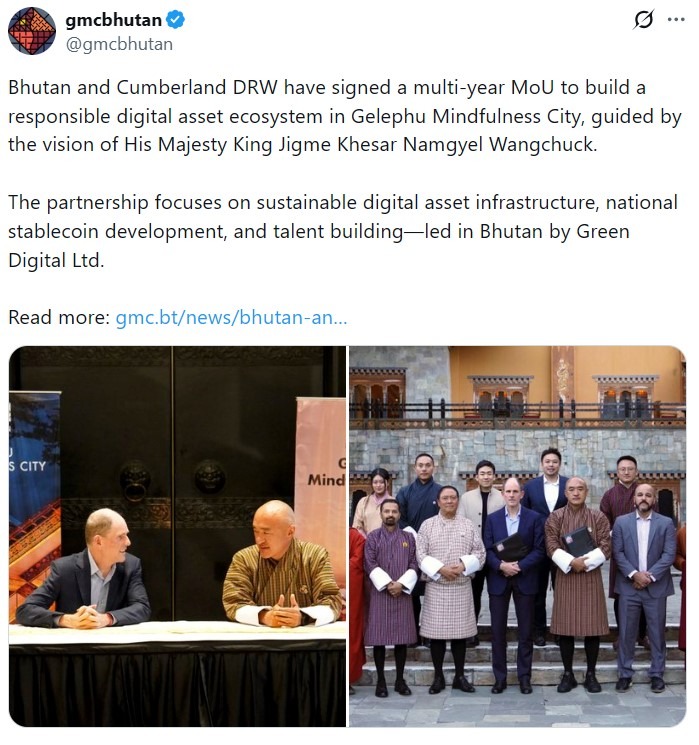
Source: GMCBhutan

Exploring the development of a national digital asset ecosystem

Cumberland, the digital asset arm of Chicago-based trading firm DRW, is one of the biggest institutional liquidity providers in crypto markets. The company has been active in the space since 2014 and services global institutions across spot and derivatives markets.

Under the MoU, Cumberland and Bhutan aim to explore the development of a national crypto ecosystem, which includes modern financial frameworks, sustainable mining and artificial intelligence compute, yield generation and stablecoin infrastructure.

The initiative is being led by Green Digital, a GMC-linked digital infrastructure company developing renewable-energy-powered computing facilities. The company is tasked with aligning digital asset development with Bhutan’s broader sustainability and economic diversification goals.

Bhutan operates with a Gross National Happiness (GNH) model, which emphasizes collective happiness over economic growth. The concept is central to Bhutan’s national identity.

“Bhutan’s clarity of vision and emphasis on sustainable development make it a natural partner for responsible and forward-looking innovation,” said DRW founder Donald R. Wilson. “We are honored to support Bhutan as it builds the foundations of a modern digital economy.”

The agreement remains an MoU, which means that it outlines areas of cooperation rather than binding commitments. It doesn’t guarantee that specific infrastructure will be deployed.

Related: How Bhutan plans to boost its local economy with crypto tourism

Bhutan dives deeper into the digital asset ecosystem

Bhutan is one of the world’s earliest sovereign Bitcoin miners, using surplus hydropower to accumulate a national Bitcoin reserve through renewable energy.

Bhutan has also integrated digital assets into the GMC’s strategic reserves, enabled crypto-based payments across tourism and merchant services and launched TER, a sovereign-backed digital token linked to physical gold.

Taken together, Bhutan’s initiatives position the country as a rare example of a state treating Bitcoin, stablecoins and blockchain infrastructure as long-term economic tools rather than speculative experiments.

Magazine: Bitcoin whale Metaplanet ‘underwater’ but eyeing more BTC: Asia Express

Trending Cryptos

Related Reads

Bitcoin Withdrawals Continue: 8 Years of Storage in a Coldcard Cold Wallet Ended in Zero

Coldcard Hardware Wallet Hacked: Losses Mount Due to Vulnerable Seed Generation A critical vulnerability in Coldcard hardware wallets has led to a continued wave of fund thefts. According to Galaxy Research, the total stolen has reached 1,367.05 BTC (approx. $88.6 million) from 4,585 addresses, a significant increase from the initial 594.5 BTC reported on July 30, 2026. Most of the stolen funds remain on the attackers' addresses. The issue is not with the current firmware, which Coinkite has updated, but with seed phrases generated on vulnerable devices between March 2021 and the release of fixed firmware versions. Due to a programmer error, devices switched from using a hardware random number generator to the software-based Yasmarang generator, which was initialized with publicly accessible data like the chip's serial number. This made the seed phrases predictable through offline brute-force attacks, meaning wallets remain at risk until funds are moved to a new wallet generated with the patched firmware. Affected devices include Mk2/Mk3 with firmware 4.0.1–4.1.9 (and up to 5.0.3), Mk4/Mk5 up to version 5.6.0, and Q models up to 1.5.0Q. The only exceptions are seeds created with a high-entropy method like at least 50 independent dice rolls or a strong unique BIP-39 passphrase. All other owners must generate a new seed on the fixed firmware and transfer their assets. A case highlighting the human impact involves a 39-year-old long-term investor who lost 2 BTC (approx. $130,000) in minutes. He had accumulated the Bitcoin over eight years through physical labor, viewing it as a financial lifeline and a retirement plan in a country suffering from hyperinflation. His story underscores that even conservative "buy and hold in cold storage" strategies can be compromised by such underlying technical flaws. From a technical perspective, this incident echoes historical failures where weak random number generators undermined cryptographic security, challenging the assumption that offline storage is automatically foolproof.

cryptonews.ru1h ago

Bitcoin Withdrawals Continue: 8 Years of Storage in a Coldcard Cold Wallet Ended in Zero

cryptonews.ru1h ago

Trading

Spot

Hot Articles

What is $BITCOIN

DIGITAL GOLD ($BITCOIN): A Comprehensive Analysis Introduction to DIGITAL GOLD ($BITCOIN) DIGITAL GOLD ($BITCOIN) is a blockchain-based project operating on the Solana network, which aims to combine the characteristics of traditional precious metals with the innovation of decentralized technologies. While it shares a name with Bitcoin, often referred to as “digital gold” due to its perception as a store of value, DIGITAL GOLD is a separate token designed to create a unique ecosystem within the Web3 landscape. Its goal is to position itself as a viable alternative digital asset, although specifics regarding its applications and functionalities are still developing. What is DIGITAL GOLD ($BITCOIN)? DIGITAL GOLD ($BITCOIN) is a cryptocurrency token explicitly designed for use on the Solana blockchain. In contrast to Bitcoin, which provides a widely recognized value storage role, this token appears to focus on broader applications and characteristics. Notable aspects include: Blockchain Infrastructure: The token is built on the Solana blockchain, known for its capacity to handle high-speed and low-cost transactions. Supply Dynamics: DIGITAL GOLD has a maximum supply capped at 100 quadrillion tokens (100P $BITCOIN), although details regarding its circulating supply are currently undisclosed. Utility: While precise functionalities are not explicitly outlined, there are indications that the token could be utilized for various applications, potentially involving decentralized applications (dApps) or asset tokenization strategies. Who is the Creator of DIGITAL GOLD ($BITCOIN)? At present, the identity of the creators and development team behind DIGITAL GOLD ($BITCOIN) remains unknown. This situation is typical among many innovative projects within the blockchain space, particularly those aligning with decentralized finance and meme coin phenomena. While such anonymity may foster a community-driven culture, it intensifies concerns about governance and accountability. Who are the Investors of DIGITAL GOLD ($BITCOIN)? The available information indicates that DIGITAL GOLD ($BITCOIN) does not have any known institutional backers or prominent venture capital investments. The project seems to operate on a peer-to-peer model focused on community support and adoption rather than traditional funding routes. Its activity and liquidity are primarily situated on decentralized exchanges (DEXs), such as PumpSwap, rather than established centralized trading platforms, further highlighting its grassroots approach. How DIGITAL GOLD ($BITCOIN) Works The operational mechanics of DIGITAL GOLD ($BITCOIN) can be elaborated on based on its blockchain design and network attributes: Consensus Mechanism: By leveraging Solana’s unique proof-of-history (PoH) combined with a proof-of-stake (PoS) model, the project ensures efficient transaction validation contributing to the network's high performance. Tokenomics: While specific deflationary mechanisms have not been extensively detailed, the vast maximum token supply implies that it may cater to microtransactions or niche use cases that are still to be defined. Interoperability: There exists the potential for integration with Solana’s broader ecosystem, including various decentralized finance (DeFi) platforms. However, the details regarding specific integrations remain unspecified. Timeline of Key Events Here is a timeline that highlights significant milestones concerning DIGITAL GOLD ($BITCOIN): 2023: The initial deployment of the token occurs on the Solana blockchain, marked by its contract address. 2024: DIGITAL GOLD gains visibility as it becomes available for trading on decentralized exchanges like PumpSwap, allowing users to trade it against SOL. 2025: The project witnesses sporadic trading activity and potential interest in community-led engagements, although no noteworthy partnerships or technical advancements have been documented as of yet. Critical Analysis Strengths Scalability: The underlying Solana infrastructure supports high transaction volumes, which could enhance the utility of $BITCOIN in various transaction scenarios. Accessibility: The potential low trading price per token could attract retail investors, facilitating wider participation due to fractional ownership opportunities. Risks Lack of Transparency: The absence of publicly known backers, developers, or an audit process may yield skepticism regarding the project's sustainability and trustworthiness. Market Volatility: The trading activity is heavily reliant on speculative behavior, which can result in significant price volatility and uncertainty for investors. Conclusion DIGITAL GOLD ($BITCOIN) emerges as an intriguing yet ambiguous project within the rapidly evolving Solana ecosystem. While it attempts to leverage the “digital gold” narrative, its departure from Bitcoin's established role as a store of value underscores the need for a clearer differentiation of its intended utility and governance structure. Future acceptance and adoption will likely depend on addressing the current opacity and defining its operational and economic strategies more explicitly. Note: This report encompasses synthesised information available as of October 2023, and developments may have transpired beyond the research period.

1.4k Total ViewsPublished 2025.05.13Updated 2025.05.13

What is $BITCOIN

Discussions

Welcome to the HTX Community. Here, you can stay informed about the latest platform developments and gain access to professional market insights. Users' opinions on the price of BTC (BTC) are presented below.

活动图片















