Beosin: 36 Major Security Incidents in May Resulting in Over $76 Million in Losses

marsbitPublished on 2026-06-10Last updated on 2026-06-10

Abstract

In May 2026, the Web3 ecosystem suffered over $76.15 million in losses across 36 major security incidents, according to Beosin Alert. The primary causes were contract vulnerabilities and private key leaks. The top loss involved the Verus-Ethereum Bridge, which lost $11.58 million due to a cross-chain message validation flaw—a vulnerability type historically responsible for massive losses at Wormhole and Nomad. The Echo Protocol attack, resulting from a private key leak, saw the minting of 1,000 eBTC (nominal value ~$76.7M), with the attacker netting ~$5.13 million due to liquidity constraints. Cross-chain bridges were the hardest-hit category, accounting for $27.995 million in losses. DeFi protocols were the most frequently targeted, with 14 attacks. Ethereum saw the highest chain-specific losses at over $48.76 million, followed by BNB Chain, Monad, and TON, indicating a multi-chain attack landscape. A detailed analysis highlighted three key incidents: 1. **Verus-Ethereum Bridge**: A flaw where the bridge contract verified proof from the Verus chain but failed to validate the underlying asset value, allowing fake outputs. 2. **Trusted Volumes**: A signature parameter defect in its RFQ system allowed an attacker to manipulate authorization checks and drain assets from the Resolver contract. 3. **Private Key Leaks (e.g., StablR)**: Operational failures, including inadequate multi-signature wallet thresholds and lack of timelocks, led to losses exceeding $25 million across...

Author: Beosin

According to monitoring data from the Beosin Alert platform, in May 2026, the total losses from various security incidents amounted to approximately $76.15 million. A total of "36" major hacking incidents occurred, primarily due to contract vulnerabilities and private key leaks. Among these, 17 security incidents were caused by contract/network vulnerabilities, and 10 involved losses due to private key leaks. The code security and operational security of the DeFi ecosystem face severe challenges.

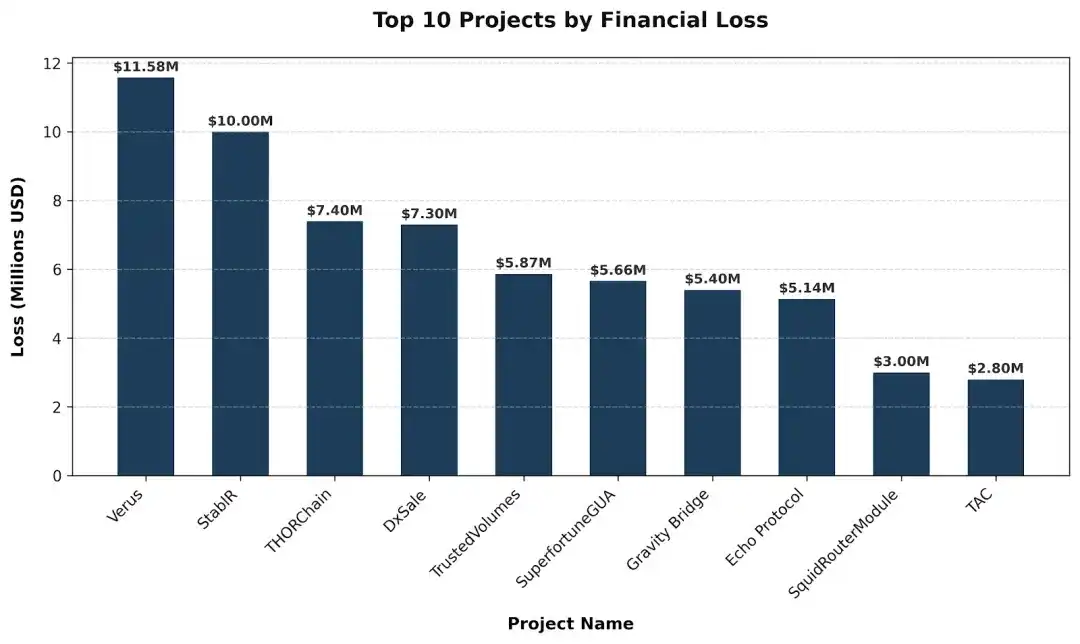
Top 10 Loss-making Protocols in May

The cross-chain bridge connecting the Verus L1 chain and Ethereum, the Verus-Ethereum Bridge, suffered the largest loss of $11.58 million due to a contract vulnerability. Echo Protocol was attacked due to a private key leak, allowing the attacker to mint 1000 eBTC (with a nominal value of approximately $76.7 million). However, due to liquidity constraints, the actual profit was about $5.13 million.
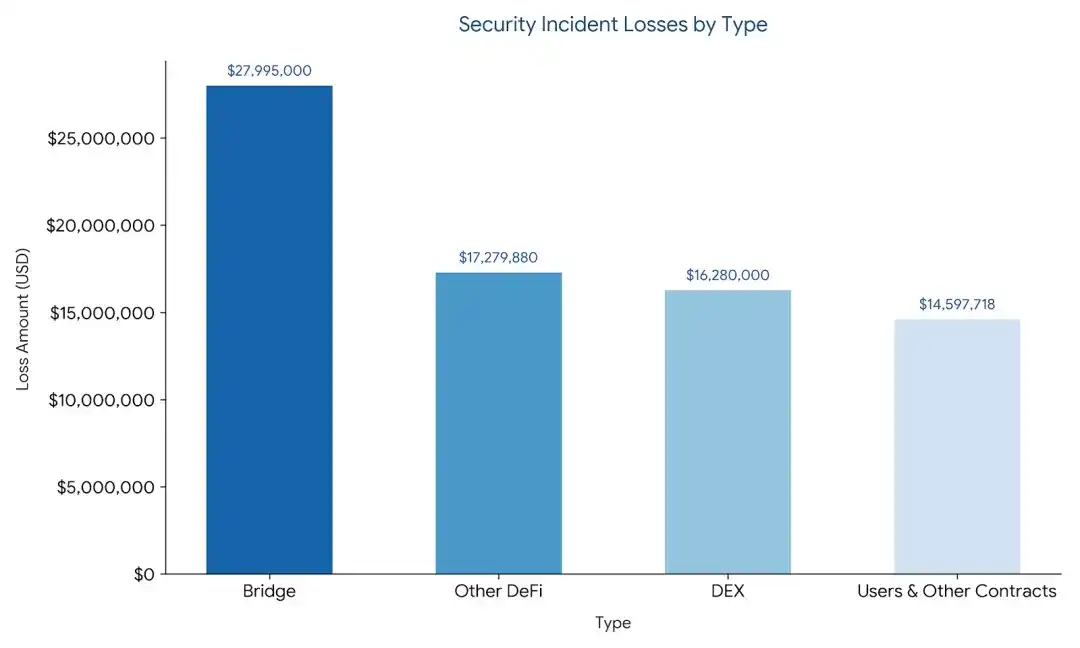
Types of Attacked Projects and Losses by Chain

The targets of attacks encompassed various types such as cross-chain bridges, decentralized exchanges, lending protocols, prediction markets, stablecoins, and ordinary users. Among these, cross-chain bridges suffered the highest total losses, reaching $27.995 million. Projects related to DeFi were attacked the most frequently, with a total of 14 incidents.
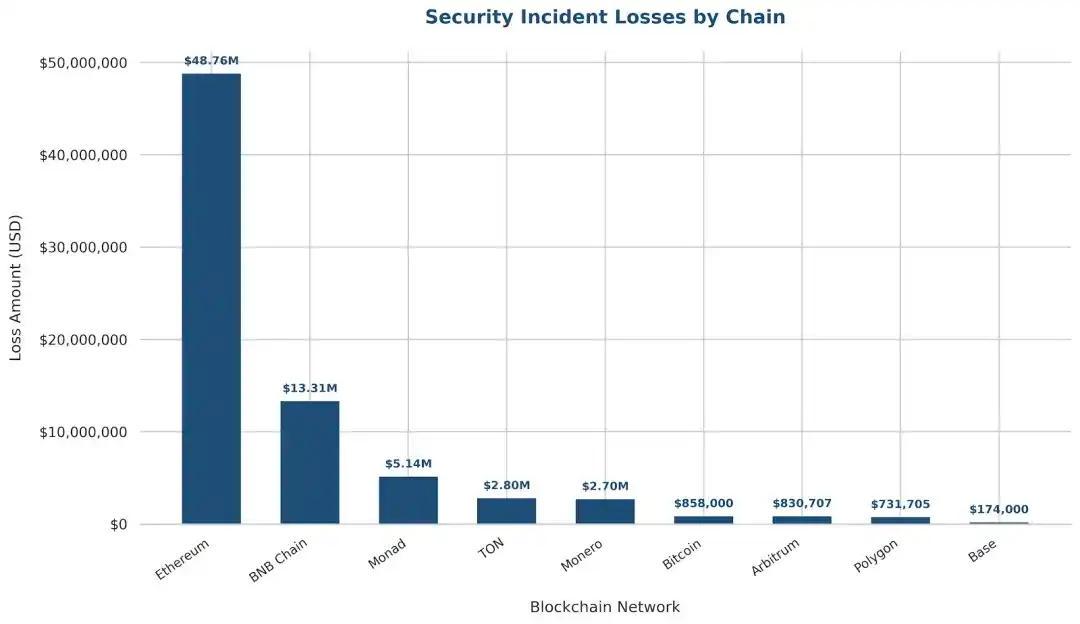
In May, the chain with the highest loss amount was Ethereum, with losses exceeding $48.76 million. Security incidents involving some cross-chain bridges and most DeFi protocols still primarily occurred on Ethereum. This was followed by BNB Chain, Monad, and TON. Additionally, security incidents occurred on Monero and Bitcoin, indicating a multi-chain trend in on-chain attacks.
Analysis of Major Security Incidents

1. Verus: Cross-chain Message Verification Flaw

The operation of the Verus-Ethereum Bridge involves a submitter providing proof data to indicate that a notary-confirmed eligible output exists on the Verus chain. The bridge contract verifies this and releases assets on Ethereum. The vulnerability lies in the fact that the bridge contract on the Ethereum side verifies the proof from the Verus chain but does not check whether the data corresponds to a valid original output. This allows an attacker to construct a fraudulent output that passes verification, enabling them to extract funds far exceeding their deposit.

The vulnerable code section:
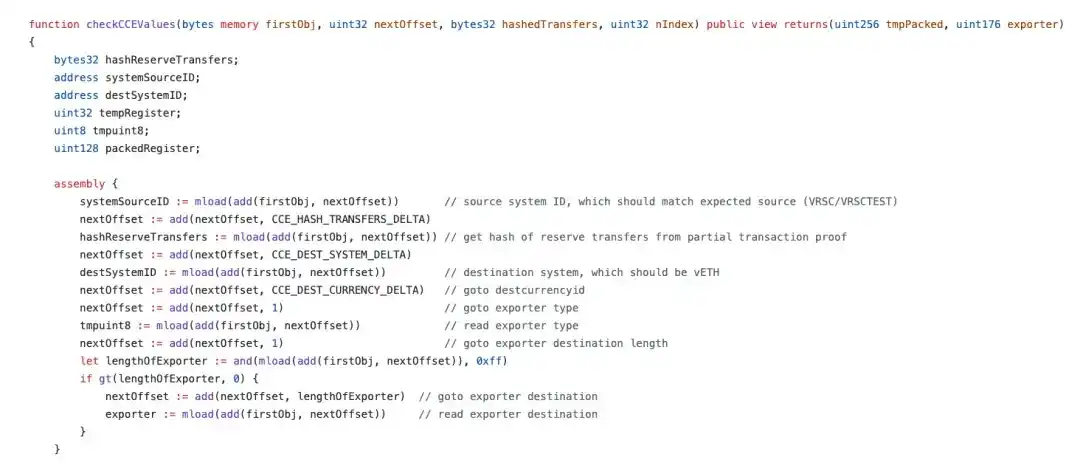
The vulnerability in this incident is of the same type as those that caused the $320 million loss for Wormhole and the $190 million loss for Nomad in 2022, where the bridge verifies the message itself but not the underlying asset value.

2. Trusted Volumes: Signature Parameter Flaw

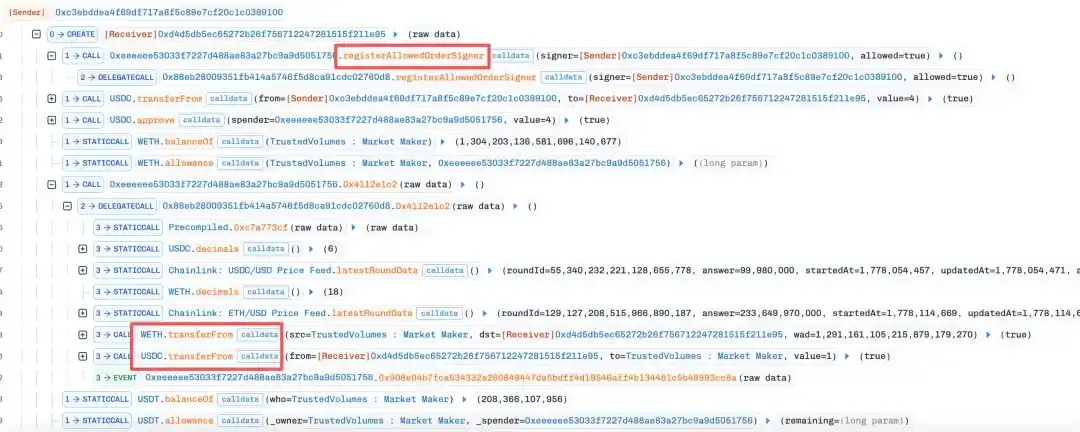
In this attack, the perpetrator exploited a design flaw in the signature process of TrustedVolumes' Request for Quote (RFQ) mechanism. By customizing signature data during the actual transfer, they set the transferor as TrustedVolumes' Resolver contract, which successfully passed verification, allowing them to transfer assets out of the Resolver contract for profit.

The vulnerable code section:
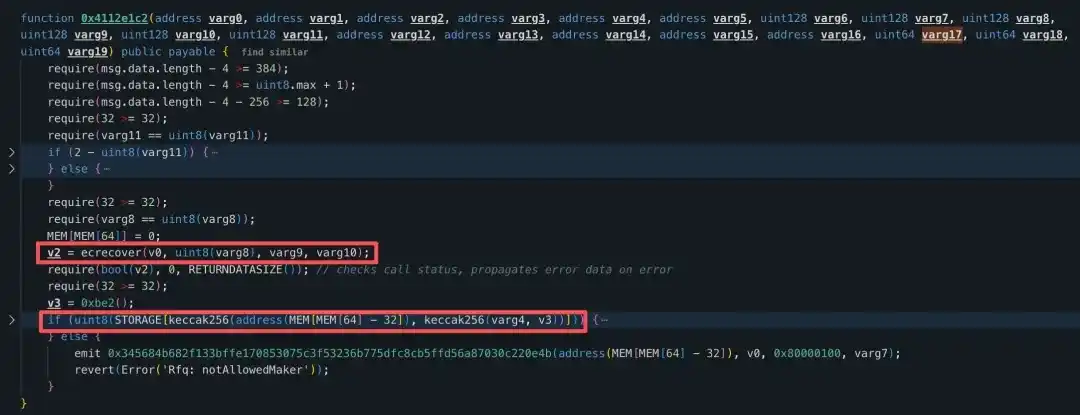
The authorization check referenced `varg4`, while the execution of the fund transfer referenced other parameters. The lack of validation led to a mismatch between the authorized signer domain and the actual debit address.

Therefore, the attacker only needed to sign an order with a registered signer address, where `maker = Exploit` (passing signature verification), and other signature parameters (token, amount) could be set to arbitrary values, such as a fake 1:1 order, allowing it to pass the reasonable price check of the price oracle, and subsequently drain assets from the protocol contract:
3. Private Key Leak Incidents, exemplified by StablR

Multiple private key leak incidents occurred in May, resulting in total losses exceeding $25 million. Among them, StablR, as a compliant stablecoin issuer, became a typical lesson in security governance for the stablecoin and DeFi sectors.

StablR launched two compliant stablecoin products: EURR and USDR. The multi-signature wallet controlling EURR minting was `0x8278D2881dBF8F6Fc01c98d196c4b16F1aade5Bc`; the multi-signature wallet controlling USDR minting was `0xF45392bd2D6e6b8C5Dc26BA6c8a12889419B82F3`.

Since transactions from these two multi-signature wallets required only 1 signature, the attacker, by controlling the owner address `0xC73fD562de86d7860EE636C20813Bcb2cF4D550d`, added the address `0xD4677B5A8B1b97EA213Fdb876b0FcBAB3f9F6CD1` to the aforementioned two multi-signature wallets, thereby gaining control over the project's minting authority:
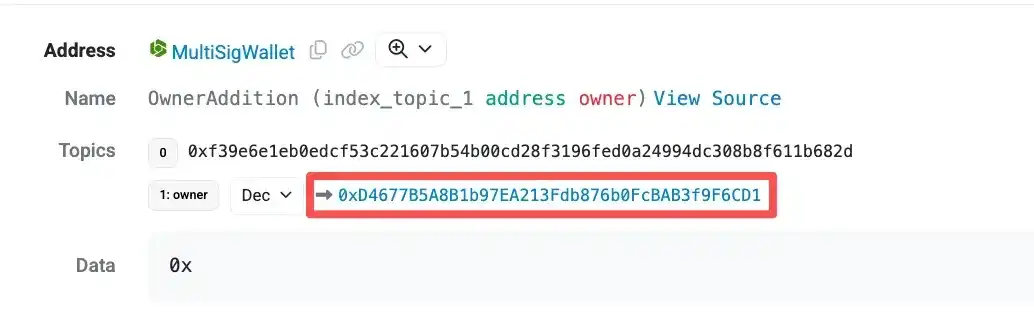
Such incidents are not about code vulnerabilities but rather operational security issues for the project team: failure to securely store private keys for privileged addresses, not using high-threshold multi-signatures for high-value/high-risk operations, lacking timelocks for large minting operations, and the absence of rapid emergency response mechanisms.

Web3 Security Threat Trends

The deepest trend in Web3 security in 2026 is the systemic expansion of the attack surface. Vulnerabilities are emerging simultaneously in code, infrastructure, interoperability, and human processes. Relying solely on a few security audits or tools cannot cover areas like operational security, employee endpoints, cloud infrastructure, and software supply chains. This imposes higher requirements on the continuous operational security of Web3 projects.

Furthermore, attacks targeting old/abandoned contracts are frequent, as vulnerabilities or authorizations within them are easily exploited. Contract developers or operators should re-examine the security of past contracts. For abandoned contracts, funds remaining in them should be processed or transferred promptly, and users should be contacted to revoke unnecessary authorizations. Users should also regularly use blockchain explorers or authorization revocation tools to check and cancel unused contract authorizations.


Trending Cryptos

Related Questions

QAccording to Beosin's report, what were the main causes of the significant hacking incidents in May 2026, and what were the respective counts?

AThe main causes were smart contract/network vulnerabilities and private key leaks. There were 17 incidents due to contract/network vulnerabilities and 10 incidents due to private key leaks.

QWhich protocol suffered the largest financial loss in May 2026, as reported by Beosin, and what was the primary cause?

AThe Verus-Ethereum Bridge suffered the largest loss, approximately $11.58 million. The primary cause was a smart contract vulnerability related to a cross-chain message verification defect.

QWhat type of project was attacked the most frequently in May 2026, and which category incurred the highest total loss amount?

ADeFi-related projects were attacked the most frequently, with 14 incidents. Cross-chain bridges incurred the highest total loss amount, at approximately $27.995 million.

QUsing the example of StablR, what operational security failures led to its private key leak incident?

AThe operational security failures for StablR included: not properly securing private keys for privileged addresses, not using a high-threshold multi-signature setup for high-value/high-risk operations (the multi-sig wallets only required 1 signature), lacking a timelock for large minting operations, and having no rapid emergency response mechanism.

QWhat is described as the deepest trend in Web3 security threats for 2026 according to the article's conclusion?

AThe deepest trend is the systemic expansion of the attack surface. Vulnerabilities are now emerging simultaneously in code, infrastructure, interoperability, and human processes, meaning that relying solely on a few security audits or tools is insufficient to cover operational security, employee endpoints, cloud infrastructure, and software supply chains.

Related Reads

STAR 50 Soars 10.73%, Why Did A-Shares Stage a "V-Shaped Reversal"?

After a prolonged decline, the Chinese A-share market staged a strong rally on July 21. The STAR 50 index surged 10.73%, its largest single-day gain in nearly a year, leading a broad-based "V-shaped" reversal. The Shanghai Composite Index rose 1.79%, the Shenzhen Component Index gained 4.81%, and the ChiNext Index jumped 7.05%. Total market turnover reached 2.97 trillion yuan, an increase of 256.1 billion yuan from the previous session, with over 3,100 stocks advancing. The semiconductor sector spearheaded the rebound, with related ETFs posting significant gains. Analysts attribute the surge to three converging factors. First, coordinated capital inflows from "national team" institutions, insurance funds, listed company buybacks, and fund house self-purchases have bolstered market liquidity and confidence. Second, supportive policy signals, including commitments from regulators to ensure stable market operations, provided a favorable backdrop. Third, a stabilization and recovery in overseas markets, notably South Korea, created a positive external environment. Institutions suggest the most severe panic selling phase for the tech sector has likely passed, following a significant digestion of crowded positions and leveraged funds. While short-term volatility may persist, the medium to long-term outlook remains underpinned by enduring trends like AI computing demand expansion and semiconductor localization. The market's focus now shifts to the sustainability of supportive fund flows, earnings reports, and upcoming catalysts from the global AI industry chain.

marsbit19m ago

STAR 50 Soars 10.73%, Why Did A-Shares Stage a "V-Shaped Reversal"?

marsbit19m ago

U.S. Tech Momentum Stocks Post Largest Single-Day Gain Ever, But Is the Plunge Over?

US tech momentum stocks staged a sharp rebound on Tuesday (July 21st). Morgan Stanley's TMT Momentum Factor surged over 12%, marking its largest single-day gain on record, exceeding even peaks from the 2000 dot-com bubble. Key momentum indices from Goldman Sachs also posted their strongest daily performances in years. The rally was led by semiconductors, with the Philadelphia Semiconductor Index jumping 4.6%. This rebound followed three consecutive down days and a cumulative 33% plunge in momentum stocks, one of the steepest drawdowns since the dot-com era. Analysts attribute the surge largely to a short squeeze. Heavy selling had pushed high-beta momentum stocks into deeply oversold territory, forcing many short sellers, particularly in Asia, to cover their positions, creating a self-reinforcing buying spiral. However, the rebound's internals appear weak. Trading volume was notably low, and advancing stocks still lagged decliners on the S&P 500, indicating a narrow, concentrated rally rather than broad market participation. Diverging views emerge on the outlook. BTIG warns the bounce has hit key resistance and recommends selling into strength, citing extreme volatility and historical parallels to past market tops. Conversely, Goldman Sachs and UBS believe the momentum unwind is nearing its end, suggesting it may be time to gradually add exposure, as positioning has been significantly reduced. They caution, however, that high volatility warrants a measured approach, potentially using defined-risk strategies. The upcoming earnings season, particularly reports from major tech firms like Alphabet, is seen as a critical test for the rally's sustainability. Simultaneously, bond markets flashed a warning, with yields rising partly due to spiking oil prices. Analysts note that if long-term Treasury yields break decisively higher, it could pose a significant headwind for equities, especially growth stocks.

marsbit26m ago

U.S. Tech Momentum Stocks Post Largest Single-Day Gain Ever, But Is the Plunge Over?

marsbit26m ago

U.S. Tech Momentum Stocks Record Largest Single-Day Gain Ever, but Has the Rout Ended?

U.S. tech momentum stocks staged a dramatic rebound on Tuesday, July 21st. Key momentum indices like the Morgan Stanley TMT Momentum Factor and Goldman Sachs' High Beta Momentum Long Index posted historic or near-historic single-day gains, fueled largely by semiconductor stocks. This sharp rally followed a severe three-day sell-off that saw momentum stocks plunge 33%, marking one of the steepest pullbacks since the dot-com bubble. Analysts attribute the bounce primarily to a short squeeze, as forced covering from over-leveraged traders, particularly in Asia, created a buying spiral. However, the rally's health is questioned due to weak market breadth—overall trading volume was low, and decliners outnumbered advancers in the S&P 500 despite the index's gain—suggesting a narrow, concentrated surge rather than broad recovery. Opinions on the sustainability diverge. BTIG strategists warn the rebound has hit key resistance levels, citing extreme volatility and historic stock dispersion as signs of an ongoing broader correction, and recommend selling into strength. Conversely, Goldman Sachs and UBS view the aggressive momentum unwinding as nearing its end, noting reduced positioning and a lack of new fundamental catalysts. They suggest the sell-off presents a selective opportunity to add exposure, albeit cautiously and gradually using defined-risk strategies. The immediate trajectory hinges on the ongoing earnings season, with market focus on Alphabet's capital expenditure guidance for AI investment clarity. Meanwhile, bond markets present a risk, with rising Treasury yields—potentially heading toward 5.5%—and widening credit spreads for mega-cap tech companies posing a threat to equity valuations. The combination of technical factors, earnings results, and macro conditions leaves the durability of the rebound in doubt.

链捕手28m ago

U.S. Tech Momentum Stocks Record Largest Single-Day Gain Ever, but Has the Rout Ended?

链捕手28m ago

Long-Divided Must Unite, Long-United Must Divide: When L1 Becomes Its Own Rollup, What Is Ethereum's Endgame?

"The Inevitable Cycle: When L1 Becomes Its Own Rollup – What is Ethereum's Endgame?" For years, the Ethereum community grappled with concerns that L2s were fragmenting the ecosystem and eroding L1's value. While L2s provided cheaper execution, they also splintered liquidity and the unified user experience of a single chain. This has prompted a fundamental reassessment of the relationship between L1 and L2. Ethereum's roadmap is evolving. The "Scale" initiative merges L1 and L2 expansion into a holistic framework. L1 itself is advancing with higher gas limits, statelessness, and zkEVM verification, no longer content to be just a low-throughput settlement layer. Consequently, the primary value proposition of L2s is shifting from merely providing cheap blockspace to offering L1 cannot easily provide: application-specific optimizations, privacy features, and flexible governance models. L2s are becoming a spectrum of execution environments with varying degrees of security inheritance from Ethereum. A critical challenge in this multi-chain future is interoperability. The vision is to make Ethereum "feel like one chain again." This relies on advancements in native account abstraction (like EIP-7702) and intent-based architectures (Open Intents Framework), where users declare desired outcomes, and solvers handle the complex cross-chain execution. Furthermore, shortening Ethereum's finality time from minutes to seconds is crucial, as it underpins trust between chains for bridges, stablecoins, and cross-chain applications. Perhaps the most provocative idea is that Ethereum L1 itself could become a form of "its own Rollup." As zkEVM and proof systems mature, high-performance nodes could execute transactions and generate validity proofs. Regular validators would then verify these proofs instead of re-executing all transactions. This blurs the traditional L1/L2 hierarchy, making "Rollup" more of a general execution-verification architecture. Native Rollup aims to integrate L2 validation more directly into the Ethereum protocol, allowing L2s to inherit L1's security more fully and move away from reliance on security councils. In the end, L2s are not destined to replace L1 or be made obsolete by it. The likely future is a unified system where diverse execution environments—each optimized for specific use cases like DeFi, gaming, or privacy—coexist. They will share a common foundation of security, liquidity, and verifiable state, seamlessly connected to restore a cohesive user experience. The next phase for Ethereum is not just about scaling through separation, but about intelligently reintegrating what was separated back into a coherent whole.

链捕手44m ago

Long-Divided Must Unite, Long-United Must Divide: When L1 Becomes Its Own Rollup, What Is Ethereum's Endgame?

链捕手44m ago

Trading

Spot

Hot Articles

What is DOGE M

Doge Matrix ($doge m): The New Breed of Community-Driven Cryptocurrency Introduction In the ever-evolving landscape of cryptocurrency, new projects constantly emerge, each aiming to capture the interest of investors and enthusiasts alike. One of the latest entrants to this domain is Doge Matrix, represented by the ticker symbol $doge m. This project has attracted attention thanks to its roots in the popular meme culture surrounding Dogecoin, establishing its place within the web3 space. This article aims to provide a comprehensive analysis of Doge Matrix, covering its overview, creator, investors, functionality, timeline, and notable aspects. What is Doge Matrix ($doge m)? Doge Matrix is a community-driven cryptocurrency project that seemingly builds upon the widespread appeal of Dogecoin, a digital currency known for its Shiba Inu mascot and its meme origins. While the overarching objectives of Doge Matrix are not extensively defined, it is characterised by a commitment to harnessing community involvement and support. Unlike traditional cryptocurrencies that often emphasise utility or intrinsic value through underlying technologies, Doge Matrix positions itself within a space that embraces the cultural phenomenon of cryptocurrencies, particularly appealing to those who resonate with the ethos of meme-based assets. Drawing on the strengths of the Dogecoin community, Doge Matrix operates as part of a broader ecosystem, inviting participation and engagement from users who share an interest in cryptocurrency and the digital landscape. Who is the Creator of Doge Matrix ($doge m)? The identity of the creator of Doge Matrix remains unknown. This lack of transparency is not an uncommon occurrence in the cryptocurrency space, where some projects are launched without revealing the identities of their founders. The absence of information regarding the founding team can raise questions among potential investors about the project’s accountability and direction. Who are the Investors of Doge Matrix ($doge m)? As it stands, there is no publicly available information detailing the investors or investment foundations that back Doge Matrix. The project appears to rely primarily on community support rather than institutional investment. This model aligns with the community-driven nature of the initiative, fostering an environment where the direction of the project is shaped by its participants rather than being dictated by a select few financial backers. How Does Doge Matrix ($doge m) Work? The specifics regarding the operational mechanisms of Doge Matrix are somewhat vague, reflecting a broader trend of projects in the meme coin space where innovative functionalities are not always clearly articulated. Nonetheless, Doge Matrix seems designed to tap into the existing cryptocurrency ecosystem by encouraging user participation while tapping into the familiar cultural references associated with Dogecoin. Its potentially unique characteristics derive from community interactions rather than technological advancements, emphasising shared experiences and collaboration among token holders. While the exact innovations have not been explicitly outlined, the project appears to create a space where community members can engage, share ideas, and propel the project's potential forward. Timeline of Doge Matrix ($doge m) Reflecting on the project’s timeline reveals notable events that have defined its journey thus far: November 25, 2024: Doge Matrix reached its all-time high value, marking a significant milestone in its early history. January 1, 2025: Conversely, Doge Matrix hit its all-time low value, illustrating the volatility often associated with cryptocurrencies, especially in the early stages of a project's lifecycle. Ongoing: The project continues to be actively traded and supported by its community, although specific future milestones or objectives have yet to be disclosed. Key Points About Doge Matrix ($doge m) Community Focus At the heart of Doge Matrix is a commitment to community engagement. The project thrives on the premise of collaboration and shared objectives among its members, emphasising the importance of collective effort. Unlike centralised projects that often have a defined leadership structure, Doge Matrix at present showcases a more fluid approach to governance, where every community member's voice matters. Volatility The cryptocurrency market is notorious for its volatility, and Doge Matrix is no exception. Its price history reflects significant fluctuations between high and low values, which is typical of many new cryptocurrencies but underscores the risks associated with investment in emerging tokens. Lack of Detailed Information One of the most striking features about Doge Matrix is the scarcity of detailed information regarding its technological underpinnings and operational mechanisms. This ambiguity necessitates that potential investors conduct thorough due diligence before engaging with the project. Conclusion In summary, Doge Matrix ($doge m) illustrates a new wave of cryptocurrency projects that lean heavily on community engagement and cultural relevance. While lacking in certain specifics—such as clear leadership, defined objectives, and detailed functionality—the project has managed to generate interest within the crypto community, leveraging the established appeal of meme culture. As with any investment in the cryptocurrency space, understanding the inherent risks and conducting comprehensive research is essential for potential participants. Doge Matrix stands as a reminder of the dynamic, sometimes unpredictable nature of the crypto industry, marked by constant evolution and enthusiasm for community-driven initiatives.

574 Total ViewsPublished 2025.02.03Updated 2025.02.03

What is DOGE M

What is $M

Understanding Mantis ($M): A New Era in Cross-Chain Interoperability In the continually evolving landscape of Web3 and cryptocurrency, new projects strive to offer innovative solutions aimed at enhancing the user experience and expanding functional possibilities within the decentralised financial ecosystem. One such project garnering attention is Mantis ($M), a pioneering protocol founded on the principles of cross-chain interoperability and intent-based settlements. This article delves into the essential aspects of Mantis, including its core functionality, creators, investment backing, innovative features, and critical milestones. What is Mantis ($M)? Mantis is described as a multi-domain intent settlement protocol that simplifies cross-chain interactions, enabling users to execute complex financial transactions across various blockchain platforms seamlessly. The protocol operates through three primary layers: Intent Expression: Users can articulate their transaction goals using natural language facilitated by the DISE LLM, an advanced AI language model. For instance, a user might express a desire to swap Ethereum (ETH) for Solana (SOL) with a specific slippage tolerance of 1%. Execution: This layer employs a network of solvers that compete to fulfil user intents. Transactions are executed using mechanisms such as Coincidence of Wants (CoWs) and Order Flow Auctions (OFAs), which ensure that user demands are met optimally. Settlement: Leveraging the Inter-Blockchain Communication (IBC) protocol, Mantis enables atomic cross-chain transactions, allowing users to operate across various supported chains, including Ethereum, Solana, and Cosmos. Mantis is engineered to introduce native yield generation for idle assets, employing cryptographic proofs to maintain the integrity of transactions throughout the entire process. Creators & Development Team Mantis was conceived by the Composable Foundation, a research-driven organisation notable for its emphasis on blockchain interoperability solutions. This foundation collaborates with esteemed academic institutions, including Harvard University and the University of Lisbon, contributing to extensive research and development efforts that inform Mantis's architecture and functionality. The Composable Foundation’s commitment to fostering innovation in the blockchain space positions Mantis as a robust solution for the growing demand for interoperability among multiple blockchain networks. Investors & Backing While specific details about individual investors have not been publicly disclosed, Mantis enjoys substantial backing from various entities, including: Ecosystem grants from IBC-enabled chains, which support the protocol's growth and integration within decentralised finance ecosystems. Strategic partnerships with infrastructure providers that enhance Mantis's network capabilities and deployment strategies. Funding through the Composable Foundation's treasury, ensuring sustained financial support for ongoing development and operational costs. These collaborative efforts reflect a consensus among stakeholders about the importance of enhancing cross-chain functionality and the potential utility of Mantis's infrastructural innovations. Key Innovations Mantis sets itself apart through several pioneering innovations that enhance its functionality and utility: Chain-Agnostic Intents: Users can initiate transactions from any supported chain while settling on another. This flexibility empowers users, driving increased interaction among different platforms. AI-Powered Interface: The integration of DISE LLM allows users to conduct complex DeFi operations using natural language, thereby simplifying interactions and making blockchain technology accessible to a broader audience. Cross-Domain MEV Capture: Mantis creates an internal market for maximal extractable value (MEV) through competitions among solvers. This innovative approach allows for greater efficiency and value extraction in complex transactions. Modular Settlement Layer: The protocol supports various verification methods, including zero-knowledge proofs and optimistic rollups, providing a versatile framework that can adapt to emerging blockchain technologies. Historical Timeline Mantis's development is marked by several critical milestones that chart its trajectory and growth: | Year | Milestone | |————|————————————————————————-| | 2022 | Initial concept development within the Composable Foundation's research division. | | Q3 2024 | Launch of the testnet with bridging capabilities between Solana and Ethereum. | | Q1 2025 | Anticipated Token Generation Event (TGE) alongside the mainnet launch. | | Q2 2025 | Expected integration of DISE LLM and expansion of cross-chain capabilities. | | 2025 H2 | Planned support for over 15 chains through further IBC upgrades. | This timeline outlines Mantis's evolution, from conceptual discussions to active implementation and future growth phases. Ecosystem Growth Strategy Mantis's strategy for ecosystem growth includes several initiatives designed to encourage user participation and developer engagement: Credits System: Users can earn protocol credits by providing liquidity and engaging in referral programmes. These credits are redeemable for incentives in the future, fostering a robust user community. Modular Software Development Kit (SDK): This toolkit empowers developers to create applications based on intent-driven models utilising Mantis's infrastructure, thus promoting innovation within its ecosystem. Governance Model: As the protocol matures, $M token holders will have a voice in protocol governance, allowing them to vote on proposed upgrades and changes, thereby enhancing community engagement and decentralisation. Mantis represents a significant advancement in the realm of cross-chain architecture. By seamlessly integrating advanced AI algorithms with a robust settlement framework, Mantis seeks to tackle the problems of fragmentation within multi-chain ecosystems. Its innovative approach prioritises improved user experiences while adhering to the foundational principles of decentralisation and security, setting a new standard for the future interoperability of blockchain technologies. As Mantis continues its journey of growth and implementation, it promises to be a project to watch closely in the competitive landscape of Web3 and decentralised finance. With its focus on crossing boundaries and elevating user engagement, Mantis is poised to be an integral part of the future developments in the cryptocurrency space.

93 Total ViewsPublished 2025.03.18Updated 2025.03.18

What is $M

Discussions

Welcome to the HTX Community. Here, you can stay informed about the latest platform developments and gain access to professional market insights. Users' opinions on the price of M (M) are presented below.

活动图片












