Original|Odaily Planet Daily(@OdailyChina)
Author|Wenser(@wenser 2010 )
ETH faces another "crisis of faith." This time, the trigger is Bankless, the crypto media that has long been a cheerleader for Ethereum. Co-founder David Hoffman proactively published an article stating he had "sold his last ETH." Community user @Ox_Lucas also revealed that Bankless recently appeared to have laid off most of its team members. Undoubtedly, "the loyal Ethereum guards are witnessing their moment of exit."
In 2026, as the wave of stock tokenization surges and crypto ETF assets have become standard for institutions, this should have been Ethereum's moment of glory. However, the invalidation of the L2 roadmap, the wave of resignations among foundation leadership, and the reality of ETH's price following declines but not gains have left its survival situation quite awkward.
David Hoffman's sell-off might just be the beginning of "the Ethereum guards' exit."
Co-founder Steps Back, Bankless Enters Its Second Phase
Perhaps newcomers are not very familiar with Bankless. Since its founding in 2020, it has been the "mouthpiece media" for the Ethereum ecosystem. The Bankless DAO, established based on this media, was once the "premier DAO community." But now, Bankless has concluded its "first phase" of development and must usher in its second phase.
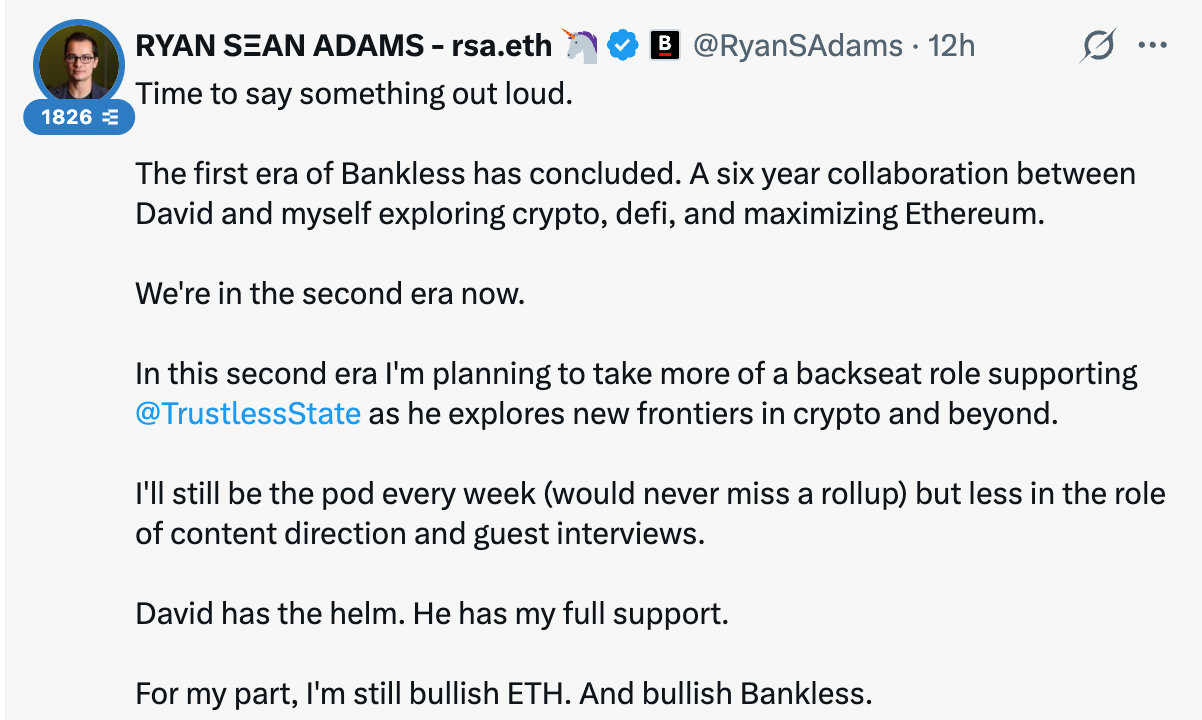
Shortly after David Hoffman's post about selling ETH, the other co-founder, Ryan Sean Adams, also posted, stating: "Time to make it public. The first era of Bankless is over. This marks six years of collaboration between David and me, exploring cryptocurrency, DeFi, and Ethereum maximalism. We are now in the second era.
In this era, I plan to step back from the forefront to support David as he explores new frontiers in crypto and beyond. I will still host the podcast weekly (never missing a recap meeting), but my role in content direction and guest interviews will diminish. David continues to steer the ship, and I fully support him. Personally, I remain bullish on ETH and bullish on Bankless."
Six years after its founding, Bankless has achieved remarkable success: apart from interviews with prominent figures like Vitalik, Chris Dixon, and Hayden Adams, the media has amassed 280,000 subscribers on YouTube, with a newsletter readership of 350,000. Its podcast has received high ratings of 4.7 stars on platforms like Spotify and Apple Podcasts, has been listed among the "Top 10 Best Crypto Podcasts" by multiple media outlets, and is hailed by many as the "ultimate guide to Web3 education."
But now, David Hoffman's discontent is evident, even resorting to "selling off ETH" to express his stance. His criticism is directly aimed at the current Ethereum Foundation.
"When the Most Loyal Ethereum Guard Decides to Sell Off ETH": Bankless Co-founder Blasts Ethereum Foundation
Following David Hoffman's post, the Ethereum community engaged in lively discussion. Some teased him, saying his "routine of periodically leaving the Ethereum ecosystem and returning" is a regular act, calling him a "seasonal barometer." They suggested that when he becomes bullish on ETH again, it might signal a market peak and a time for caution.
Subsequently, David Hoffman responded directly: "I have always supported the Ethereum blockchain network, but the ETH asset is becoming increasingly questionable. Let's not conflate the two."
A community member then pointedly asked: "Is it that you support ETH but doubt the Ethereum Foundation?"
David Hoffman's answer was straightforward: "Unfortunately, you cannot separate ETH's price performance from its leadership." His dissatisfaction with the Ethereum Foundation, the "ecosystem leader," is palpable.
It is worth noting that this is not the first time David Hoffman has expressed dissatisfaction with the Ethereum Foundation:
- In April of last year, when ETH prices fell below $1,500, he publicly stated, "Ethereum's leadership and culture are driving away users and developers";
- In October of last year, the departure of Ethereum Foundation researcher Dankrad Feist prompted him to express concern about the brain drain in the Ethereum ecosystem;
- In March of this year, he directly criticized the Ethereum Foundation in his article "The EF's Endless Manifestos," stating it "does not strive for Ethereum's market expansion."
Now, it seems David Hoffman's attitude towards ETH and the Ethereum Foundation has already transitioned from "frustration at its stagnation and misfortune" to a state of "hopeless despair."
On the other side of the story, naturally, lies ETH and the Ethereum Foundation's own "lack of drive."
According to Coinglass data, the ETH/BTC exchange rate briefly fell to 0.02835 on May 12, marking its lowest level since July 2025, with a cumulative decline of over 35% from the August 2025 high of 0.04324.
Simultaneously, the Ethereum Foundation is experiencing a wave of resignations: On May 19, Ethereum Foundation researchers Carl Beek and Julian Ma officially announced their imminent departure. The former had been with the organization for seven years, while the latter had worked at the Ethereum Foundation for four years, accompanying it through thousands of days and nights.
Prior to this, several executives and researchers from the Ethereum Foundation had already left, including Co-Executive Director Tomasz K. Stańczak, who departed in February of this year, Josh Stark, who left in March, and Protocol team leads Barnabé Monnot, Tim Beiko, and Alex Stokes, who announced their resignations earlier this month. So far this year, at least 8 senior figures at the Ethereum Foundation have resigned.
Absurdly, a primary reason for these departures appears to be the ludicrous requirement for employees to sign loyalty pledges, a factor that is both laughable and infuriating.
Paired with previous incidents where the Ethereum Foundation continued selling ETH regardless of market cycles, and even engaged in direct OTC transactions with DAT treasury company Bitmine, this organization seems to have lost its "last bit of fundamental support." Internal brain drain, external competitive weakness—the future of the Ethereum Foundation appears even bleaker than that of Bankless.
After DAT, What Is Ethereum's Next Solution?
In April of last year, based on interviews from attending an ETH Hangzhou offline event, the author wrote the article "ETH Hangzhou On-site Investigation: Ethereum Has Entered Middle Age, No Hope for Price Highs Within Three Years." At that time, ETH prices were also struggling, and countless people held little hope for its future performance. However, with the DAT frenzy arriving in June and July, buying pressure from listed companies like Bitmine and Sharplink still managed to push ETH's price high to nearly $5,000.
Now, ETH's price has more than halved from its peak. The difference is that when people discuss Ethereum, it is no longer seen as the sole answer for "new financial infrastructure." The L2 roadmap has been thoroughly invalidated, and Hyperliquid has emerged as the new "on-chain infrastructure." What is the next solution awaiting ETH and Ethereum? No one can provide a definitive answer.
Compared to the past when token prices fell but ecosystem development was booming, perhaps the current silence within the Ethereum ecosystem is even more despairing. David Hoffman's sale of ETH may have its own reasons, but his growing distance from the Ethereum ecosystem has become an undeniable fact.




















