Are Crypto Exchanges Manipulating The Bitcoin Price Crash?

bitcoinistPublished on 2026-01-20Last updated on 2026-01-20

Abstract

Crypto pundit Wimar accuses major exchanges like Binance and Coinbase of manipulating Bitcoin’s price, causing a crash from its 2026 high. He claims exchanges orchestrate rapid price pumps to trigger retail FOMO and liquidate leveraged positions, then dump large volumes to cause sharp declines. Wimar argues recent Trump tariff announcements and EU retaliation reports are not the real cause; instead, he points to coordinated trading activity and on-chain data showing synchronized movements between exchanges and ETF-linked wallets. Bitcoin fell over 2% to around $90,900, with Wimar insisting such volatility is driven by exchange manipulation rather than news events.

Crypto pundit Wimar has claimed that crypto exchanges are manipulating the Bitcoin price, causing it to crash from its 2026 high. This comes amid recent developments with the Trump tariffs, which have caused the flagship crypto to also decline.

Crypto Pundit Accuses Crypto Exchanges Of Manipulating Bitcoin Price

In an X post, Wimar asserted that crypto exchanges are manipulating the Bitcoin price. He noted how BTC just dumped from $95,500 to $91,900 with no news. The pundit claimed it is the same script, over and over again, as the flagship crypto rose from $89,000 to $95,000 and has now fallen to $91,000, just as it did when it rose from $85,000 to $88,000 and then fell to $84,000.

Wimar claimed that this is a liquidity hunt, alluding to the flows to prove that the Bitcoin price is manipulated. He noted that within minutes, Wintermute, Binance, Coinbase, and ETF-linked wallets were all active simultaneously. Large blocks were said to have moved from exchange to exchange, with huge market buys hitting thin books, and then, just as fast, these tokens were dumped.

The crypto pundit also highlighted Arkham data, noting that the flows tell the real story. Wimar claimed that coins move into exchanges right after the pump, which he stated is not a coincidence. The pundit further remarked that these crypto exchanges wait for a setup where liquidity is low, leverage is high, and funding is stretched.
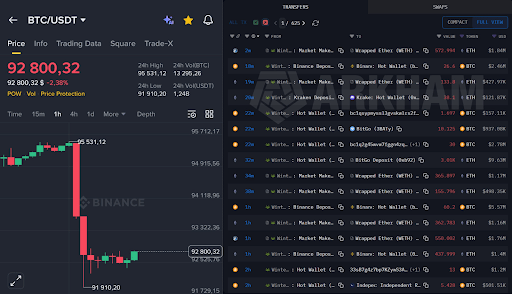
Source: Chart from Wimar on X

Wimar asserted that these crypto exchanges run the same play every time, where they first pump the Bitcoin price fast on thin books to trigger FOMO and then liquidate shorts. Retail investors then see green candles and open long positions because the price action appears to be a breakout, but they fall into the trap, according to the pundit.

Wimar stated that once enough people are stuck in leverage, the coins hit crypto exchanges and selling starts, leading to a Bitcoin price crash. The pundit accused these exchanges of dumping into the demand they just created, forcing fresh longs to get liquidated and farming both long and short traders with no news.

BTC’s Current Price Action Isn’t Based On Headlines

Wimar doubled down on his accusation of crypto exchanges being responsible for the Bitcoin price crash, stating that BTC doesn’t move like this because of headlines. He claimed that it moves like because leverage piles up, and someone decides it is “payday.” As such, the pundit suggested that the Trump tariffs fears aren’t what is sparking this recent market crash.

Trump had announced fresh tariffs on France, the U.K., the Netherlands, Denmark, Germany, Sweden, Finland, and Norway over the weekend. The Bitcoin price had remained unchanged following the announcement, but began to crash following reports that the European Union (EU) was considering retaliatory tariffs.

At the time of writing, the Bitcoin price is trading at around $90,900, down over 2% in the last 24 hours, according to data from CoinMarketCap.

BTC trading at $91,070 on the 1D chart | Source: BTCUSDT on Tradingview.com

Featured image from Pixabay, chart from Tradingview.com

Trending Cryptos

Related Questions

QWhat does crypto pundit Wimar accuse crypto exchanges of doing to the Bitcoin price?

AWimar accuses crypto exchanges of manipulating the Bitcoin price, causing it to crash through a coordinated process of pumping the price to trigger FOMO and liquidate shorts, then dumping coins to force liquidations.

QAccording to Wimar, what pattern do crypto exchanges follow in their alleged manipulation?

AWimar claims exchanges follow the same script: they pump the Bitcoin price fast on thin books to trigger FOMO and liquidate shorts, then once leverage is high, they dump coins into the demand they created, causing a crash.

QWhich specific entities does Wimar mention as being active simultaneously during the price movement?

AWimar mentions that Wintermute, Binance, Coinbase, and ETF-linked wallets were all active simultaneously during the price movement.

QWhat reason does Wimar give for dismissing headlines (like Trump tariffs) as the cause of the crash?

AWimar states that BTC doesn't move like this because of headlines, but rather because leverage piles up and someone decides it is 'payday', implying coordinated trading activity is the real cause.

QWhat was the price range of Bitcoin's movement that Wimar describes as part of the manipulation?

AWimar describes Bitcoin dumping from $95,500 to $91,900, and references a previous similar pattern where it rose from $89,000 to $95,000 then fell to $91,000, and also when it rose from $85,000 to $88,000 then fell to $84,000.

Related Reads

In Jinjiang, Fujian, a Storage Super Unicorn Lies Quiet

In Fujian's Jinjiang, a city known for sportswear, lies a quiet semiconductor giant: Fujian Jinhua Integrated Circuit Co. (JHICC). Once a promising domestic DRAM manufacturer alongside Yangtze Memory and ChangXin Memory Technologies (CXMT), its journey was derailed in 2018 when the U.S. placed it on an Entity List and filed criminal charges for alleged trade secret theft. This halted production for years. A turning point came in February 2024 when a U.S. federal court found JHICC not guilty. However, it had lost crucial time. While CXMT soared to become a top-valued A-share company in 2024, JHICC, with an estimated valuation of 80 billion RMB, was just restarting. Its current output is primarily customized DDR4 chips, not the advanced DDR5/HBM demanded for AI, but it still benefits from the broader memory chip upcycle. JHICC's story is tied to Chen Zhengkun, a veteran engineer who left Micron to lead the venture. Founded in 2016 with state-backed funding, JHICC partnered with Taiwan's UMC to develop DRAM technology. Rapid progress was cut short by the U.S. actions, which Micron initiated, partly due to its heavy reliance on the Chinese market. Post-sanctions, Chen's team worked to rebuild the production line with reduced reliance on U.S. technology. According to its records, JHICC achieved small-scale production and revenue growth under immense pressure. It now focuses on the stable "niche" DRAM market (e.g., TVs, routers) with a monthly capacity of ~40,000 wafers, aiming for 60,000 by 2026. It holds over 1,000 patents but remains on the Entity List. For Jinjiang, investing in JHICC was a bold industrial leap. The local government provided unwavering financial and logistical support during the crisis, helping the company survive. JHICC has become the anchor for a growing local semiconductor cluster. Though its scale lags behind domestic peers, JHICC's persistence symbolizes a hard-won foothold in a global market long dominated by Samsung, SK Hynix, and Micron. Having missed one boom, it seeks a place in the new AI-driven memory supercycle.

marsbit27m ago

In Jinjiang, Fujian, a Storage Super Unicorn Lies Quiet

marsbit27m ago

Must-Watch Events Next Week|CLARITY Act Could Face Senate Vote; SpaceX, Circle to Report Earnings (8.3-8.9)

**Summary: Key Events and Developments to Watch (August 3-9)** The upcoming week is marked by significant financial disclosures, key legislative deadlines, and notable product updates. **Major Financial Events:** Several companies are scheduled to release their Q2 2026 earnings. American Bitcoin (ABTC) will report on August 3, followed by SpaceX and Hut 8 Mining Corp. on August 4, and Circle on August 5. Notably, a significant portion of SpaceX shares (up to 12% of total shares) will be unlocked on August 6 following their earnings release. **Key Legislative Deadline:** The U.S. Senate faces an August 7 deadline to secure 60 votes for the CLARITY Act, a bipartisan bill aiming to establish a federal regulatory framework for cryptocurrencies. The Senate may hold a full vote on the bill during the week. **Economic Data:** The U.S. July Non-Farm Payrolls report will be released on August 7, providing crucial labor market data. **Technology & Product Updates:** * **Shutdowns:** DeFi portfolio tracker Zapper and wallet app Ctrl Wallet will cease operations on August 3. * **Upgrades:** LayerZero will deprecate its v1 relayers on August 3. XRP Ledger's new version 3.3.0, featuring five new functions, is expected next week. * **AI:** Elon Musk announced that the advanced Grok 4.6 AI model is set for release around August 7. * **Bitcoin:** The BIP-110 forced signaling for a potential Bitcoin network change is scheduled to begin around August 8. **Other Notable Events:** Chinese robotics firm Unitree Tech has set its preliminary price inquiry for its IPO for August 5. South Korean exchange Upbit will delist AQT and AERGO tokens on August 3.

marsbit2h ago

Must-Watch Events Next Week|CLARITY Act Could Face Senate Vote; SpaceX, Circle to Report Earnings (8.3-8.9)

marsbit2h ago

Trading

Spot

Hot Articles

What is $BITCOIN

DIGITAL GOLD ($BITCOIN): A Comprehensive Analysis Introduction to DIGITAL GOLD ($BITCOIN) DIGITAL GOLD ($BITCOIN) is a blockchain-based project operating on the Solana network, which aims to combine the characteristics of traditional precious metals with the innovation of decentralized technologies. While it shares a name with Bitcoin, often referred to as “digital gold” due to its perception as a store of value, DIGITAL GOLD is a separate token designed to create a unique ecosystem within the Web3 landscape. Its goal is to position itself as a viable alternative digital asset, although specifics regarding its applications and functionalities are still developing. What is DIGITAL GOLD ($BITCOIN)? DIGITAL GOLD ($BITCOIN) is a cryptocurrency token explicitly designed for use on the Solana blockchain. In contrast to Bitcoin, which provides a widely recognized value storage role, this token appears to focus on broader applications and characteristics. Notable aspects include: Blockchain Infrastructure: The token is built on the Solana blockchain, known for its capacity to handle high-speed and low-cost transactions. Supply Dynamics: DIGITAL GOLD has a maximum supply capped at 100 quadrillion tokens (100P $BITCOIN), although details regarding its circulating supply are currently undisclosed. Utility: While precise functionalities are not explicitly outlined, there are indications that the token could be utilized for various applications, potentially involving decentralized applications (dApps) or asset tokenization strategies. Who is the Creator of DIGITAL GOLD ($BITCOIN)? At present, the identity of the creators and development team behind DIGITAL GOLD ($BITCOIN) remains unknown. This situation is typical among many innovative projects within the blockchain space, particularly those aligning with decentralized finance and meme coin phenomena. While such anonymity may foster a community-driven culture, it intensifies concerns about governance and accountability. Who are the Investors of DIGITAL GOLD ($BITCOIN)? The available information indicates that DIGITAL GOLD ($BITCOIN) does not have any known institutional backers or prominent venture capital investments. The project seems to operate on a peer-to-peer model focused on community support and adoption rather than traditional funding routes. Its activity and liquidity are primarily situated on decentralized exchanges (DEXs), such as PumpSwap, rather than established centralized trading platforms, further highlighting its grassroots approach. How DIGITAL GOLD ($BITCOIN) Works The operational mechanics of DIGITAL GOLD ($BITCOIN) can be elaborated on based on its blockchain design and network attributes: Consensus Mechanism: By leveraging Solana’s unique proof-of-history (PoH) combined with a proof-of-stake (PoS) model, the project ensures efficient transaction validation contributing to the network's high performance. Tokenomics: While specific deflationary mechanisms have not been extensively detailed, the vast maximum token supply implies that it may cater to microtransactions or niche use cases that are still to be defined. Interoperability: There exists the potential for integration with Solana’s broader ecosystem, including various decentralized finance (DeFi) platforms. However, the details regarding specific integrations remain unspecified. Timeline of Key Events Here is a timeline that highlights significant milestones concerning DIGITAL GOLD ($BITCOIN): 2023: The initial deployment of the token occurs on the Solana blockchain, marked by its contract address. 2024: DIGITAL GOLD gains visibility as it becomes available for trading on decentralized exchanges like PumpSwap, allowing users to trade it against SOL. 2025: The project witnesses sporadic trading activity and potential interest in community-led engagements, although no noteworthy partnerships or technical advancements have been documented as of yet. Critical Analysis Strengths Scalability: The underlying Solana infrastructure supports high transaction volumes, which could enhance the utility of $BITCOIN in various transaction scenarios. Accessibility: The potential low trading price per token could attract retail investors, facilitating wider participation due to fractional ownership opportunities. Risks Lack of Transparency: The absence of publicly known backers, developers, or an audit process may yield skepticism regarding the project's sustainability and trustworthiness. Market Volatility: The trading activity is heavily reliant on speculative behavior, which can result in significant price volatility and uncertainty for investors. Conclusion DIGITAL GOLD ($BITCOIN) emerges as an intriguing yet ambiguous project within the rapidly evolving Solana ecosystem. While it attempts to leverage the “digital gold” narrative, its departure from Bitcoin's established role as a store of value underscores the need for a clearer differentiation of its intended utility and governance structure. Future acceptance and adoption will likely depend on addressing the current opacity and defining its operational and economic strategies more explicitly. Note: This report encompasses synthesised information available as of October 2023, and developments may have transpired beyond the research period.

1.4k Total ViewsPublished 2025.05.13Updated 2025.05.13

What is $BITCOIN

Discussions

Welcome to the HTX Community. Here, you can stay informed about the latest platform developments and gain access to professional market insights. Users' opinions on the price of BTC (BTC) are presented below.

活动图片















