Analyzing Artificial Superintelligence Alliance’s 16% jump: $0.30 next for FET?

ambcryptoPublished on 2026-03-24Last updated on 2026-03-24

Abstract

FET surged 15.5% to $0.238, reclaiming the $0.20 support and flipping its short-term moving averages, signaling strong bullish momentum. The rally was fueled by renewed interest in AI tokens, with significant capital inflows and a net outflow of 1.5 million FET from exchanges, reducing selling pressure. However, whale activity remained bearish, with large sell orders between $0.20–$0.22 potentially capping upside. Technical indicators like the rising momentum suggest a possible push toward $0.30 if demand holds, but a pullback to $0.20 remains possible if whale selling persists.

Amid the broader crypto market resurgence, the Artificial Superintelligence Alliance made a strong trend reversal. After a week of sideways movement, FET finally defended the $0.20 level and climbed to a local high of $0.239 before slightly retracing.

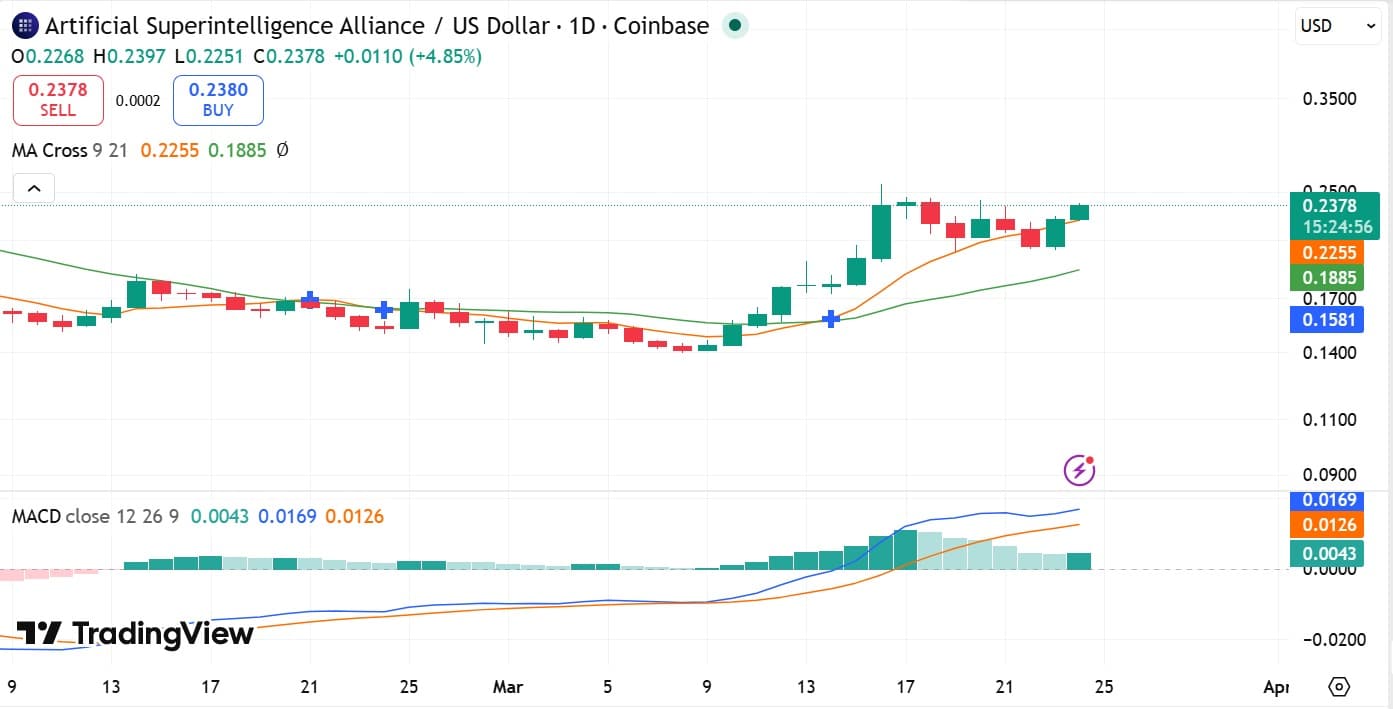
As of this writing, Artificial Superintelligence Alliance [FET] traded at $0.238, up 15.5% on the daily charts. With the price uptick, the altcoin flipped its 9-day moving averages, reflecting strong upside momentum.

FET rallied a sector-wide strength as AI tokens made considerable gains, with all major AI coins, including TAO and Render, rebounding.

Thus, the market shows renewed positive sentiment in the AI narrative, driving significant capital inflow into the sector. FET, alongside other AI coins, experienced strong speculative demand.

FET sees renewed capital rotation

Amid sector-wide capital rotation, FET saw massive capital inflows as late buyers rushed into the market to position themselves.

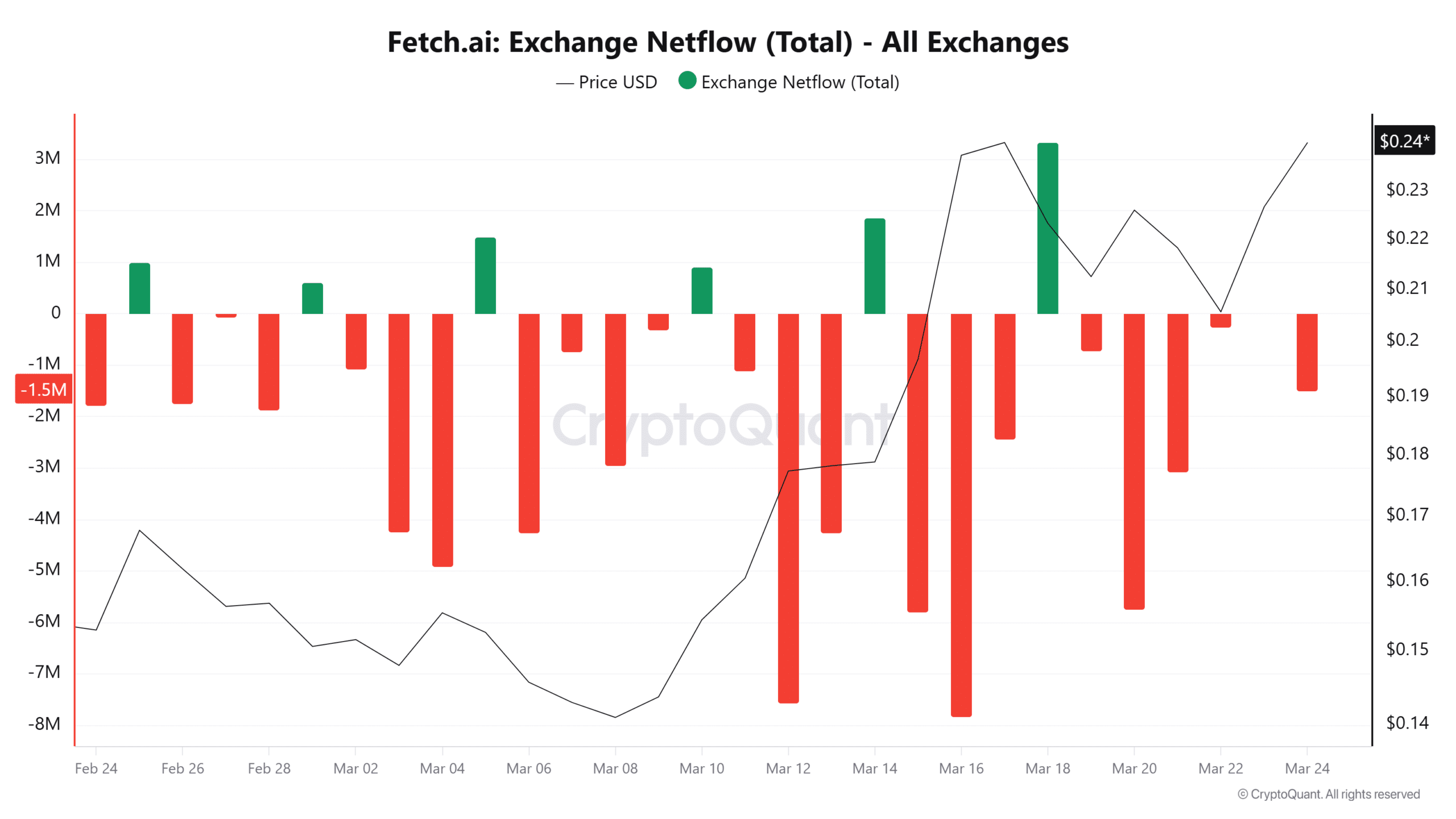
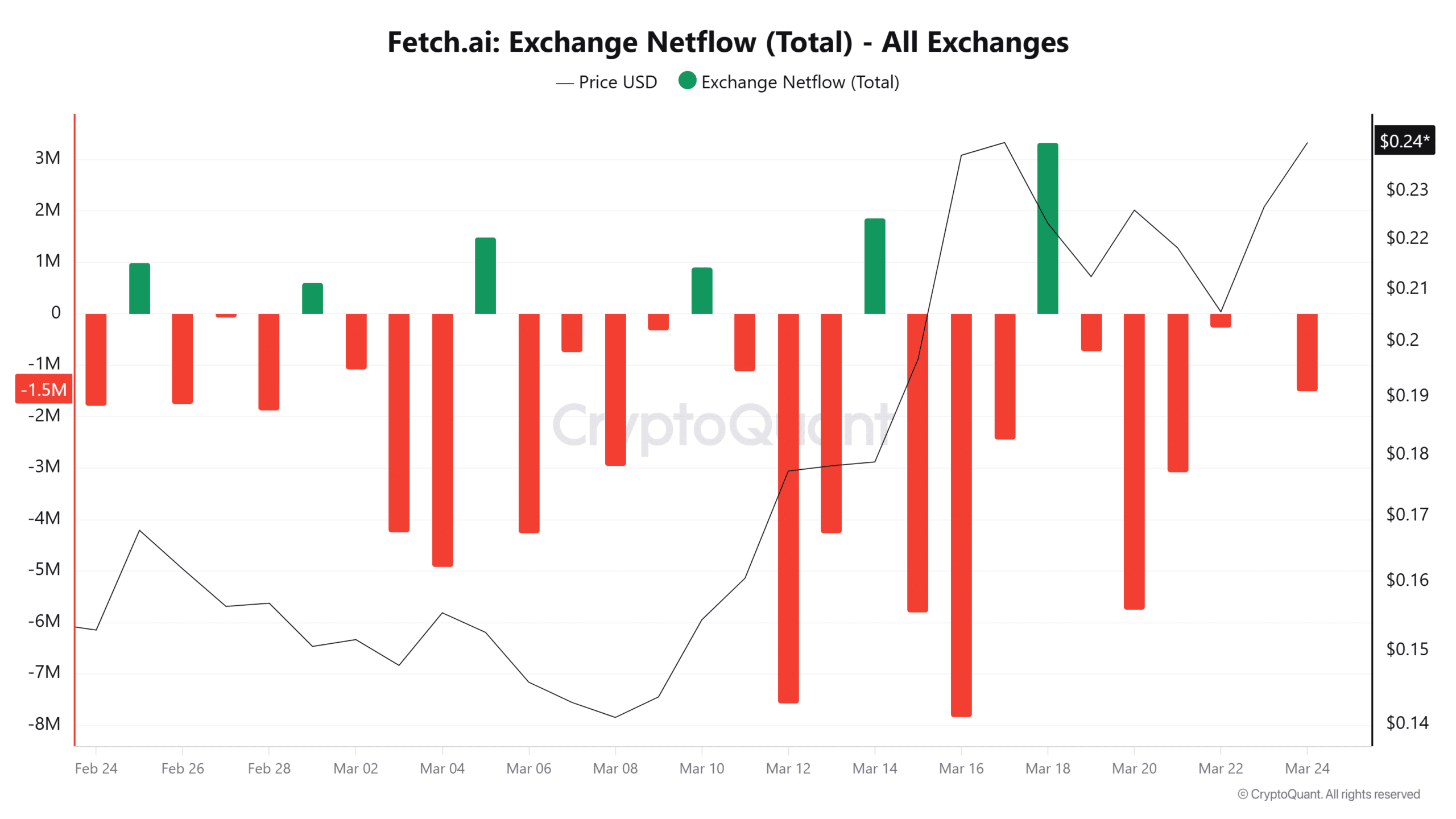
Over the past 24 hours, over 17.7 million FET flowed out of exchanges, compared to 16.2 million in inflows. As a result, the altcoin’s Exchange Netflow dropped to -1.5 million, down significantly from 7k the previous day.
Source: CryptoQuant

Such a trend reversal indicated a significant shift in market sentiment, with buyers outpacing sellers.

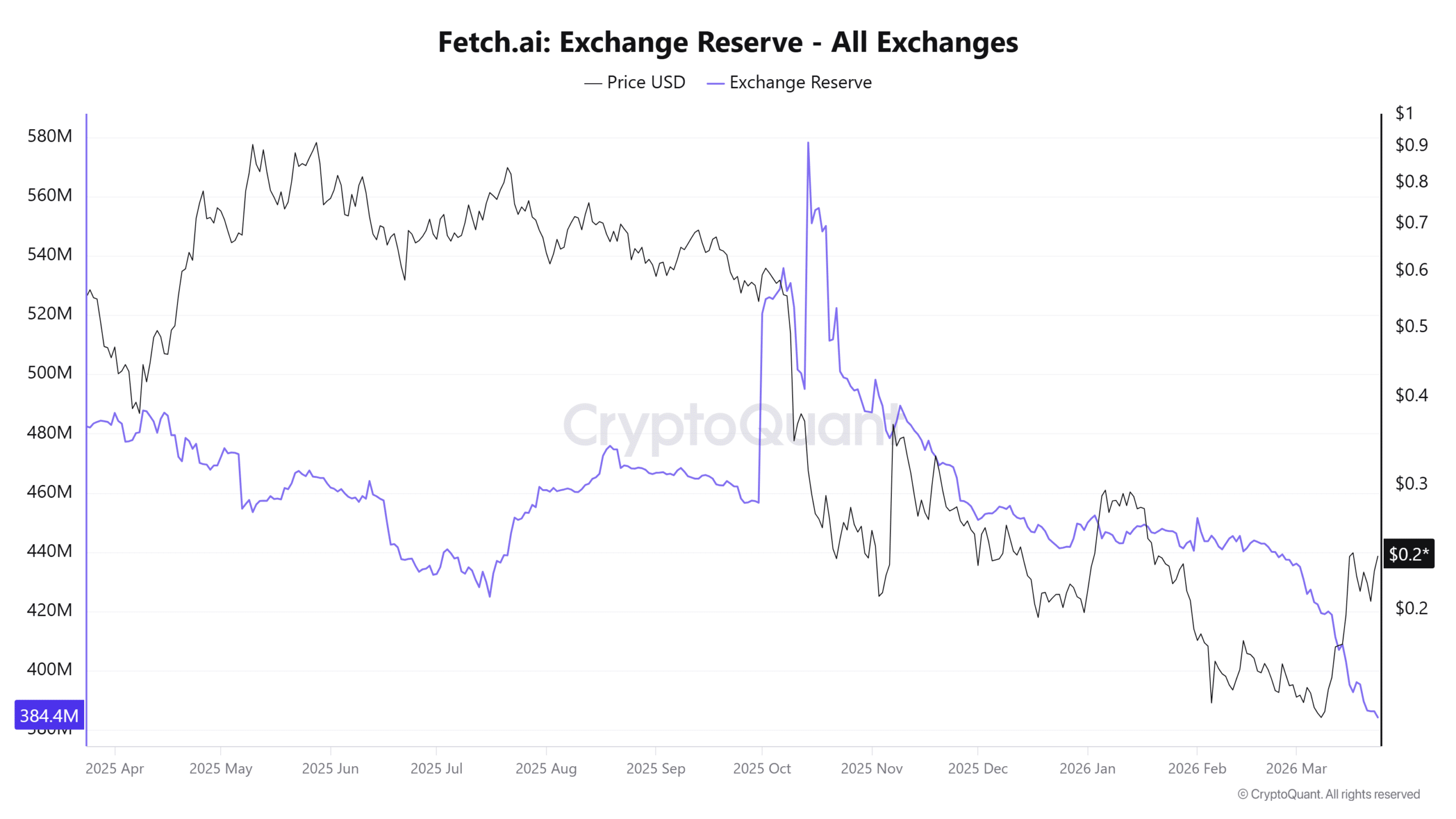
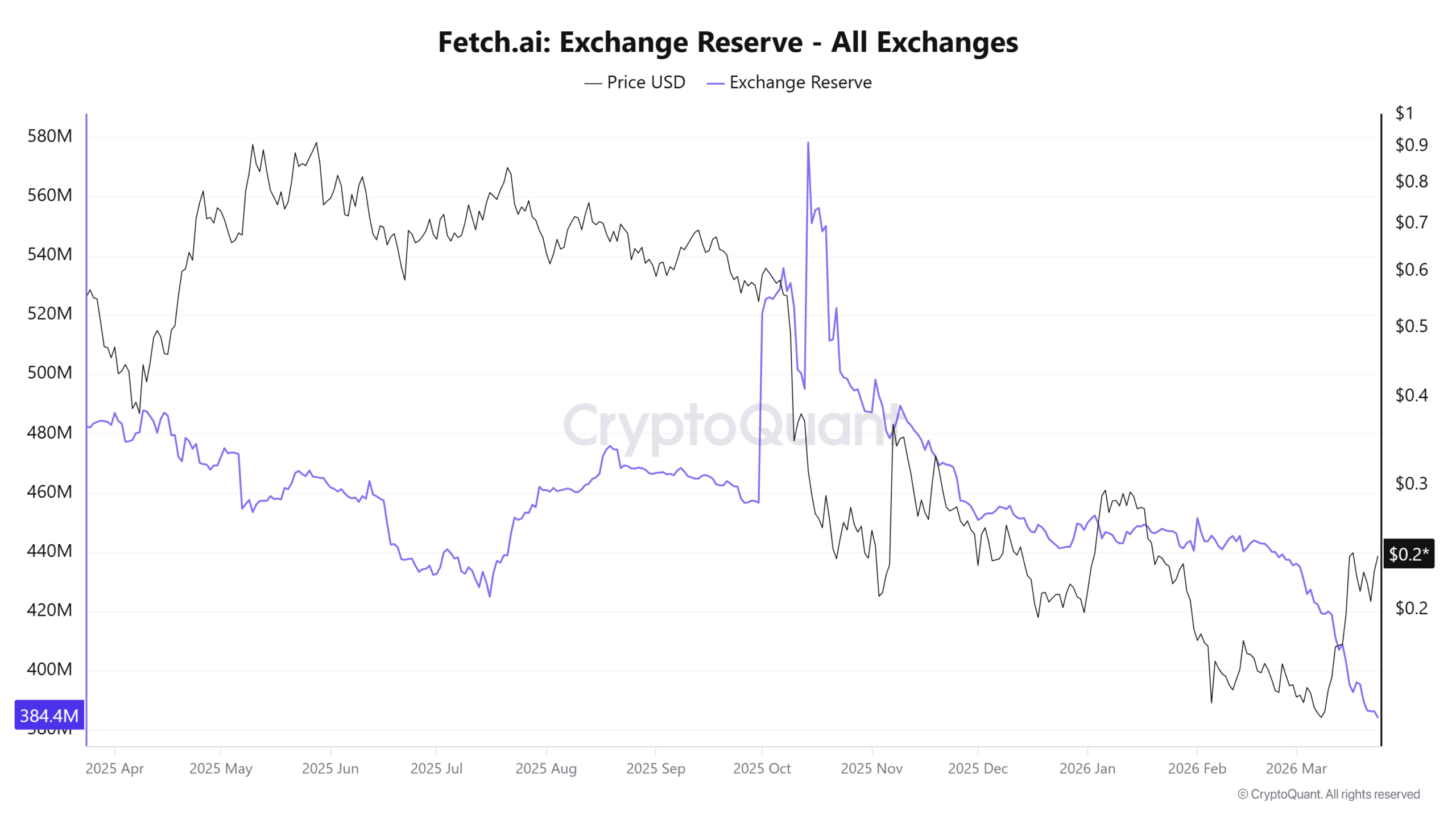
Additionally, the altcoin’s Exchange Reserve plummeted to 384 million, marking a 2024 low. Often, a lower exchange reserve, especially for altcoins, has indicated reduced selling pressure and higher buying outflows.
Source: CryptoQuant

Thus, FET has become increasingly scarce, effectively reducing the supply available for immediate sale. Often, greater scarcity has accelerated an asset’s upward momentum, leading to higher prices.

Whales remain bearish, though

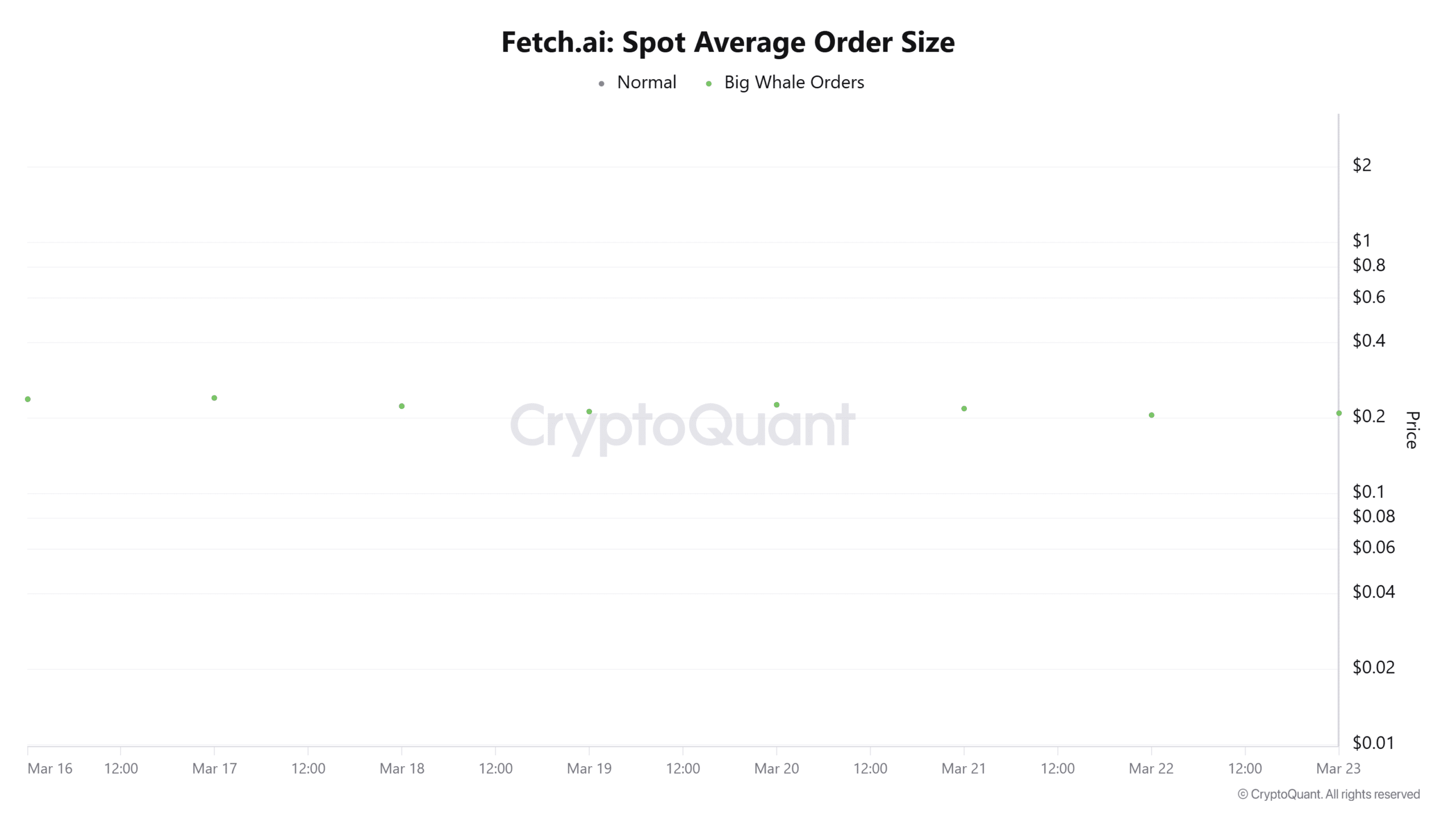
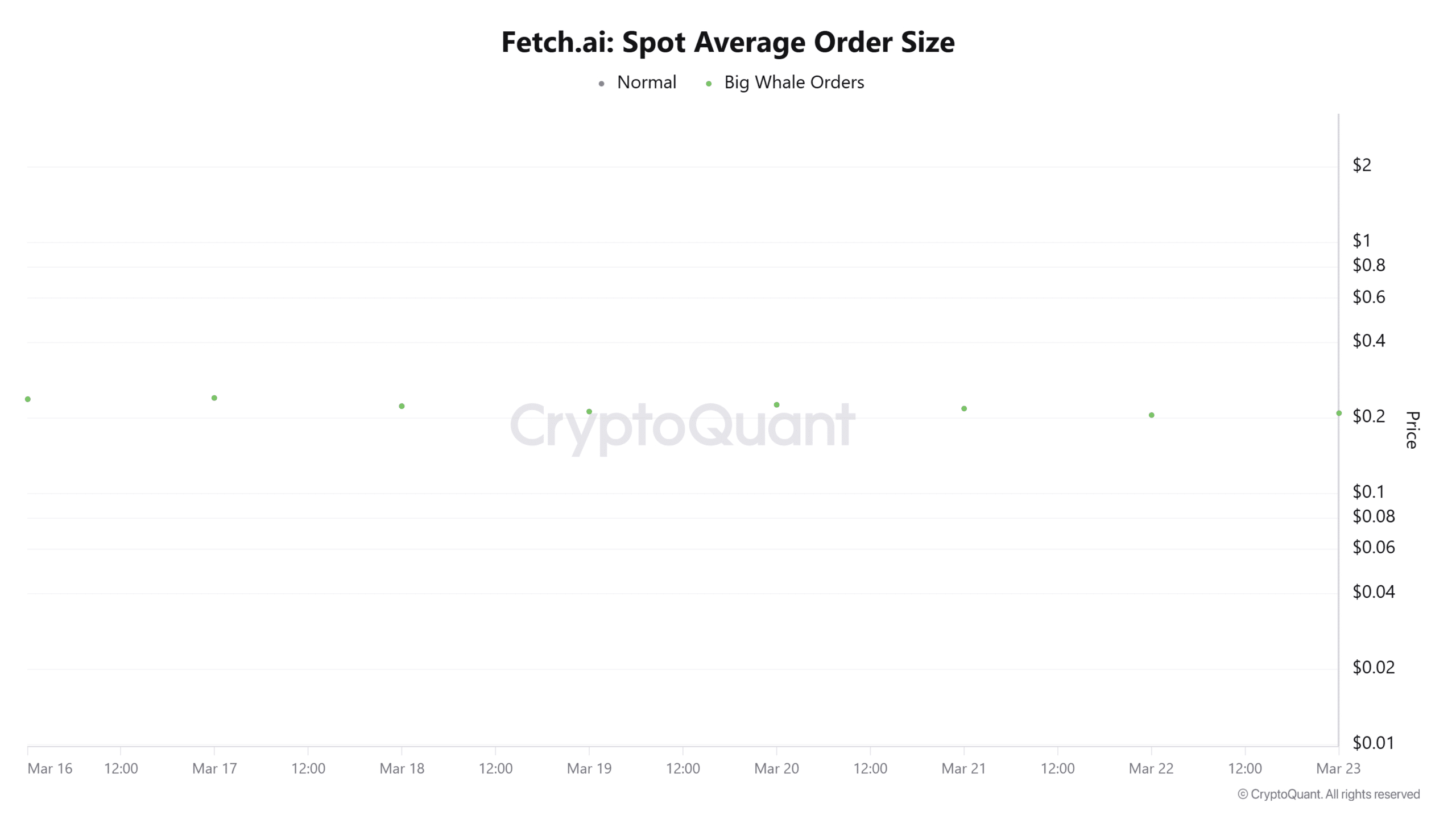
Despite the recent market pump, spot whales have remained skeptical and are holding back the market. Spot Average Order Size data from Cryptoquant showed sustained whale participation on the spot market.
Source: CryptoQuant

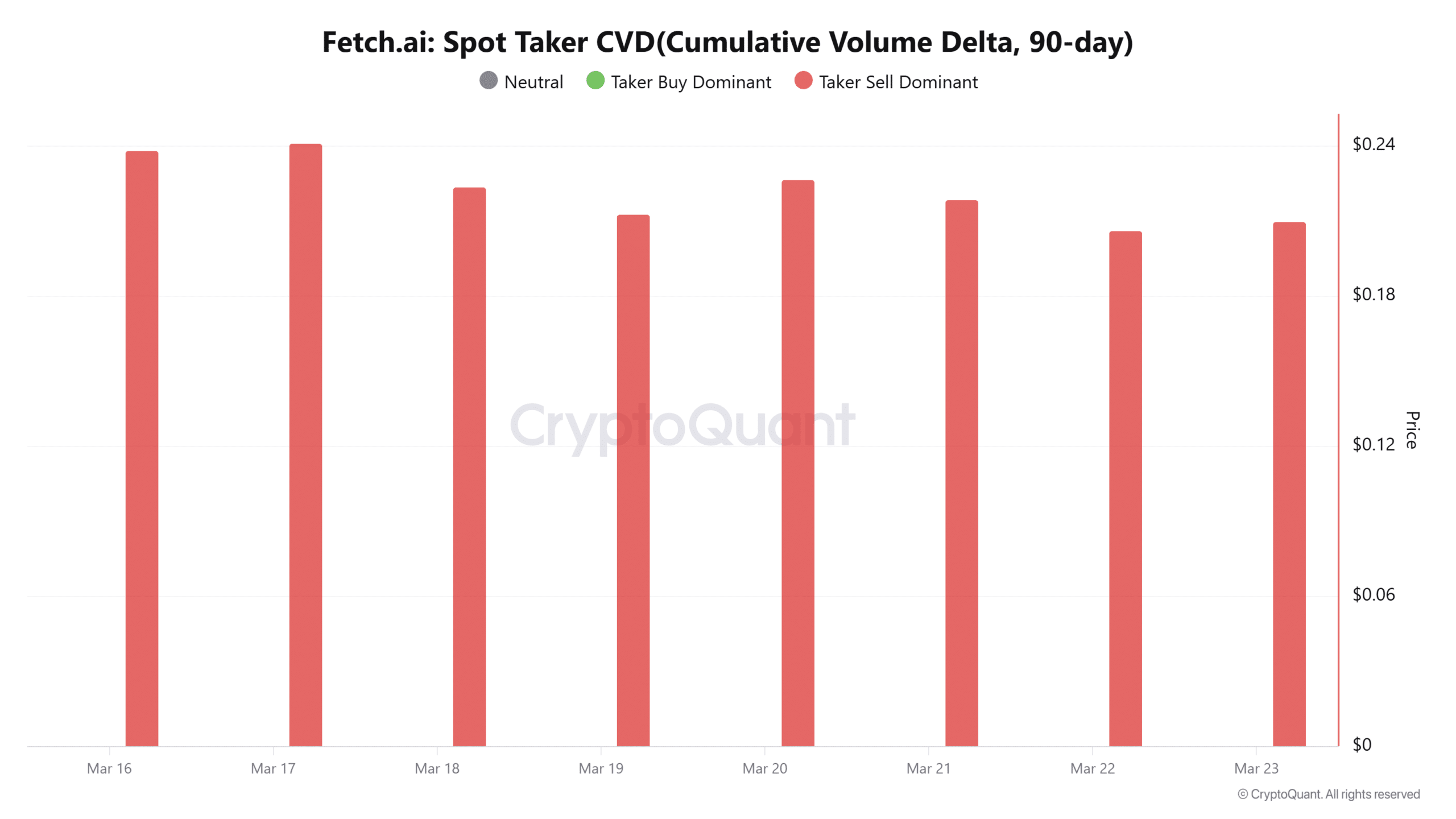
These large market players have repeatedly entered the market at prices between $0.20 and $0.22.These orders could be buy or sell, and based on Spot Order CVD, they have mostly been sell orders.

Thus, whales have been aggressively dumping at $0.20-$0.22, which has significantly dragged down the market. Historically, increased whale selling pressure has weakened the market, thereby accelerating downside and often serving as a precursor to lower prices.
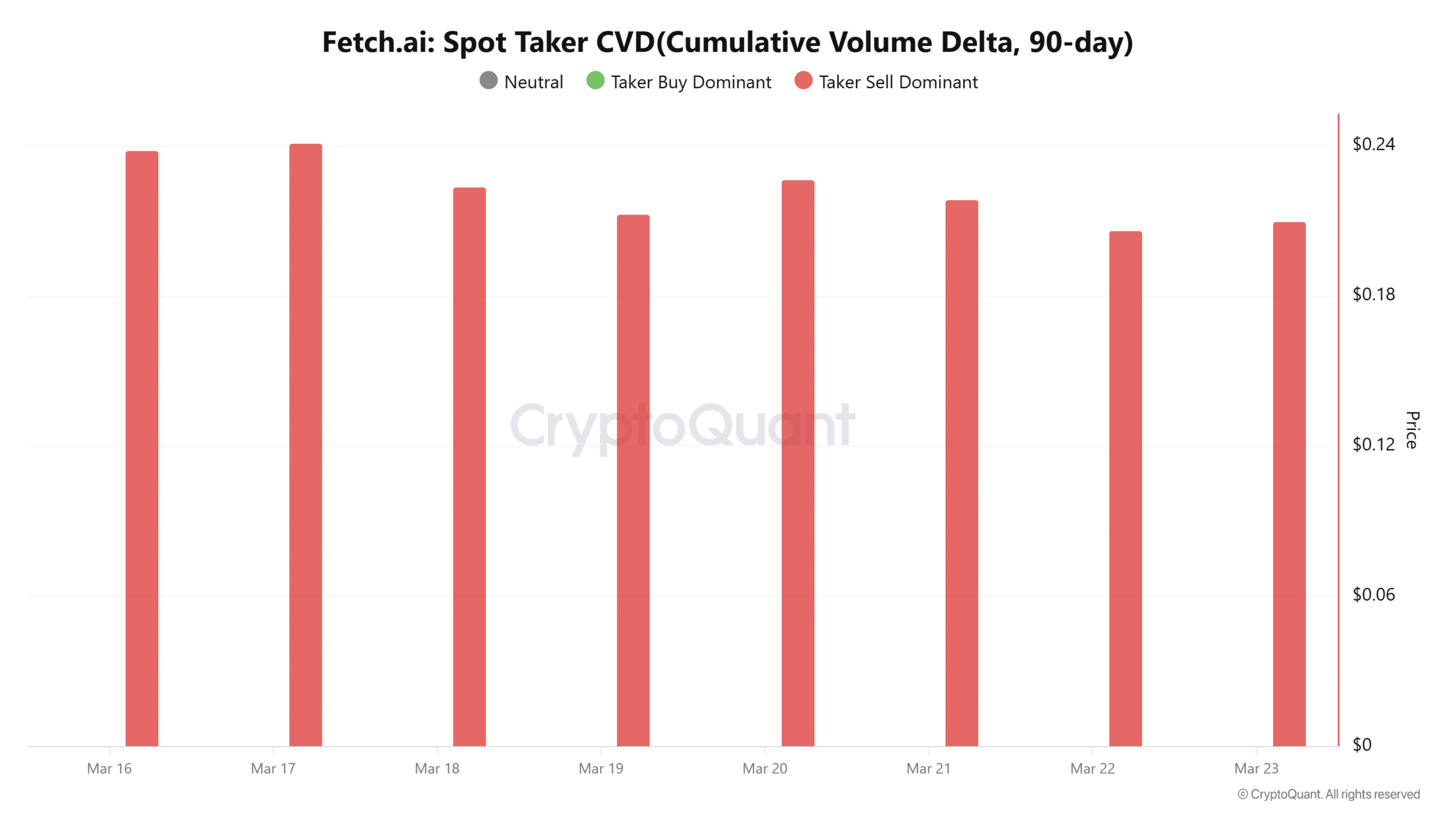
Source: CryptoQuant

What’s next for FET

Artificial Superintelligence Alliance experienced a significant jump amid increased capital rotation into the AI sector.

As a result, the altcoin flipped its short-term moving averages, MA9, indicating strong upside momentum. At the same time, the MACD continued to rise, hitting 0.016, further validating the trend’s strength.
Source: TradingView

When momentum indicators are set in this manner, it signals established market demand, with buyers in total control. Often, such a setup has historically signaled the continuation of a trend.

Therefore, if demand holds steady, Artificial SuperIntelligence Alliance could flip its immediate resistance at $0.25 and target $0.3. However, with whales still selling, the threat of a pullback remains, and FET could breach $0.22 before seeking support around $0.20.


Final Summary

  • Artificial Superintelligence Alliance [FET] successfully held $0.20, surged 15.5% to a local high of $0.238.
  • FET saw renewed capital rotation amid a recovery in speculative demand and a resurgence in the AI sector.


Trending Cryptos

Related Questions

QWhat was the percentage increase in FET's price on the daily charts as mentioned in the article?

AFET was up 15.5% on the daily charts.

QWhat key price level did FET successfully defend before climbing to a local high?

AFET successfully defended the $0.20 level.

QAccording to the on-chain data, what was the value of FET's Exchange Netflow and what does it indicate?

AThe Exchange Netflow dropped to -1.5 million, indicating that more tokens were flowing out of exchanges than into them, suggesting a shift in sentiment with buyers outpacing sellers.

QDespite the price pump, which group of investors remained bearish and was applying selling pressure?

ASpot whales remained bearish and were aggressively selling, particularly at the $0.20-$0.22 price range.

QWhat are the two potential price targets for FET mentioned in the article, one for an upward move and one for a pullback?

AIf demand holds, FET could target $0.3. However, if a pullback occurs, it could breach $0.22 and seek support around $0.20.

Related Reads

Can Generative Models Finally Be Trained End-to-End? The Core Is a For Loop

This article introduces a novel training paradigm for generative models called Explorative Modeling (XM), which enables true end-to-end training. Traditionally, powerful generative models like autoregressive and diffusion models are not trained end-to-end. They are trained to predict a single small step but require iterative multi-step sampling for inference. This "exposure bias" leads to error accumulation and limits performance. The core challenge XM addresses is "mode blurring." In generative tasks, a single input (e.g., "generate a dog") corresponds to many valid outputs (multiple modes). Standard training objectives like reconstruction loss force the model to average these modes, producing unrealistic, blurry outputs. To avoid this, existing models break generation into many small, almost deterministic steps, sacrificing end-to-end training. XM tackles this by restructuring the training loop itself. Its key insight is to amplify "generative expressivity." For each training input, instead of generating one sample, the model generates K candidate outputs. Only the candidate closest to the real data is used for computing the loss and updating the model via backpropagation. This simple "best-of-K" mechanism is implemented as a short for-loop. By exploring multiple possibilities, the model learns to distribute its guesses across different modes rather than collapsing to their uninformative average. The paper demonstrates that "exploration" acts as a new, powerful scaling axis. Gains from XM increase with model size, data scale, and compute. Experiments show improvements in FID scores for image generation and significant efficiency gains, sometimes outperforming larger models without exploration. When pushed to the limit, XM enables fully single-step, end-to-end generative models. In robotics tasks, an "Explorative Policy" matched the performance of a 100-step Diffusion Policy with a single forward pass, drastically improving inference speed. While the best-of-K concept is not entirely new, the authors' contribution lies in formally understanding it as a direct method to boost generative expressivity without fragmenting the generation process. This work suggests that as models scale, enhancing exploration during training may become crucial for overcoming fundamental performance bottlenecks.

marsbit48m ago

Can Generative Models Finally Be Trained End-to-End? The Core Is a For Loop

marsbit48m ago

Annual Salary of Millions Competing for Electricians, Meta Rushes to Open Its Own Technical School

The AI boom is facing an unexpected bottleneck: a severe shortage of skilled construction workers and electricians. As tech giants like Meta, OpenAI, and Alphabet race to build massive data centers—such as OpenAI's $16 billion "Stargate" project—they are hitting a critical labor wall. The U.S. needs an estimated 130,000 more electricians, 240,000 construction workers, and 150,000 supervisors by 2030 for AI infrastructure alone, but tens of thousands of electrician jobs go unfilled each year. While AI companies offer high premiums, with electricians earning up to $280,000 annually, worker scarcity still causes massive losses—delays on a single project can cost $14.2 million per month. The complexity of building AI data centers, which require immense power (equivalent to powering hundreds of thousands of homes), sophisticated electrical systems, and advanced liquid cooling solutions, demands highly skilled technicians who are in short supply. To combat this, companies are investing heavily in training. Meta has committed $115 million to a free training school offering tuition, housing, and stipends, targeting 5,000 new workers. OpenAI is partnering with unions to secure skilled labor. These efforts are paying off, with a significant rise in Gen Z interest in trade schools over college. However, the power demands are staggering. AI data centers are driving a rapid surge in electricity consumption, projected to account for up to 12% of U.S. power use by 2028 and raising costs for consumers. Furthermore, the construction boom is project-based, leading to a potential future glut of trained workers once building peaks, which could depress wages industry-wide. The race for AI supremacy now depends as much on skilled hands as on advanced chips.

marsbit2h ago

Annual Salary of Millions Competing for Electricians, Meta Rushes to Open Its Own Technical School

marsbit2h ago

Trading

Spot

Hot Articles

How to Buy FET

Welcome to HTX.com! We've made purchasing FETCH.ai (FET) simple and convenient. Follow our step-by-step guide to embark on your crypto journey.Step 1: Create Your HTX AccountUse your email or phone number to sign up for a free account on HTX. Experience a hassle-free registration journey and unlock all features.Get My AccountStep 2: Go to Buy Crypto and Choose Your Payment MethodCredit/Debit Card: Use your Visa or Mastercard to buy FETCH.ai (FET) instantly.Balance: Use funds from your HTX account balance to trade seamlessly.Third Parties: We've added popular payment methods such as Google Pay and Apple Pay to enhance convenience.P2P: Trade directly with other users on HTX.Over-the-Counter (OTC): We offer tailor-made services and competitive exchange rates for traders.Step 3: Store Your FETCH.ai (FET)After purchasing your FETCH.ai (FET), store it in your HTX account. Alternatively, you can send it elsewhere via blockchain transfer or use it to trade other cryptocurrencies.Step 4: Trade FETCH.ai (FET)Easily trade FETCH.ai (FET) on HTX's spot market. Simply access your account, select your trading pair, execute your trades, and monitor in real-time. We offer a user-friendly experience for both beginners and seasoned traders.

2.9k Total ViewsPublished 2024.03.29Updated 2026.06.02

How to Buy FET

Discussions

Welcome to the HTX Community. Here, you can stay informed about the latest platform developments and gain access to professional market insights. Users' opinions on the price of FET (FET) are presented below.

活动图片