Analyst Predicts Bitcoin Price Crash To $15,000 Using Gold Chart

bitcoinistPublished on 2025-12-09Last updated on 2025-12-09

Abstract

Analyst The Great Martis predicts a significant Bitcoin price crash to as low as $15,000, using the performance of gold as a key indicator. This forecast follows Bitcoin's recent drop below $100,000, with the analyst suggesting an inverse relationship between the two assets. As gold reaches new all-time highs, driven by Federal Reserve interventions and speculation, Martis expects it could rise to the $12,000 range. Consequently, Bitcoin may face a severe bear market, potentially declining over 70% from current levels and nearly 90% from its $126,000 peak. In 2025, gold has surged 55%, while Bitcoin has fallen 30% from its October high, reinforcing gold's status as a safer investment amid Bitcoin's volatility.

Following the Bitcoin price crash below $100,000 back in November, different bearish predictions have begun to make the rounds in the crypto community. For some, this crash signifies the end of the bull market, ushering in the dreaded bear market. While some of the predictions have been conservative, putting the pioneer cryptocurrency somewhere around $50,000 at the bottom, one analyst in particular has predicted a deeper crash, and this was done using the gold chart.

Why A Crash Could Be Coming For The Bitcoin Price

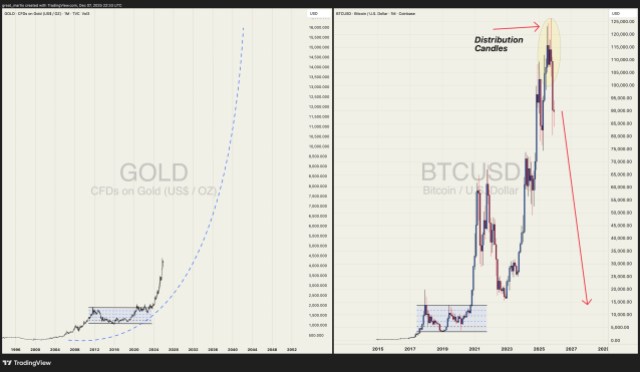
Crypto analyst The Great Martis took to X (formerly Twitter) to share their prediction of where the Bitcoin price is headed next. The chart shows a possible decline that could send Bitcoin moving below $20,000, before eventually reaching a bottom at around $15,000. Although this is not out of the ordinary for analysts to predict such crashes, the reason why Mathis believes this is possible is what is interesting.

The crypto analyst points out that the gold performance, which has seen the asset hitting new all-time highs this year, was being driven by speculation. Martis explains that the Fed’s intervention is something that will continue to drive the price of gold higher, and this could, in turn, continue to push down the Bitcoin price.

Furthermore, the analyst expects that the gold price will rise into the $12,000 territory, putting it in the same region that the Bitcoin price was in back in 2021. The interesting thing to note about Bitcoin in 2021 is that this was the year that the digital asset went on one of its most explosive rallies so far.
Source: X

If Bitcoin continues to perform inversely to gold, then a rise to 5-digits for gold would mean a bearish market for Bitcoin. A crash to $15,000 would translate to a more than 70% decrease in price from the current level, and an almost 90% decline from its $126,000 all-time high.

So far, this year, gold has been the better performer of the two when compared side-by-side. For context, the gold price is already up over 55% in the year 2025; meanwhile, the Bitcoin price suffered a major 30% drop in price after hitting $126,000 back in October.

While both of these assets continue to lead in their respective sectors, gold continues to remain the standard for what investors consider a “safe” investment compared to Bitcoin, which is known for its wild price fluctuations.

BTC retraces weekend gains | Source: BTCUSD on Tradingview.com

Trending Cryptos

Related Reads

Dialogue with Yihui Capital, SoundAI Technology, Ling Universe, and Zhongbo Jili: Opportunities and Challenges in the AI Smart Hardware Track

On June 28, 2026, an event titled "New Opportunities in AI Hardware: The Battle for Interactive Entry Points Begins" was held in Beijing. It featured a report from ITJuzi and discussions with experts from SoundAI, Ling Universe, One Reed Capital, and Zhongbo Juli on the opportunities and challenges in China's AI hardware sector. Key report findings highlight the sector's intense activity: 327 out of 431 startups founded post-2023 have secured funding, with 179 investments in H1 2026 alone. The landscape is dominated by embodied intelligent robots, while wearable tech like smart rings and AI glasses shows rapid growth. Geographically, Shenzhen leads, leveraging its superior hardware supply chain, followed by Beijing and Shanghai. The overarching trend is for companies to focus on micro-innovations within specific scenarios rather than reinventing foundational technology. Industry leaders shared several critical insights: 1. **Balancing Innovation & Market Readiness**: Entrepreneurs face the "hammer looking for a nail" dilemma. Success requires balancing technical capability with user acceptance, cost control, and incremental design improvements rather than chasing disruptive innovation. 2. **Competitive Landscape**: The future interactive entry point may not be a single super-device but a mix of universal terminals and specialized, scenario-specific hardware. While large companies have ecosystem advantages, startups can win by deeply targeting vertical markets and specific user groups. 3. **Core Challenges & Business Models**: Key hurdles include deep understanding of AI models and navigating non-transparent hardware supply chains. Viable business models may involve selling hardware at cost and generating revenue through software subscriptions, but this requires tight control over both hardware BOM and model inference costs. 4. **The Road to Commercialization**: The ultimate test is market validation—achieving sales growth and sustainable cash flow. Companies must find the right application scenario, use edge computing effectively, and close the loop from technology to commercial success. 5. **The Future of Interaction**: Proactive, context-aware interaction is the next frontier, though it's currently limited by issues like model hallucinations and environmental perception. The near-term focus should be on identifying target users and creating a coherent experience in specific domains, such as health wearables. In summary, to succeed in the competitive AI hardware arena, companies must strategically choose their niche, build a team with the right geographical advantages (e.g., leveraging Shenzhen's supply chain), and most importantly, execute a flawless commercialization strategy that translates technology into market-accepted products and sustainable business growth.

marsbit22m ago

Dialogue with Yihui Capital, SoundAI Technology, Ling Universe, and Zhongbo Jili: Opportunities and Challenges in the AI Smart Hardware Track

marsbit22m ago

CryptoQuant Founder: The Cost to Double BTC Has Increased by 20,000 Times, Where Will the $100 Billion Buying Power Come From?

CryptoQuant founder Ki Young Ju analyzes Bitcoin's current capital challenge. He notes that the cryptocurrency market has grown too large for retail-driven momentum alone to generate massive price increases as in past cycles. His calculations show that in 2011, approximately $2.7 million in capital inflow could push BTC's price up by 550x, whereas the current cycle requires an estimated $101 billion in new capital just for a 100% price increase. This shift underscores that sustaining a bull run now depends on attracting large-scale, long-term institutional capital rather than short-term speculative trading. Recent outflows from US spot Bitcoin ETFs, totaling nearly $10 billion since May, highlight the fragility of current demand and challenge the narrative of deep institutional support. While surveys indicate continued institutional interest, these entities prioritize regulated products, risk management, and portfolio integration over speculative gains. For the next significant bull market, Bitcoin must transition to being a core macro asset. The key drivers are no longer just more buyers, but capital allocation from larger, slower-moving entities like wealth advisors, corporate treasuries, banks, and sovereign wealth funds. This new phase pits Bitcoin against other major asset classes like AI for a share of institutional capital, making its growth trajectory dependent on sustained, high-quality inflows from diversified financial balance sheets.

marsbit26m ago

CryptoQuant Founder: The Cost to Double BTC Has Increased by 20,000 Times, Where Will the $100 Billion Buying Power Come From?

marsbit26m ago

Trading

Spot

Hot Articles

What is $BITCOIN

DIGITAL GOLD ($BITCOIN): A Comprehensive Analysis Introduction to DIGITAL GOLD ($BITCOIN) DIGITAL GOLD ($BITCOIN) is a blockchain-based project operating on the Solana network, which aims to combine the characteristics of traditional precious metals with the innovation of decentralized technologies. While it shares a name with Bitcoin, often referred to as “digital gold” due to its perception as a store of value, DIGITAL GOLD is a separate token designed to create a unique ecosystem within the Web3 landscape. Its goal is to position itself as a viable alternative digital asset, although specifics regarding its applications and functionalities are still developing. What is DIGITAL GOLD ($BITCOIN)? DIGITAL GOLD ($BITCOIN) is a cryptocurrency token explicitly designed for use on the Solana blockchain. In contrast to Bitcoin, which provides a widely recognized value storage role, this token appears to focus on broader applications and characteristics. Notable aspects include: Blockchain Infrastructure: The token is built on the Solana blockchain, known for its capacity to handle high-speed and low-cost transactions. Supply Dynamics: DIGITAL GOLD has a maximum supply capped at 100 quadrillion tokens (100P $BITCOIN), although details regarding its circulating supply are currently undisclosed. Utility: While precise functionalities are not explicitly outlined, there are indications that the token could be utilized for various applications, potentially involving decentralized applications (dApps) or asset tokenization strategies. Who is the Creator of DIGITAL GOLD ($BITCOIN)? At present, the identity of the creators and development team behind DIGITAL GOLD ($BITCOIN) remains unknown. This situation is typical among many innovative projects within the blockchain space, particularly those aligning with decentralized finance and meme coin phenomena. While such anonymity may foster a community-driven culture, it intensifies concerns about governance and accountability. Who are the Investors of DIGITAL GOLD ($BITCOIN)? The available information indicates that DIGITAL GOLD ($BITCOIN) does not have any known institutional backers or prominent venture capital investments. The project seems to operate on a peer-to-peer model focused on community support and adoption rather than traditional funding routes. Its activity and liquidity are primarily situated on decentralized exchanges (DEXs), such as PumpSwap, rather than established centralized trading platforms, further highlighting its grassroots approach. How DIGITAL GOLD ($BITCOIN) Works The operational mechanics of DIGITAL GOLD ($BITCOIN) can be elaborated on based on its blockchain design and network attributes: Consensus Mechanism: By leveraging Solana’s unique proof-of-history (PoH) combined with a proof-of-stake (PoS) model, the project ensures efficient transaction validation contributing to the network's high performance. Tokenomics: While specific deflationary mechanisms have not been extensively detailed, the vast maximum token supply implies that it may cater to microtransactions or niche use cases that are still to be defined. Interoperability: There exists the potential for integration with Solana’s broader ecosystem, including various decentralized finance (DeFi) platforms. However, the details regarding specific integrations remain unspecified. Timeline of Key Events Here is a timeline that highlights significant milestones concerning DIGITAL GOLD ($BITCOIN): 2023: The initial deployment of the token occurs on the Solana blockchain, marked by its contract address. 2024: DIGITAL GOLD gains visibility as it becomes available for trading on decentralized exchanges like PumpSwap, allowing users to trade it against SOL. 2025: The project witnesses sporadic trading activity and potential interest in community-led engagements, although no noteworthy partnerships or technical advancements have been documented as of yet. Critical Analysis Strengths Scalability: The underlying Solana infrastructure supports high transaction volumes, which could enhance the utility of $BITCOIN in various transaction scenarios. Accessibility: The potential low trading price per token could attract retail investors, facilitating wider participation due to fractional ownership opportunities. Risks Lack of Transparency: The absence of publicly known backers, developers, or an audit process may yield skepticism regarding the project's sustainability and trustworthiness. Market Volatility: The trading activity is heavily reliant on speculative behavior, which can result in significant price volatility and uncertainty for investors. Conclusion DIGITAL GOLD ($BITCOIN) emerges as an intriguing yet ambiguous project within the rapidly evolving Solana ecosystem. While it attempts to leverage the “digital gold” narrative, its departure from Bitcoin's established role as a store of value underscores the need for a clearer differentiation of its intended utility and governance structure. Future acceptance and adoption will likely depend on addressing the current opacity and defining its operational and economic strategies more explicitly. Note: This report encompasses synthesised information available as of October 2023, and developments may have transpired beyond the research period.

650 Total ViewsPublished 2025.05.13Updated 2025.05.13

What is $BITCOIN

Discussions

Welcome to the HTX Community. Here, you can stay informed about the latest platform developments and gain access to professional market insights. Users' opinions on the price of BTC (BTC) are presented below.

活动图片