Abstract
Alibaba's AI-related product revenue reached 12.38 billion yuan this quarter, maintaining triple-digit year-on-year growth for the 12th consecutive quarter, while cloud business growth accelerated to 45%. By releasing open-weight and multi-size Qwen models, Alibaba is expanding developer coverage and converting model influence into demand for cloud computing power. AI commercialization is moving from concept to financial reports.
It's not uncommon for tech companies to talk about AI; what's truly rare is writing it into the income statement. The figures Alibaba delivered this quarter are: AI-related product revenue reached 12.38 billion yuan (approximately 1.82 billion USD), achieving triple-digit year-on-year growth for the 12th consecutive quarter.
This revenue is not a forecast for the future but fees already paid by customers. Training and deploying models require cloud computing power, and after applications go live, they continue to generate ongoing demands for inference, storage, and data processing. As usage increases, AI evolves from product demos at launch events into a business for Alibaba Cloud that can be charged based on API calls and service periods.
Qwen Chooses to Prioritize Expanding User Scale
Alibaba's strategy is not to lock its most powerful models entirely behind closed APIs. The Qwen series continues to offer open-weight versions, covering different parameter scales and hardware environments. Large enterprises can invoke more powerful models on Alibaba Cloud, while developers and general users can also run smaller versions on devices like laptops.
This approach may not yield the highest per-call revenue in the short term but can more rapidly expand the number of users and applications. Developers first use Qwen to build prototypes; when projects move into production environments, they often require more stable capabilities for training, inference, and operations, making Alibaba Cloud the natural platform to take over. The more widespread the model, the easier it is for the cloud business to secure sustained demand for computing power.
The report also mentions that by mid-2026, Chinese open-weight models accounted for about 61% of token usage on the OpenRouter platform. This indicates that global developers are increasingly accepting Chinese models. If Alibaba can maintain Qwen's influence among developers, what it gains is not just model rankings but also a potential customer gateway for its cloud services.
12.38 Billion Yuan is Just the Starting Point; The Key is Whether Growth Can Be Sustained
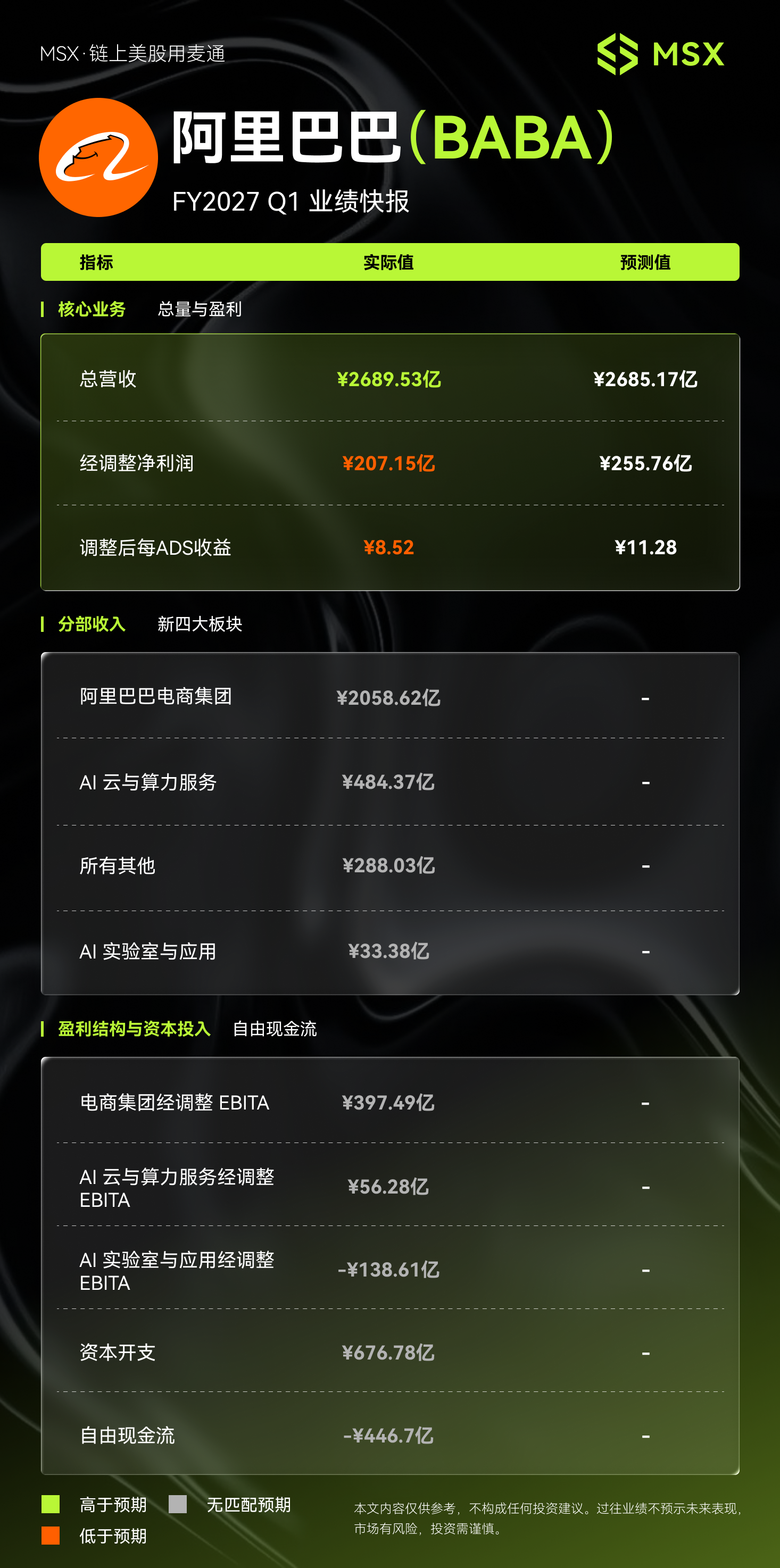
Revenue from Alibaba's AI Cloud and Computing Services grew 45% year-on-year to 48.44 billion yuan this quarter, while overall revenue increased 9% to 268.95 billion yuan, marking the fastest quarterly growth rate in about three years. The scale of AI business is not yet sufficient to replace e-commerce, but it is already significant enough to noticeably boost the group's growth rate.
Of course, commercialization still comes with high costs. Capital expenditures increased by 75% year-on-year, free cash flow showed a net outflow of approximately 44.67 billion yuan, and model training and inference will continue to consume funds. If revenue growth slows, the market will quickly question the return on investment again.
However, compared to two or three years ago, Alibaba's AI story now has an added layer of solid support: it not only has models and users but also product revenue that has grown for 12 consecutive quarters. For BABA investors, the most important metrics to track in the next phase are not how many new models are released, but whether AI-related revenue, cloud business profits, and customer usage can rise simultaneously. As long as these three continue to materialize, Alibaba has the opportunity to gradually turn Qwen's technological influence into genuine, long-term cash flow.