AI Leads Market Trend, Marvell Surges Over 14% in Night Trading, Gold Rises 1%, Aluminum at Four-Year High, Bitcoin Falls Below 70k

华尔街日报Published on 2026-06-02Last updated on 2026-06-02

Abstract

Global markets regained ground after a brief dip, driven by renewed buying in AI-related stocks. The MSCI World Index rose 0.1%, with Asian equities reversing early losses and the Nasdaq 100 futures narrowing declines. Marvell soared over 14% in after-hours trading. Meanwhile, Iran's suspension of talks with the US heightened Middle East tensions, impacting commodities. Brent crude hovered near $94 a barrel, while gold rose about 1%. Aluminum prices hit a four-year high above $3,775 per ton on supply concerns, and copper also gained. Bitcoin fell 1.4% to just over $70,000. Investors remain focused on AI-driven gains—evident in the Philadelphia Semiconductor Index's surge—but some warn of stretched valuations. Upcoming US economic data, including Friday's jobs report, will be closely watched for clues on Federal Reserve policy.

Global stock markets recovered after a brief decline, with renewed buying interest in AI-related stocks boosting market risk appetite; at the same time, Iran's announcement of a pause in talks with the United States has reignited tensions in the Middle East, with geopolitical risks continuing to increase their disturbance on markets.

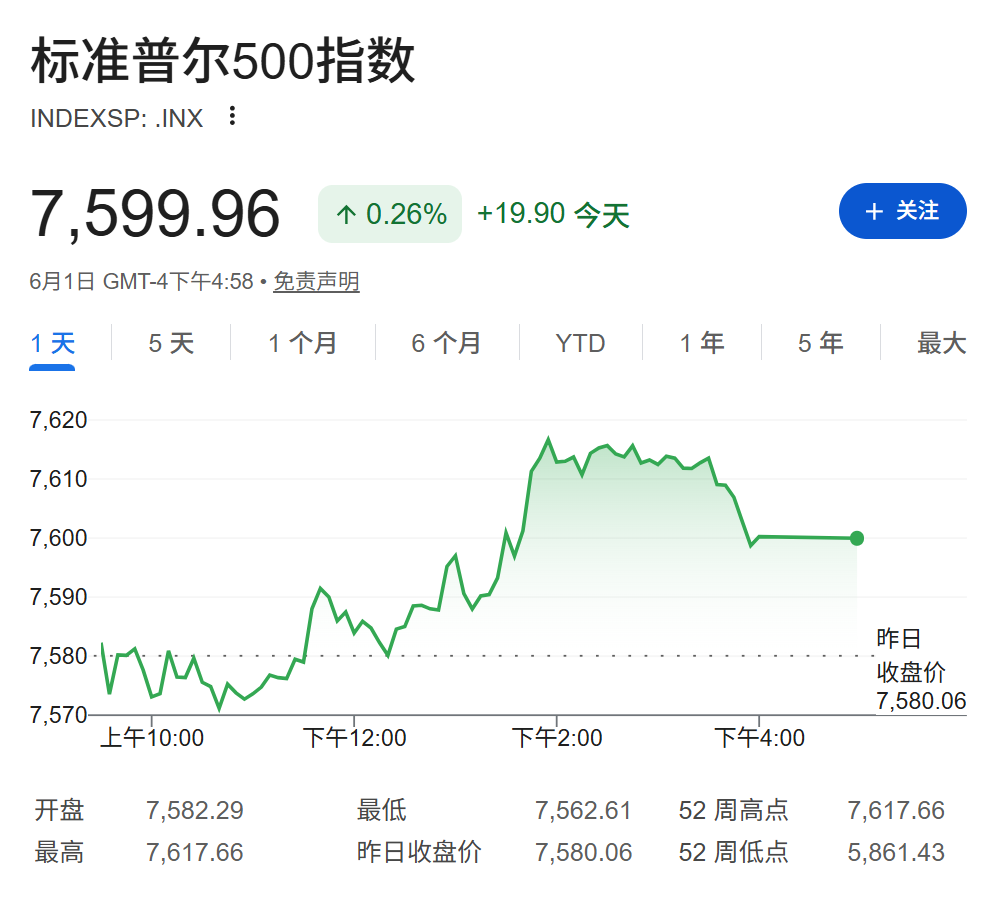
The MSCI World Index rose slightly by 0.1%, staying near its record high, after having fallen as much as 0.2% earlier in the session. Asian stocks rebounded from a drop of up to 1%, climbing 0.3% overall, with South Korea's Kospi—often seen as a bellwether for AI investment—closing up 0.1%, erasing all its losses. Nasdaq 100 index futures narrowed their decline to 0.3%, while Marvell soared over 14% in night trading. European equity futures extended their gains to 0.6%, indicating a return of tech stock buying and a clear improvement in market risk appetite.

In the commodities market, Brent crude oil hovered near $94 per barrel, and the gold price rose about 1% to $4,523 per ounce. Aluminum prices extended gains for a fourth consecutive day, with London Metal Exchange aluminum briefly hitting $3,775 per ton in early trading, its highest level since 2022. Copper prices rose 0.5% to $13,899.50 per ton. Iran's announcement that it was suspending talks, citing Israeli military actions in Lebanon, further heightened market concerns about potential supply disruptions through the Strait of Hormuz.

Hebe Chen, an analyst at Vantage Global Prime, said: "The AI trade isn't over, but after such a stretched rally, it has become hypersensitive to any headline that could potentially reignite the oil-inflation-rates feedback loop—a loop the market took three months to escape."

  • The Nikkei 225 index closed down 0.3% at 66,734.24 points, and the Topix index closed down 0.4% at 3,924.24 points. South Korea's Kospi closed up 0.1%, erasing all its losses.
  • Nasdaq 100 index futures narrowed their decline to 0.3%, while Marvell soared over 14% in night trading. European equity futures extended their gains to 0.6%.
  • Japan's 10-year government bond yield fell after a well-received bond auction, and US Treasury prices also strengthened slightly.
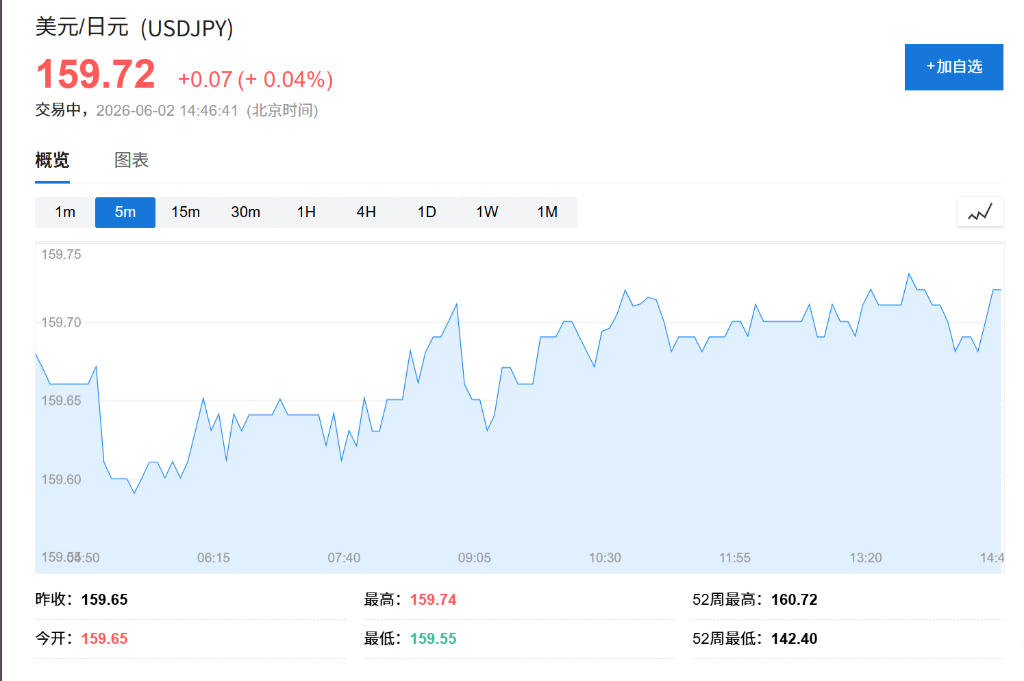
  • The yen held near 159.70 against the US dollar.
  • Gold rose about 1% to $4,523 per ounce.
  • Brent crude oil hovered near $94 per barrel.
  • Aluminum extended gains for a fourth day, with LME aluminum briefly hitting $3,775 per ton, its highest since 2022.
  • Copper rose 0.5% to $13,899.50 per ton.
  • Bitcoin fell 1.4% to $70,386.76.

Sustained strong demand for AI-related stocks has been the core engine driving global equity markets to record highs this year, helping to offset market volatility stemming from Middle East tensions. The S&P 500 recorded its eighth consecutive session of gains on Monday, its longest winning streak since May 2025. The Philadelphia Semiconductor Index (SOX) has surged about 70% over the past two months and is on track for its strongest quarterly performance ever; the chip sector, by a wide margin, has been the best-performing sector in the S&P 500 this year.
However, some investors are beginning to be wary of stretched valuations. Vikas Pershad, a portfolio manager at M&G Investments, said in a Bloomberg Television interview: "The magnitude of the move that we've witnessed has exceeded our expectations. The direction is not surprising, but given where we are, we've cut back on our exposure to memory chips."

Bloomberg strategist Garfield Reynolds also flagged risks: Momentum has dominated equity markets over the past year, meaning any sharp, swift pullback in major indices could trigger a sustained downturn; and if substantive negative macro factors emerge, the AI-driven rally faces cooling pressure.

Aluminum prices have risen about 25% year-to-date, with Middle East hostilities a key driver. The region is a major hub for global aluminum smelting, with several smelters forced to close or reduce output due to the conflict. Iran's latest announcement to pause talks further unsettled the market about regional supply prospects. At the same time, investors are optimistic about the demand outlook for industrial metals, continuing to pour into copper and aluminum markets.
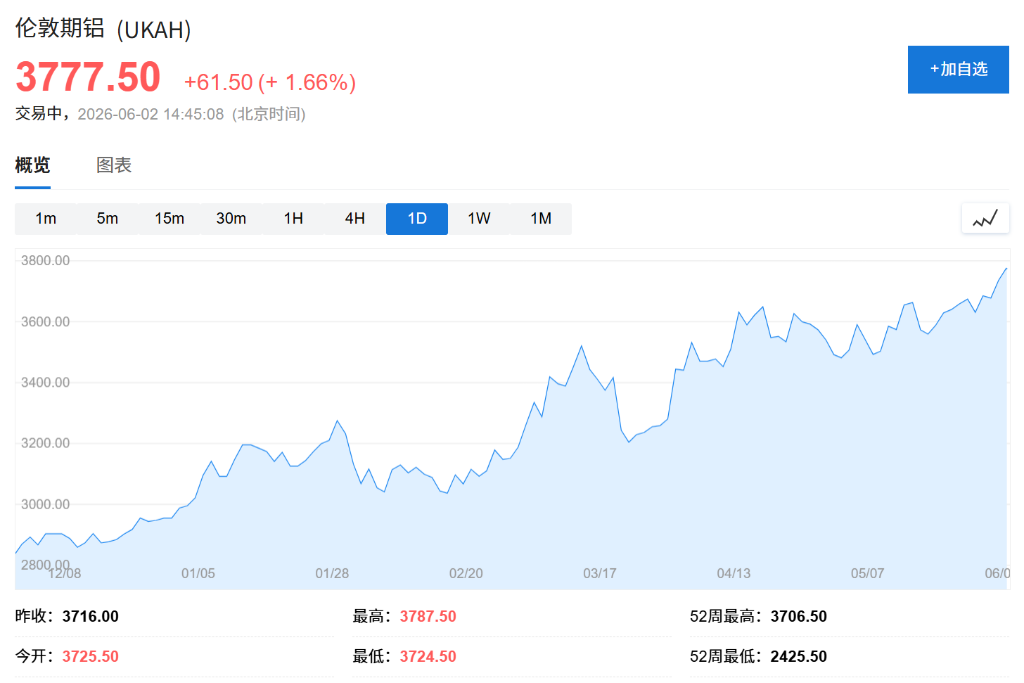
The tightness in the physical market is clearly visible in the futures structure: On Monday, the premium of the LME aluminum cash contract over the three-month contract reached $111.75 per ton, its highest since 2007, indicating a rapidly widening near-term supply deficit and extremely urgent demand for immediate delivery.

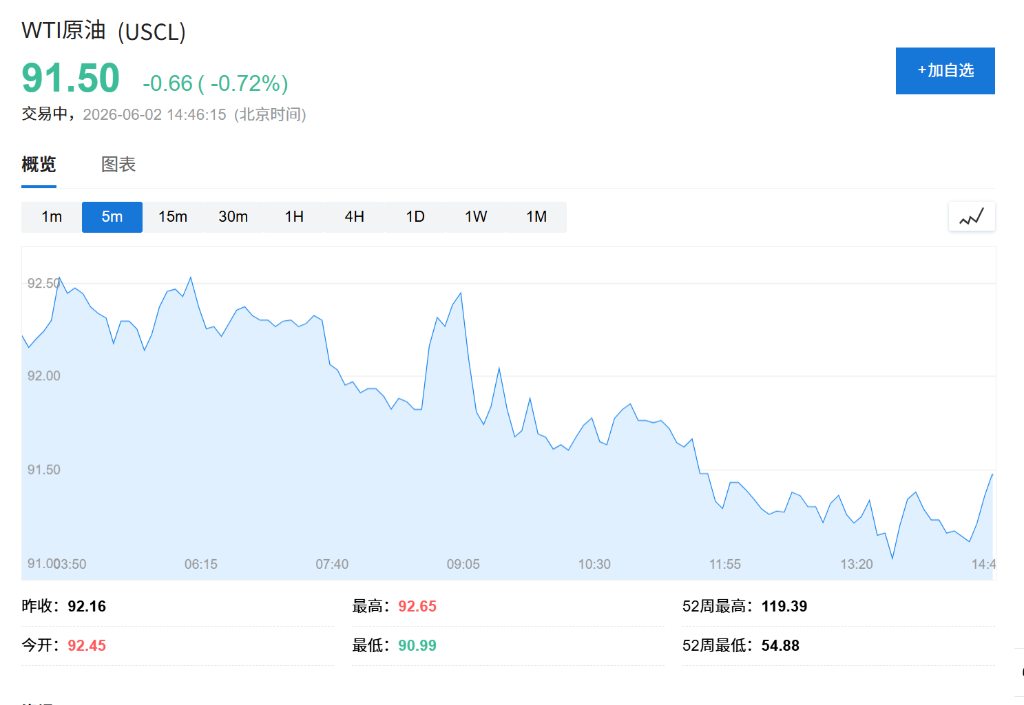
Brent crude oil edged lower near $94 per barrel on Tuesday, having risen on Monday after a phone call between President Trump and Israeli Prime Minister Netanyahu about the Lebanon conflict yielded contradictory accounts. The opposing narratives from the two sides are the latest example of mixed signals regarding ceasefire negotiations. Trump has repeatedly stated that talks are progressing and nearing an agreement, while Iran last week dismissed reports of an imminent interim deal and on Monday said it would coordinate actions with its proxies.
Jason Pride and Michael Reynolds of Glenmede said: "Expectations for a US-Iran deal remain in flux. Recent conflict events and the contradictory statements from both sides indicate that key details remain unresolved."

In other news, the White House announced it would lower tariffs on agricultural machinery such as combine harvesters to reduce production costs for American farmers and manufacturers.

In currency markets, the yen held near 159.70 against the US dollar. Japan's Finance Minister Satsuki Katayama said authorities are ready to take foreign exchange intervention measures if necessary, following the finance ministry's release of monthly intervention data last Friday. Japan's 10-year government bond yield fell after a well-received bond auction, with investors drawn in by the high yields despite lingering Middle East uncertainties. US Treasury prices also strengthened slightly. Among major Asian markets, the Nikkei 225 closed down 0.3% at 66,734.24 points, and the Topix closed down 0.4% at 3,924.24 points.
A busy week of US economic data releases will be another key focus for markets, culminating in Friday's May non-farm payrolls report, from which investors hope to glean clues about the health of the US economy and the policy path of new Federal Reserve Chair Kevin Warsh. Chris Turner, head of FX strategy at ING Bank, wrote in a note on Monday that markets are gradually forming the view that US economic growth is re-accelerating as AI investment spreads deeper into the broader economy, and he expects this week's data to further support the market narrative that "the Fed can comfortably maintain its full employment objective while focusing policy efforts on inflation upside risks."


Trending Cryptos

Related Questions

QWhat was the main driver behind the market's risk appetite and recovery according to the article?

AAccording to the article, renewed buying in AI-related stocks was the main driver that boosted market risk appetite and helped global equities recover from earlier losses.

QWhich commodity price reached a four-year high, and what was cited as a significant factor contributing to its rise?

AAluminum prices on the London Metal Exchange reached a four-year high. The article cites the conflict in the Middle East, a major aluminum smelting hub, which forced several smelters to shut down or reduce output, as a significant factor. Iran's suspension of talks further fueled supply concerns.

QWhy is the AI-driven market rally described as being 'extremely sensitive' to certain headlines?

AThe AI-driven rally is described as 'extremely sensitive' to headlines that could reignite the oil-inflation-interest rate chain reaction. This is because the market spent three months recovering from such pressures, and a renewed cycle could threaten the stretched valuations of the AI sector.

QWhat key US economic report are investors focusing on at the end of the week, and what insights are they hoping to gain from it?

AInvestors are focusing on the US nonfarm payrolls report for May due on Friday. They hope to gain insights into the health of the US economy and clues about the policy path of the new Federal Reserve Chair, Kevin Warsh.

QWhat contradictory statements contributed to the volatility in oil prices and Middle East tensions mentioned in the article?

AContradictory statements from former President Trump and Israeli Prime Minister Netanyahu about their call regarding the Lebanon conflict contributed to the volatility. Trump claimed negotiations were progressing, while Iran refuted reports of an imminent interim deal and later announced a suspension of talks.

Related Reads

Former CFTC Chairman, Circle President Tarbert: Preaching Long-Termism While Cashing Out $30 Million Himself

Former CFTC Chairman and Circle President Heath Tarbert has consistently advocated for a long-term vision in public, urging patience from investors as Circle’s stock price has fallen significantly from its peak. However, it has been revealed that since Circle’s IPO, Tarbert has continuously sold his CRCL shares through pre-arranged trading plans, cashing out approximately $30 million, without making any public market purchases. This contrast between his public messaging and personal actions has drawn criticism. Tarbert joined Circle in July 2023 as Chief Legal Officer, leveraging his regulatory experience to help guide the company through its IPO and expansion. Despite promoting stablecoins as long-term infrastructure, he established a 10b5-1 trading plan just before Circle went public, leading to substantial stock sales over the following year. In March 2026, he initiated another plan to sell more shares. His career trajectory highlights a pattern of moving between high-level regulatory roles and influential positions in the financial sector. After resigning as CFTC Chairman in early 2021, he joined Citadel Securities as Chief Legal Officer just 27 days later, during a period of intense regulatory scrutiny for the firm. He later joined Circle, aiding its efforts to navigate regulatory challenges for its public listing. While Tarbert's expertise in policy and compliance is valuable to companies like Circle, his actions—advocating long-term confidence while personally divesting—raise questions about the alignment between his public statements and his private financial decisions, leaving investors who followed his advice to bear the market risks.

marsbit16m ago

Former CFTC Chairman, Circle President Tarbert: Preaching Long-Termism While Cashing Out $30 Million Himself

marsbit16m ago

Gate Research Institute: The 'Wall Street-ization' Wave of Crypto Financial Products – Competition or Integration?

The article titled "Gate Research Institute: Are Crypto Financial Products Sparking a 'Wall Street' Wave—Competition or Convergence?" explores the evolving relationship between the crypto ecosystem and traditional finance (TradFi). The piece begins by reflecting on Bitcoin's original 2009 vision of decentralization, disintermediation, and moving away from banks. It then contrasts this with the 2024 landscape, where key crypto assets like Bitcoin are increasingly held through Wall Street products like ETFs issued by giants like BlackRock. The article questions whether this signifies that TradFi is systematically taking over the rights to issue, price, custody, and distribute crypto financial assets. The core argument is that this is not a zero-sum takeover but rather a bidirectional convergence where each side addresses the other's weaknesses. Crypto offers 24/7 global markets, programmable settlement, and open access but lacks compliant channels, institutional-grade custody, deep fiat liquidity, and mainstream distribution. TradFi possesses these but is constrained by legacy systems, limited operating hours, and slow settlement. Two primary convergence paths are highlighted: * **Path A (CEX to TradFi):** Exemplified by Gate, which has progressed from offering tokenized stocks and CFDs to providing direct, real stock trading (US, Hong Kong, South Korea) within its platform, using USDT. * **Path B (TradFi to Crypto):** Exemplified by Robinhood, which has integrated crypto trading, acquired exchanges like Bitstamp, and is moving traditional assets like stocks onto the blockchain via tokenization and its own Layer 2. Both paths are ultimately competing to become the next-generation, unified financial account—a "super account" where users can seamlessly trade cryptocurrencies, stocks, ETFs, RWA (Real World Assets), and tokenized treasury products in one interface. The growth of RWA and tokenized treasuries (e.g., BlackRock's BUIDL) is presented as the asset-layer fusion, providing stable, yield-bearing assets on-chain and acting as a bridge between the two worlds. In conclusion, the "Wall Street-ization" of crypto is framed as a mutual transformation. Decentralized ideals persist in the protocol layer, while at the application layer, a more efficient, global, and accessible unified capital market is emerging from this convergence. The future competition lies not between crypto exchanges and stockbrokers, but between platforms vying to offer the most comprehensive asset coverage, liquidity, and user experience within a single account.

marsbit20m ago

Gate Research Institute: The 'Wall Street-ization' Wave of Crypto Financial Products – Competition or Integration?

marsbit20m ago

Claude's Major New Feature: Screen Recording + Voice, Distilling Your Skills into AI Tasks in One Click

Claude has introduced a major new feature called "Record a Skill," available for Pro, Max, and Team users. This function, found in the Claude desktop app's CoWork menu, allows users to create reusable AI skills simply by recording their screen and providing voice narration while performing a task. Claude then automatically analyzes the recording and generates a functional Skill. A hands-on test confirmed the feature works seamlessly. Users start recording via the Skills manager, perform their workflow while verbally explaining the steps and logic, and avoid including sensitive information. After recording, Claude processes the content and creates the Skill, which can be saved and later invoked with a slash command (/). This eliminates the need for manual adjustments or writing complex instruction files. The innovation goes beyond mere efficiency. Previously, creating a Skill required writing a detailed SKILL.md file in Markdown—a significant barrier for non-technical users. "Record a Skill" bypasses this by directly capturing both actions and the implicit reasoning shared in the narration. This lowers the barrier to knowledge transfer and automation, addressing a core challenge in corporate knowledge management: the difficulty of getting experts to write and maintain documentation. However, the feature also highlights a shift in the nature of work. A case study from March 2026 showed a freelancer whose five-year client relationship was effectively replaced by a hand-coded Claude Skill automating their content workflow. With the even lower barrier of screen recording, the ability to distill personal expertise into automatable skills accelerates this trend. The "moat" for work is moving from simply knowing how to do a task to mastering tasks that are difficult or impossible to automate.

marsbit25m ago

Claude's Major New Feature: Screen Recording + Voice, Distilling Your Skills into AI Tasks in One Click

marsbit25m ago

Feeding AI "Noise" Can Also Boost Scores, This Work Enables Positive Transfer with Noise

Feeding "Noise" to AI Can Improve Performance: A Method Enables Positive Transfer from Noise This work, Semi-Supervised Noise Adaptation (SSNA), introduces a Noise Adaptation Framework (NAF) that challenges traditional transfer learning. Instead of requiring a labeled source domain of real data (e.g., images, text), NAF uses randomly generated Gaussian noise as the source. For a target task with C classes, it constructs C noise clusters by sampling from Gaussian distributions. Although this synthetic noise contains no semantic meaning, NAF trains it to form a discriminative class structure in a shared representation space—clustering same-class noise and separating different classes. The key is aligning this learned structure from the noise domain to the real, sparsely labeled target domain. A small number of target labels are still essential to establish the correspondence between noise clusters and actual classes. The training objective combines: 1) supervised loss on the few labeled target samples, 2) classification loss for the noise to build its structure, and 3) a distribution alignment loss (using Negative Domain Similarity) to minimize the gap between the noise and target domains in the shared space. Experiments show significant gains in few-label settings. With just 4 labels per class, NAF with a ResNet-18 backbone improves accuracy over a standard supervised baseline (ERM) by +12.35% on CIFAR-10, +7.61% on CIFAR-100, +4.38% on DTD-47, and +2.74% on Caltech-101. It also benefits fine-grained datasets and scales to ImageNet-1K (with 100 labels/class) and text classification (AG News). NAF can be integrated into existing semi-supervised methods like FixMatch for further gains. Ablation studies confirm the transferred benefit comes from the discriminative structure of the noise, not randomness itself. Collapsing all noise into a single point causes negative transfer, while increasing separation between noise cluster centers improves performance. The amount of noise per class is less critical once a basic structure forms. In conclusion, this work demonstrates that for positive transfer, the semantic content of source data may not be necessary. What can be effectively transferred is the *organizational structure* of categories within a representation space. This offers a promising alternative for scenarios where real source data is unavailable due to privacy, copyright, or procurement constraints.

marsbit26m ago

Feeding AI "Noise" Can Also Boost Scores, This Work Enables Positive Transfer with Noise

marsbit26m ago

Trading

Spot

Hot Articles

What is $BITCOIN

DIGITAL GOLD ($BITCOIN): A Comprehensive Analysis Introduction to DIGITAL GOLD ($BITCOIN) DIGITAL GOLD ($BITCOIN) is a blockchain-based project operating on the Solana network, which aims to combine the characteristics of traditional precious metals with the innovation of decentralized technologies. While it shares a name with Bitcoin, often referred to as “digital gold” due to its perception as a store of value, DIGITAL GOLD is a separate token designed to create a unique ecosystem within the Web3 landscape. Its goal is to position itself as a viable alternative digital asset, although specifics regarding its applications and functionalities are still developing. What is DIGITAL GOLD ($BITCOIN)? DIGITAL GOLD ($BITCOIN) is a cryptocurrency token explicitly designed for use on the Solana blockchain. In contrast to Bitcoin, which provides a widely recognized value storage role, this token appears to focus on broader applications and characteristics. Notable aspects include: Blockchain Infrastructure: The token is built on the Solana blockchain, known for its capacity to handle high-speed and low-cost transactions. Supply Dynamics: DIGITAL GOLD has a maximum supply capped at 100 quadrillion tokens (100P $BITCOIN), although details regarding its circulating supply are currently undisclosed. Utility: While precise functionalities are not explicitly outlined, there are indications that the token could be utilized for various applications, potentially involving decentralized applications (dApps) or asset tokenization strategies. Who is the Creator of DIGITAL GOLD ($BITCOIN)? At present, the identity of the creators and development team behind DIGITAL GOLD ($BITCOIN) remains unknown. This situation is typical among many innovative projects within the blockchain space, particularly those aligning with decentralized finance and meme coin phenomena. While such anonymity may foster a community-driven culture, it intensifies concerns about governance and accountability. Who are the Investors of DIGITAL GOLD ($BITCOIN)? The available information indicates that DIGITAL GOLD ($BITCOIN) does not have any known institutional backers or prominent venture capital investments. The project seems to operate on a peer-to-peer model focused on community support and adoption rather than traditional funding routes. Its activity and liquidity are primarily situated on decentralized exchanges (DEXs), such as PumpSwap, rather than established centralized trading platforms, further highlighting its grassroots approach. How DIGITAL GOLD ($BITCOIN) Works The operational mechanics of DIGITAL GOLD ($BITCOIN) can be elaborated on based on its blockchain design and network attributes: Consensus Mechanism: By leveraging Solana’s unique proof-of-history (PoH) combined with a proof-of-stake (PoS) model, the project ensures efficient transaction validation contributing to the network's high performance. Tokenomics: While specific deflationary mechanisms have not been extensively detailed, the vast maximum token supply implies that it may cater to microtransactions or niche use cases that are still to be defined. Interoperability: There exists the potential for integration with Solana’s broader ecosystem, including various decentralized finance (DeFi) platforms. However, the details regarding specific integrations remain unspecified. Timeline of Key Events Here is a timeline that highlights significant milestones concerning DIGITAL GOLD ($BITCOIN): 2023: The initial deployment of the token occurs on the Solana blockchain, marked by its contract address. 2024: DIGITAL GOLD gains visibility as it becomes available for trading on decentralized exchanges like PumpSwap, allowing users to trade it against SOL. 2025: The project witnesses sporadic trading activity and potential interest in community-led engagements, although no noteworthy partnerships or technical advancements have been documented as of yet. Critical Analysis Strengths Scalability: The underlying Solana infrastructure supports high transaction volumes, which could enhance the utility of $BITCOIN in various transaction scenarios. Accessibility: The potential low trading price per token could attract retail investors, facilitating wider participation due to fractional ownership opportunities. Risks Lack of Transparency: The absence of publicly known backers, developers, or an audit process may yield skepticism regarding the project's sustainability and trustworthiness. Market Volatility: The trading activity is heavily reliant on speculative behavior, which can result in significant price volatility and uncertainty for investors. Conclusion DIGITAL GOLD ($BITCOIN) emerges as an intriguing yet ambiguous project within the rapidly evolving Solana ecosystem. While it attempts to leverage the “digital gold” narrative, its departure from Bitcoin's established role as a store of value underscores the need for a clearer differentiation of its intended utility and governance structure. Future acceptance and adoption will likely depend on addressing the current opacity and defining its operational and economic strategies more explicitly. Note: This report encompasses synthesised information available as of October 2023, and developments may have transpired beyond the research period.

975 Total ViewsPublished 2025.05.13Updated 2025.05.13

What is $BITCOIN

Discussions

Welcome to the HTX Community. Here, you can stay informed about the latest platform developments and gain access to professional market insights. Users' opinions on the price of BTC (BTC) are presented below.

活动图片