AI Billing Black Box Exposed: 1.7 Million Overcharged, Anthropic Refunds But Doesn’t Admit Fault

marsbitPublished on 2026-06-29Last updated on 2026-06-29

Abstract

A startup named Vaudit, founded by former Oracle director Michael Hahn, audits AI bills for companies and claims to have identified approximately $1.7 million in overcharges across 60 businesses, totaling $34 million in reviewed bills. The alleged discrepancies primarily involve charges for Anthropic's Claude Code. Common issues cited include billing for newer, more expensive models when older, cheaper ones were used; charging for failed or errored requests; and "retry storms" where AI agents silently retry failed tasks, accumulating costs unnoticed. Major clients like Panasonic, HP, and Honda were among those audited. While Vaudit reports that around 80% of the disputed charges were refunded by providers like Amazon, Google, Microsoft, Anthropic, and OpenAI after申诉, the AI companies largely deny systemic problems. Anthropic stated overcharges do not appear widespread and it does not bill for uncompleted requests or errors, while OpenAI said it found no evidence of such issues affecting its customers. The situation highlights the inherent opacity and complexity of AI billing, which is based on token usage that is difficult to track and predict, especially with multi-agent, multi-model workflows. This complexity is creating a new market for third-party AI bill auditing services like Vaudit, which charges fees based on recovered amounts. Separately, Anthropic faces a proposed class-action lawsuit alleging its high-tier subscription plans deliver far less usage than advertis...

A former Oracle director named Michael Hahn has recently started a business exposing fake AI bills.

His company, Vaudit, examined AI bills totaling approximately $34 million from 60 companies, primarily for the use of Claude Code, and identified about $1.7 million in overcharges.
The Information reported: The auditing firm Vaudit stated that it identified about $1.7 million in suspected overcharges in the corporate AI bills it handled, mainly involving Claude Code.

The audited client list included major corporations such as Panasonic, HP, and Honda.

But if you ask the two AI giants on the other side of the bills, you get a different version.

Anthropic says it does not charge for unfulfilled requests or errors, nor does it secretly route requests to older models, and overcharging does not appear to be a widespread phenomenon.

OpenAI is more direct: there is no evidence that these issues occurred with its customers.

Both sides claim there is no problem.

However, after rounds of appeals by Vaudit and its clients, about 80% of these disputed amounts were ultimately refunded by Amazon, Google, Microsoft, Anthropic, and OpenAI.

Hahn says these companies were very cooperative when issues arose, agreeing to refund the money but refusing to admit any mistake.

Thus, the situation becomes strange: the auditing firm points to the ledger saying "I found it," about 80% of the overcharges were refunded, yet the model vendors collectively shrug and say "nothing happened."

If everyone claims there's no mistake, how did these refunds come about?

How Did This 1.7 Million Become "Excess"?

First, let's see what Vaudit uncovered.

Michael listed three of the most common overcharging methods, each hidden in inconspicuous corners of the bill where no one would normally check line by line.

The first: model misassignment.

The client actually called an older, cheaper model, but the bill was calculated based on a newer, more expensive tier.

For example, you bought an economy-class seat but were charged a first-class price. It's unnoticeable once or twice, but after millions of calls, the price difference becomes apparent.

The second: paying for failure.

An agent or chatbot that fails to complete a request, or even directly returns an error, is still included in the bill.

The third is the most insidious. Hahn calls it a "retry storm." An agent task fails, and it silently retries repeatedly in the background. The user has no idea money is being burned in the background, and the costs stack up layer by layer.

None of these three are caused by the user "actively using more."

The third one is the most frightening.

In the past, when you used software, you monitored it step by step, and could immediately stop it if it went haywire.

But the selling point of AI agents is precisely "let it work on its own," with the human stepping out of the process.

This means that when an AI agent hits a wall, retries, hits another wall, and burns tokens like crazy in the background, the person who would normally call a stop doesn't know about it, and the bill doesn't arrive until the end of the month.

Anthropic, OpenAI: We Didn't Overcharge

The point of this matter is not "who cheated whom."

Vaudit found it, but Anthropic and OpenAI didn't admit it. This is just the auditing firm's version. One cannot simply label the two companies as overchargers based on the phrase "found 1.7 million."

But they did cooperate when it came to refunds. The fact that 80% was refunded at once precisely shows that this 80% shouldn't have been charged in the first place.

Refunds are error corrections. The money is back, but the account is still a mess.

The reason for this "refund without admission" stalemate lies in the inherent algorithm of the AI billing business itself.

Why AI Bills Are Inherently Incomprehensible

The problem might not be "miscalculation," but "inherently impossible to calculate clearly."

Because it charges based on token usage—the more you use, the more you pay; the more complex the usage, the more you pay. Yet tokens are essentially invisible in the infrastructure dashboards you commonly use.

What's more troublesome is that it can fluctuate wildly. Asking the same question, depending on which model is used, how the prompt is written, and how the agent is orchestrated, the tokens burned can differ by orders of magnitude.

The more models move towards being "agentic," the more tokens they consume. An agent running a task for you could involve dozens or even hundreds of model calls in the background, each burning money.

Inherently unpredictable and hard to explain—this is how the ambiguous zone of "overcharging" emerges.

Hahn's words hit the nail on the head: AI bills are becoming increasingly opaque. This statement precisely hits the soft spot of the entire industry.

AI has evolved from the earliest "per-call billing" to today's "multi-model + multi-agent + cloud intermediary," stretching the billing chain longer and longer: the model vendor charges once, the cloud vendor charges once, and the SDK agent in the middle adds another layer.

Each layer looks reasonable on its own, but when the three are stacked together, it's hard to see at a glance where the money was actually spent.

What's even more critical is that money is often not burned where you can see it.

The scenarios that truly eat up the bill are almost all hidden in the background, and each one has publicly available GitHub issues or incident reports that can be checked.
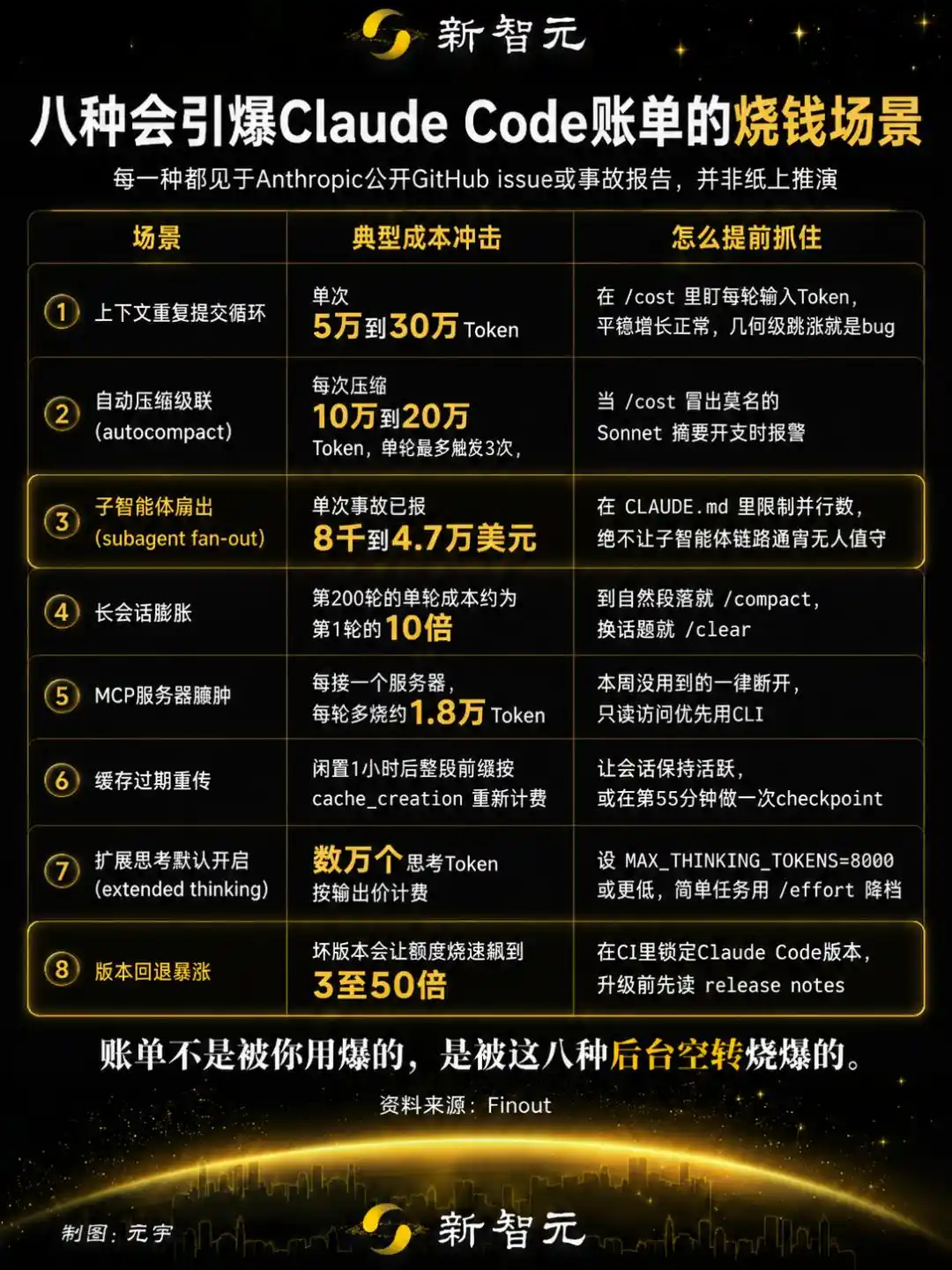
After looking at these eight scenarios, you'll find that either the context is repeatedly retransmitted, or sub-agents run idly overnight with no one watching, and the bill just grows larger and larger on its own, out of sight.

$200 Subscription, $50,000 Bill

This is not the first time Anthropic has faced challenges with AI billing.

On June 15, a client from Washington D.C., Karl Kahn, sued Anthropic in federal court, accusing it of failing to deliver on high-priced subscriptions.
According to The Wall Street Journal, Anthropic's Max 5x costs $100 per month, and Max 20x costs $200 per month. The advertised selling point was 5 times and 20 times the usage limits of the Pro plan, respectively.

But Kahn says the actual usable amount is far lower than advertised.

He upgraded to Max 20x in April this year, but within weeks, he hit the weekly usage ceiling. One 5-hour sprint directly burned through 15% of his weekly quota.

He was left with only three options: stop work, use sparingly, or pay more for additional purchases.

The basis of this lawsuit is primarily a batch of emails sent by Anthropic in July 2025 to subscribers of different tiers, which specified the approximate weekly usage for each tier.

The plaintiff used these black-and-white emails to compare against the actual quotas received, concluding they were "far below the advertised amount."

The lawsuit seeks class-action status, covering all individuals who purchased these two tiers since April 2025.

Finding Errors in AI Bills Is Becoming a Business

Vaudit, which "exposes" AI bills, was founded in 2023 and has a team of about 30 people.

Founder Hahn is a former Oracle director. His old trade was auditing bills for logistics, transportation, advertising, and cloud services—essentially, he specialized in helping people "check accounts and save money."

Earlier this year, he applied this skill directly to AI bills.
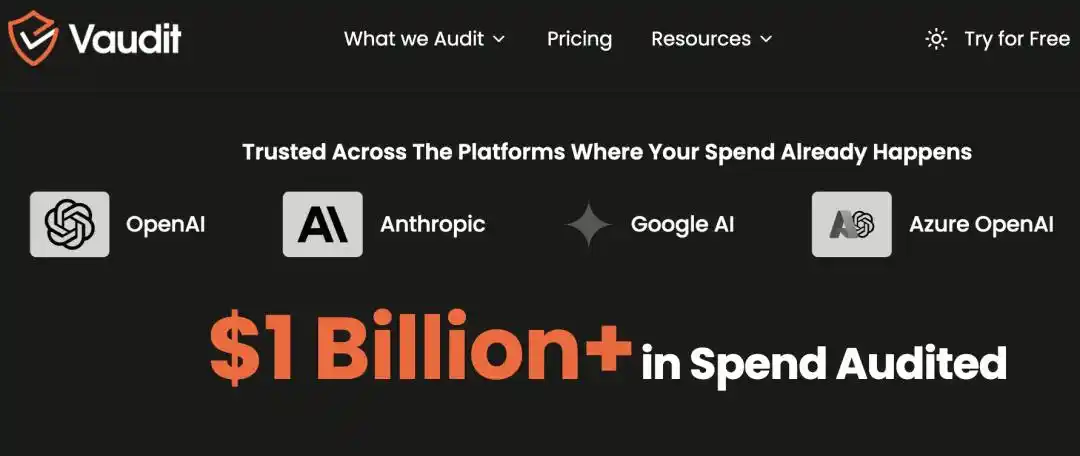
Vaudit's website states that it monitors and recovers every penny of your AI spending, having audited over $1 billion to date.

Vaudit's method is straightforward:

Clients install a piece of software into their AI environment, typically via a Software Development Kit (SDK), which quietly captures raw data on AI usage. This data is then compared line by line with invoices and bills. If they don't match, Vaudit files appeals on the client's behalf.

The fee structure is also direct: 1% of the audited amount, plus 30% of the recovered money. The more they recover for you, the more they earn themselves.

The fact that specializing in finding errors in AI bills can become a business in itself shows: AI billing has become so complex that hiring a "third-party auditor" is now necessary.

And all of this happens at a微妙 (subtle) point in time.

Both Anthropic and OpenAI are sprinting toward IPOs, rushing to pack new features for customers. On one side is the狂奔 (galloping) valuation and revenue, and on the other side are paying users frowning at incomprehensible bills.

Thus, a completely new profession has emerged: the "bill tax accountant" of the AI era.

And who has calculated that AI bill in your hand?

References:

https://www.theinformation.com/newsletters/applied-ai/anthropic-customers-find-errant-charges-auditing-startup-says?rc=epv9gi

This article is from the WeChat public account "New Zhiyuan," author: ASI Apocalypse.

Trending Cryptos

Related Reads

Goldman Sachs In-Depth Report: Who Will Be the Long-Term Winners in China's AI Large Model Industry?

Goldman Sachs Report: China's AI Models at an Inflection Point China's open-source/open-weight large language models (LLMs) have reached performance parity with top global proprietary models, according to a Goldman Sachs report. This is driven by architectural innovations and higher parameter efficiency, allowing Chinese models to achieve comparable capabilities at 2%-10% the parameter size and significantly lower cost. The market is evolving into a two-tiered structure: a high-end segment (e.g., GLM5.2, Qwen3.7 Max) with premium pricing and a low-end, price-sensitive segment for global SMEs and individual users. Key points: * **Cost & Performance:** Innovations like Mixture of Experts (MoE) enable high performance with smaller models. Projects like Meituan's LongCat 2.0, trained on domestic hardware, highlight progress in tech self-sufficiency. * **Open-Source Strategy:** Most Chinese players use open-source/open-weight models for flexibility and ecosystem growth. However, Goldman notes this may underreport actual deployment and revenue. A shift toward "open-weight + community license" models with revenue sharing (e.g., MiniMax) could improve monetization. * **Market Shift & Global Expansion:** Enterprise AI adoption is shifting from "token maximization" to "ROI-first." International expansion, especially in non-US markets, is a major growth driver. Chinese models are increasingly available on global platforms like AWS Bedrock and Microsoft Copilot. * **Competitive Landscape:** Using a framework based on pricing power, cost advantage, and financial strength, Goldman identifies **Zhipu AI and DeepSeek** as the strongest in foundational text models, and **ByteDance** as the leader in multimodal/video generation. The report maintains Buy ratings on MiniMax and Kuaishou. * **Market Growth:** China's AI model API and subscription revenue is projected to grow from an estimated ¥35 billion in 2026 to ¥879 billion by 2030.

marsbit11m ago

Goldman Sachs In-Depth Report: Who Will Be the Long-Term Winners in China's AI Large Model Industry?

marsbit11m ago

Goldman Sachs Deep Dive Report: Who Will Become the Long-Term Winners in China's AI Large Model Industry?

Goldman Sachs Report: Who Will Be the Long-Term Winners in China's AI Large Model Industry? China's AI large model sector is at a historic inflection point. Goldman Sachs argues that the intelligence of Chinese open-source/open-weight models is approaching top global proprietary models. Rapid adoption by domestic enterprises and global SMEs is creating a data flywheel effect that will further drive model iteration. The evolution is summarized as moving from "DeepSeek's cost-efficiency moment last year to GLM's model-intelligence moment this year." Chinese models achieve near-state-of-the-art performance at significantly lower cost, primarily due to architectural innovations like Mixture of Experts (MoE) and higher parameter efficiency. Models like DeepSeek V4 Pro (1.6T params), GLM5.2 (0.7T), and MiniMax M3 (0.4T) are much smaller than global leaders. Recent advancements in coding capability are attributed to better data curation and RLHF. Landmarks like Meituan's LongCat 2.0, trained fully on domestic AI chips, demonstrate progress in hardware stack independence. The market is forming a "two-tiered structure." The high-end tier (e.g., GLM5.2, Alibaba's Qwen3.7 Max) prices around $1 per million tokens, about 10-25% of US top models, with estimated inference gross margins of 10-20%. The low-end tier (priced as low as $0.06-$0.2 per million tokens) targets price-sensitive global SMEs and individuals. MiniMax derives 60-70% of revenue overseas. Goldman forecasts China's AI model API/subscription revenue to grow from an estimated RMB 35bn in 2026 to RMB 879bn by 2030. Most Chinese players adopt open-source/open-weight strategies for deployment flexibility and community feedback, though this limits monetization as deployments on third-party platforms (e.g., Alibaba Cloud) may not generate direct revenue. A shift towards "open-weight + community license" models with revenue-sharing agreements (like MiniMax's approach) could improve unit economics. International expansion, particularly in non-US markets, is the key growth driver. The global enterprise AI paradigm is shifting from "token maximization" to "ROI prioritization." Chinese models are already hosted on major global platforms like AWS Bedrock and are under consideration for integration into Microsoft Copilot. Using a competitive framework based on pricing power, cost advantage, and financial strength, Goldman identifies the strongest players: In foundational text models, Zhipu AI (initiated coverage) and DeepSeek lead. In multimodal/video generation, ByteDance's Seed is the frontrunner, with Kuaishou's Kling and MiniMax's Hailuo also well-positioned. Goldman maintains a Buy rating on MiniMax, citing its attractive valuation.

链捕手15m ago

Goldman Sachs Deep Dive Report: Who Will Become the Long-Term Winners in China's AI Large Model Industry?

链捕手15m ago

Is Ethereum Truly a "World Computer"?

Title: Is Ethereum Really a "World Computer"? Ethereum, envisioned as a "world computer" by its founder Vitalik Buterin, aims to be a decentralized platform for global applications. However, a recent analysis by Four Pillars raises questions about whether it is more accurately a "Western computer," based on the geographical distribution of its validators. Currently, the United States dominates with 38.19% of all validators, followed by Germany at 13.04%. Combined, these two countries account for over half of the network. In contrast, Asian representation is minimal, with Singapore holding only 3.15%. The concentration is partly due to affordable cloud hosting services like Hetzner and OVH in Europe and North America, as well as the prevalence of residential validators in the U.S., where individuals run nodes via home internet connections. When examining professionally operated validators, the distribution becomes more balanced. The U.S. share drops to 25.81%, while Asian countries like Singapore (7.28%), Hong Kong (6.44%), Japan (6.38%), and South Korea (4.59%) collectively approach the U.S. level. This shift reflects strategic deployments by institutions to meet regulatory requirements and reduce latency for local users. However, regions like South America, the Middle East, and Africa remain underrepresented. Ethereum's peer-to-peer network mechanisms, such as gossipsub, disadvantage areas with low node density, creating a feedback loop where delayed message propagation reduces validator performance and rewards. This imbalance challenges Ethereum's promises of censorship resistance and global accessibility. Despite these issues, opportunities exist for growth in underrepresented regions. As demand for localized staking infrastructure rises, early entrants in areas like the Middle East could establish dominant positions by offering compliant, low-latency solutions. The evolving validator landscape highlights both the structural challenges and the potential for Ethereum to move closer to its "world computer" ideal.

Foresight News2h ago

Is Ethereum Truly a "World Computer"?

Foresight News2h ago

Trading

Spot

Hot Articles

How to Buy T

Welcome to HTX.com! We've made purchasing Threshold Network Token (T) simple and convenient. Follow our step-by-step guide to embark on your crypto journey.Step 1: Create Your HTX AccountUse your email or phone number to sign up for a free account on HTX. Experience a hassle-free registration journey and unlock all features.Get My AccountStep 2: Go to Buy Crypto and Choose Your Payment MethodCredit/Debit Card: Use your Visa or Mastercard to buy Threshold Network Token (T) instantly.Balance: Use funds from your HTX account balance to trade seamlessly.Third Parties: We've added popular payment methods such as Google Pay and Apple Pay to enhance convenience.P2P: Trade directly with other users on HTX.Over-the-Counter (OTC): We offer tailor-made services and competitive exchange rates for traders.Step 3: Store Your Threshold Network Token (T)After purchasing your Threshold Network Token (T), store it in your HTX account. Alternatively, you can send it elsewhere via blockchain transfer or use it to trade other cryptocurrencies.Step 4: Trade Threshold Network Token (T)Easily trade Threshold Network Token (T) on HTX's spot market. Simply access your account, select your trading pair, execute your trades, and monitor in real-time. We offer a user-friendly experience for both beginners and seasoned traders.

12.3k Total ViewsPublished 2024.03.29Updated 2026.06.02

How to Buy T

Discussions

Welcome to the HTX Community. Here, you can stay informed about the latest platform developments and gain access to professional market insights. Users' opinions on the price of T (T) are presented below.

活动图片