AI Benefits Senior Staff? 40% of CEOs Plan to Cut Junior Positions, Young People's Jobs Are More at Risk

marsbitPublished on 2026-05-18Last updated on 2026-05-18

Abstract

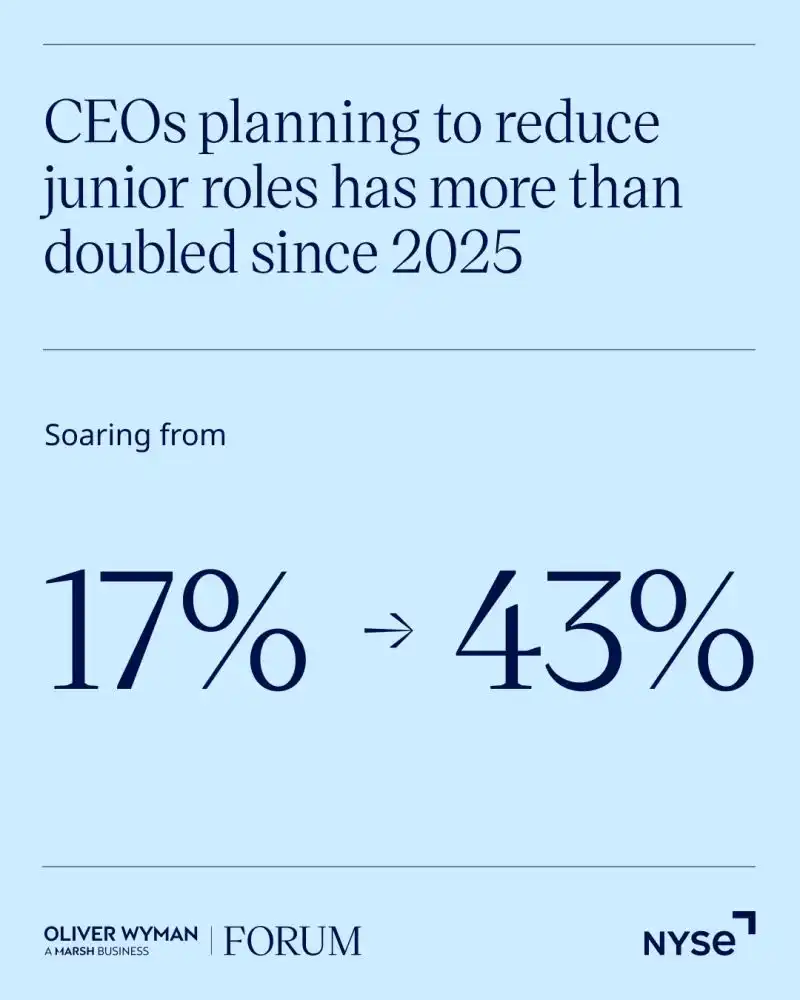
The traditional assumption that senior employees are first in line during layoffs is being inverted in the AI era. A survey of 415 CEOs by Oliver Wyman and the NYSE reveals 43% plan to cut entry-level positions in the next 1-2 years to shift towards a mid-to-senior talent structure, a sharp rise from 17% last year. The logic is that AI excels at automating routine, cognitive tasks typically handled by junior staff (e.g., coding, data review), while the experience and judgment of senior employees remain harder to replicate. Research indicates this shift primarily manifests as a hiring freeze for junior roles rather than mass layoffs. Goldman Sachs estimates AI currently nets a loss of about 16,000 US jobs monthly, disproportionately impacting Generation Z concentrated in highly automatable white-collar roles. This raises long-term concerns about a broken talent pipeline, as companies risk having no future senior managers trained internally. Despite the dominant trend, a minority of successful AI adopters, like IBM and Salesforce, are expanding junior hiring, arguing these employees are adept at using and building AI tools. However, most companies are still in early AI deployment phases, with 67% in planning/pilot stages and many reporting returns below expectations. The overarching reality is a weakening of job security across all levels, as organizations reshape for an AI-augmented, leaner future.

Author: Claude, Shenchao TechFlow

Shenchao's Insight: A recent survey of 415 global CEOs by Oliver Wyman in partnership with the New York Stock Exchange shows that 43% of CEOs plan to reduce junior positions in the next one to two years, shifting their workforce composition towards mid- to senior-level talent. This figure has more than doubled from 17% last year. AI is systematically replacing routine tasks typically handled by junior employees, while experienced employees become more valuable due to their judgment and expertise. Goldman Sachs previously estimated that AI is eliminating a net of approximately 16,000 US jobs per month, with Generation Z being the most affected.

In past waves of layoffs, older, higher-paid employees were often the first targets. But the logic of the AI era is reversing this trend.

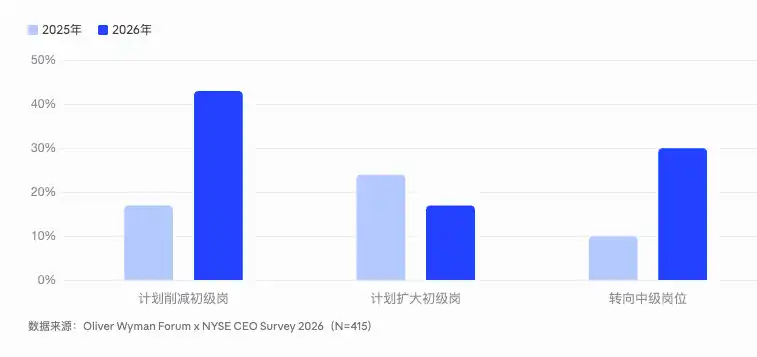
According to a Bloomberg report on May 16th, the 2026 CEO Agenda survey released by management consultancy Oliver Wyman and the New York Stock Exchange reveals that over 40% of CEOs plan to reduce junior positions in the next one to two years, tilting their workforce structure towards more mid- to senior-level employees; only 17% of CEOs indicated they would increase the proportion of junior roles. A year ago, these numbers were almost the opposite.

The survey covered 415 CEOs (266 from public companies, 149 from private companies), with the public company sample representing about 10% of global market capitalization, including 65 Fortune 500 CEOs.

John Romeo, Head of the Oliver Wyman Forum, told Bloomberg in an interview, "The difficulty for junior employees to enter the workforce is indeed increasing. CEOs now place greater emphasis on mid- to senior-level employees to drive productivity."
43% of CEOs Plan to Cut Junior Positions, AI's 'Experience Bias' Effect Emerges

The logic behind this shift is not hard to understand: the tasks that AI agents are currently capable of performing are highly concentrated in the typical scope of work for junior employees. Writing code, evaluating sales leads, reviewing documents, compiling data reports—these routine cognitive tasks previously handled by junior staff are being rapidly replaced by AI systems.

However, what AI currently cannot replicate is the judgment formed through years of industry experience. Future of work advisor Ravin Jesuthasan told Bloomberg that the corporate attitude is shifting to "I need someone who has actually done this, because her experience, judgment, and problem-solving ability make her more valuable than the AI."

This phenomenon has data support in academia. A paper by Harvard University researchers Seyed M. Hosseini and Guy Lichtinger analyzed resume and hiring data covering 62 million employees and 285,000 US companies. The results show that since early 2023, among companies actively adopting generative AI, the number of junior employees decreased by 7.7% over six quarters compared to non-adopting firms, while the number of senior employees was largely unaffected. A key finding is that this decline primarily stems from a hiring slowdown, not large-scale layoffs. In other words, they are not firing people, but simply not hiring them.
The Oliver Wyman report states the implication of this trend more bluntly: "CEOs with the longest planning horizons are the most likely to plan for headcount reductions. This suggests they anticipate that organizations will become leaner, enhanced by AI, not as a cost-cutting measure, but as an end-state."

Goldman Sachs Estimates: AI Net Eliminates 16,000 US Jobs Monthly, Generation Z Bears the Brunt

Goldman Sachs economist Elsie Peng estimated in an April research report that the AI substitution effect eliminated about 25,000 jobs per month over the past year, while the AI augmentation effect created about 9,000 jobs per month in the same period, resulting in a net elimination of about 16,000 jobs. Frontierbeat

The impact is highly unevenly distributed. In occupations with the highest exposure to AI substitution, the unemployment rate gap between entry-level workers under 30 and experienced workers aged 31 to 50 has widened significantly compared to pre-pandemic levels. The wage gap has also worsened concurrently; Goldman's regression analysis estimates that for every one standard deviation increase in AI substitution exposure, the wage gap between entry-level and experienced workers widens by approximately 3.3 percentage points. Fortune

Generation Z is disproportionately concentrated in routine white-collar roles such as data entry, customer service, legal support, and billing processing—precisely the areas AI is most adept at automating. They lack the experiential buffer that senior employees possess. Fortune

A Stanford University study from last November further confirms this: in fields with the highest AI exposure, young employees are 16% more likely to be unemployed than other groups. Fortune

Long-Term Risks of a Broken Talent Pipeline

While cutting junior positions can lower costs and improve efficiency in the short term, the hidden costs are raising alarms.

Helen Leis, Global Head of Leadership and Change at Oliver Wyman, pointed out to Bloomberg that if companies want to have mid- to senior-level talent to manage AI-driven workflows in the future, "these people need to first learn the job within the company." Not hiring junior employees is akin to cutting off one's own talent pipeline.

Andrew McAfee, co-director of MIT's Initiative on the Digital Economy, previously expressed similar concerns to the Harvard Business Review: "Other than on-the-job learning and apprenticeship training, how are people supposed to learn how to do a job?"

Monster survey data shows that nearly 90% of the class of 2026 are worried that AI or automation will replace entry-level positions, a sharp rise from 64% in 2025. Fortune

These concerns are not unfounded. According to a SignalFire report, from 2023 to 2024, the hiring volume for junior positions at the 15 largest US tech companies fell by 25%. The situation in the UK is more severe, with graduate roles in the tech sector decreasing by 46% in 2024, projected to drop another 53% by 2026. IEEE SpectrumRezi

A Few Companies Go Against the Grain: AI 'Winners' Actually Value Junior Employees More

Interestingly, companies most successful in AI deployment are adopting a different talent strategy.

The Oliver Wyman report points out that "a cohort of contrarian, advanced AI adopters believe this technology is increasing the value of junior talent, not displacing them." Among companies with higher ROI from AI investments, the proportion leaning towards increasing junior positions is higher than among those not yet seeing returns.

IBM announced in February this year its plan to triple its hiring of US junior positions and rewrite job descriptions for the AI era. Salesforce CEO Marc Benioff announced this week the hiring of 1,000 recent graduates and interns to build its AI systems, writing on platform X: "They say AI will kill junior jobs. But these grads & interns are BUILDING AI." Amazon Web Services CEO Matt Garman publicly stated that replacing junior employees with AI is "one of the dumbest decisions a company can make," reasoning that junior employees are often the most proficient users of AI tools.

However, these cases remain the minority in the overall trend. The Oliver Wyman survey shows that 74% of CEOs are freezing or reducing headcount, up from 67% last year. The most aggressive cuts are happening in the technology, media, and telecom industries.

AI's ROI Dilemma: Most Companies Still in the 'Money-Burning Experimentation' Stage

There is a significant gap between CEOs' confidence in AI's ability to change workforce structures and the actual returns AI is delivering.

The Oliver Wyman survey reveals that 67% of corporate AI deployments remain in the planning and pilot stages. 53% of CEOs say it is too early to assess AI investment returns, a figure that has increased from 41% last year. Only 27% of CEOs report that AI investment returns meet or exceed expectations, down from 38% last year. Nearly a quarter say AI has had no impact on revenue whatsoever.

The report describes this as "not a crisis of confidence, but a recognition that redesigning work at scale is slower and more difficult than initial enthusiasm anticipated."

However, the report also notes that companies deploying AI across more than two application areas report cost savings and revenue growth roughly double that of companies with single-scenario deployments. The value curve for AI is non-linear, with real returns concentrated after scaled deployment.

A statement by economist Teresa Ghilarducci of The New School to Bloomberg perhaps sums up the current situation: Even if AI tilts the workplace balance in favor of experienced employees, it does not mean they have gained job security. "Companies are increasingly less committed to their employees."


Related Questions

QAccording to the Oliver Wyman survey, what is the key change in CEO hiring plans for junior positions?

AOver 40% of CEOs plan to reduce junior positions over the next one to two years, shifting their workforce structure towards more mid- to senior-level talent. This figure has more than doubled from 17% the previous year, representing a significant reversal in hiring strategy.

QWhat is the 'seniority bias' effect of AI on the workforce mentioned in the article?

AThe 'seniority bias' effect refers to the trend where AI is systematically automating routine, cognitive tasks typically performed by junior employees (e.g., coding, document review, data reporting). Meanwhile, senior employees, whose value lies in experience, judgment, and complex problem-solving abilities that AI cannot yet replicate, are becoming more valuable and less likely to be replaced.

QWhat does the Goldman Sachs research cited in the article say about AI's net impact on US jobs?

AGoldman Sachs economists estimate that AI is currently displacing about 25,000 US jobs per month while simultaneously creating around 9,000 new ones. This results in a net loss of approximately 16,000 jobs per month, with Generation Z workers being disproportionately affected.

QWhat long-term risk does cutting junior positions pose to companies, according to experts in the article?

ACutting junior positions risks severing a company's talent pipeline. Experts warn that future mid- and senior-level leaders, who will need to manage AI-driven workflows, must first learn the business from within the company. By not hiring and training junior employees, companies are undermining their own long-term succession planning and leadership development.

QHow do the most successful AI-adopting companies differ in their approach to hiring junior staff, according to the article?

AA minority of successful, advanced AI adopters are taking a counter-trend approach. Companies like IBM, Salesforce, and Amazon Web Services are expanding hiring for junior roles. They view AI as a tool that enhances the value of junior talent (who often become skilled AI users) rather than simply replacing them, and they are actively recruiting graduates to help build and work with AI systems.

Related Reads

Deconstructing the U.S. Stock Quantum Computing Sector: IonQ, Rigetti, D-Wave, Which of These Concept Stocks is Worth Betting On?

**Title:** Analyzing the US Quantum Computing Race: IonQ, Rigetti, D-Wave – Which Concept Stock is Worth Betting On? **Summary:** The podcast discusses the resurgence of quantum computing as a national priority for both the US and China, driven by its potential to break current encryption, revolutionize drug discovery, finance, and logistics. The core challenge is commercializing the technology, which is hampered by high error rates in quantum bits (qubits). Quantum error correction, requiring thousands of physical qubits per reliable logical qubit, is key but years away. The analysis compares three main publicly traded US quantum computing firms: * **IonQ (Ion Trap):** Considered the most financially stable with the fastest commercial progress (2025 revenue: $130M, +202%) and high-quality clients. Its valuation is very high, pricing in significant future growth. * **Rigetti (Superconducting):** Seen as the highest-risk, highest-potential-reward bet. It has the smallest revenue but recently launched a 108-qubit system. Its valuation multiples are extreme, making it highly sensitive to news. * **D-Wave (Quantum Annealing):** Has the most unique positioning with real-world enterprise clients today (e.g., Mastercard, Volkswagen) solving optimization problems. Its recent acquisition moves it into general-purpose quantum computing ("dual-platform"), adding execution risk. Major tech giants like Google, IBM, and Microsoft are also heavily invested, pursuing various technical approaches. Nvidia is positioning itself as the essential bridge between classical and quantum computing. The investment phase is likened to AI in 2018-2020: promising underlying technology with accelerating breakthroughs but a commercial inflection point still 3-7 years away, suggesting potential for a market correction ("bubble washout"). For investors, suggested approaches include gaining exposure through tech giants with quantum divisions (e.g., Google, IBM) or using niche ETFs like WQTM for pure-play quantum exposure, rather than direct stock picks in the highly volatile pure-play companies at this early stage.

marsbit11m ago

Deconstructing the U.S. Stock Quantum Computing Sector: IonQ, Rigetti, D-Wave, Which of These Concept Stocks is Worth Betting On?

marsbit11m ago

From Parallel Finance to Mainstream Finance: The On-Chain Securities Era Ushers in a Historic Window

From Parallel Finance to Mainstream: The Dawn of On-Chain Securities For over a decade, the crypto industry has operated as a parallel financial system with its own currencies, markets, and assets—from Bitcoin and ICOs to DeFi, NFTs, and memecoins. Despite building a robust internal ecosystem, a wall has separated it from the traditional financial world. That barrier is now crumbling. The industry's first act was one of internal evolution: ICOs streamlined fundraising, DeFi recreated financial services on-chain, and layer-2 networks competed for scalability—all within the crypto bubble. While innovative, this cycle remained closed, with capital and users circulating internally, leading to volatile boom-bust cycles. Even Bitcoin ETFs, while attracting Wall Street capital, merely provided a channel to buy crypto assets without bridging the systems. The next, larger narrative is Real-World Assets (RWA) moving on-chain. This involves tokenizing stocks, bonds, funds, and future cash flows. Blockchain can compress the complex traditional processes of trading, settlement, clearing, and custody into a seamless, automated network operating in seconds. This shift is creating a new financial gateway: the native crypto securities broker. This entity will combine functions of an exchange, broker, bank, and custodian into a unified global financial operating system. Consequently, the next major battleground won't be the "public chain wars" focused on speed and cost, but the competition to build the financial infrastructure capable of hosting high-quality, liquid real-world assets. Access to global equities, index funds, or stakes in companies like SpaceX could erase the boundary between crypto and traditional finance, unlocking a market orders of magnitude larger than crypto's current valuation. In summary, after years of creating a separate financial world, crypto's next decade will be defined by its integration into the existing global financial system, marking the true beginning of its largest growth story.

marsbit32m ago

From Parallel Finance to Mainstream Finance: The On-Chain Securities Era Ushers in a Historic Window

marsbit32m ago

Wang Chuan: When the Neighbor Old Wang Made 30x on Memory Stocks, How to Avoid Anxiety (Part Six) - The Trap of Commoditized Goods

Wang Chuan: When the Neighbor Lao Wang Made 30x on Storage Stocks, How to Stay Anxiety-Free (Part 6) - The Trap of Commoditized Goods. This essay uses historical and current examples to analyze the cyclical and high-risk nature of the data storage industry. It begins with the 1990s rise and dramatic fall of Iomega, whose stock soared over 160x in 18 months before collapsing 97% from its peak, illustrating the fleeting success of storage "meme stocks." The core problem is that storage products, like DRAM and flash memory, are highly commoditized. This leads to extreme volatility: prices have plummeted over 80% multiple times, and company stocks often crash 95% or go bankrupt. The industry's dynamic is defined by "elastic demand facing heavy-asset, long-cycle, rigid supply." When demand spikes and supply is fixed, prices skyrocket, as seen recently with AI-driven demand for High Bandwidth Memory (HBM). Companies like Sandisk and Micron have reported massive revenue and gross margin jumps (e.g., Sandisk's gross margin rising from 22.5% to 78.3%) despite minimal increases in production volume. However, these high margins are self-defeating. They incentivize massive new capacity investments (hundreds of billions planned from 2026), with supply expected to surge by late 2027. Once new supply meets demand, prices and profits will crash, potentially leading to a scenario where "selling more results in earning less." The article debunks the safety of long-term supply agreements, comparing them to fragile non-aggression pacts easily broken when market conditions shift. It warns that when an industry is highly profitable but trades at low P/E ratios, the risk is greatest, as plummeting prices quickly erase those earnings. Multiple asymmetric risks loom, including economic recession, reduced AI spending, faster-than-expected capacity expansion (especially from Chinese firms), and technological innovations that reduce memory requirements. In conclusion, the storage sector is a cyclical trap where periods of euphoric profits are often precursors to devastating downturns, luring unprepared investors into a "wealth incinerator."

marsbit42m ago

Wang Chuan: When the Neighbor Old Wang Made 30x on Memory Stocks, How to Avoid Anxiety (Part Six) - The Trap of Commoditized Goods

marsbit42m ago

Wang Chuan: When the neighbor Lao Wang earned thirty times from investing in memory storage stocks, how can you still avoid anxiety (6) - The trap of homogeneous products

The article, "Wang Chuan: How to Remain Unanxious After Neighbor Lao Wang's Thirty-Fold Gain on Storage Stocks (Part 6) - The Trap of Commoditized Goods," analyzes the cyclical and perilous nature of the data storage industry through historical and current case studies. It begins with the example of Iomega, whose Zip drives led to a stock surge of over 160x in the mid-1990s before collapsing over 97% from its peak due to competition from cheaper CD-R technology. This pattern is characteristic of storage, where products like DRAM are highly commoditized, leading to extreme price volatility. The sector has seen prices crash over 80% multiple times, with companies often facing bankruptcy. The core dynamic is "elastic demand facing heavy-asset, long-cycle, rigid supply." High prices attract new capacity, but the long lead time means supply eventually overshoots, causing sharp price corrections. The current AI-driven boom, exemplified by surging demand for High-Bandwidth Memory (HBM), has led to skyrocketing prices and profit margins for companies like SanDisk and Micron, despite relatively flat production volumes. However, the author warns this high-margin environment is self-defeating. The high profits are already triggering massive new capacity investments (hundreds of billions starting 2026), with supply expected to ramp up by late 2027. When supply catches up, total revenue and profits may fall even as more units are sold. Long-term supply agreements offer little protection, as buyers can find ways to renegotiate if market prices drop, similar to fragile political treaties. Key risks include economic downturns, cuts in AI spending, faster-than-expected capacity expansion (especially from Chinese firms), and innovations in chip/algorithm design that reduce memory needs. A critical trap is that at the cycle's peak, storage stocks often appear cheap with low P/E ratios, luring value investors just before an impending downturn where profits evaporate. The conclusion cautions that for commoditized goods like storage, high margins inevitably destroy themselves, and the current asymmetry favors downside risk over further upside. The neighbor's dream of easy wealth from storage stocks is portrayed as a precarious illusion.

链捕手59m ago

Wang Chuan: When the neighbor Lao Wang earned thirty times from investing in memory storage stocks, how can you still avoid anxiety (6) - The trap of homogeneous products

链捕手59m ago

Trading

Spot
Futures

Hot Articles

How to Buy PEOPLE

Welcome to HTX.com! We've made purchasing ConstitutionDAO (PEOPLE) simple and convenient. Follow our step-by-step guide to embark on your crypto journey.Step 1: Create Your HTX AccountUse your email or phone number to sign up for a free account on HTX. Experience a hassle-free registration journey and unlock all features.Get My AccountStep 2: Go to Buy Crypto and Choose Your Payment MethodCredit/Debit Card: Use your Visa or Mastercard to buy ConstitutionDAO (PEOPLE) instantly.Balance: Use funds from your HTX account balance to trade seamlessly.Third Parties: We've added popular payment methods such as Google Pay and Apple Pay to enhance convenience.P2P: Trade directly with other users on HTX.Over-the-Counter (OTC): We offer tailor-made services and competitive exchange rates for traders.Step 3: Store Your ConstitutionDAO (PEOPLE)After purchasing your ConstitutionDAO (PEOPLE), store it in your HTX account. Alternatively, you can send it elsewhere via blockchain transfer or use it to trade other cryptocurrencies.Step 4: Trade ConstitutionDAO (PEOPLE)Easily trade ConstitutionDAO (PEOPLE) on HTX's spot market. Simply access your account, select your trading pair, execute your trades, and monitor in real-time. We offer a user-friendly experience for both beginners and seasoned traders.

6.9k Total ViewsPublished 2024.03.29Updated 2025.03.21

How to Buy PEOPLE

Discussions

Welcome to the HTX Community. Here, you can stay informed about the latest platform developments and gain access to professional market insights. Users' opinions on the price of PEOPLE (PEOPLE) are presented below.

活动图片