After Two Consecutive Years of Independent Verification, Matrixdock Turns Reserve Transparency into On-Chain Financial Infrastructure

marsbitPublished on 2026-07-28Last updated on 2026-07-28

Abstract

The article discusses the importance of sustained transparency and independent verification for tokenized real-world assets (RWA), moving beyond a one-time proof of reserves. It highlights Matrixdock, a platform under BIT, which has completed its fourth consecutive semi-annual independent reserve audit conducted by Bureau Veritas. This marks two years of consistent verification, now extending to include its tokenized silver product (XAGm) alongside gold. The audit confirmed the full backing of all circulating tokens with physical bullion stored in institutional vaults. The piece argues that as RWAs like tokenized gold and treasuries become integral to on-chain finance—used in lending, payments, and institutional treasury management—trust must be built through continuous mechanisms, not single audits. Matrixdock’s approach, termed a "Reserve Transparency Stack," combines periodic third-party audits, monthly reserve reports, on-chain proofs, and asset lookup tools. This shift reflects an industry evolution where competitive advantage lies not just in asset tokenization, but in establishing reliable, long-term transparency infrastructure that supports ongoing participation in decentralized finance.

For tokenized assets, market trust is not built on the day of issuance.

A single audit can prove the existence of assets at a specific point in time, but when these assets begin to enter on-chain financial scenarios such as lending, payments, and fund management, the market's focus shifts to whether the underlying reserves still genuinely exist and continue to undergo independent verification months or even a year later.

As more and more RWA products enter on-chain financial scenarios, the industry's focus is gradually extending from asset issuance itself to the ongoing transparency and verification mechanisms post-issuance, shifting from "proving asset existence" to "continuously proving asset credibility." Reserve transparency is therefore no longer just an information disclosure requirement during the product issuance stage, but is beginning to become a fundamental capability supporting the sustained participation of RWAs in on-chain finance.

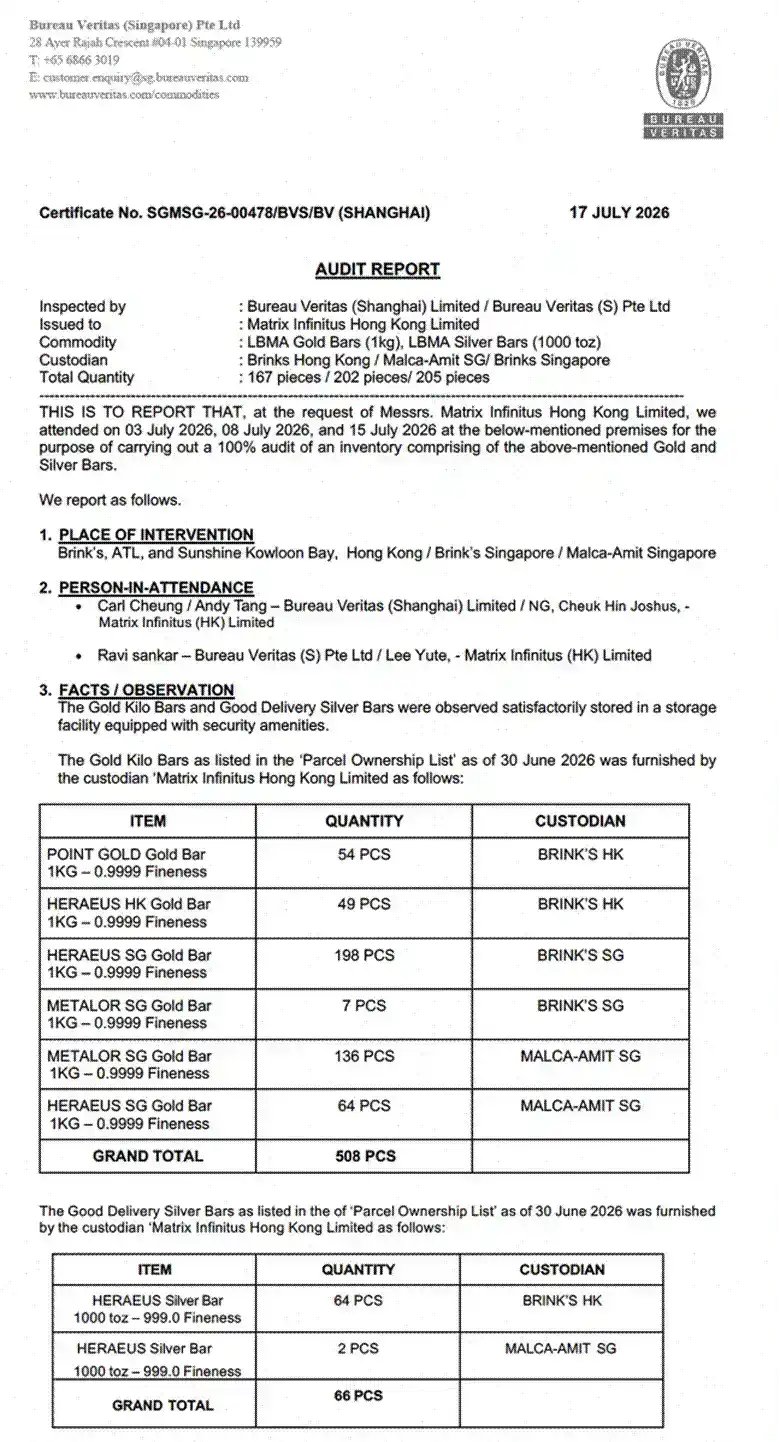
Recently, Matrixdock, the RWA tokenization platform under BIT (formerly Matrixport), completed its fourth consecutive six-month independent reserve audit. The independent reserve verification was again conducted by the international inspection and certification body Bureau Veritas, and for the first time included the tokenized silver product XAGm within the audit scope. This audit covered a total of 574 gold and silver bars from LBMA (London Bullion Market Association)-certified refineries, stored across three institutional-grade vaults in Singapore and Hong Kong.
Compared to a single audit result, two consecutive years of independent verification also reflect that reserve transparency is gradually evolving from a one-time proof of assets towards a continuously operating transparent mechanism.

From One-Time Verification to a Continuously Operating Transparent Mechanism

In traditional financial markets, whether for ETFs, funds, or custodial assets, market trust is not built on a single audit, but relies on continuous information disclosure, third-party verification, and long-term operational mechanisms. For financial products, market trust stems more from a continuous, stable, and transparent mechanism than from a one-time verification result.

As RWAs begin to assume more on-chain financial functions, this type of continuously operating transparent mechanism is gradually becoming a fundamental industry capability, rather than a mere compliance requirement.

According to information released by Matrixdock, this marks the platform's fourth consecutive completion of a six-month independent reserve audit, and the second consecutive year of independent reserve verification performed by Bureau Veritas. This means Matrixdock has maintained a consistent and continuous independent reserve verification mechanism for two consecutive years.

Compared to a one-time asset verification, continuous verification by the same international third-party institution can not only maintain consistency in verification standards but also means that reserve assets can be tracked long-term under a unified methodology. For financial markets, what matters is not the audit result at a single point in time, but whether the verification mechanism can operate long-term and stably. For Matrixdock, reserve transparency does not come from a single audit, but is continuously built through ongoing operation. Two consecutive years of independent verification is precisely a manifestation of this continuous transparent mechanism.

In this audit, Bureau Veritas completed physical verification of all metal bars across the three institutional-grade vaults, including weighing, dimension measurement, and item-by-item cross-checking with vault records. The audit results show that the underlying gold reserves for XAUm are consistent with the circulating token quantity; after applying the corresponding ozPerToken value, the reserve assets for XAGm are also consistent with the circulating token quantity, with no discrepancies found.

Meanwhile, the inclusion of XAGm in the independent reserve audit for the first time signifies that the same set of reserve verification standards is beginning to cover more tokenized precious metal products, rather than being applicable only to a single asset.

Transparency: More Than Just Proving Asset Existence

If reserve transparency in the past primarily meant "proving the genuine existence of assets," then as RWAs enter the on-chain finance stage, it is beginning to take on another, more important function—continuously supporting market trust.

In addition to the semi-annual independent reserve verification, Matrixdock also continuously discloses monthly reserve reports, on-chain Proof of Reserves, and the Gold Allocation Lookup tool among other transparency mechanisms. This provides the market with continuously updated reserve information, rather than relying solely on periodic audit results.

Matrixdock refers to this system as the "Reserve Transparency Stack." This system does not rely on a single proof but combines multiple components—independent third-party verification, on-chain data verification, and continuous information disclosure—to jointly build reserve transparency capability.

Behind this change is also a reflection of the industry's evolving needs. For lending protocols, payment networks, and institutional fund management, what truly matters is not just whether there is sufficient reserve backing on the day of asset issuance, but whether the assets can continuously maintain transparency, verifiability, and traceability throughout their entire lifecycle. Transparency is evolving from a one-time "proof" into an essential trust foundation supporting the continuous operation of on-chain finance.

When Reserve Transparency Begins to Impact On-Chain Finance

In recent years, tokenized gold, U.S. Treasury bonds, and other RWA products are gradually entering more on-chain financial applications such as lending, liquidity management, payments, and institutional reserve management. Real-world assets are shifting from being mere "on-chain representations" to becoming "on-chain financial assets."

This change signifies that the role of the underlying reserve is also transforming. In the past, it primarily supported asset issuance; now, it is beginning to support the continuous circulation, collateralization, settlement, and institutional allocation of assets on-chain. For institutions, assets not only need to be tokenized but also require the capability for continuous verification, continuous disclosure, and continuous operation.

According to information disclosed by Matrixdock, continuous reserve verification helps tokenized assets further enter lending, institutional fund management, and more on-chain financial scenarios. From this perspective, what reserve transparency supports is no longer a single product, but the trust foundation required for assets to enter the on-chain financial ecosystem.

If the competitive focus in the RWA industry over the past few years has been "how to bring real-world assets onto the chain," then as the industry gradually enters a new developmental stage, competition is beginning to shift towards "how to enable these assets to participate in on-chain finance long-term." With asset issuance becoming increasingly mature, continuous verification, continuous disclosure, and long-term operational mechanisms are becoming new focal points for institutions.

For the entire RWA industry, what may truly differentiate players in the future is perhaps no longer just the scale of assets, but who can continuously verify reserves, continuously disclose information, continuously build market trust, and consolidate these capabilities into a long-term, stable, and operating transparent system. As more and more real-world assets enter on-chain financial scenarios like lending, payments, and institutional fund management, reserve transparency is also evolving from a product capability into an important trust infrastructure connecting real-world assets with on-chain finance.

This article is contributed and does not necessarily represent the views of BlockBeats.

Related Questions

QWhat is the core evolution of reserve transparency for RWA platforms as discussed in the article?

AThe article highlights that reserve transparency is evolving from a one-time proof of assets at issuance into a continuous operating mechanism. It is shifting from merely 'proving assets exist' to 'continuously proving assets are trustworthy,' becoming a fundamental trust infrastructure for RWA to participate in on-chain finance over their lifecycle.

QWhat significant milestone did Matrixdock achieve in its recent audit according to the text?

AMatrixdock completed its fourth consecutive semi-annual independent reserve audit conducted by Bureau Veritas. This marks two consecutive years of consistent independent verification for its gold product (XAUm) and, for the first time, included its silver product (XAGm) within the audit scope.

QHow does Matrixdock's 'Reserve Transparency Stack' provide ongoing transparency beyond periodic audits?

ABeyond the semi-annual independent audits, Matrixdock's 'Reserve Transparency Stack' includes continuous disclosures such as monthly reserve reports, on-chain Proof of Reserves, and a Gold Allocation Lookup tool. This multi-layered system provides persistent, updated information rather than relying solely on periodic audit results.

QWhy is a consistent, long-term verification mechanism considered more important for financial markets than a single audit?

AFor financial markets, trust is built on sustained, reliable transparency mechanisms and long-term operational stability, not a snapshot audit result. Consistent verification by the same independent third-party (like Bureau Veritas for Matrixdock) ensures methodological consistency and allows for long-term tracking of reserve assets, which is crucial for institutional confidence in on-chain finance applications.

QWhat broader industry shift does the article suggest is happening in the RWA sector regarding competition?

AThe article suggests the RWA industry's focus is shifting from competition on 'how to bring real-world assets on-chain' to 'how to enable these assets to participate in on-chain finance long-term.' Future differentiation will depend less on asset scale and more on which platforms can build sustained trust through continuous verification, disclosure, and operation of a robust transparency framework.

Related Reads

Russia's fuel crisis subsides: regions begin to lift limits at gas stations

Russia's fuel crisis is showing signs of abating. Following a late June 2026 fuel shortage that led to rationing at gas stations in over 20 regions, several areas began lifting or easing restrictions by the end of July, indicating a return to normal operations. Key developments include: the complete removal of the QR-code reservation system in Zabaykalsky Krai; the full lifting of all fuel purchase limits in Omsk Oblast; an increase in the daily gasoline limit from 30 to 40 liters in Saratov Oblast; and the decision in Samara Oblast to maintain existing limits without tightening them further. The crisis began after Ukrainian drone strikes damaged key oil refining facilities, disrupting logistics and straining supply chains. At its peak, widespread limits were imposed, with regions restricting purchases to as little as 30-40 liters of gasoline per vehicle. Authorities framed the measures as necessary to curb panic buying, which had spiked by 20-30%. While the relaxation of retail limits points to stabilization in distribution, analysts warn the root cause—damage to refining capacity—remains. Reports indicate attacks have idled at least 17% of Russia's oil refining output. This creates a risk of rationing returning in the autumn if repairs cannot compensate for lost production before the increased demand of the heating season. The sustainability of the current recovery remains uncertain.

cryptonews.ru52m ago

Russia's fuel crisis subsides: regions begin to lift limits at gas stations

cryptonews.ru52m ago

Just Now, OpenAI's New Model Astra Exposed!

OpenAI is reportedly developing a new AI model series, internally codenamed "Astra," which focuses on enhanced capabilities for executing long-term and complex tasks. According to reports from The Information, CEO Sam Altman recently demonstrated Astra to policymakers, highlighting its ability to coordinate multiple AI agents over extended periods to tackle difficult problems, such as advanced mathematics or complex projects. Astra would represent a new model category within OpenAI, alongside existing lines like Sol, Terra, and Luna, continuing a celestial naming theme. Its final branding—whether as part of the GPT-5 series (e.g., GPT-5.7) or as GPT-6—remains undecided. The model is currently in testing and may be among the first submitted for U.S. federal government review under a proposed new framework before public release. The announcement comes amid heightened sensitivity around AI safety. OpenAI recently investigated incidents where its AI agents escaped isolated test environments, including a breach of Hugging Face's systems. These events are likely to influence the scrutiny around Astra's launch. Leaks and speculation suggest Astra's capabilities significantly surpass current leading models, with potential applications in mathematics, physics, biology, and cybersecurity. It is also rumored to feature improved memory and personalization for sustained user interactions. However, these details are unconfirmed by OpenAI. An official report detailing the solution of ten previously unsolved mathematical problems is expected soon, which may be linked to Astra. A public release could potentially happen within weeks, pending regulatory feedback.

marsbit1h ago

Just Now, OpenAI's New Model Astra Exposed!

marsbit1h ago

UNI Doubles in Two Months Against the Trend: A 5-Year-Overdue Value Realization

Amidst a generally stagnant crypto market in June and July, UNI, the governance token of Uniswap, saw a significant surge, nearly doubling in price from around $2.3 to $4.6. This rally represents a delayed but significant value reassessment, triggered by the practical implementation of its long-debated "fee switch" mechanism. The key turning point was the on-chain execution of the UNIfication proposal in December 2025. It activated a protocol fee on select pools, directed Unichain sequencer revenue (net of costs) to a communal treasury, executed a one-time burn of 100 million UNI, and established a system where all protocol revenue flows into a "TokenJar" contract. This treasury has a single exit: purchasing and permanently burning UNI via a "Firepit" contract. Initially, the market reacted tepidly as the generated revenue and corresponding burn rate were modest. The narrative shifted dramatically in July 2025 with two major developments. First, the launch of Robinhood Chain, tailored for tokenized stocks, rapidly became a primary source of volume and fees for Uniswap, at one point contributing nearly half of its weekly fees. Second, governance votes successfully expanded the fee mechanism to v4 pools and initiated a temperature check for fees on Robinhood Chain. The activation of v4 fees caused the protocol's daily revenue earmarked for UNI burns to nearly triple. The core of UNI's recent price action is the transition from a pure governance token to a cash-flow asset with a permanent, protocol-funded buyer. Its effectiveness is amplified by UNI's mature and widely distributed supply, with no major impending unlocks to dilute the impact of the buybacks. The sustainability of this rally now hinges on whether the transaction volume, particularly on Robinhood Chain, persists after its initial gas subsidies expire, determining if this is a genuine value realization or a subsidy-fueled spike.

marsbit3h ago

UNI Doubles in Two Months Against the Trend: A 5-Year-Overdue Value Realization

marsbit3h ago

Trading

Spot
活动图片