ADA in Consolidation: Bears Control Cardano, $0.40 Becomes the Make-or-Break Line

金色财经Published on 2025-12-15Last updated on 2025-12-15

Abstract

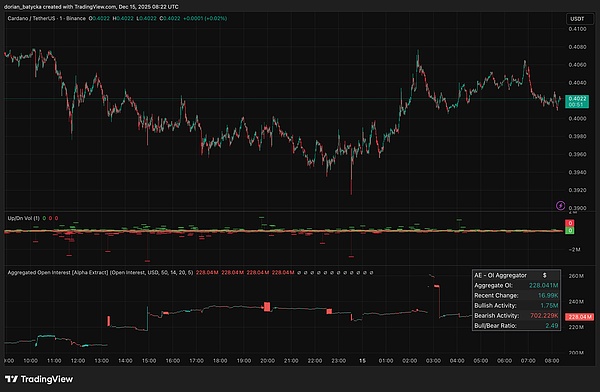
ADA is currently consolidating around the $0.40 level, with bears maintaining control as the price faces persistent selling pressure near key moving averages. Trading volume remains moderate, with Binance alone recording around 100 million ADA traded in 24 hours. The order book shows substantial mid-range sell-side liquidity, while buy-side interest persists at lower levels. The short-term trend remains vulnerable, and a break below the current support zone could accelerate the decline. Conversely, a breakout above the descending moving averages might open the path toward higher resistance levels, though such a move would likely encounter intensified selling pressure. Overall, ADA is in a low-energy consolidation phase, with prices oscillating between $0.39 and $0.41. The market lacks strong momentum, and a clear directional move may require either a dissipation of bearish sentiment or a decisive breach of key technical levels. Risk management is advised during this period of uncertainty.

Recently, the price of Cardano (ADA) has been playing "ninja hopscotch"—consistently suppressed by key moving averages, making a rebound difficult. Selling pressure is strong, with mid-range sell orders piling up, putting the short-term trend at risk. If market sentiment cools, the support below may not hold.
Market Dynamics

Spot ADA price is hovering around $0.40, with minimal daily gains. The 24-hour trading volume ranges between $500–600 million, with Binance alone accounting for approximately 100 million ADA trades. Analysts note that while the price is stabilizing slightly, the overall technical picture suggests that bearish momentum hasn't faded. Suppression below short- and medium-term moving averages keeps sellers in control, and a breakout would require more "momentum."
Consolidation Pattern: Mid-Range Sell Orders Under Heavy Pressure

The order book shows ample liquidity in mid-range sell orders, while buy-side interest remains below. However, if the support zone is breached, the consolidation could break immediately. In other words, ADA is currently stepping on a suspended plank—its stability entirely depends on market sentiment.
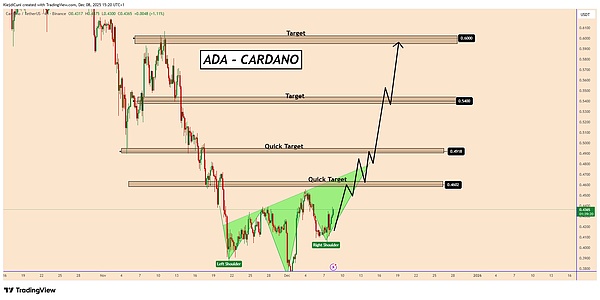
If the price can break above the declining moving averages, it may open the door to higher resistance levels in the short term. However, sellers are unlikely to give way easily, and any breakout could face selling pressure.

Support and Resistance

Daily charts indicate that the first key test for the price is near the declining moving averages. A breakdown could accelerate the downtrend, while a breakout might open the door to higher resistance levels, though selling pressure could intensify. The support zone below provides some cushion, but if market sentiment suddenly deteriorates, this "defense line" may not hold.
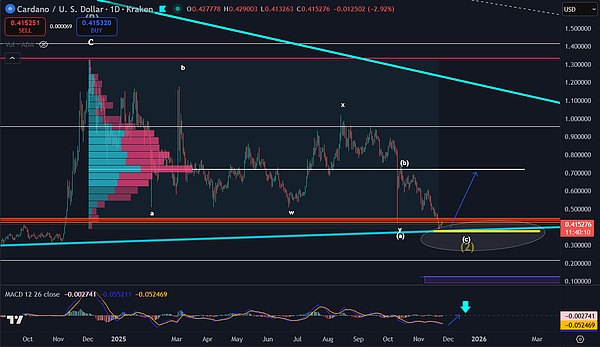
Summary

Overall, ADA is in a typical "low-energy consolidation": intraday fluctuations range between $0.39–0.41, trading volume is stable, and there are no significant liquidations or sharp price swings. The short-term outlook may require patience, waiting for bearish momentum to fade or a breakout above resistance before a clear direction emerges.

Tip: During such range-bound consolidation, steady operations and risk management are more important than chasing rallies or selling off—don't be swayed by minor fluctuations.

Like, share, and follow me to catch more market trends and ride the bull and bear waves together! Let's keep pushing!

Struggling in the crypto world? Don't tough it out alone! Xiaoyun shares real-time swing and long-term strategies, helping you stand on the shoulders of giants to quickly ascend the wealth ladder. Missing one opportunity could mean missing out on 100x gains! Join us!

---END

Trending Cryptos

Related Questions

QWhat is the current price range of Cardano (ADA) and why is the $0.40 level considered critical?

ACardano (ADA) is currently trading around $0.40, within a range of $0.39 to $0.41. The $0.40 level is considered a critical 'make-or-break' line because it is a key support. If this support is broken, the price could decline further, but if it holds and breaks above the descending moving averages, it could target higher resistance levels.

QWho is currently in control of the market according to the technical analysis of ADA?

AAccording to the technical analysis, sellers (the bears) are in control of the Cardano (ADA) market. The price is being suppressed by key moving averages, and there is significant selling pressure in the mid-range of the order book.

QWhat does the order book data reveal about the selling and buying pressure for ADA?

AThe order book data shows ample liquidity in the mid-range sell orders, indicating strong selling pressure. While there is still some buying interest in the support zone below, a break of this support region could quickly end the current consolidation phase.

QWhat is the potential outcome if ADA's price breaks above the descending moving averages?

AIf ADA's price manages to break above the descending moving averages, it could open the path to higher resistance levels in the short term. However, this breakout is likely to be met with significant selling pressure from the bears.

QWhat type of market phase is ADA in, and what is the recommended trading approach?

AADA is in a typical 'low-energy consolidation' phase with stable volume and no major liquidations or sharp price movements. The recommended trading approach is to be patient, practice sound risk management, and avoid chasing small price fluctuations until a clear market direction emerges from a key breakout or a fade in bearish momentum.

Related Reads

Gate Research Institute: The 'Wall Street-ization' Wave of Crypto Financial Products – Competition or Integration?

The article titled "Gate Research Institute: Are Crypto Financial Products Sparking a 'Wall Street' Wave—Competition or Convergence?" explores the evolving relationship between the crypto ecosystem and traditional finance (TradFi). The piece begins by reflecting on Bitcoin's original 2009 vision of decentralization, disintermediation, and moving away from banks. It then contrasts this with the 2024 landscape, where key crypto assets like Bitcoin are increasingly held through Wall Street products like ETFs issued by giants like BlackRock. The article questions whether this signifies that TradFi is systematically taking over the rights to issue, price, custody, and distribute crypto financial assets. The core argument is that this is not a zero-sum takeover but rather a bidirectional convergence where each side addresses the other's weaknesses. Crypto offers 24/7 global markets, programmable settlement, and open access but lacks compliant channels, institutional-grade custody, deep fiat liquidity, and mainstream distribution. TradFi possesses these but is constrained by legacy systems, limited operating hours, and slow settlement. Two primary convergence paths are highlighted: * **Path A (CEX to TradFi):** Exemplified by Gate, which has progressed from offering tokenized stocks and CFDs to providing direct, real stock trading (US, Hong Kong, South Korea) within its platform, using USDT. * **Path B (TradFi to Crypto):** Exemplified by Robinhood, which has integrated crypto trading, acquired exchanges like Bitstamp, and is moving traditional assets like stocks onto the blockchain via tokenization and its own Layer 2. Both paths are ultimately competing to become the next-generation, unified financial account—a "super account" where users can seamlessly trade cryptocurrencies, stocks, ETFs, RWA (Real World Assets), and tokenized treasury products in one interface. The growth of RWA and tokenized treasuries (e.g., BlackRock's BUIDL) is presented as the asset-layer fusion, providing stable, yield-bearing assets on-chain and acting as a bridge between the two worlds. In conclusion, the "Wall Street-ization" of crypto is framed as a mutual transformation. Decentralized ideals persist in the protocol layer, while at the application layer, a more efficient, global, and accessible unified capital market is emerging from this convergence. The future competition lies not between crypto exchanges and stockbrokers, but between platforms vying to offer the most comprehensive asset coverage, liquidity, and user experience within a single account.

marsbit2m ago

Gate Research Institute: The 'Wall Street-ization' Wave of Crypto Financial Products – Competition or Integration?

marsbit2m ago

Claude's Major New Feature: Screen Recording + Voice, Distilling Your Skills into AI Tasks in One Click

Claude has introduced a major new feature called "Record a Skill," available for Pro, Max, and Team users. This function, found in the Claude desktop app's CoWork menu, allows users to create reusable AI skills simply by recording their screen and providing voice narration while performing a task. Claude then automatically analyzes the recording and generates a functional Skill. A hands-on test confirmed the feature works seamlessly. Users start recording via the Skills manager, perform their workflow while verbally explaining the steps and logic, and avoid including sensitive information. After recording, Claude processes the content and creates the Skill, which can be saved and later invoked with a slash command (/). This eliminates the need for manual adjustments or writing complex instruction files. The innovation goes beyond mere efficiency. Previously, creating a Skill required writing a detailed SKILL.md file in Markdown—a significant barrier for non-technical users. "Record a Skill" bypasses this by directly capturing both actions and the implicit reasoning shared in the narration. This lowers the barrier to knowledge transfer and automation, addressing a core challenge in corporate knowledge management: the difficulty of getting experts to write and maintain documentation. However, the feature also highlights a shift in the nature of work. A case study from March 2026 showed a freelancer whose five-year client relationship was effectively replaced by a hand-coded Claude Skill automating their content workflow. With the even lower barrier of screen recording, the ability to distill personal expertise into automatable skills accelerates this trend. The "moat" for work is moving from simply knowing how to do a task to mastering tasks that are difficult or impossible to automate.

marsbit7m ago

Claude's Major New Feature: Screen Recording + Voice, Distilling Your Skills into AI Tasks in One Click

marsbit7m ago

Feeding AI "Noise" Can Also Boost Scores, This Work Enables Positive Transfer with Noise

Feeding "Noise" to AI Can Improve Performance: A Method Enables Positive Transfer from Noise This work, Semi-Supervised Noise Adaptation (SSNA), introduces a Noise Adaptation Framework (NAF) that challenges traditional transfer learning. Instead of requiring a labeled source domain of real data (e.g., images, text), NAF uses randomly generated Gaussian noise as the source. For a target task with C classes, it constructs C noise clusters by sampling from Gaussian distributions. Although this synthetic noise contains no semantic meaning, NAF trains it to form a discriminative class structure in a shared representation space—clustering same-class noise and separating different classes. The key is aligning this learned structure from the noise domain to the real, sparsely labeled target domain. A small number of target labels are still essential to establish the correspondence between noise clusters and actual classes. The training objective combines: 1) supervised loss on the few labeled target samples, 2) classification loss for the noise to build its structure, and 3) a distribution alignment loss (using Negative Domain Similarity) to minimize the gap between the noise and target domains in the shared space. Experiments show significant gains in few-label settings. With just 4 labels per class, NAF with a ResNet-18 backbone improves accuracy over a standard supervised baseline (ERM) by +12.35% on CIFAR-10, +7.61% on CIFAR-100, +4.38% on DTD-47, and +2.74% on Caltech-101. It also benefits fine-grained datasets and scales to ImageNet-1K (with 100 labels/class) and text classification (AG News). NAF can be integrated into existing semi-supervised methods like FixMatch for further gains. Ablation studies confirm the transferred benefit comes from the discriminative structure of the noise, not randomness itself. Collapsing all noise into a single point causes negative transfer, while increasing separation between noise cluster centers improves performance. The amount of noise per class is less critical once a basic structure forms. In conclusion, this work demonstrates that for positive transfer, the semantic content of source data may not be necessary. What can be effectively transferred is the *organizational structure* of categories within a representation space. This offers a promising alternative for scenarios where real source data is unavailable due to privacy, copyright, or procurement constraints.

marsbit8m ago

Feeding AI "Noise" Can Also Boost Scores, This Work Enables Positive Transfer with Noise

marsbit8m ago

Trading

Spot

Hot Articles

Discussions

Welcome to the HTX Community. Here, you can stay informed about the latest platform developments and gain access to professional market insights. Users' opinions on the price of ADA (ADA) are presented below.

活动图片