Aave founder outlines 2026 ‘master plan’ after end to SEC probe

cointelegraphPublished on 2025-12-17Last updated on 2025-12-17

Abstract

Aave founder and CEO Stani Kulechov has announced the platform's "master plan" for 2026, following the conclusion of a four-year SEC investigation. The strategy focuses on three main pillars: Aave V4, Horizon, and the Aave mobile app. Aave V4 will introduce a Hub and Spoke model to enhance cross-chain liquidity and scalability, aiming to handle trillions in assets. Horizon, the RWA market, plans to grow from $550 million to over $1 billion in deposits by partnering with institutions like Circle and Franklin Templeton. The mobile app, launched in November, targets mainstream adoption by simplifying DeFi access and competing in the $2 trillion fintech sector. Kulechov also confirmed the SEC has ended its probe, allowing the platform to focus on future growth. He personally purchased $9.8 million worth of AAVE, signaling strong confidence in the protocol's direction.

Aave founder and CEO Stani Kulechov has unveiled his decentralized protocol’s “master plan” for 2026, shortly after revealing the US Securities and Exchange Commission has dropped its four-year investigation into the platform.

In a post to X on Tuesday, Kulechov said despite 2025 marking the most “successful year” for the platform to date, he still feels that Aave is on “day zero compared to what lies ahead.”

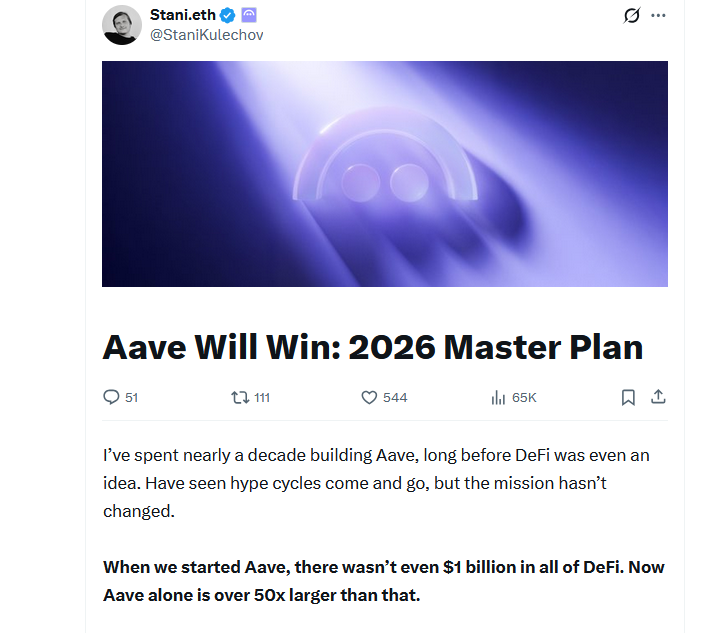
Pointing to 2026, the CEO outlined a master plan that places significant focus on scaling the DeFi platform and achieving specific usage metrics, such as $1 billion in real-world asset (RWA) deposits.

“As it stands, our strategy going into next year has three main pillars: Aave V4, Horizon, and Aave App,” he said.
Source: Stani Kulechov

Aave V4 is major upgrade touted to bring significant enhancements to the platform’s borrowing and lending pools, user interface and liquidation parameters, among other things.

In his post, Kulechov said V4 will be the “backbone of all finance,” as he pointed to the tailored lending markets that the V4’s Hub and Spoke model will provide.

Under this model, the hub refers to a single unified crosschain liquidity pool that functions as the central location for all assets on the protocol, while the spokes refer to highly customizable markets that tap into hub liquidity.

“This will allow Aave to handle trillions of dollars in assets, making it the go-to choice for any institution, fintech, or company looking to access Aave’s deep, reliable liquidity,” he said, adding:

“In 2026, Aave will be home to new markets, new assets, and new integrations that have never existed before in DeFi. We’ll continue engaging with fintechs and work closely with the DAO and our partners on the rollout to progressively scale TVL throughout the year.”

Looking at the next pillar in Horizon, Aave’s decentralized real-world asset market, the CEO outlined intentions to onboard “many top financial institutions” to become a central player in the RWA space.

“Horizon currently sits at $550M net deposits. In 2026 we’ll look to quickly scale this to $1 billion and beyond by expanding our work with leading institutional partners like Circle, Ripple, Franklin Templeton, VanEck, and others to bring major global asset classes to Aave,” he said.

The final pillar is Aave’s mobile app, which launched on the Apple store in mid-November, with Kulechov describing it as a “trojan horse” to bring DeFi to the mainstream.

The CEO said the mobile fintech sector is a “$2+ trillion dollar industry” that Aave wants to capitalize on by making its complex infrastructure as easy as possible for people to use, as well as beating competitors by offering better savings products.

Related: Crypto’s ‘super app’ race is on as industry enters aggregation era: Report

“Early next year, we’ll begin the full rollout of Aave App and start the journey to our first million users. This will directly fuel growth for Aave Protocol through an entirely new and untapped market. Aave cannot scale to trillions of dollars without mass adoption on the product level.”

SEC ends four-year investigation

On Tuesday, Kulechov confirmed the end of the SEC’s four-year SEC investigation into Aave, sharing a letter dated Aug. 12, 2025.

Kulechov said the platform is “glad to put this behind us as we enter a new era where developers can truly build the future of finance.”

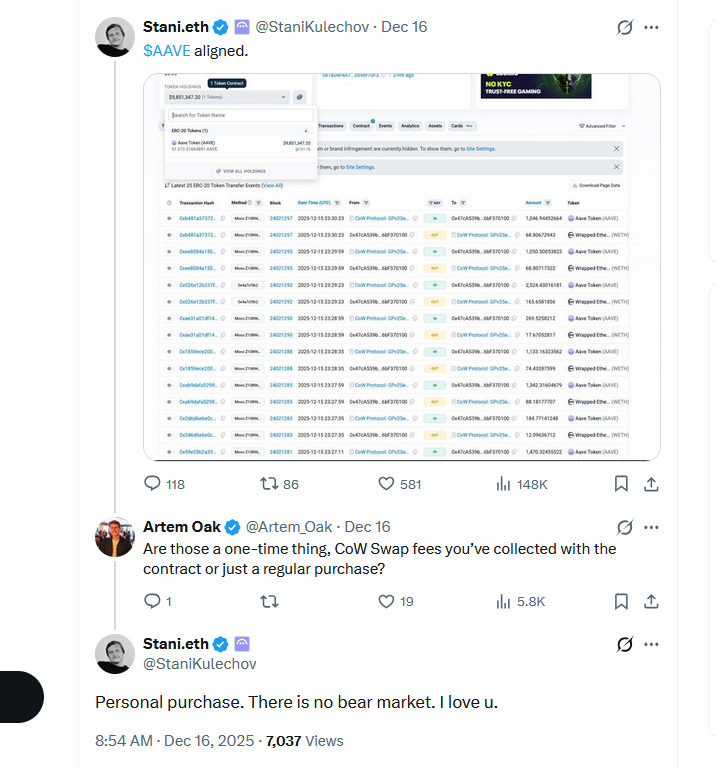
Alongside the SEC and masterplan announcement, Kulechov capped things off on Tuesday by sharing that he had personally purchased $9.8 million worth of AAVE, outside of the Aave DAO’s proposed buyback program.
Source: Stani Kulechov

Magazine: Big questions: Would Bitcoin survive a 10-year power outage?

Trending Cryptos

Related Reads

Amidst Capital's Encirclement, Decentralization is the Sole Defense for Public Blockchains

In a landscape dominated by power and profit motives, the author argues that decentralization is not merely one desirable feature among many in blockchain design—it is the singular, non-negotiable defense against corporate and capital capture. The article adopts a Machiavellian, realist perspective on human institutions, positing that businesses will inevitably attempt to co-opt any valuable network to protect their profits and dominance. While external attacks like 51% forks are often discussed, the greater existential risk is internal capture—the gradual erosion of a protocol’s neutrality by vested interests, as seen historically with platforms like Visa and Google. The piece critiques permissioned chains, highly centralized “permissionless” layer-1s, and layer-2s without sufficient decentralization (e.g., single sequencers) as inherently vulnerable. These compromised systems, promoted by established financial players, are framed as delaying tactics to stifle truly open networks that threaten existing high-fee, inefficient business models. Real-world examples, such as closed enterprise consortiums that exclude competitors, illustrate how such systems cement oligopolies rather than foster innovation. The author concludes that while decentralized protocols like Ethereum are imperfect and costly to operate, they represent the only viable long-term equilibrium. In a market where value naturally flows to the most secure and neutral settlement layer, only maximally decentralized public blockchains can resist being subsumed by capital and powerful incumbents.

Foresight News4m ago

Amidst Capital's Encirclement, Decentralization is the Sole Defense for Public Blockchains

Foresight News4m ago

Who Decides the Rules of Bitcoin? BIP-110 Ignites Governance Debate

Bitcoin's governance is once again at the center of a heated debate, this time ignited by BIP-110, the "Reduced Data Temporary Softfork." This proposal aims to curb non-monetary data (like inscriptions and Runes) by introducing seven new consensus-layer restrictions over a year, such as limiting new output scripts to 34 bytes and restoring the OP_RETURN cap to 83 bytes. The controversy stems from BIP-110's fundamental shift: it moves the battle against "spam" from node relay and miner policies to the consensus layer, rendering currently valid transactions invalid. Supporters, arguing that default policy governance has failed (highlighted by Bitcoin Core v30's relaxation of OP_RETURN limits), see this as necessary to protect node resources and Bitcoin's monetary focus. Opponents, led by figures like Michael Saylor and Adam Back, warn it dangerously centralizes governance. Saylor listed 110 reasons against it, criticizing its low 55% miner activation threshold and potential for chain splits. Back emphasized Bitcoin's "permissionless" ethos, arguing no single group should impose value judgments via consensus rules. Further complicating matters, technical critiques suggest BIP-110 may be technically circumventable, and a "BlockSlop" vulnerability in its upgrade path poses a consensus risk. The debate has drawn in diverse stakeholders: miners (with pools like Ocean signaling support and Foundry polling clients), node operators (like Bitcoin Knots), and new players like corporate treasury holder MicroStrategy (Saylor), whose market influence adds a novel dimension. Ultimately, BIP-110 acts as a governance stress test, exposing the unresolved question: who decides Bitcoin's rules? It pits the authority of miners, node operators, developers, and capital holders against each other, with each side claiming to defend Bitcoin's core principles of neutrality and security.

marsbit21m ago

Who Decides the Rules of Bitcoin? BIP-110 Ignites Governance Debate

marsbit21m ago

Who Decides Bitcoin's Rules? BIP-110 Ignites Governance Debate

Title: Who Decides Bitcoin's Rules? BIP-110 Ignites Governance Debate A new technical proposal, BIP-110 (Reduced Data Temporary Softfork), has sparked a fundamental governance debate within the Bitcoin community. It aims to impose new consensus rules for one year to limit non-financial data (like inscriptions and Runes) on-chain, moving beyond simple node and miner policy filters to invalidate currently valid transactions. Supporters argue that default policies have failed due to workarounds, necessitating consensus-layer changes to protect Bitcoin's core monetary function from data spam. Critics, including Michael Saylor and Adam Back, contend this dangerously centralizes judgment, undermines permissionlessness, and sets a risky governance precedent. They advocate for market-based solutions like fees or Layer 2s instead. The debate exposes deeper tensions: miners are divided on activation; node operators assert their sovereignty; Bitcoin Core developers influence defaults without direct accountability; and large corporate holders like MicroStrategy now wield narrative influence. Technically, BIP-110 may not fully block data and carries a disclosed consensus bug risk. Ultimately, BIP-110 acts as a stress test, forcing the community to confront the unresolved question: who legitimately decides what Bitcoin is and how it evolves, amidst competing claims from miners, nodes, developers, and capital holders.

链捕手32m ago

Who Decides Bitcoin's Rules? BIP-110 Ignites Governance Debate

链捕手32m ago

Zcash's New Node Zakura Goes Live: Privacy Payments Can Reach 50,000 TPS, Aiming to Rival Visa and Mastercard

Zcash, a privacy-focused cryptocurrency, has launched a new full node software called Zakura version 1.0.0. Developed by Zcash co-founder Sean Bowe and Dev Ojha, with private ZEC donations, its goal is to enable Zcash to process over 50,000 transactions per second (TPS)—matching the scale of Visa and Mastercard—while maintaining full transaction privacy and verifiability. This addresses a key bottleneck, as Zcash currently handles only about 1 private transaction per second. Zakura is a fork of the Zcash Foundation's Zebra node. It features chain pruning and snapshots, reducing disk usage and allowing new nodes to sync in under two minutes. It also offers compatibility with the legacy `zcashd` client interface. The scalability challenge stems from the large data size of privacy proofs. Bowe's Tachyon project aims to use recursive proofs to reduce consensus-layer data needs from ~500 MB/s to ~100 MB/s. For wallet scalability, Valar Group is researching Private Information Retrieval (PIR) tech to allow wallets to fetch their data privately. Zakura supports fast block propagation and the upcoming "Ironwood" network upgrade (NU6.3), scheduled for activation around July 28th. Ironwood was created to contain a critical inflation bug discovered in the Orchard shielded pool in May 2024. The fix uses "turnstiles" to trap any counterfeit ZEC created during the vulnerability period within the shielded pool, preventing it from entering circulation and restoring supply integrity.

marsbit47m ago

Zcash's New Node Zakura Goes Live: Privacy Payments Can Reach 50,000 TPS, Aiming to Rival Visa and Mastercard

marsbit47m ago

Trading

Spot

Hot Articles

How to Buy AAVE

Welcome to HTX.com! We've made purchasing Aave Protocol (AAVE) simple and convenient. Follow our step-by-step guide to embark on your crypto journey.Step 1: Create Your HTX AccountUse your email or phone number to sign up for a free account on HTX. Experience a hassle-free registration journey and unlock all features.Get My AccountStep 2: Go to Buy Crypto and Choose Your Payment MethodCredit/Debit Card: Use your Visa or Mastercard to buy Aave Protocol (AAVE) instantly.Balance: Use funds from your HTX account balance to trade seamlessly.Third Parties: We've added popular payment methods such as Google Pay and Apple Pay to enhance convenience.P2P: Trade directly with other users on HTX.Over-the-Counter (OTC): We offer tailor-made services and competitive exchange rates for traders.Step 3: Store Your Aave Protocol (AAVE)After purchasing your Aave Protocol (AAVE), store it in your HTX account. Alternatively, you can send it elsewhere via blockchain transfer or use it to trade other cryptocurrencies.Step 4: Trade Aave Protocol (AAVE)Easily trade Aave Protocol (AAVE) on HTX's spot market. Simply access your account, select your trading pair, execute your trades, and monitor in real-time. We offer a user-friendly experience for both beginners and seasoned traders.

5.8k Total ViewsPublished 2024.03.29Updated 2026.06.02

How to Buy AAVE

Discussions

Welcome to the HTX Community. Here, you can stay informed about the latest platform developments and gain access to professional market insights. Users' opinions on the price of AAVE (AAVE) are presented below.

活动图片