a16z Crypto Partner: Cash Flow is the Moat

链捕手Published on 2026-06-12Last updated on 2026-06-12

Abstract

Title: a16z Crypto Partner: Cash Flow Is the Moat Summary: Historically, many of the best businesses were built by positioning themselves within the "flow of funds"—facilitating the creation and transfer of value within a network and taking a cut. The more value flows through, the larger the business grows. Cryptocurrency is the first modern technology natively built for this purpose. If a startup hasn't architected its product and business to benefit from these principles, it's missing a major opportunity. Thanks to stablecoins, capital and value now move at internet speed—globally settled, 24/7, with end-to-end programmability. Blockchains are inherently network businesses. Each transaction settles on a shared ledger, and every new participant strengthens the same underlying network. Network tokens amplify this effect. A well-designed token aligns all participants—users, developers, suppliers, validators, the protocol—around a single goal: growing the network. Participants are paid proportionally to their contributions, creating a transparent feedback loop between value flowing in the system and value accumulating to those building it. This model isn't new; crypto simply makes it more accessible and scalable for startups. The pattern is consistent: find where value flows and position yourself in the middle. Examples range from railroads (earning from freight) and Standard Oil to Google, Meta, and AWS (earning from attention, commerce, and compute flows, respectively). Fi...

Author: Jason Rosenthal, a16z Operating Partner

Compiled by: Hu Tao, ChainCatcher Highlights

Many of history's greatest businesses were built by positioning themselves in the "flow of funds" – facilitating the creation and transfer of value within a network and taking a cut. The more value that flows through the network, the larger the business typically grows.

Cryptocurrency is the first modern technology natively built for this purpose. If your startup hasn't yet architected its product and business to benefit from these principles, you're missing an opportunity. Thanks to stablecoins, funds and value now flow at internet speed – 24/7, with global settlement, and end-to-end programmability. Payment rails are frictionless, unit economics are transparent, and every dollar flowing globally is addressable.

The Specific Model

Blockchains are network businesses by design. Every transaction settles on a shared ledger. Every new participant strengthens the same underlying network that the next builder can use. As more people use and build on it, the network becomes more valuable for all users.

Most companies spend years manufacturing network effects on top of traditional infrastructure. Crypto founders inherit them as starting conditions.

Network tokens amplify this. A well-designed token aligns users, developers, suppliers, validators, and the protocol around a single outcome—growing the network—and pays each proportionally to their contribution. But the protocol's revenue belongs to the people who use it. No partner rebates, no side deals. Just a feedback loop between value flowing in the system and value accumulating in the hands of the people building and growing it.

This isn't a new model. Cryptocurrency just makes it accessible and scalable for startups for the first time.

Railroads didn't make money on locomotives. They made money on every ton of grain, coal, and steel that crossed their tracks. Standard Oil, U.S. Steel, and AT&T were companies in the flow of funds. Google and Meta replaced print and TV not because their ads were better, but because they sat at the choke point where attention turned into commerce, enabling them to take a cut of trillions in commercial intent. AWS is in the flow of compute.

The pattern is consistent: find where value moves and put yourself in the middle.
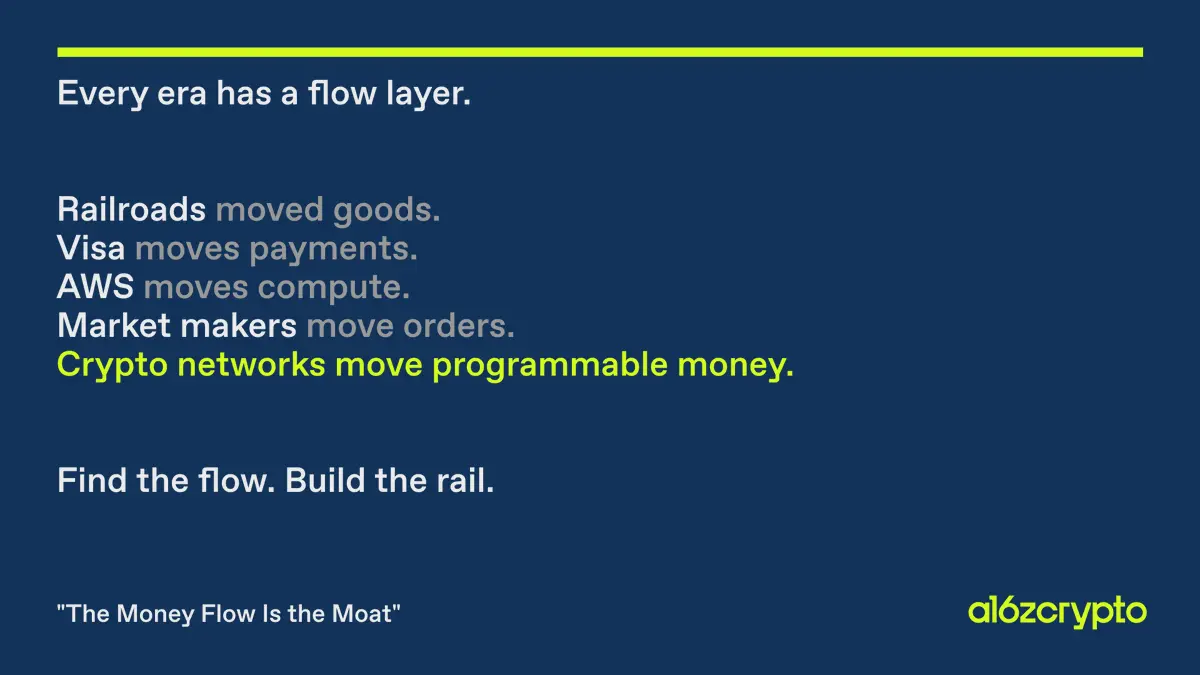
Financial markets make this model even clearer. Visa processed $15.7 trillion in payment volume in FY 2024 and reported $35.9 billion in net income. Jane Street posted $20.5 billion in net trading income last year – more than Citigroup or Bank of America. The top five US market makers handled 87% of order flow payment: they don't predict markets; they sit in the flow of every order and earn more as volume grows.

These businesses share another trait: network effects. Visa is more useful to more merchants because there are more cards; more useful to more cardholders because more merchants accept it. Same with order flow – each additional broker tightens spreads, attracting more brokers, which attracts more flow.

Flow of funds plus network effects is one of the most durable business structures ever.

Your Margin Is My Opportunity

Bezos called it “your margin is my opportunity.” He was talking about retail, but it applies even more to traditional financial services – the world's largest pool of profit extraction. Payments, custody, lending, FX, securitization, settlement, market making, without exception. Visa and Mastercard charge 2–3% transaction fees on networks designed in the 1960s. Remittance corridors take 6–9%. Prime brokers and custodians take a piece of every securities trade. Even after the US moved to T+1 settlement in 2024, funds still sit idle overnight as a structural tax on everyone involved.

Each of these margins is a target. Compress the cost, increase the speed, and potentially expand the whole market. Stripe and Square proved this was possible in payments.

Crypto founders have the opportunity to build the next version – programmable, instant, global, and natively in the flow of funds.

And the frontier extends far beyond financial services. Compute and GPU markets. Memory chips. AI training data. Energy. Robotics. Space. Rare earth metals. Each is a category where global value can begin to move at volumes the existing rails were never designed to carry.

Each is greenfield for building a flow-of-funds business on programmable infrastructure from the ground up. These markets have no existing rails, no entrenched intermediaries, and nothing to defend.

As a founder, ask yourself:

1. Are you in the flow of funds today?

2. When the value of activity on your product grows 10x, does your revenue grow with it?

3. If you're building a new product, where in your target market is the profit extraction highest relative to the value being created?
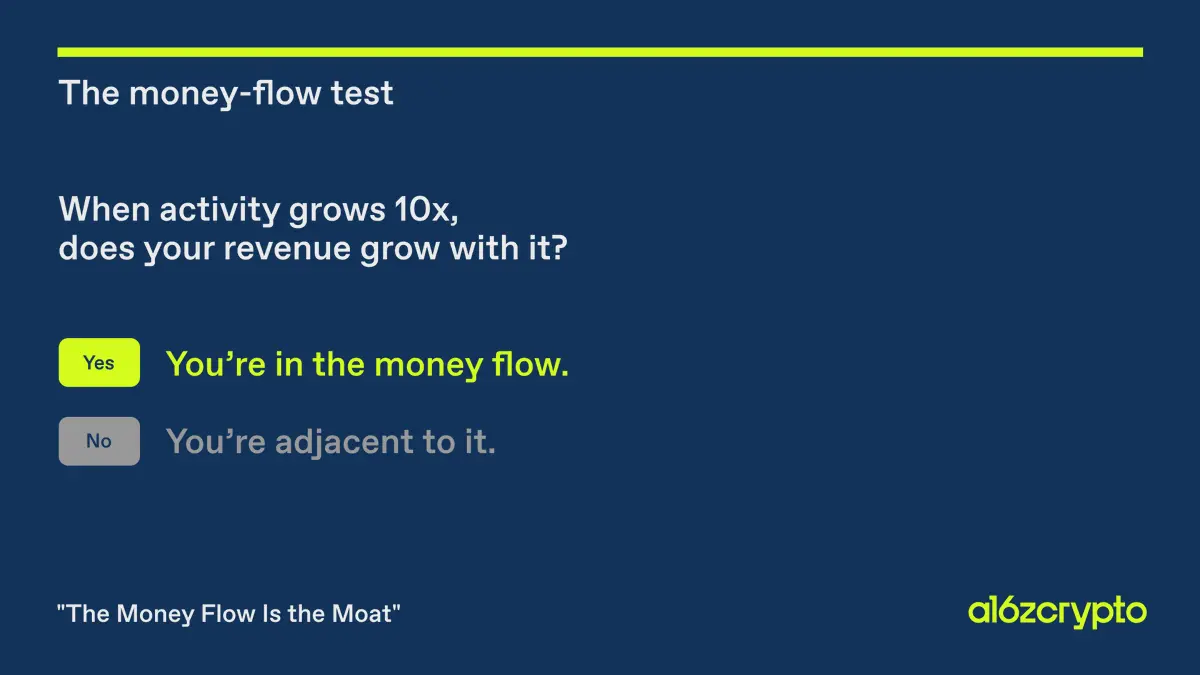
The opportunity is there. Take it, get into the new flow, and let the network compound from there.


Trending Cryptos

Related Questions

QAccording to the article, what is the core principle shared by historically great businesses like railroads, Google, Meta, and AWS?

AThe core principle is that historically great businesses position themselves within the 'flow of funds.' They facilitate the creation and transfer of value within a network and capture a portion of it. The more value that flows through the network, the larger the business typically becomes.

QHow does the article describe the unique advantage that cryptocurrency provides for startups regarding business models?

ACryptocurrency is the first modern technology natively built for the 'flow of funds' model. It enables value to move at internet speed—24/7, settled globally, with end-to-end programmability. This gives startups the advantage of inheriting network effects from the start and building on programmable infrastructure where payment rails are frictionless.

QWhat two powerful business concepts, when combined, does the article claim create one of the most durable business structures ever?

AThe combination of being in the 'flow of funds' and having 'network effects' creates one of the most durable business structures ever. The flow of funds generates revenue, while network effects make the service more valuable as more participants join, creating a powerful, self-reinforcing cycle.

QWhat does the article suggest is the primary target for crypto founders looking to disrupt traditional industries?

AThe primary target is the high-profit margins extracted by entrenched intermediaries in traditional industries, especially in financial services (payments, custody, lending, FX, etc.). The article quotes Jeff Bezos: 'Your margin is my opportunity.' Crypto founders can build cheaper, faster, and more programmable alternatives.

QWhat are the three key questions the article advises founders to ask themselves about their business?

A1. Are you in the flow of funds today? 2. When the value of activity on your product grows 10x, does your revenue scale with it? 3. If you're building a new product, where in your target market is profit extraction highest relative to the value being created?

Related Reads

Bitcoin Mining Farms Are Becoming AI Factories

Bitcoin mines are transforming into AI factories. This shift is driven by the convergence of three key assets from the previous crypto cycle: infrastructure, talent, and capital. Crypto mining companies like Crusoe, CoreWeave, and Bitdeer are repurposing their core competency—securing power, land, and grid connections in remote locations—to build data centers for AI clients. These firms are signing multi-billion dollar, long-term contracts with companies like Anthropic, AWS, and Microsoft, as AI's demand for reliable, high-capacity compute surpasses the profitability of Bitcoin mining. Simultaneously, crypto entrepreneurs and engineers are applying their skills to new AI ventures. Examples include OpenSea's co-founder launching OpenRouter (an AI model aggregator), and former Coinbase engineers building Fal.ai (a generative media infrastructure platform). Their experience in building scalable, global software networks translates effectively to the AI space. Furthermore, capital accumulated during the crypto boom is now fueling AI. Figures like Jed McCaleb (co-founder of Ripple) funded Voltage Park, a large-scale GPU cloud provider. Notably, some crypto investments, like FTX's early bets on Anthropic and Cursor, have generated astronomical paper returns, demonstrating how high-risk crypto capital flowed into AI before it became mainstream. The transition is not just about repurposing hardware, but about redirecting critical resources—power infrastructure, distributed systems expertise, and venture funding—to the next technological frontier: artificial intelligence.

链捕手11m ago

Bitcoin Mining Farms Are Becoming AI Factories

链捕手11m ago

Morpho Launches Fixed-Rate Product Midnight: Lenders and Borrowers Set Their Own Rates, Ending the Era of Interest Rate Models

Morpho Launches Fixed-Rate Product Midnight: Lenders and Borrowers Set Their Own Rates, Ending the Era of Algorithmic Interest Models On-chain lending has grown to $60 billion but remains minuscule compared to traditional finance's $200 trillion annual credit volume. Morpho identifies the lack of fixed rates and maturity dates as key bottlenecks. Institutions need predictability, not the passive floating rates set by algorithmic models. Midnight allows lenders and borrowers to directly quote rates, set terms, and become price makers, not takers. Fixed-rate lending is now viable due to cheaper, faster blockchains and the entry of institutions demanding control and certainty over returns, costs, and duration. Morpho Blue previously gave users control over risk; Midnight adds control over interest rates. Past attempts at on-chain fixed-rate lending failed primarily because they were built on top of floating-rate pools (creating unpredictability) or lacked sufficient active participants. Midnight avoids these pitfalls as a standalone primitive with fixed rates at its core, built upon Morpho Blue's existing large and active user base. Midnight offers distinct value: institutions gain predictable term structures and full control; fintech companies can offer tailored fixed-rate products; lenders/borrowers achieve predictability and efficiency; and curators can now differentiate by configuring both risk and interest rates. Morpho Midnight is not a replacement for Morpho Blue. The Morpho network will now feature two complementary market structures: floating-rate/open-term (Blue) for flexibility and fixed-rate/fixed-term (Midnight) for predictability. Liquidity can flow between them. The launch will be gradual, prioritizing security. Initially, it will support direct lending on Base network with one trading pair (cbBTC/USDC) and limited maturity dates. Advanced features like auto-rollovers will be introduced later.

marsbit12m ago

Morpho Launches Fixed-Rate Product Midnight: Lenders and Borrowers Set Their Own Rates, Ending the Era of Interest Rate Models

marsbit12m ago

human.tech Launches Clean SDK for Privacy-First Web3 Apps

human.tech has launched the Clean SDK, a toolkit enabling developers to build privacy-first Web3 applications with transparent accountability. Released alongside Aztec's version 5, the SDK provides components for integrating zero-knowledge identity verification, sanctions screening, and private transactions, without developers handling sensitive user data or building compliance infrastructure from scratch. It uses zero-knowledge proofs and programmable verification to allow apps to confirm user legitimacy and sanctions compliance while keeping identities confidential. The first application built on the SDK, Shield, a privacy bridge to Aztec, also launched. It allows users to transfer assets privately while proving a unique human is behind each transfer and that funds have passed sanctions checks, as verified by a May 2026 audit. The SDK offers three core verification techniques: Proof of Innocence (sanctions screening against 23 sources), Proof of Personhood (simpler verification via Human Passport), and Proof of Clean Hands (higher-assurance zero-knowledge government ID checks). This allows apps to authenticate users and transactions without exposing personal data. Designed for Aztec builders, the SDK lets developers add programmable privacy to decentralized apps, eliminating the need to create their own verification and ZK infrastructure. Shield demonstrates its practical use for private bridges, but the SDK aims to enable a wider ecosystem of private, accountable financial apps and services. The launch addresses growing demand for infrastructure that balances privacy and accountability. The SDK avoids traditional identity databases, storing encrypted data off-chain, screening at both entry and exit points, and including a gated disclosure mechanism for legal requests. human.tech's products, including the Clean SDK, focus on using zero-knowledge technology to enable verifiable personhood and privacy in digital systems.

TheNewsCrypto48m ago

human.tech Launches Clean SDK for Privacy-First Web3 Apps

TheNewsCrypto48m ago

Unlocking $100 Million in Liquidity? Pump.fun's New Policy Tests the 5-Minute Pump Technique

Pump.fun, a popular meme coin launchpad, has introduced a new standard mechanism called BOOST. It aims to address a significant capital efficiency issue: when a newly launched token graduates from its initial bonding curve to a liquidity pool (LP), roughly 20% of its liquidity becomes permanently locked as "dead liquidity," estimated to waste over $100 million annually. Instead of locking these funds permanently, BOOST repurposes them. Upon a token's migration, approximately 20% of the settlement funds (e.g., 17.6 SOL or ~$2516 USDC) are used to buy back the token on the open market over a 5-minute period via a Time-Weighted Average Price (TWAP) mechanism. All purchased tokens are immediately burned. This creates a brief, systematic buy pressure immediately after migration, potentially generating a short-term price surge ("pump") while permanently reducing the token's circulating supply. The goal is to enhance the immediate post-launch trading experience, potentially increasing trader retention and sustainable protocol revenue, which funds ongoing token buybacks. However, concerns exist that this artificial 5-minute boost could lower the barrier for launching low-quality tokens and lead to steeper price crashes once the buy pressure stops, if followed by large sell-offs. The feature automatically applies to tokens migrating after July 21, 2024, but not to previously migrated tokens or those launched via the Mayhem AI Agent lab.

marsbit56m ago

Unlocking $100 Million in Liquidity? Pump.fun's New Policy Tests the 5-Minute Pump Technique

marsbit56m ago

Trading

Spot

Hot Articles

How to Buy FLOW

Welcome to HTX.com! We've made purchasing Flow (FLOW) simple and convenient. Follow our step-by-step guide to embark on your crypto journey.Step 1: Create Your HTX AccountUse your email or phone number to sign up for a free account on HTX. Experience a hassle-free registration journey and unlock all features.Get My AccountStep 2: Go to Buy Crypto and Choose Your Payment MethodCredit/Debit Card: Use your Visa or Mastercard to buy Flow (FLOW) instantly.Balance: Use funds from your HTX account balance to trade seamlessly.Third Parties: We've added popular payment methods such as Google Pay and Apple Pay to enhance convenience.P2P: Trade directly with other users on HTX.Over-the-Counter (OTC): We offer tailor-made services and competitive exchange rates for traders.Step 3: Store Your Flow (FLOW)After purchasing your Flow (FLOW), store it in your HTX account. Alternatively, you can send it elsewhere via blockchain transfer or use it to trade other cryptocurrencies.Step 4: Trade Flow (FLOW)Easily trade Flow (FLOW) on HTX's spot market. Simply access your account, select your trading pair, execute your trades, and monitor in real-time. We offer a user-friendly experience for both beginners and seasoned traders.

3.8k Total ViewsPublished 2024.03.29Updated 2026.06.02

How to Buy FLOW

Discussions

Welcome to the HTX Community. Here, you can stay informed about the latest platform developments and gain access to professional market insights. Users' opinions on the price of FLOW (FLOW) are presented below.

活动图片