A Longer Iran War Could Send Bitcoin Higher, Arthur Hayes Says

bitcoinistPublished on 2026-03-02Last updated on 2026-03-02

Abstract

Arthur Hayes, co-founder of BitMEX, argues that a prolonged US military conflict with Iran could become a bullish catalyst for Bitcoin. He suggests that such a war would likely pressure the Federal Reserve to implement monetary easing—cutting interest rates and increasing liquidity—to support the economy and stabilize markets amid heightened uncertainty. Hayes cites historical precedents, including the Fed's responses to the Gulf War and the 9/11 attacks, where geopolitical shocks led to easier monetary policy. He advises waiting for clear policy signals, like a Fed rate cut, before aggressively buying Bitcoin and other cryptocurrencies. At the time of writing, Bitcoin was trading at $66,218.

Arthur Hayes argues that a deeper US conflict with Iran could ultimately become a bullish macro setup for Bitcoin, not because war is constructive for markets, but because it may push the Federal Reserve toward cheaper and more abundant money.

Why Bitcoin Could Surge

In his March 2 essay iOS Warfare, the BitMEX co-founder laid out a simple thesis: if President Donald Trump commits the US to a prolonged and expensive campaign tied to Iran, the political and fiscal strain could raise the odds of monetary easing. For Hayes, that matters more than the conflict itself. “The longer Trump engages in the extremely costly activity of Iranian nation-building,” he wrote, “the higher the likelihood the Fed lowers the price and increases the quantity of money to support Pax Americana’s latest bout of Middle Eastern adventurism.”

Hayes’ argument rests on a historical pattern rather than a direct forecast on oil, geopolitics or battlefield outcomes. He points to prior US military engagements in the Middle East and says major conflicts were followed, or accompanied, by easier monetary policy. In his reading, wars do not just damage confidence and strain public finances; they also create conditions in which the Fed has cover to cut rates, support liquidity and help stabilize asset markets.

To support that view, Hayes cites several episodes going back to 1990. After the Gulf War began, he notes, the Fed initially stayed put but signaled that worsening conditions could force a shift. From the August 21, 1990 FOMC discussion, he quotes: “The heightened uncertainties and the prospectively less satisfactory performance of the economy stemming from events in the Middle East had greatly complicated the formulation of an effective monetary policy. In the opinion of several members, events appeared likely to unfold in a direction that would require an easing of policy at some point to counter weakening tendencies in the economy that had been in train before the oil price increase.”

He also highlights the Fed’s response after the September 2001 attacks and the launch of the Global War on Terror. In an emergency meeting, then-Chair Alan Greenspan said: “It’s clear that the events of last week, at a minimum, have created a heightened degree of fear and uncertainty that is placing considerable downward pressure on asset prices, increasing the probability of an asset price deflation, with its obvious impact on the economy. Therefore, I propose a 50-basis point cut in the federal funds rate target.”

For Hayes, those episodes show that geopolitical shocks can become monetary events. His framing is blunt: when war dents confidence, threatens growth or pressures markets, the policy answer tends to be lower rates and more liquidity. That, in turn, is the backdrop he believes tends to favor Bitcoin.

Still, Hayes is not calling for an immediate risk-on trade. He says the market does not yet know how long Trump would stay committed to reshaping Iran, nor how much market or political pain the administration can absorb before changing course. Because of that, he argues the cleaner trade is to wait for confirmation from policy rather than front-run the thesis too early.

“The prudent action is to wait and see,” Hayes wrote. “The time to back up the truck and buy Bitcoin and high-quality shitcoins like HYPE is immediately after the Fed cuts rates and or prints money to support the government’s goals in Iran.”

At press time, Bitcoin traded at $66,218.
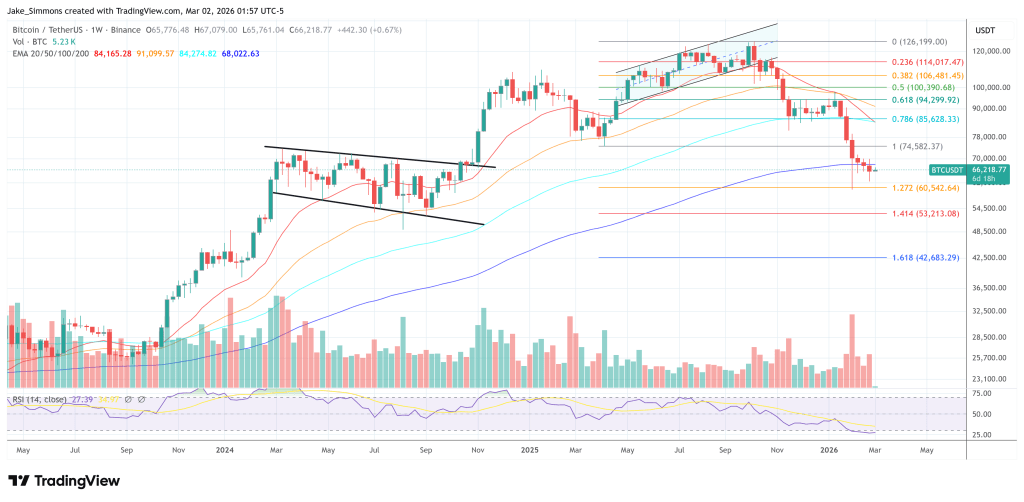
Bitcoin must reclaim the 200-week EMA, 1-week chart | Source: BTCUSDT on TradingView.com

Related Questions

QAccording to Arthur Hayes, why could a prolonged US conflict with Iran become a bullish setup for Bitcoin?

ABecause it may push the Federal Reserve toward implementing cheaper and more abundant monetary policy (like cutting rates and increasing liquidity) to support the costly military campaign, which historically creates a favorable macro environment for Bitcoin.

QWhat historical pattern does Hayes cite to support his argument about war and monetary policy?

AHe points to prior U.S. military engagements in the Middle East, such as the Gulf War and the post-9/11 Global War on Terror, which were followed or accompanied by easier monetary policy from the Fed to counter economic weakening and stabilize markets.

QWhat specific Fed actions from history does Hayes reference?

AHe quotes from the August 1990 FOMC discussion about the potential need for easing due to the Gulf War and highlights then-Chair Alan Greenspan's emergency 50-basis-point rate cut following the September 2001 attacks.

QWhat is Hayes' recommended trading strategy based on his thesis?

AHe advises a prudent 'wait and see' approach, suggesting that the 'cleaner trade' is to wait for confirmation from Fed policy (like an actual rate cut or money printing) before buying Bitcoin and other cryptocurrencies.

QWhat key technical level for Bitcoin is mentioned in the article's chart caption?

AThe chart caption states that Bitcoin must reclaim the 200-week Exponential Moving Average (EMA).

Related Reads

Lowering Expectations for BTC's Next Bull Market

The author, Alex Xu, explains his decision to significantly reduce his Bitcoin holdings (from full to ~30% of his portfolio) during the current bull cycle, citing a lowered long-term outlook for BTC's price appreciation in the next cycle. He outlines six key reasons for this reduced expectation: 1. **Diminished Growth Drivers:** The narrative of exponential user adoption has largely played out with institutional ETF adoption. The next major growth phase—adoption by sovereign national reserves or central banks—seems unlikely in the near future. 2. **Personal Opportunity Cost:** More attractive investment opportunities have emerged in other assets, such as undervalued companies. 3. **Industry-Wide Contraction:** The broader crypto industry is struggling, with most Web3 business models (SocialFi, GameFi, DePIN) failing. This overall萧条 (depression) reduces the fundamental demand and consensus for Bitcoin. 4. **Strain on Major Buyer:** MicroStrategy, a major corporate buyer of BTC, faces rising financing expenses for its debt, which could slow its purchasing rate and create significant marginal pressure on the market. 5. **Increased Competition from Gold:** The emergence of "tokenized gold" has closed the functional gap (portability, divisibility) between physical gold and Bitcoin, offering a strong competitor in the non-sovereign store-of-value space. 6. **Security Budget Concerns:** The block reward halving continues to exacerbate the long-standing issue of funding Bitcoin's network security, with new fee source explorations like Ordinals and L2s largely failing. The author's decision to hold a significant (though reduced) position reflects a cautious, not bearish, outlook. He remains open to increasing his exposure if the fundamental reasons for his skepticism change or if new positive catalysts emerge.

marsbit37m ago

Lowering Expectations for BTC's Next Bull Market

marsbit37m ago

Can Iran 'Control' the Strait of Hormuz?

Iran has announced a comprehensive plan to assert control over the strategic Strait of Hormuz, a critical global oil shipping chokepoint. The proposed measures include requiring all vessels to obtain Iranian permission for passage, imposing fees for security, environmental protection, and navigation management—preferably paid in Iranian rials—and absolutely banning Israeli ships. Vessels from countries deemed hostile by Iran’s top security bodies may also be barred. Analysts suggest Iran’s motives are multifaceted: increasing pressure on the U.S. and Israel by leveraging control over oil transit to influence global prices and inflation; creating a new revenue stream, potentially exceeding $7.7 billion annually, to counter Western sanctions and support postwar reconstruction; and using transit permissions as bargaining chips in future negotiations, notably with the U.S. However, the plan faces significant practical and diplomatic challenges. Enforcing comprehensive interception and fee collection in the busy waterway, patrolled by international military forces, would be difficult. The U.S. has already countering with a blockade of Iranian ports and threats to intercept any ship paying fees, potentially strangling Iran’s oil exports and fee revenue. Broad international opposition, led by European and Gulf states, and legal controversies further complicate implementation. The proposal may ultimately serve more as a negotiating tactic than a feasible policy, with its execution remaining highly uncertain.

marsbit1h ago

Can Iran 'Control' the Strait of Hormuz?

marsbit1h ago

Trading

Spot
Futures

Hot Articles

What is $BITCOIN

DIGITAL GOLD ($BITCOIN): A Comprehensive Analysis Introduction to DIGITAL GOLD ($BITCOIN) DIGITAL GOLD ($BITCOIN) is a blockchain-based project operating on the Solana network, which aims to combine the characteristics of traditional precious metals with the innovation of decentralized technologies. While it shares a name with Bitcoin, often referred to as “digital gold” due to its perception as a store of value, DIGITAL GOLD is a separate token designed to create a unique ecosystem within the Web3 landscape. Its goal is to position itself as a viable alternative digital asset, although specifics regarding its applications and functionalities are still developing. What is DIGITAL GOLD ($BITCOIN)? DIGITAL GOLD ($BITCOIN) is a cryptocurrency token explicitly designed for use on the Solana blockchain. In contrast to Bitcoin, which provides a widely recognized value storage role, this token appears to focus on broader applications and characteristics. Notable aspects include: Blockchain Infrastructure: The token is built on the Solana blockchain, known for its capacity to handle high-speed and low-cost transactions. Supply Dynamics: DIGITAL GOLD has a maximum supply capped at 100 quadrillion tokens (100P $BITCOIN), although details regarding its circulating supply are currently undisclosed. Utility: While precise functionalities are not explicitly outlined, there are indications that the token could be utilized for various applications, potentially involving decentralized applications (dApps) or asset tokenization strategies. Who is the Creator of DIGITAL GOLD ($BITCOIN)? At present, the identity of the creators and development team behind DIGITAL GOLD ($BITCOIN) remains unknown. This situation is typical among many innovative projects within the blockchain space, particularly those aligning with decentralized finance and meme coin phenomena. While such anonymity may foster a community-driven culture, it intensifies concerns about governance and accountability. Who are the Investors of DIGITAL GOLD ($BITCOIN)? The available information indicates that DIGITAL GOLD ($BITCOIN) does not have any known institutional backers or prominent venture capital investments. The project seems to operate on a peer-to-peer model focused on community support and adoption rather than traditional funding routes. Its activity and liquidity are primarily situated on decentralized exchanges (DEXs), such as PumpSwap, rather than established centralized trading platforms, further highlighting its grassroots approach. How DIGITAL GOLD ($BITCOIN) Works The operational mechanics of DIGITAL GOLD ($BITCOIN) can be elaborated on based on its blockchain design and network attributes: Consensus Mechanism: By leveraging Solana’s unique proof-of-history (PoH) combined with a proof-of-stake (PoS) model, the project ensures efficient transaction validation contributing to the network's high performance. Tokenomics: While specific deflationary mechanisms have not been extensively detailed, the vast maximum token supply implies that it may cater to microtransactions or niche use cases that are still to be defined. Interoperability: There exists the potential for integration with Solana’s broader ecosystem, including various decentralized finance (DeFi) platforms. However, the details regarding specific integrations remain unspecified. Timeline of Key Events Here is a timeline that highlights significant milestones concerning DIGITAL GOLD ($BITCOIN): 2023: The initial deployment of the token occurs on the Solana blockchain, marked by its contract address. 2024: DIGITAL GOLD gains visibility as it becomes available for trading on decentralized exchanges like PumpSwap, allowing users to trade it against SOL. 2025: The project witnesses sporadic trading activity and potential interest in community-led engagements, although no noteworthy partnerships or technical advancements have been documented as of yet. Critical Analysis Strengths Scalability: The underlying Solana infrastructure supports high transaction volumes, which could enhance the utility of $BITCOIN in various transaction scenarios. Accessibility: The potential low trading price per token could attract retail investors, facilitating wider participation due to fractional ownership opportunities. Risks Lack of Transparency: The absence of publicly known backers, developers, or an audit process may yield skepticism regarding the project's sustainability and trustworthiness. Market Volatility: The trading activity is heavily reliant on speculative behavior, which can result in significant price volatility and uncertainty for investors. Conclusion DIGITAL GOLD ($BITCOIN) emerges as an intriguing yet ambiguous project within the rapidly evolving Solana ecosystem. While it attempts to leverage the “digital gold” narrative, its departure from Bitcoin's established role as a store of value underscores the need for a clearer differentiation of its intended utility and governance structure. Future acceptance and adoption will likely depend on addressing the current opacity and defining its operational and economic strategies more explicitly. Note: This report encompasses synthesised information available as of October 2023, and developments may have transpired beyond the research period.

363 Total ViewsPublished 2025.05.13Updated 2025.05.13

What is $BITCOIN

Discussions

Welcome to the HTX Community. Here, you can stay informed about the latest platform developments and gain access to professional market insights. Users' opinions on the price of BTC (BTC) are presented below.

活动图片















