A Calculation Vulnerability Led to the Theft of 8,535 ETH from Truebit

marsbitPublished on 2026-01-13Last updated on 2026-01-13

Abstract

On January 8, 2026, the Truebit Protocol was exploited, resulting in a loss of 8,535.36 ETH (approximately $26.44 million). The attack involved a critical integer overflow vulnerability in the token purchase price calculation function. The attacker executed four rounds of transactions by calling functions getPurchasePrice, 0xa0296215, and 0xc471b10b. In the first round, the attacker called getPurchasePrice with a large input value (240442509453545333947284131), which returned 0 due to an arithmetic flaw. Then, they invoked function 0xa0296215 with msg.value = 0, successfully minting a massive amount of TRU tokens. Finally, by calling function 0xc471b10b, they burned the minted tokens and received 5,105.06 ETH. The root cause was an unchecked addition operation (v12 + v9) in the price calculation logic (function 0x1446), which overflowed to a small value, making (v12 + v9) / v6 = 0. The contract used Solidity ^0.6.10 without overflow checks, enabling the exploit. This incident highlights the risks of older DeFi protocols with unpatched vulnerabilities, possibly identified through AI-assisted scanning. Projects are advised to conduct security audits, upgrade contracts, and monitor链上 activity to mitigate such threats.

On January 8, 2026, the Truebit Protocol was hacked, resulting in a loss of 8,535.36 ETH (approximately $26.44 million). The Truebit Protocol officially confirmed the incident in the early hours of the following day. The ExVul security team conducted a detailed analysis of the vulnerability, with the results as follows:

Attack Process

Attacker's address:

0x6c8ec8f14be7c01672d31cfa5f2cefeab2562b50

Attack transaction hash:

0xcd4755645595094a8ab984d0db7e3b4aabde72a5c87c4f176a030629c47fb014

The attacker completed the attack by cyclically calling getPurchasePrice→0xa0296215→0xc471b10b for four rounds. The first cycle is analyzed as an example.

1. The attacker first called the getPurchasePrice(240442509453545333947284131) function, which returned 0.

2. The attacker called the 0xa0296215(c6e3ae8e2cbab1298abaa3) function with msg.value as 0. Finally, 240442509453545333947284131 TRU were successfully minted.

3. The attacker called the 0xc471b10b(c6e3ae8e2cbab1298abaa3) function. Finally, 240442509453545333947284131 TRU were burned, and 5105.06 ETH were obtained.

Attack Logic Analysis

By understanding the above attack process, it is clear that there is an issue with the logic of the getPurchasePrice function and the 0xa0296215 function. The following is an in-depth analysis (since the contract is not open source, the code below is decompiled).
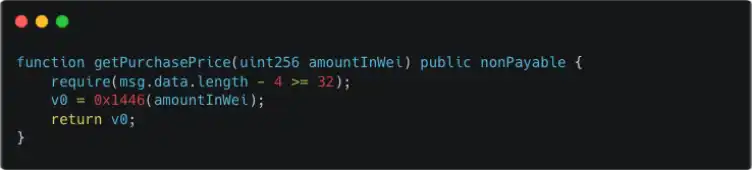
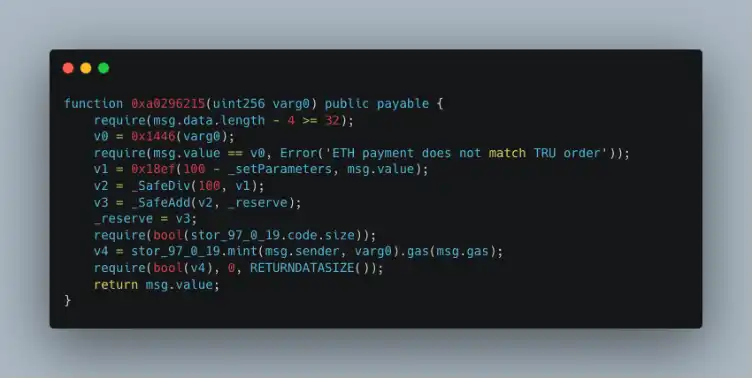
By comparing the common points of the two functions, we can see that the 0x1446 function is used to calculate how much ETH is needed to purchase a specified amount of TRU. Clearly, the logic of the 0x1446 function is flawed, leading to an incorrect ETH calculation. The logic within the 0x1446 function is analyzed in detail below.
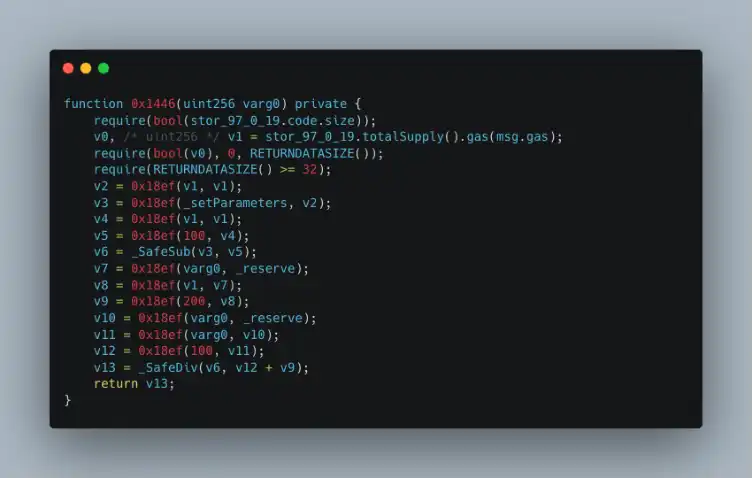
Observing the logic in the 0x1446 function, since the final calculation result v13 == 0, the calculation logic mentioned above must be problematic. It is important to note that the 0x18ef function is the same as _SafeMul, so the issue lies in the native addition v12 + v9 (the contract version is ^0.6.10, so there is no overflow check).

v12 and v9 represent:
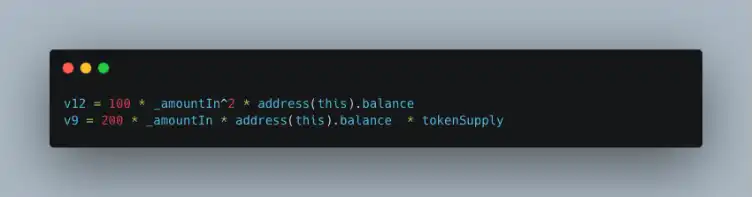
Based on the above analysis, the attacker's strategy was to input a huge _amountIn to cause v12 + v9 to overflow into a very small value, ultimately resulting in (v12 + v9) / v6 == 0.

Summary

The root cause of the Truebit Protocol attack is a severe integer overflow vulnerability in its token purchase price calculation logic. Since the contract uses Solidity ^0.6.10 and lacks safety checks for critical arithmetic operations, it ultimately led to a significant loss of 8,535.36 ETH. The latest versions of Solidity have already mitigated overflow vulnerabilities. This attack was likely discovered by hackers using AI to automatically scan older DeFi protocols that are already live (including recent attacks on Balancer and yETH). We believe such attacks exploiting AI to target older DeFi protocols will become increasingly common in the near future. Therefore, we recommend that project teams conduct new security audits of their contract code. If vulnerabilities are found, they should upgrade the contract or transfer assets as soon as possible, and implement on-chain monitoring to detect anomalies promptly and minimize losses.


Trending Cryptos

Related Questions

QWhat was the main vulnerability exploited in the Truebit Protocol attack?

AThe main vulnerability was an integer overflow issue in the token purchase price calculation logic, specifically in the `getPurchasePrice` function, which allowed the attacker to manipulate calculations and mint a large number of TRU tokens without paying the required ETH.

QHow much ETH was stolen in the Truebit Protocol attack?

A8,535.36 ETH, which was approximately equivalent to $26.44 million at the time of the attack.

QWhat was the attacker's address involved in the Truebit exploit?

AThe attacker's address was 0x6c8ec8f14be7c01672d31cfa5f2cefeab2562b50.

QWhich Solidity version was the Truebit Protocol contract using, and why was it significant?

AThe contract was using Solidity ^0.6.10, which did not have built-in overflow checks for arithmetic operations. This lack of safety checks allowed the integer overflow vulnerability to be exploited.

QWhat was the key step the attacker took to trigger the integer overflow vulnerability?

AThe attacker input a very large value for `_amountIn` in the `getPurchasePrice` function, causing the calculation `v12 + v9` to overflow and result in a very small value, ultimately making `(v12 + v9) / v6` equal to zero, which allowed minting tokens without cost.

Related Reads

In Jinjiang, Fujian, a Storage Super Unicorn Lies Quiet

In Fujian's Jinjiang, a city known for sportswear, lies a quiet semiconductor giant: Fujian Jinhua Integrated Circuit Co. (JHICC). Once a promising domestic DRAM manufacturer alongside Yangtze Memory and ChangXin Memory Technologies (CXMT), its journey was derailed in 2018 when the U.S. placed it on an Entity List and filed criminal charges for alleged trade secret theft. This halted production for years. A turning point came in February 2024 when a U.S. federal court found JHICC not guilty. However, it had lost crucial time. While CXMT soared to become a top-valued A-share company in 2024, JHICC, with an estimated valuation of 80 billion RMB, was just restarting. Its current output is primarily customized DDR4 chips, not the advanced DDR5/HBM demanded for AI, but it still benefits from the broader memory chip upcycle. JHICC's story is tied to Chen Zhengkun, a veteran engineer who left Micron to lead the venture. Founded in 2016 with state-backed funding, JHICC partnered with Taiwan's UMC to develop DRAM technology. Rapid progress was cut short by the U.S. actions, which Micron initiated, partly due to its heavy reliance on the Chinese market. Post-sanctions, Chen's team worked to rebuild the production line with reduced reliance on U.S. technology. According to its records, JHICC achieved small-scale production and revenue growth under immense pressure. It now focuses on the stable "niche" DRAM market (e.g., TVs, routers) with a monthly capacity of ~40,000 wafers, aiming for 60,000 by 2026. It holds over 1,000 patents but remains on the Entity List. For Jinjiang, investing in JHICC was a bold industrial leap. The local government provided unwavering financial and logistical support during the crisis, helping the company survive. JHICC has become the anchor for a growing local semiconductor cluster. Though its scale lags behind domestic peers, JHICC's persistence symbolizes a hard-won foothold in a global market long dominated by Samsung, SK Hynix, and Micron. Having missed one boom, it seeks a place in the new AI-driven memory supercycle.

marsbit50m ago

In Jinjiang, Fujian, a Storage Super Unicorn Lies Quiet

marsbit50m ago

Trading

Spot

Hot Articles

Discussions

Welcome to the HTX Community. Here, you can stay informed about the latest platform developments and gain access to professional market insights. Users' opinions on the price of ETH (ETH) are presented below.

活动图片














