Hyperliquid Traders Drive CXMT Trading Volumes to Peak Levels on IPO Day

cryptonews.ruPublished on 2026-07-27Last updated on 2026-07-27

Abstract

On July 27th, ChangXin Memory Technologies (CXMT), a major Chinese DRAM manufacturer, made its highly anticipated debut on the Shanghai Stock Exchange (SSE), becoming China's most valuable publicly traded AI-infrastructure company. The IPO coincided with record trading volumes for CXMT on the Hyperliquid blockchain platform (HIP-3), peaking at over $9 million. The stock surged 470-530% at its debut, pushing its market cap over $483 billion, driven by massive demand exceeding the IPO's supply. On Hyperliquid, pre-IPO trading saw prices fluctuate significantly, with the futures market reaching $234 million in early hours. Notably, a former major Bitcoin trader shifted entirely to trading CXMT futures. The event highlights how crypto derivatives platforms are being used for early price discovery and potential hedging against volatility in major traditional market IPOs.

ChangXin Memory Technologies (CXMT) held its long-awaited IPO on Monday, July 27th. The stock listing coincided with a surge of activity on the Hyperliquid exchange, as CXMT attracted attention from both large and retail traders.

CXMT's IPO was expected to be the largest stock listing on the Shanghai Stock Exchange since 2011. As Cryptopolitan reported, the buzz around Chinese AI-related stocks was seen as a new opportunity, and crypto traders immediately seized it.
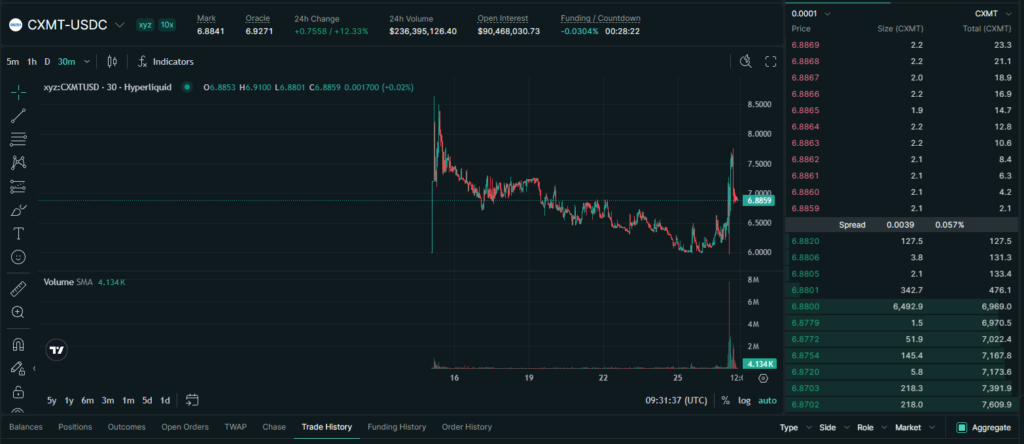
The CXMT exchange saw a record surge in activity, alongside an influx of large crypto investors taking directional positions in one of mainland China's largest IPOs. | Source: HIP-3

The CXMT exchange is already available through TradeXYZ after the platform acquired rights to this ticker on Hyperliquid for 500 HYPE.

As of July 27th, CXMT on HIP-3 exceeded $45 million, and after an initial record spike, daily trading volume reached a new peak, surpassing $9 million. The IPO day saw significant selling as both perpetual futures and the underlying shares were in price discovery.

CXMT Shares Soar in Shanghai Trading

Chipmaker CXMT became China's most valuable AI infrastructure company after its shares surged 470-530% upon its debut on the Shanghai exchange. The company's total market capitalization is estimated at over $483 billion, making it the most valuable company listed on an exchange in mainland China.

The stock market debut also tests the resilience of forecasts for chipmaker and AI-related stocks. CXMT is a major DRAM producer, a basic component used in consumer electronics and data centers.

Funds raised from the IPO are expected to be directed towards production expansion and additional R&D.

Beyond CXMT's business model, a key driver for the rapid price surge was peak demand for the shares, significantly exceeding IPO volumes.

The demand spread to blockchain trading as well, with Hyperliquid offering an entry point for early price discovery speculation. On the first day of trading, the HIP-3 market for CXMT reached 1.14% of the volumes on the Shanghai Stock Exchange, jumping to $234 million in the first hours after the IPO.

Former Major $BTC Market Player Shifts to CXMT

On the HIP-3 platform, the price of CXMT shares fluctuated from over $8 to $5.99. The price range set by perpetual futures traders was closer to the actual IPO price than the company's initial target price of $1.20 per share.

Following the IPO, the HIP-3 company held 13 large positions in CXMT shares, of which seven showed bullish sentiment, taking long positions.

The leader still holds a short position with a notional value of $17.87 million. After the price rise, the volume investment leader incurred an unrealized loss of $1.24 million.

Another major player, primarily known for their positions in $BTC, has fully switched to trading CXMT. Their position still stands at $4.81 million, fluctuating between a profit of $300k and small temporary losses. Large players are still waiting for the stock to choose its own direction in the first days after the IPO.

At this point, it is unknown whether any of the major investors managed to secure IPO shares directly from the company. In that case, selling CXMT shares short would be a hedging strategy in case of a sharp price drop after the initial hype. Such a scenario also points to Hyperliquid as a hedging tool that could be used in other upcoming major IPOs.

end-content

Related Questions

QWhat company conducted a highly anticipated IPO and what was the date?

AThe company ChangXin Memory Technologies (CXMT) conducted its highly anticipated IPO on Monday, July 27th.

QWhich trading platform acquired the rights to trade the CXMT ticker on Hyperliquid?

AThe trading platform TradeXYZ acquired the rights to trade the CXMT ticker on Hyperliquid for 500 HYPE.

QHow much did CXMT's shares surge on its Shanghai stock exchange debut?

ACXMT's shares surged 470-530% on its debut on the Shanghai stock exchange.

QWhat was the estimated total market capitalization of CXMT after its IPO?

AThe estimated total market capitalization of CXMT after its IPO was over $483 billion.

QWhat did a trader known for major Bitcoin positions do regarding CXMT, according to the article?

AAccording to the article, a trader known for major Bitcoin positions fully switched to trading CXMT, with a current position worth $4.81 million.

Related Reads

The 800x Golden Dog, "Gacha" Saves NFT Trading

Title: 800x Golden Dog: How 'Gacha' Mechanics Are Rescuing NFT Trading In the past month, the on-chain TCG (Trading Card Game) narrative, centered around "gacha" or loot box mechanics, has emerged as a major crypto-native revenue generator, second only to platforms like Hyperliquid and pump.fun. Recently, this trend hit Ethereum with Fake World Assets (FWA). Within just over a week, FWA generated approximately $1.3 million in revenue, ranking 15th in the past week's crypto app earnings. Its token, $FWA, surged from an initial market cap of ~$47,550 to a peak of ~$38.8 million—an 800x gain. Meanwhile, Collector Cards' token $CARDS declined significantly from its previous highs. FWA, developed by the team behind "PunkStrategy," operates as an NFT gacha system with a built-in token flywheel. Users deposit NFTs paired with ETH as liquidity into pools. Each deposit creates a personal pool; more ETH deposited lowers the chance of the NFT being "won" in a draw. Players spend ETH to "draw" (gacha). If they get an undesirable NFT, they can instantly sell it back to the original depositor at an 85% discount, generating income for the depositor. A 1% fee is taken on each draw and on depositor earnings when an NFT is kept. The key to FWA's momentum is its token $FWA. It cannot be bought directly externally. The primary way to acquire it is by playing the gacha and choosing to receive $FWA (instead of ETH) when selling back an unwanted NFT. This mechanism creates constant buy pressure for $FWA as players engage, especially during its price ascent. Early participants who held $FWA benefited massively from subsequent inflows. This contrasts with projects like Collector Cards, which, despite strong revenues, suffer from perceived low token utility beyond buybacks. In conclusion, while FWA's flywheel design—linking speculative token gains directly to NFT trading activity—has driven rapid growth, its sustainability is questionable. The model relies heavily on continuous $FWA price appreciation to offset the inherent negative expectancy of each draw. When price momentum stalls, activity will likely decline. The case highlights that in crypto markets, pure profitability narratives can be fleeting; understanding the relationship between attention, token buy pressure, and sustainable mechanics is crucial to avoid speculative pitfalls.

marsbit23m ago

The 800x Golden Dog, "Gacha" Saves NFT Trading

marsbit23m ago

The Quantum Computing Threat Approaches, Cryptocurrency May Be Exposed to Risks Before Banks

Quantum computing poses a significant threat to all cryptographic systems, including banks and governments, but decentralized cryptocurrencies with public ledgers like Bitcoin are likely the first practical target. Experts warn that a cryptographically relevant quantum computer (CRQC), capable of running Shor's algorithm to break the elliptic curve cryptography securing most crypto wallets, could emerge around 2029. Recent research shows the required quantum resources for such attacks are shrinking dramatically, potentially enabling key extraction in minutes. The core vulnerability for cryptocurrencies is not the cryptography itself—post-quantum standards are being developed—but the slow, decentralized governance required to implement upgrades. Unlike centralized banks that can swiftly transition, Bitcoin needs near-unanimous consensus among its global network, a historically difficult process as seen in past upgrades. Estimates suggest migrating all vulnerable Bitcoin funds could take at least 76 days of dedicated network time, and it must be completed before a CRQC exists to prevent "now-or-never" attacks on exposed keys. The threat is not binary; it begins when a quantum computer can decrypt data before it loses value, not necessarily in real-time. A significant portion of Bitcoin (estimated at millions of coins) already has public keys permanently exposed on-chain, making them vulnerable to eventual "static attacks." While technical solutions exist, the race is against time for decentralized networks to coordinate a defensive transition, serving as an early warning for the broader financial system.

marsbit34m ago

The Quantum Computing Threat Approaches, Cryptocurrency May Be Exposed to Risks Before Banks

marsbit34m ago

On the First Day of Listing, Changxin Technology's Market Value Exceeds 3 Trillion Yuan, Which Securities Firm Has the Largest Floating Profit?

On July 27th, Changxin Technology, the largest-ever IPO on China's STAR Market, debuted with its share price soaring 465.82% to close at 49 yuan. Its market capitalization reached 3.28 trillion yuan, instantly making it the most valuable A-share company. The stellar performance delivered substantial gains for involved securities firms, primarily through equity investments rather than underwriting fees. China Merchants Securities emerged as the biggest winner. Its direct investment subsidiary, Zhaozheng Investment, alone holds a 0.54% pre-issue stake, translating to a paper profit exceeding 155 billion yuan based on the first-day closing price—surpassing the firm's entire 2025 net profit of 123.5 billion yuan. Other major beneficiaries include Huaan Securities, with an estimated profit of around 123 billion yuan from its 0.44% stake, and the lead underwriters, CICC and CITIC Securities, which each gained approximately 46 billion yuan from mandatory follow-on investments. Firms like Founder Securities, Haitong Securities, and GF Securities also reported significant holdings valued in the billions. Despite these paper gains, shares of some brokerages like Huaan and China Merchants fell on the listing day, reflecting broader market pressures. Analysts remain bullish on Changxin's long-term prospects, citing the AI-driven demand surge for DRAM (Dynamic Random-Access Memory) and a supportive supply-demand dynamic with projected shortages through 2028. As China's largest and most advanced integrated DRAM designer and manufacturer, Changxin is poised to capture growth from domestic substitution and global market shifts, potentially challenging the current "big three" oligopoly (Samsung, SK Hynix, Micron). The IPO proceeds, focused on capacity upgrades and R&D, are expected to accelerate China's semiconductor self-sufficiency.

marsbit1h ago

On the First Day of Listing, Changxin Technology's Market Value Exceeds 3 Trillion Yuan, Which Securities Firm Has the Largest Floating Profit?

marsbit1h ago

Will Changxin Technology Continue to Rise Today?

Changxin Technology made a historic debut on the stock market, with its share price soaring 465.82% to close at 49 yuan. Its market capitalization reached 3.28 trillion yuan, surpassing Industrial and Commercial Bank of China to become the largest company by market cap on the A-share market. Daily trading volume exceeded 140 billion yuan, a first in A-share history. This created a moment of realization for 7.7 million investors who won the lottery for its shares. On the first day, investor strategies varied: some sold immediately and later regretted missing intraday highs, others secured profits to avoid future volatility, while a third group held or even bought more shares, betting on long-term growth. The staggering IPO, massive public enthusiasm, and debut during a peak industry cycle led some to compare Changxin to PetroChina's 2007 listing, which was followed by a long decline. Key similarities noted include comparable fundraising scales (approx. 666 billion yuan for Changxin vs. 668 billion for PetroChina) and both companies listing at a perceived high point in their respective commodity cycles (oil then, memory chips now). However, analysts caution against over-simplifying the comparison. They highlight core differences: Changxin operates in the high-growth semiconductor sector with strong "domestic substitution" tailwinds. Brokerages like Huaxi Securities project significant revenue and profit growth from 2026 to 2028, driven by DDR5 adoption, product mix optimization, and economies of scale. Nomura Securities issued a "buy" rating with a 116 yuan target price, citing AI-driven demand for DRAM, tight supply as major players shift to HBM production, and Changxin's vast room for market share growth. Some analysts position the current memory cycle, fueled by AI, as just beginning, contrasting with the mature energy cycle PetroChina entered. The article concludes that for investors, monitoring the memory cycle's progression and Changxin's breakthroughs in high-end technologies like HBM will be crucial, rather than relying on superficial historical parallels.

marsbit1h ago

Will Changxin Technology Continue to Rise Today?

marsbit1h ago

Trading

Spot
活动图片