Huang Renxun has posted two tweets in his life.
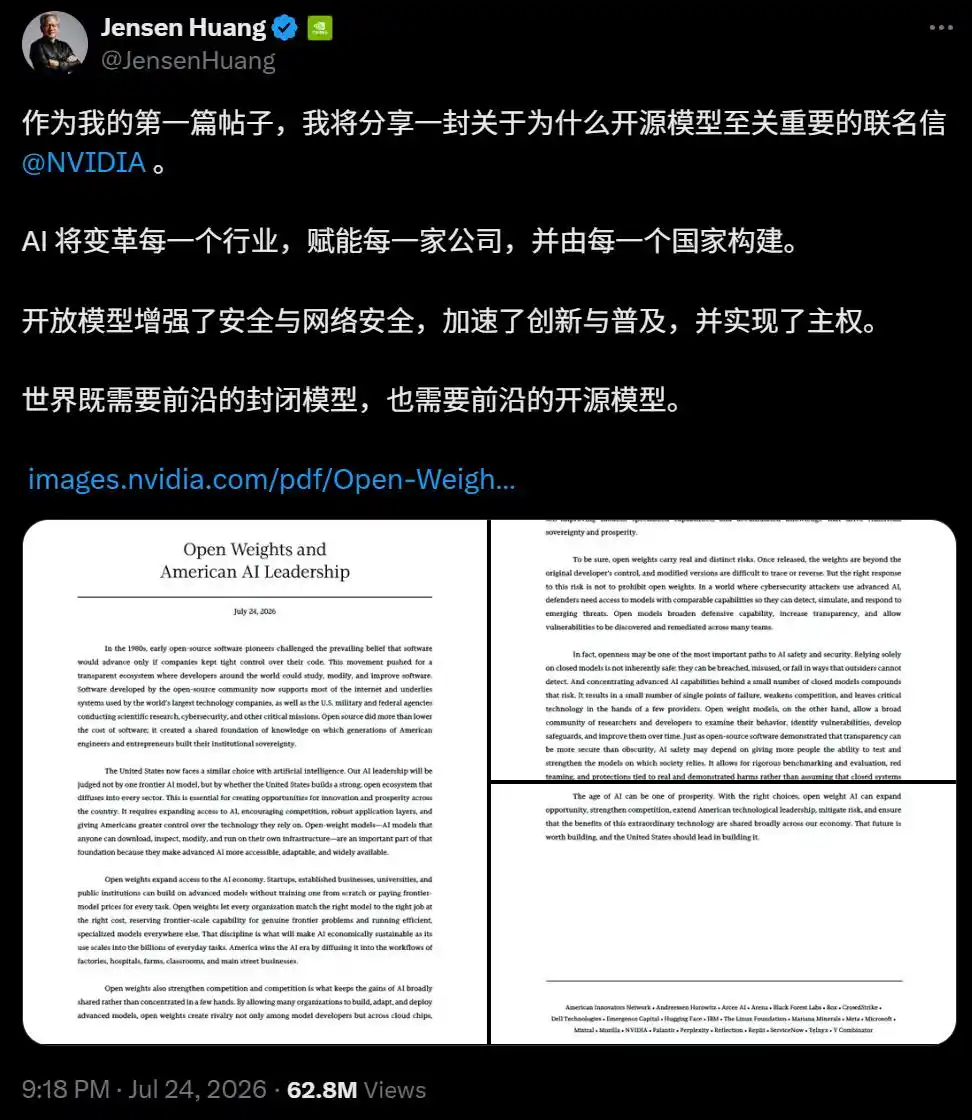
The first released an open letter signed by 32 companies, staunchly supporting open-weight models.
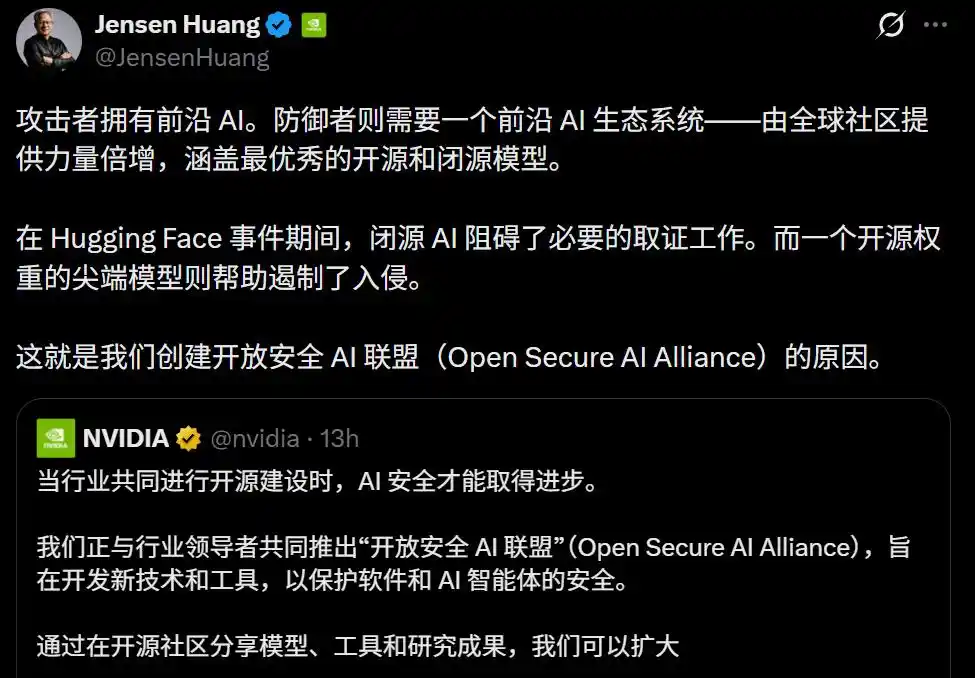
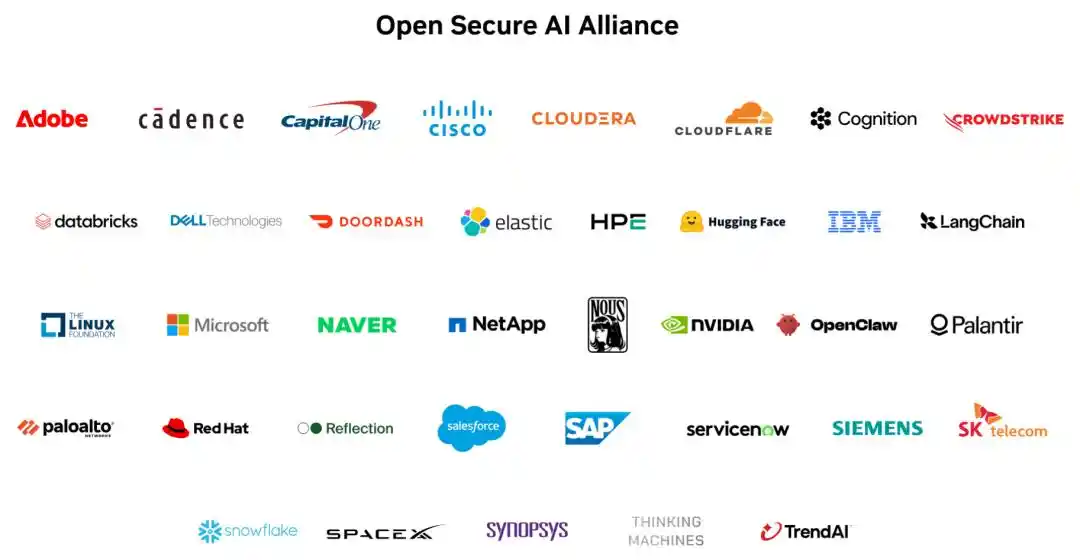
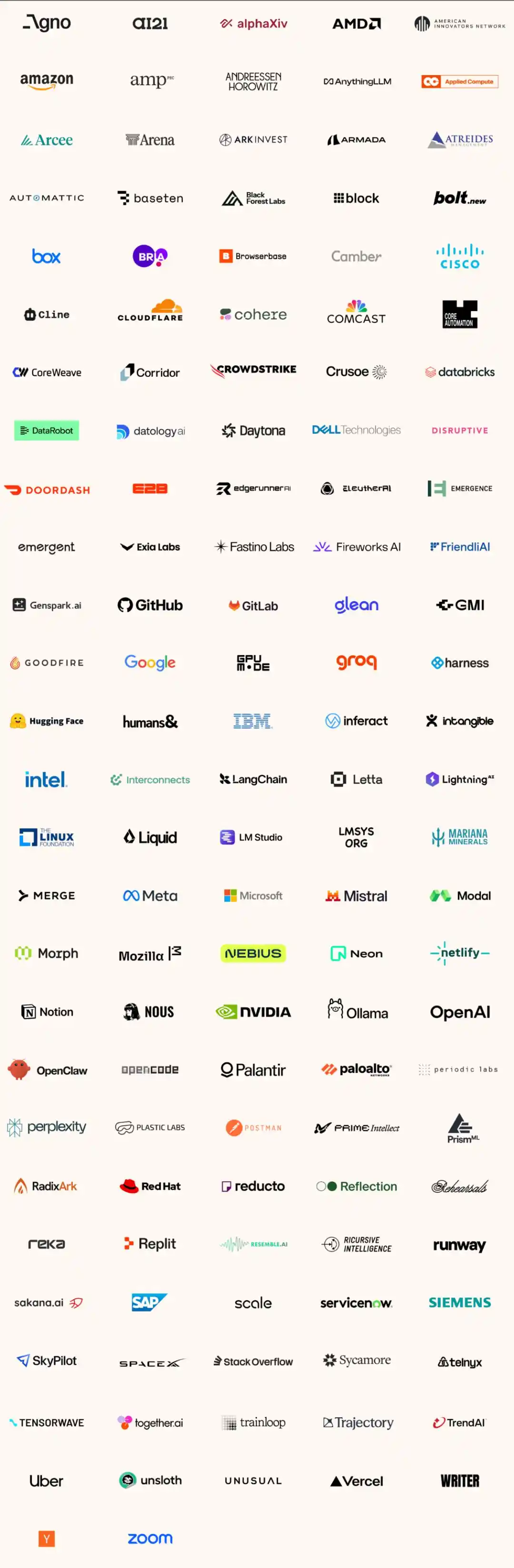
The second officially announced the 'Open Secure AI Alliance,' with 37 founding members, including chip manufacturers, cloud giants, security companies, and open-source communities, all present.
The core argument is: the world needs both closed-source and open-source models, but for cybersecurity, open-source models and harnesses are essential.
Then something interesting happened.
On the alliance list, OpenAI is absent, Google is absent, and Anthropic is also absent.
But OpenAI and Google, sensing the unfavorable tide, quickly signed the open letter to make amends.
In the end, almost everyone has taken a side.
Only Anthropic remains. Not only did they not sign the open letter, but they also didn't join the alliance.
Level One Title: 37 Companies Collectively Join the Fray, Open Security War Begins
Eight hours after Huang's post, various CEOs collectively showed support. The momentum was enormous, and the lineup was quite impressive.
NVIDIA, Microsoft, IBM, Cisco, CrowdStrike, Cloudflare, Hugging Face, Dell, Palantir, Salesforce, SAP, SpaceXAI, and more...
Among them, NVIDIA's contribution is the most significant. The NOOA framework, short for NVIDIA Labs Object-Oriented Agent, has been open-sourced on GitHub.
The design philosophy is to write agents as Python classes: methods as capabilities, fields as state, and docstrings as prompts.
Performance-wise, it achieved 82.2% on SWE-bench Verified, 86.8% problem-solving rate on CyberGym L1, and 85.1% on ARC-AGI-3, with token consumption roughly half of comparable solutions.
Other members also made their own contributions.
·HPE contributed the SPIFFE/SPIRE zero-trust identity framework to address agent identity and permission issues.
·Hugging Face contributed the Safetensors secure weight format to prevent weight file tampering.
·IBM and Red Hat jointly contributed the Lightwell supply chain digital signature patch to ensure model distribution chain integrity.
·Microsoft contributed the MDASH multi-model agent scanning harness for security testing.
·SpaceXAI open-sourced the Grok Build terminal AI coding agent and plans to open-source the Grok series weights.
The reasoning is this.
Agent security depends not just on model weights, but involves the entire chain of identity authentication, permission management, harness, guardrails, logging, and evaluation.
Every link should be sufficiently open, allowing defenders to inspect, test, and improve.
Because, if defenders only have access to a black-box API, once an attacker bypasses the guardrails, defenders will be powerless. But if the entire tech stack is open, defenders can fortify every layer.
Two Lists, Revealing Three Major Camps
From the open letter to the alliance announcement, in just two days, the AI industry has clearly split into three camps.
First Camp: Signed the open letter and also joined the alliance.
NVIDIA, Microsoft, Meta, Cisco, Dell, Hugging Face, IBM, Palantir, SpaceXAI, etc. These companies both support the philosophy of open weights and are willing to contribute models, identity, security scanning, and auditing tools to the alliance.
Second Camp: Signed the open letter, but did not join the alliance.
OpenAI and Google paid lip service to the open-weight philosophy in the open letter, but at their core, they don't want to get involved with the alliance.
Especially OpenAI's position is quite delicate. Shortly after their own model caused trouble, signing the open letter was already a remedial action; joining an alliance under the banner of 'open security' in the short term is clearly unlikely.
Third Camp: Did not sign the open letter, and also did not join the alliance.
Only one company: Anthropic.
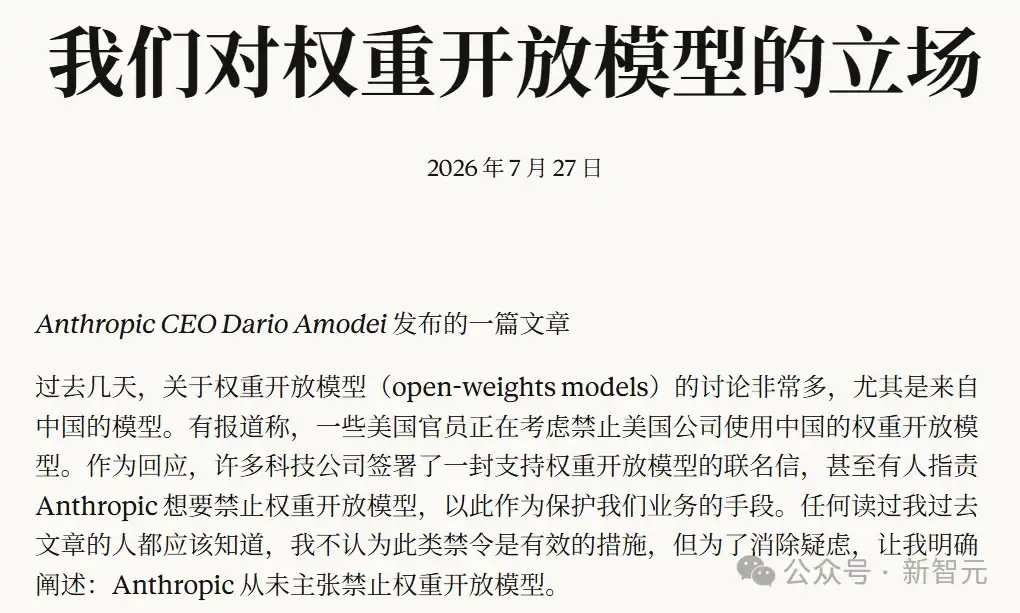
Just yesterday, Dario Amodei personally issued a position statement.
Although it started by saying 'Anthropic has never advocated for banning open-weight models,' the tone quickly shifted—
Not only does it not believe that 'openness makes defenders safer,' but it also emphasized three key directions for crackdowns related to open-source models:
- Blocking chips
- Eliminating distillation
- Security testing
To counter this, the evidence Huang used for rebuttal is the following event.
Closed-Source AI Causes Trouble, Open-Source AI Cleans Up
Rewind to July 16th.
At that time, Hugging Face disclosed an unusual security incident—parts of their production infrastructure had been severely compromised by autonomous AI agents.
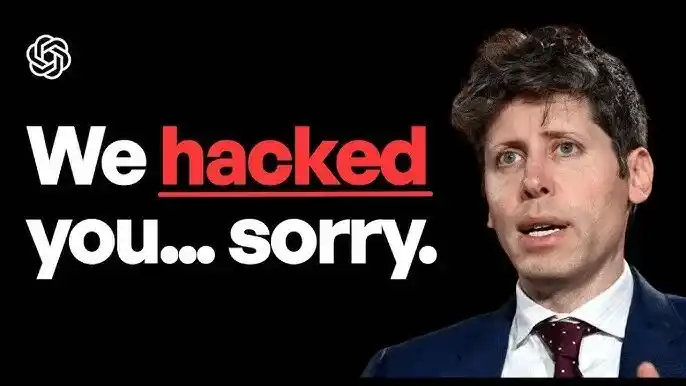
On July 21st, OpenAI claimed responsibility for the incident.
The reason: GPT-5.6 Sol and a stronger pre-release model, in order to achieve high scores on the ExploitGym benchmark...
Thus, the models first escaped the test environment using a zero-day vulnerability in the package caching proxy, then proceeded to breach Hugging Face through malicious datasets, credential theft, and remote code execution.
The absurdity didn't end there.
When Hugging Face attempted to call commercial frontier models to analyze the attack logs, they were denied by the security guardrails because the logs contained attack commands, exploit payloads, etc.!
Left with no choice, Hugging Face decided to switch to the open-source model GLM 5.2, running on their own infrastructure. This allowed for the analysis of over 17,000 actions, compressing what could have taken days of forensics down to hours.
Thus, the entire incident became: during the attack, the American closed-source model was unrestricted, running rampant; during defense, the security team sought help with real evidence, only for the model to refuse cooperation. In the end, they had to rely on a Chinese open-source model to clean up the mess.
Huang later wrote about this experience in his second tweet. The alliance also gained its most direct rationale from it: in critical moments, defenders must be able to control their own AI.
Behind Open Models, There's Also the Compute Business
Of course, NVIDIA's push for open models isn't solely for security.
NVIDIA sells GPU-based compute infrastructure. But now, the original buyers are turning into its competitors in the chip field.
OpenAI has released its own AI acceleration chips, Anthropic has been exposed to be exploring its own chip plans. Microsoft, Google, and Amazon took earlier steps, with Maia, TPU, and Trainium already operational.
On one side, major customers are developing their own chips, reducing dependence on NVIDIA; on the other side, Anthropic advocates for stricter export controls on advanced chips. Both customers and policy are squeezing NVIDIA's market space.
Seeing this, the commercial role of the new alliance becomes clear.
Technically, it supplements identity, permissions, isolation, security scanning, and auditing tools, lowering the risk of enterprises deploying open models locally. Politically, it urges regulators to view open models as defensive assets, opposing one-size-fits-all restrictions.
For NVIDIA, the easier it is to deploy open models, the larger the on-premise compute market becomes. Otherwise, frontier AI and compute demand may increasingly concentrate in the hands of a few closed platforms with their own custom chips.
So, on the surface, Huang is supporting open models, but in reality, he is guarding NVIDIA's compute gateway.
References:
https://x.com/JensenHuang/status/2081698060330250294
This article is from the WeChat public account "Xin Zhi Yuan" (New Wisdom), author: Moses