From OpenSea to OpenRouter: Is Alex Atallah Repeating His 'Exit at the Peak' Playbook?

链捕手Published on 2026-07-24Last updated on 2026-07-24

Abstract

From OpenSea to OpenRouter: Is Alex Atallah Repeating His "Exit at the Peak" Playbook? According to the Wall Street Journal, payments giant Stripe is in talks to acquire the AI model aggregation platform OpenRouter in a potential deal valuing the company near $100 billion. This would mark founder Alex Atallah's second creation of a company reaching a $100 billion valuation, following his co-founding of NFT marketplace OpenSea. OpenRouter, founded just over three years ago, has grown rapidly by acting as a unified gateway for developers to access over 400 AI models. It currently has about 10 million users and processes over 200 trillion tokens monthly. While the platform's annualized revenue is around $50 million, its valuation has skyrocketed from $1.3 billion in March 2026. The potential acquisition by Stripe, a company OpenRouter's founder once likened it to, represents a major expansion into AI infrastructure for the payments leader. This move echoes Atallah's previous timing with OpenSea, where he departed before the NFT market's significant downturn. For OpenRouter, selling now may be strategic. Despite its scale, its business model—charging a 5-5.5% fee on AI inference calls—faces pressure from competition, open-source models, and potential price wars among model providers, limiting its profitability narrative for an IPO. A key asset for potential acquirers like Stripe is OpenRouter's vast repository of real-world AI usage data, which offers unique insights into mod...

Author:Nancy,PANews

Over four years ago, Alex Atallah exited before the peak of the NFT bubble; now, he is in the spotlight again amid the AI boom and is preparing to sell his AI model aggregation platform OpenRouter at a high price.

On July 23, according to the Wall Street Journal, payment giant Stripe is in talks to acquire OpenRouter, with a potential transaction valuation nearing $10 billion. If the deal goes through, this would be another successful creation of a company worth tens of billions of dollars by Alex Atallah, following the NFT platform OpenSea.

Stripe Plans to Acquire OpenRouter, Valuation Could Reach $10 Billion

Rumors of OpenRouter's "sell-out" have been brewing for some time.

Last week, multiple foreign media outlets including The Information and Jawl reported that OpenRouter has received acquisition interest from several large technology companies and has initiated discussions regarding a sale, with a potential deal size reaching several billion dollars.
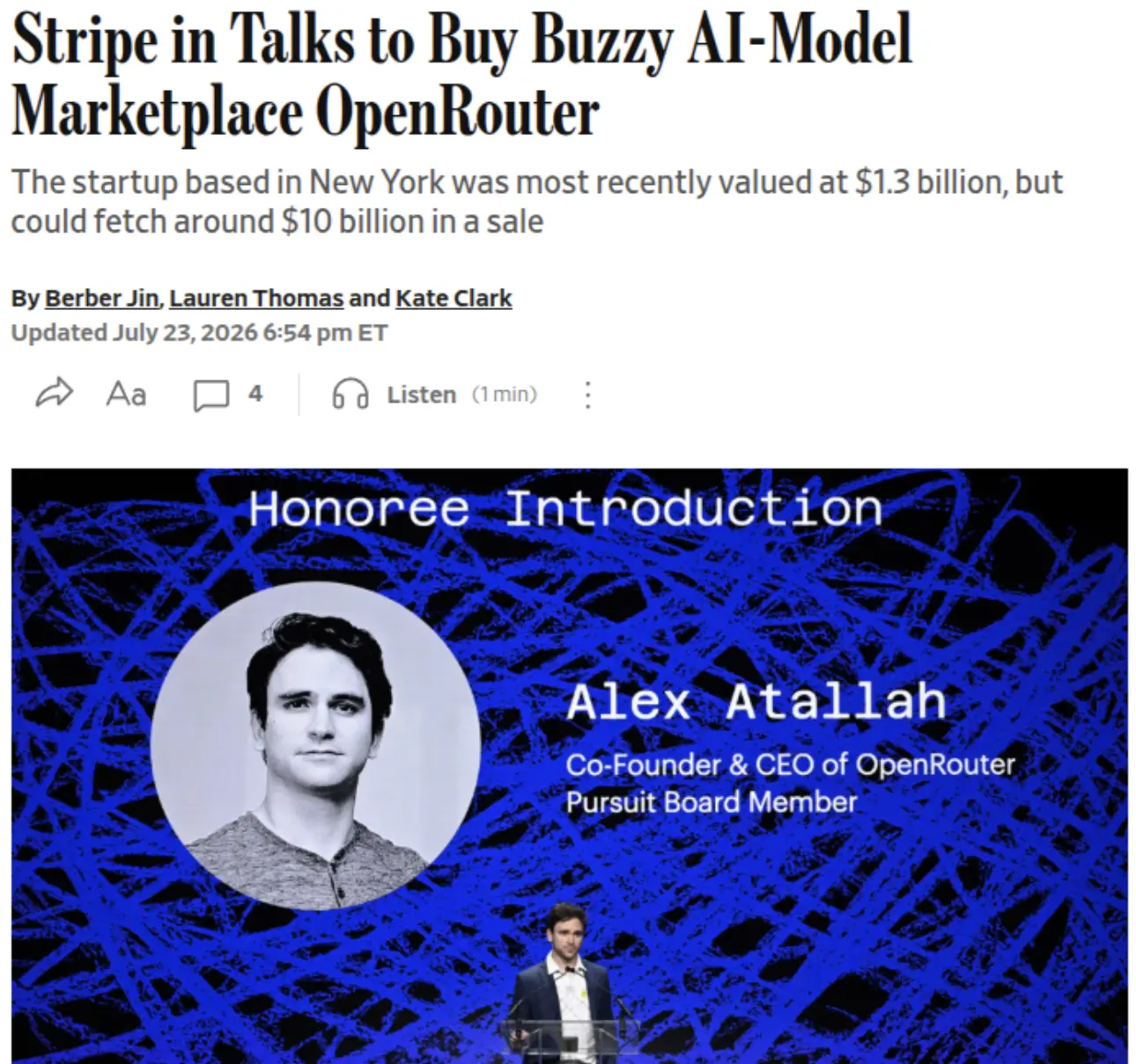
According to the latest report from the Wall Street Journal, Stripe is considering acquiring this global largest AI model aggregation platform. Informed sources reveal that transaction talks between the two parties may be announced soon, but uncertainties remain, and the possibility of negotiation breakdown or other potential buyers joining the bid cannot be ruled out.

Interestingly, Alex Atallah once described OpenRouter as "the Stripe of the AI field." In his view, just as Stripe helps clients handle various payments through a unified entry point, OpenRouter aims to become a unified entry point for enterprises to access different AI models, reducing the cost of switching between multiple AI suppliers while avoiding being "locked in" by a single model supplier.

In fact, OpenRouter and Stripe have already established a cooperative relationship. This potential transaction between the two parties is also seen as an important strategic move by the payment infrastructure giant to further extend into the AI infrastructure sector. It's worth noting that this could be another major acquisition move by Stripe, following recent market rumors of its plan to acquire PayPal.

Currently, neither party has disclosed specific transaction amounts. However, according to informed sources, if the deal is finalized, OpenRouter's valuation at the time of sale could be close to $10 billion.

This figure far exceeds OpenRouter's valuation during its previous financing rounds. In just over three years since its founding, this AI infrastructure company has achieved rapid growth driven by the wave of large models.
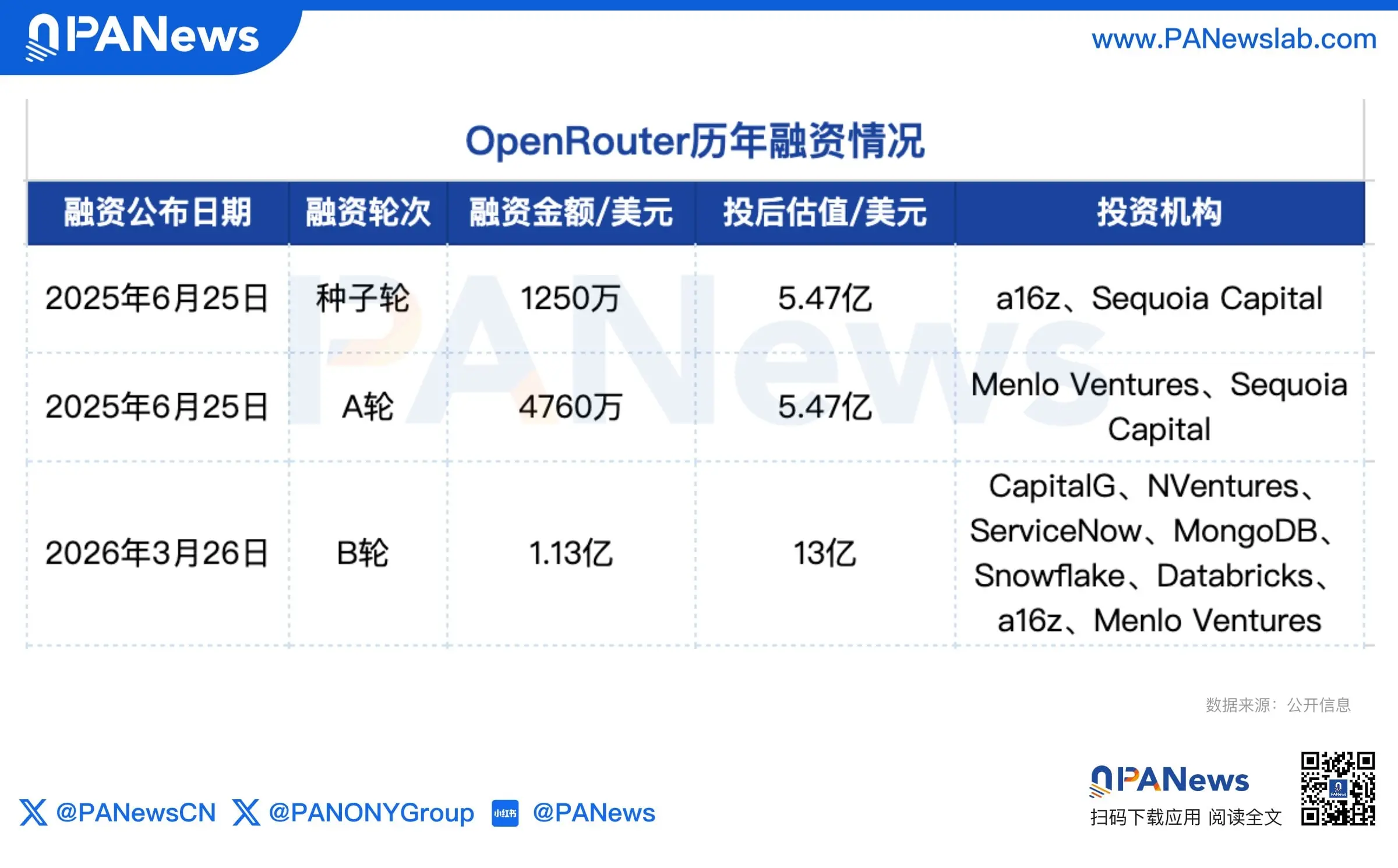
Public data shows that OpenRouter has completed three rounds of financing, raising over $150 million cumulatively. In June 2025, OpenRouter announced the completion of $40 million in seed and Series A funding, with a post-money valuation of approximately $547 million at the time; on March 26, 2026, OpenRouter announced the completion of a $113 million Series B funding round, with a post-money valuation of about $1.3 billion.

If this transaction materializes, it would mean OpenRouter's valuation could increase nearly tenfold within months, joining the ranks of decacorns (companies valued over $10 billion).

Behind OpenRouter's rising value lies not only the explosive demand brought about by the rapid expansion of large models but also increased attention from the capital market towards the AI infrastructure sector.

Repeating the OpenSea Exit Playbook? Why is OpenRouter Choosing to 'Sell Out'?

This is not the first time Alex Atallah has built a company worth tens of billions of dollars.

Prior to this, the serial entrepreneur co-founded OpenSea, bringing NFTs from a niche circle into the mainstream spotlight. During the peak of NFT frenzy, OpenSea grew from a little-known platform into the world's largest NFT marketplace, with its valuation once exceeding $13 billion, and the net worth of its two founders reaching approximately $2.2 billion each.

However, before the comprehensive downturn of the NFT market in 2022, Alex Atallah chose to leave OpenSea. Subsequently, as the industry bubble burst, OpenSea's valuation shrank significantly, and the former NFT leader gradually faded from its peak glory. Alex Atallah's early exit was also seen by the market as a significant signal of the peak.

Afterwards, Alex Atallah turned his focus to AI infrastructure, and the OpenRouter he founded became the largest transit hub in the AI era.
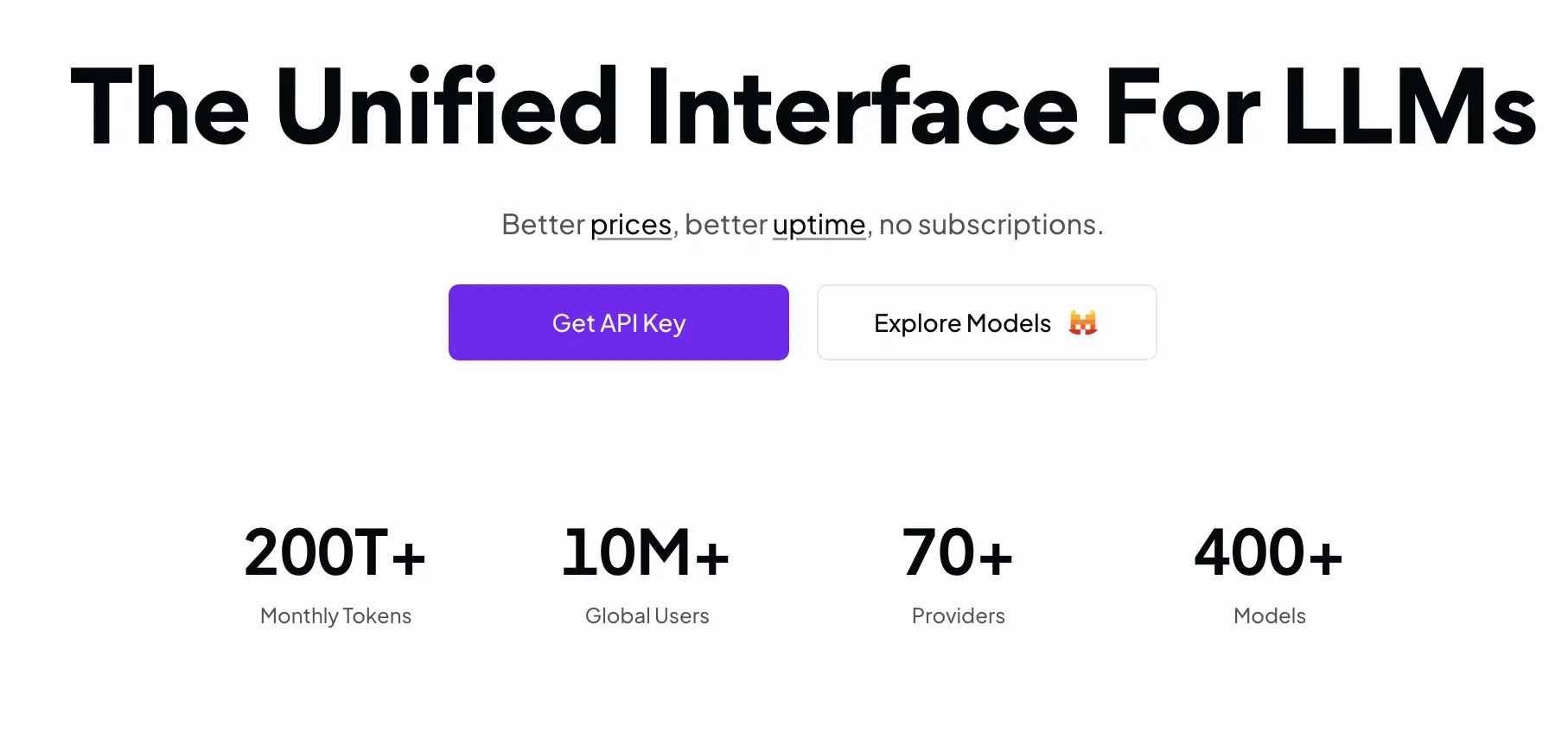
Currently, OpenRouter has integrated over 400 AI models, boasts approximately 10 million users, and processes over 200 trillion tokens per month. This year, the number of tokens processed through its API has increased roughly tenfold.

But it is worth noting that despite rapid business growth, OpenRouter has not chosen an IPO but is heading down the path of a potential sale. The reason lies in it being a large-scale but low-margin gateway business.

Currently, OpenRouter primarily profits by charging a platform service fee when developers call AI models, with a commission rate of about 5%-5.5%. Although its annualized AI inference consumption scale has reached several hundred million dollars, as of April 2026, the company's annualized revenue was approximately $50 million.

In other words, OpenRouter connects to a massive AI demand market but does not fully control the upstream value chain. As model capabilities gradually standardize, the platform is susceptible to factors such as the rise of open-source models, ecosystem lock-in by cloud providers, and direct price reductions by model suppliers, which could continuously pressure profit margins. OpenRouter finds it difficult to tell a story of exponential growth and ultra-high profits in the capital market.

Meanwhile, competition in the AI model aggregation track is intensifying. For example, Meta's internal AI incubator is developing a dispatch service similar to OpenRouter to reduce code development and compute costs; domestically in China, large model aggregation platforms have also emerged, including Cheetah Mobile's EasyRouter and NetEase Youdao's ThinkFlow.

Therefore, the high valuation currently given to OpenRouter by the market is more about pricing its future potential rather than its current profitability.

However, for potential buyers, the truly attractive asset of OpenRouter may not be its current revenue scale but rather the real AI usage data it has accumulated over the long term.

By connecting hundreds of models and tens of millions of users, OpenRouter has amassed a large amount of invocation data from real production environments, including performance differences of various models in actual tasks, developer preferences, price sensitivity, and substitution relationships between open-source and closed-source models. Compared to lab test data, this real-world AI usage data is closer to market demand and harder to replicate quickly through short-term investment. This is perhaps a key reason why large technology companies are willing to pay a high premium for OpenRouter.

From NFTs to AI, Alex Atallah has twice caught the wave of the times. If OpenRouter is ultimately sold at a $10 billion valuation, will it signify a repricing of AI infrastructure value or be another signal of a cyclical peak? The answer may still require time to verify.

Trending Cryptos

Related Questions

QWho is the founder of OpenRouter, and what other notable company did he co-found before?

AThe founder of OpenRouter is Alex Atallah. He previously co-founded the NFT marketplace OpenSea.

QWhat is the reported potential valuation of OpenRouter in the acquisition talks with Stripe?

AThe reported potential valuation of OpenRouter in the acquisition talks with Stripe is close to 100 billion US dollars.

QHow does OpenRouter generate its revenue according to the article?

AOpenRouter generates revenue primarily by charging a platform service fee, approximately 5%-5.5%, when developers use its API to call AI models.

QWhat are some competitive challenges OpenRouter faces in the AI model aggregation space?

AOpenRouter faces competitive challenges such as the rise of open-source models, potential bundling by cloud service providers, price reductions by model suppliers, and new entrants like Meta's internal AI incubator service and similar platforms in China.

QWhat unique asset of OpenRouter is highlighted as a key attraction for potential acquirers like Stripe?

AA key asset of OpenRouter is its extensive collection of real-world AI usage data, including performance differences of models in production tasks, developer preferences, and substitution relationships between open-source and closed-source models, which is difficult to replicate quickly.

Related Reads

The Verdict in Choi Tae-won's Divorce Case: Revealing the Inheritance Undercurrent Behind SK Hynix's Trillion-Won Empire

SK Group Chairman Chey Tae-won's high-profile divorce case, involving a record 1.38 trillion won settlement, has drawn attention to the succession plans for Korea's second-largest conglomerate, especially its crown jewel, SK hynix. Unlike traditional chaebol scripts centered on the eldest son, Chey's three children from his marriage to former President Roh Tae-woo's daughter, Roh Soh-yeong, are carving distinct, non-traditional paths. Eldest daughter Chey Yun-jung (b. 1989) is seen as the most evident successor. With a scientific and consulting background, she holds executive roles at SK bioscience and SK Inc.'s growth support department, focusing on future strategy and biopharma. Her marriage is to an AI infrastructure entrepreneur, not a traditional business alliance. Second daughter Chey Min-jung (b. 1991) took a unique route, voluntarily serving as a South Korean naval officer, including an anti-piracy deployment. She later worked on policy and strategy for SK hynix in Washington D.C. before co-founding an AI-driven healthcare startup. She married a former U.S. Marine Corps officer, connecting her to U.S. defense and policy circles—networks crucial for a global semiconductor giant. The only son, Chey In-geun (b. 1995), who studied physics like his father, worked briefly at SK E&S before joining McKinsey. Despite fitting the traditional "heir" profile as the eldest son, he remains silent and holds no public position or shares in SK, suggesting the old succession playbook is obsolete. As SK hynix's valuation soars, becoming a geopolitical asset in the AI era, the heirs' legitimacy is no longer automatic. They must prove themselves in fields like AI biotech, global policy, and strategic consulting. Their marriages also reflect new elite networks in tech and defense, not old political alliances. Their inheritance is the complex challenge of navigating a globalized, tech-driven world, not just a corporate throne.

marsbit7h ago

The Verdict in Choi Tae-won's Divorce Case: Revealing the Inheritance Undercurrent Behind SK Hynix's Trillion-Won Empire

marsbit7h ago

Trading

Spot

Hot Articles

What is ₿O₿

Bitcoin Bob ($₿o₿): Pioneering Bitcoin-Centric DeFi Through Hybrid Layer-2 Innovation In an era where the digital economy is rapidly evolving, Bitcoin Bob ($₿o₿) emerges as a revolutionary project aiming to enhance Bitcoin's utility in the decentralized finance (DeFi) sector. Officially launched in May 2024, Bitcoin Bob, also known as Build on Bitcoin (BOB), represents a hybrid Layer-2 blockchain solution that melds Bitcoin’s renowned security and immutability with Ethereum's programmability. This initiative seeks to fill a crucial gap in the Bitcoin ecosystem by facilitating the integration of smart contracts and decentralized applications while maintaining the core principles of trust and security inherent to Bitcoin. With significant backing from prominent venture capitalists, Bitcoin Bob is positioned to redefine the role of Bitcoin in the DeFi landscape, making it a cornerstone of decentralized financial operations globally. What Is Bitcoin Bob, $₿o₿? At its core, Bitcoin Bob is a hybrid blockchain solution designed to enhance the functionality of Bitcoin. The main objective of the project is to enable decentralized finance on Bitcoin, facilitating swift and seamless transactions while ensuring high levels of security. Bitcoin Bob employs advanced technology, specifically a hybrid layer-2 architecture that combines Bitcoin's security attributes with the programmability and flexibility of the Ethereum Virtual Machine (EVM). This pragmatic approach allows the project to operate effectively without compromising the fundamental values of Bitcoin, making it a monumental step in bridging the gap between traditional Bitcoin holders and the emerging DeFi ecosystem. One of the standout features of Bitcoin Bob is its role in providing a trust-minimized environment through innovative mechanisms, such as optimistic rollups initially relying on Ethereum, transitioning eventually to full Bitcoin integration. This hybrid system is designed to ensure that the vast liquidity present in Bitcoin is not only preserved but also utilized effectively in various DeFi protocols. Who Is the Creator of Bitcoin Bob, $₿o₿? The creative force behind Bitcoin Bob is co-founder and CEO Alexei Zamyatin, who brings a wealth of experience and knowledge from his extensive background in the cryptocurrency space. Zamyatin holds a PhD in Computer Science and has been actively involved in Bitcoin development since 2015. His deep understanding of both Bitcoin and Ethereum ecosystems plays a crucial role in shaping Bitcoin Bob’s vision and technological underpinnings. Alongside Zamyatin is co-founder Dominik Harz, who serves as the Chief Technology Officer (CTO). Together, the duo has cultivated a team of talented individuals with a shared passion for pushing the boundaries of blockchain technology, ensuring Bitcoin Bob's innovative stature in the market. Who Are the Investors of Bitcoin Bob, $₿o₿? Bitcoin Bob has successfully garnered support from a range of prominent investors and venture capital firms that recognize its potential to transform the Bitcoin landscape. In March 2024, the project completed a robust $10 million seed funding round, led by Castle Island Ventures, with notable participation from firms like Coinbase Ventures and Bankless Ventures. Shortly afterward, in July 2024, Bitcoin Bob secured an additional $1.6 million in strategic funding. This round was co-led by Ledger Ventures and featured angels from various prominent firms such as BlackRock, Aave, and Curve. The strong financial backing reflects an industry-wide recognition of Bitcoin Bob’s innovative approach to unlocking Bitcoin’s potential in the DeFi space. This funding is crucial not only for the project’s continued development but also for establishing an incubator to foster Bitcoin-native decentralized applications (dApps) aimed specifically at meeting the needs of a growing user base. How Does Bitcoin Bob, $₿o₿ Work? The operational mechanics of Bitcoin Bob are rooted in its hybrid rollup architecture, which is designed to combine the benefits of Bitcoin's security with the versatility of Ethereum’s EVM. The project employs a phased security model that outlines its interaction with users and developers in the following manner: Phase 1 – The initial phase operates as an optimistic rollup on Ethereum, wherein transactions are processed with a promising expectation of validity, paving the way for future developments on Bitcoin. Phase 2 – As the project transitions, it will integrate Bitcoin finality through Bitcoin Staking, leveraging the Babylon Network to enhance security. This mechanism requires validators to lock up Bitcoin, thus verifying BOB transactions, which not only enhances security but also creates yield prospects for participants. Phase 3 – The forward-looking vision for Bitcoin Bob is to fully integrate with Bitcoin, using innovative technologies such as BitVM and zero-knowledge proofs to facilitate off-chain computation while retaining the security integrity of Bitcoin. Key innovations such as BitVM2, a trust-minimized bridge protocol co-authored by Zamyatin, are critical to the project's functionality, allowing for Bitcoin deposits and withdrawals without the need for extensive network reliance. This enables the ecosystem to efficiently connect with Ethereum and other compatible chains, creating a streamlined and effective interaction model for users and developers. Timeline of Bitcoin Bob, $₿o₿ Understanding the evolution of Bitcoin Bob involves tracking its important milestones: 2019: Alexei Zamyatin and Dominik Harz establish a research firm focused on blockchain solutions, laying the groundwork for future projects. March 2024: Bitcoin Bob successfully raises $10 million in a seed funding round, marking its entrance into the competitive blockchain landscape. May 1, 2024: The official mainnet launch occurs, showcasing the project’s capabilities with significant user adoption and total value locked (TVL). July 2024: The project attracts an additional $1.6 million in strategic funding for establishing its incubator, aimed at fostering Bitcoin-driven innovations. October 2024: Bitcoin Bob releases a “Vision Paper,” detailing its hybrid layer-2 design and forward-looking strategies. 2025: Expected rollout of Phase 2 features, focusing on Bitcoin finality and BitVM bridges aimed at enhancing overall functionality. Conclusion: Redefining Bitcoin’s Role in Decentralized Finance Bitcoin Bob ($₿o₿) is not just another blockchain project; it represents a paradigm shift in the way Bitcoin can interact with broader financial applications. By meticulously combining Bitcoin's security with Ethereum's flexibility, Bitcoin Bob aims to reshape the DeFi landscape, bridging the gap between digital currency and decentralized applications. With a robust technological framework, strong leadership, and strategic funding, Bitcoin Bob is well-positioned to establish itself as a fundamental player in the cryptocurrency ecosystem, unlocking new dimensions of liquidity and utility for Bitcoin. As the project continues to evolve and expand, it promises to usher in a new era of innovation, proving that Bitcoin's potential extends far beyond being a mere store of value, but rather as a cornerstone of the future financial landscape. As the project advances through its anticipated phases, all eyes will be on Bitcoin Bob, particularly regarding its commitment to incorporating decentralized principles and ensuring that users can enjoy the full benefits of DeFi anchored by Bitcoin.

79 Total ViewsPublished 2025.06.30Updated 2025.06.30

What is ₿O₿

Discussions

Welcome to the HTX Community. Here, you can stay informed about the latest platform developments and gain access to professional market insights. Users' opinions on the price of O (O) are presented below.

活动图片