Two days ago, on August 1, Bitcoin.com News reported that the Coldcard vulnerability appears to be pushing bitcoin holders toward centralized exchanges and custodial services, while long-dormant $BTC have also begun to return to life. To date, approximately 1,431.97 $BTC have been stolen due to vulnerabilities in Coldcard's firmware and random number generator.
500 $BTC Transfer from 2013
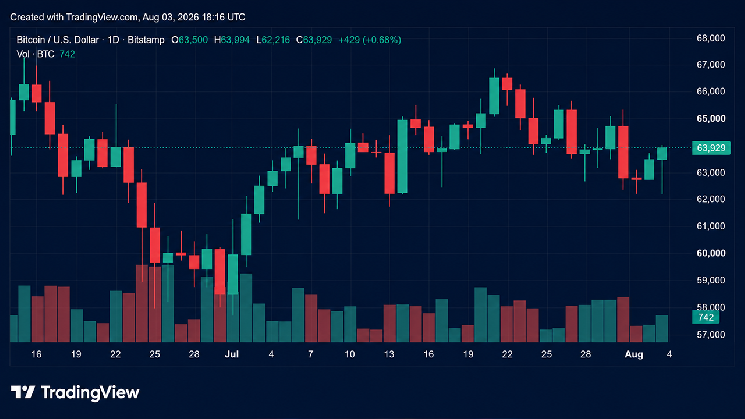
The latest report stated that between July 30 and August 1, 306 $BTC were transferred from long-dormant wallets, likely prompted by vulnerability concerns. This trend has not abated since the publication of that report, and on Monday, a staggering volume of 500 $BTC worth $31.32 million was moved from a long-dormant 2013 address. This transfer was first reported by btcparser.com and Whale Alert.
Blockchain explorer data shows the original Pay-to-Public-Key-Hash (P2PKH) address was created on December 6, 2013. In late 2013, bitcoin first surpassed the $1,000 mark, and on that day, 1 $BTC was selling for $1,042 per coin. Thus, the 500 $BTC held in this wallet were valued at approximately $521,000 at the time of their initial acquisition.
The Security Dilemma
Arkham Intelligence data shows that the Pay-to-Witness-Public-Key-Hash (P2WPKH) address that received the funds is not linked to any known exchanges, custodians, institutions, or other identifiable entities. For early bitcoin users, a wallet untouched for over a decade represents far more than just a balance. It reflects a decision made in 2013, when bitcoin had only recently broken above $1,000 and most of the world had never heard of it.
Many holders from that era adopted self-custody as a core tenet, relying on hardware wallets instead of entrusting centralized exchanges. The Coldcard firmware vulnerability directly contradicts this philosophy, as it jeopardizes the very thing these users sought to protect: exclusive control over their private keys. The movement of 500 $BTC is less about market timing and more about the realization that a wallet created many years ago may no longer meet modern security standards.
Safeguarding Capital Before It's Too Late
The blockchain activity also fits a pattern that is becoming increasingly difficult to ignore. Over 1,400 $BTC have already been stolen via the Coldcard vulnerability, and since July 30, hundreds more coins have been voluntarily moved from long-dormant wallets. For many long-term holders, the choice has become stark: either believe that an outdated generation of wallets has never been compromised, or move the funds before someone else makes that decision for them.
The decision to move such a significant balance, despite revealing an address that has lain dormant for years, speaks to security measures rather than a trading decision. The blockchain indicates that for some of bitcoin's oldest holders, the priority may have shifted to capital preservation over speculation.
Header/Featured Image Credit: mempool.space.
end-content