Author: David, Chao Xiang Research
On June 22nd, the Ministry of Commerce issued Announcement No. 23 of 2026, adding 10 U.S. entities including Ivex, Red Cat Holdings, and MP Materials to the export control list, prohibiting the export of dual-use items to them; on the same day, an additional 46 U.S. companies were added to the government procurement restriction list.
(Author's note: Dual-use items refer to goods, technologies, and services that have both civilian and military applications or can enhance military potential.)
This marks another round in the normalization of China's rare earth countermeasures since October 2025. The 10 targeted U.S. companies are primarily concentrated in three sectors: defense, drones, and rare earths.
The two most prominent names on the list are MP Materials and USA Rare Earth, both flagships of the U.S. rare earth industry. China's action against them prompted the market's initial reaction to favor the A-share rare earth sector: with competitors being restricted, domestic players gain greater scarcity and value.
The question is, the rare earth sector has been rising from last October until now, with leading upstream companies already near their year-to-date highs. Is it too late to react now?
If it is late, where might the money go?
The Commerce Ministry's control list involves more than just the rare earth thread. The fully appreciated rare earth sector might still have further catalysts ahead, and overlooked, less popular threads might still be under the radar.
We attempt to outline the potentially affected threads and place them on a price coordinate for reference.
Key Conclusions
1 The upstream A-share rare earth sector is fully priced-in; this control measure is not a new catalyst.
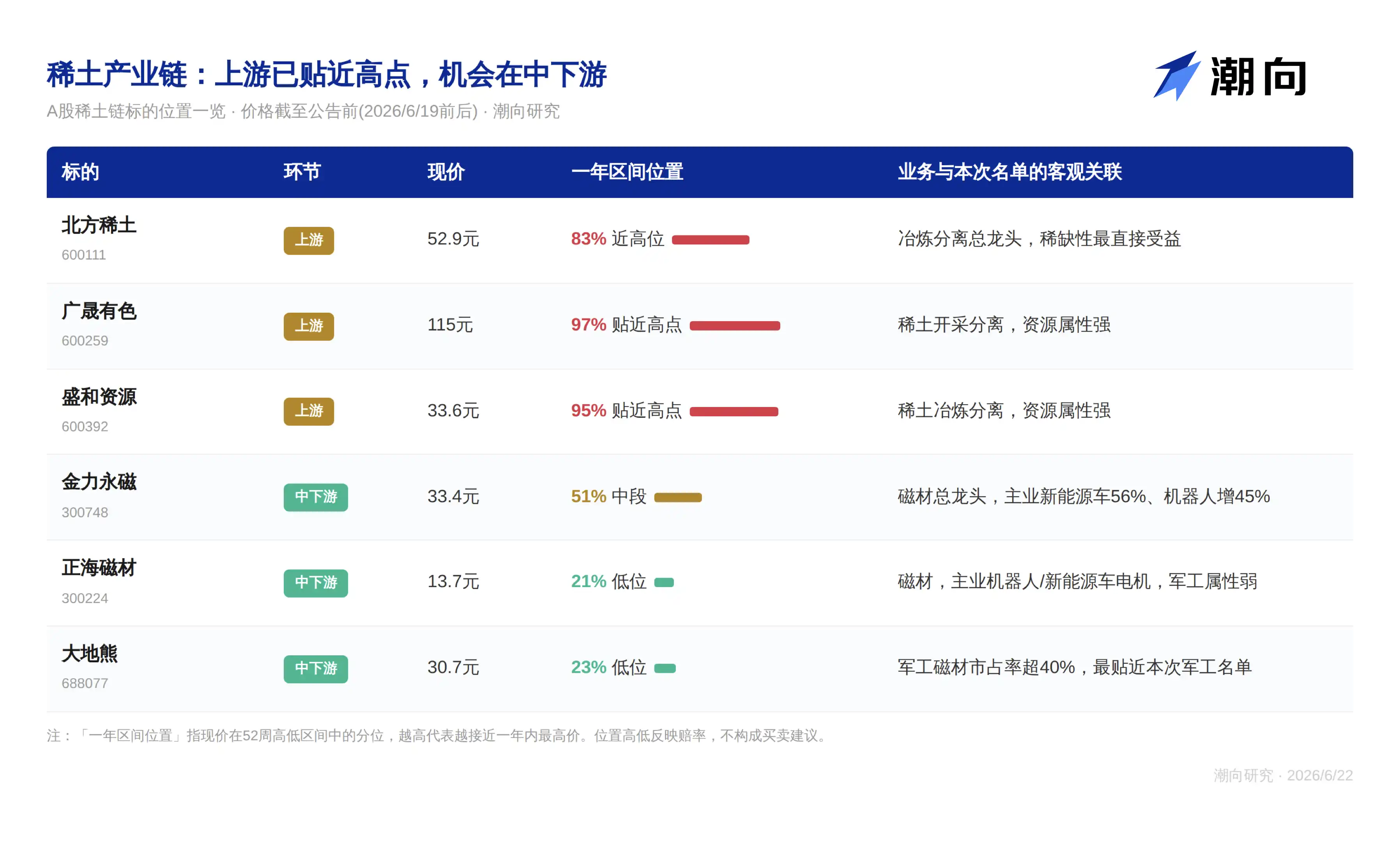
Northern Rare Earth's current price of 52.9 yuan is only about 20% away from its one-year high of 63.6 yuan; Guangdong Rising Nonferrous Metals at 115 yuan and Shenghe Resources at 33.6 yuan are both close to their one-year highs. These upstream resource stocks have been trending upward since October last year, and the logic of "benefiting from rare earth countermeasures" has largely been priced in. For the upstream rare earth industry, this control measure is more of a reconfirmation of the trend rather than a new starting point for a rally.
2 The relatively underpriced segments are the mid-to-downstream rare earth magnet materials and the drone industry chain.
Within the same rare earth chain, valuations in the midstream and downstream are significantly lower than upstream:
Magnet sector players like Earth-Panda (30.7 yuan) and Sinomag (13.7 yuan) are still near the lower end of their one-year ranges, their gains notably lagging behind upstream resource stocks. The drone sector corresponding to Red Cat and Teal Drones on the control list is even quieter, with Avic UAS near its one-year low and receiving limited market attention. The pricing progress of various segments is not uniform under the same event.
3 The targeted U.S. stocks do not necessarily constitute a one-sided negative; the open market needs to verify.
MP Materials and USA Rare Earth are core players in the U.S. domestic rare earth supply chain, with MP having background investment from the U.S. Department of Defense.
For such companies, China's export controls and U.S. policy support are two coexisting forces, and their impact directions may not align. All three mentioned stocks were not at low levels before the announcement. The announcement was made on Monday before U.S. markets opened, so their true pricing reaction awaits the market's verdict.
Investors holding related positions should pay close attention to the post-open price action.
Why Do Export Controls Benefit Domestic Rare Earths?
Many find it counterintuitive at first glance: banning exports means Chinese businesses do less trade, so how is that a positive?
The key lies in the direction of the control. This ban prevents China from selling rare earth-related items to those 10 U.S. companies, cutting off the supply sources for these American firms, not the raw material procurement for Chinese manufacturers.
China's rare earth industry, from mining, smelting, and separation to magnet manufacturing, is the world's most complete chain, self-sufficient and not reliant on sourcing from the U.S. In other words, this announcement does not affect Chinese suppliers' upstream operations; they can produce and export as usual.
It's the U.S. side that is truly pinched.
Companies like MP Materials and USA Rare Earth want to build a self-reliant supply chain bypassing China, yet they still depend on China for separation technology, equipment, and some intermediate materials. Restricting competitors' access conversely enhances the scarcity and bargaining power of Chinese companies within the global rare earth landscape, which is the real reason the market interprets this as positive for A-share rare earths.
Rare Earth Upstream is Fully Priced; Money Hasn't Flowed Downstream
First, clarify the chain. Rare earths are mined, then smelted and separated into materials like praseodymium-neodymium oxide; this is the upstream, handled by companies like Northern Rare Earth, Guangdong Rising Nonferrous Metals, and Shenghe Resources.
These raw materials are further processed into NdFeB permanent magnet materials and installed into various motors; this is the midstream and downstream, where JL Mag, Sinomag, and Earth-Panda operate.
The upstream sells raw materials; the downstream sells magnet materials.
In this round of market movement, money primarily surged into the upstream. Northern Rare Earth at 52.9 yuan, Guangdong Rising Nonferrous Metals at 115 yuan, and Shenghe Resources at 33.6 yuan are all near their one-year highs. The logic is straightforward: every time rare earths' strategic importance is emphasized, the first beneficiaries are the upstream players with mines and smelting capacity, whose scarcity is tangible.
In my view, this control event is a positive in the same direction for the upstream, but the price has already digested this expectation. Entering now is more like taking over at high levels, offering less favorable risk-reward.
Moving downstream to magnet materials, the pricing progress is noticeably slower.
Among the three magnet leaders, JL Mag, with 7.7 billion yuan in revenue and doubled net profit, saw its 2025 stock price rise over 90%, placing it at a high level. However, Sinomag and Earth-Panda are still pressed near the lower end of their one-year price ranges, not catching up with the upstream gains.
There is a background detail easily overlooked:
Since the second half of 2025, China has opened up exports to U.S. magnet manufacturers. For instance, JL Mag's U.S. sales reached 500 million yuan for the full year, up 40%; Sinomag and Earth-Panda also obtained U.S. export licenses. China's addition of 10 companies to the control list this time is a precise move under the framework of "allowing ordinary commercial customers while cutting off specific defense entities," not a comprehensive embargo.
Therefore, the impact of this logic on magnet companies' financial statements is actually limited.
The 10 restricted U.S. companies were not among their major clients to begin with. The real revenue for JL Mag and Sinomag comes from new energy vehicle and robot motors, largely unrelated to defense exports to the U.S.
This control measure is more of a sentiment boost for the magnet stock sector, unlikely to translate into tangible orders. However, regarding the rare earth downstream, what's truly noteworthy might be which company's business aligns more closely with the defense theme of this list.
On this point, Earth-Panda aligns better than the other two.
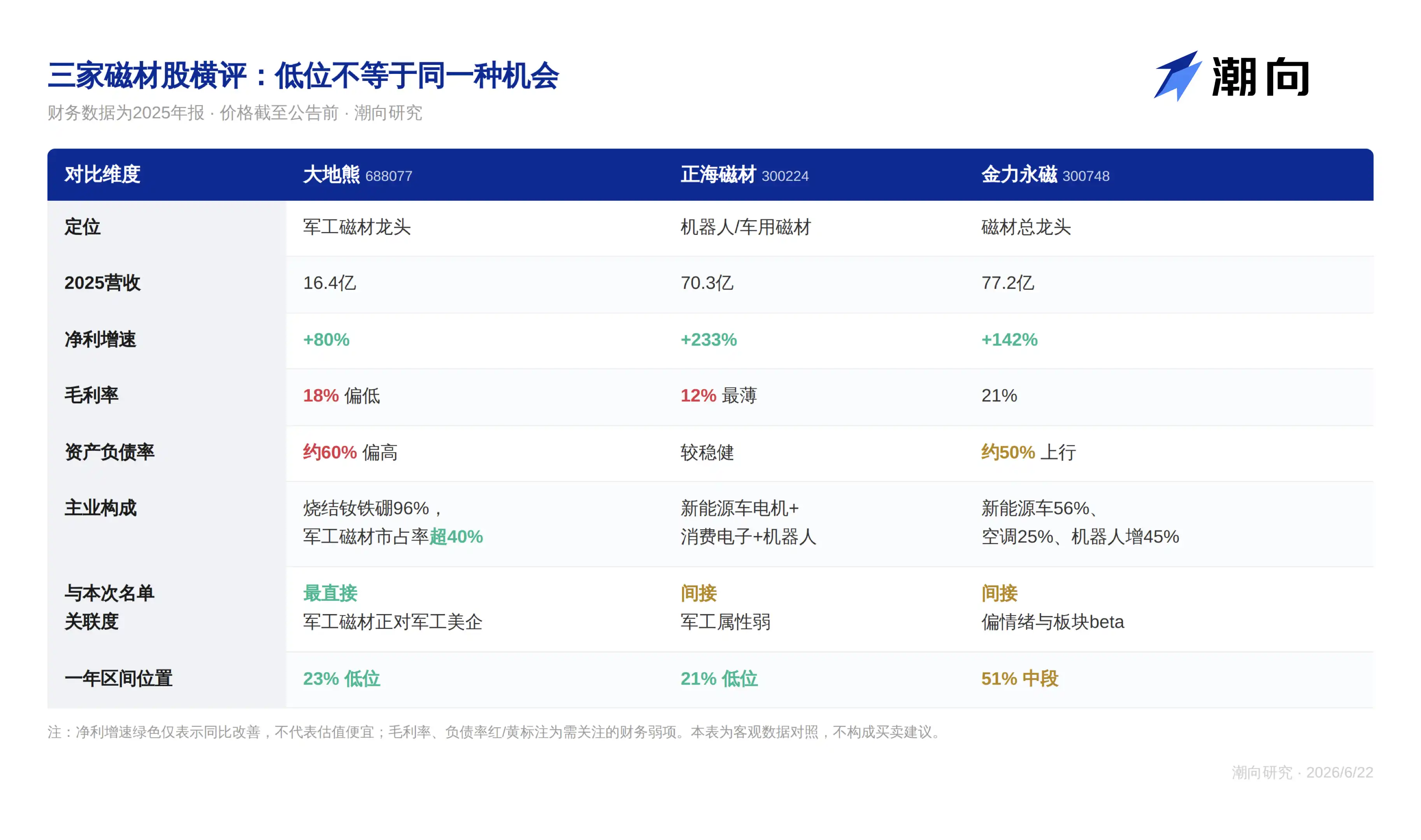
Earth-Panda has a small market cap, with 2025 revenue of 1.6 billion yuan and net profit of 57.4 million yuan. However, it is a major domestic supplier of defense magnet materials, with publicly available data showing over 40% market share in this segment. Its products are used in equipment like aero engines and missiles, directly corresponding to the targeted defense and drone U.S. companies on the control list. This is its most direct narrative link to the event.
However, narrative alignment doesn't equal stability: financially, its gross margin is only 18%, and its debt ratio is nearing 60%, indicating weaker profitability and financial safety compared to peers. Combined with its small market cap, its stock price can bounce up quickly but also plummet sharply.
It suits those who can tolerate volatility and prioritize "purest theme," not as a cornerstone holding.
Sinomag represents another type. Its 2025 net profit more than tripled, a reversal much stronger than Earth-Panda's, but driven by humanoid robots and new energy vehicle motors, largely unrelated to this defense list. Its low price is more due to the robotics story not being fully priced in by the market yet.
Therefore, reading the rare earth thread reveals two different situations upstream and downstream.
Upstream holds resources with the most tangible scarcity, but prices have already reflected the positives; it's now a high-level handoff. Downstream magnet materials are still at low levels. Earth-Panda aligns more with the defense list, at the cost of a small market cap and weak finances. Sinomag is cheap but has weak relevance.
Drones: The List Points to This Thread, But No Direct Positive
Red Cat Holdings and its subsidiary Teal Drones on the control list produce military reconnaissance and strike drones in the U.S., exactly the type of military drone suppliers the U.S. aims to support to replace Chinese products.
The market naturally associates this with the A-share military drone sector, but the positive logic here is likely not the same as for rare earths. This won't directly bring orders to any specific Chinese drone company. It's more about bringing "Sino-U.S. competition in military drones" to the forefront, prompting the market to refocus on the strategic value and military export competitiveness of domestic military drones.
Following this thread to find corresponding A-share targets, the most business-aligned company is Avic UAS.
Avic UAS is a leader in large domestic military drones. Its core product is the Wing Loong series of reconnaissance-strike integrated drones, with drone systems accounting for over 90% of its main revenue. It primarily exports through military trade, being a main force in China's military drone exports.
In terms of business alignment, it indeed competes in the same arena as the targeted U.S. drone companies, making it the highest relevance play on this thread.
Its current price is 44 yuan, at the lower end of its one-year range. However, this position formed after a decline from highs, not from a lack of movement.
Its 2025 financial report shows significant performance growth with military trade orders, with revenue in the first three quarters more than tripling year-on-year, and the stock price once reached 48 yuan. The current pullback is more akin to cooling off after realization.
It's important to note that military trade revenue heavily depends on single large orders. Revenue fell nearly 70% year-on-year in 2024, turning to a loss, then rebounded strongly in 2025. This boom-bust characteristic means judging its cheapness based on price position is unreliable. The real variable is the signing and delivery rhythm of subsequent military trade orders. Valuation-wise, the company's P/E ratio has long been in the tens, not constituting undervaluation.
Export Restrictions Do Not Equate to Pure Negatives for Corresponding U.S. Stocks
This is the primary concern for holders of related U.S. stocks, and the answer might differ from intuition: not necessarily.
The most significant names on the export control list, MP Materials and USA Rare Earth, are core vehicles for the U.S. to reduce its reliance on Chinese rare earths. MP is the only vertically integrated rare earth producer of scale in the U.S., receiving investment from the U.S. Department of Defense in 2025, making it an object of national strategic support. This status determines its dual-sided situation:
China cuts off its access to Chinese dual-use items, but precisely due to supply chain security concerns, the U.S. government might instead provide it with more orders and subsidies.
Pre-announcement prices also support this view. MP, USA Rare Earth, and Red Cat Holdings were not at low levels before the control news emerged. The market did not sell off in advance due to "potential sanctions," indicating investors had not previously priced them simply as victims.
Of course, the final direction depends on the market opening. The announcement was made on Monday before U.S. markets opened. Whether sanctions are read as a material negative or offset by support expectations will be answered by post-open trading.
Note: This article is for information organization and viewpoint analysis. The mentioned stocks, ratings, and target prices are from public sources and are time-sensitive, constituting no investment advice. The market involves risks; decisions require independent judgment.