Pakistan clears Binance and HTX to seek local crypto licenses

cointelegraphPublished on 2025-12-12Last updated on 2025-12-12

Abstract

Pakistan's Virtual Assets Regulatory Authority (PVARA) has granted preliminary no objection certificates (NOCs) to global cryptocurrency exchanges Binance and HTX, allowing them to begin the process of establishing local operations and applying for full licenses. This move is part of Pakistan's phased regulatory approach to crypto asset service providers, aligning with FATF Anti-Money Laundering (AML) policies. The announcement follows meetings between Pakistan's Finance Minister and key industry figures, including Binance executives and HTX adviser Justin Sun. Binance CEO Richard Teng confirmed the exchange also obtained an AML registration, marking a significant step toward deeper local collaboration and the development of a regulated digital asset ecosystem in Pakistan.

Pakistan’s authorities are moving to regulate major global cryptocurrency exchanges, issuing preliminary clearances to platforms including Binance to set up shop in the country.

The Pakistan Virtual Assets Regulatory Authority (PVARA) has granted no objection certificates (NOCs) to Binance and HTX, paving the way for the exchanges to register locally and pursue full licensing, the regulator announced on X on Friday.

The NOCs aim to ensure Pakistan’s phased approach to regulating crypto asset service providers in alignment with Anti-Money Laundering (AML) policies by the Financial Action Task Force (FATF), PVARA said.

“Strong governance, AML and CFT compliance remain central as Pakistan builds a trusted digital asset ecosystem,” the announcement noted.

CZ, Justin Sun meet with Pakistan’s finance minister

After receiving the NOCs, Binance and HTX are officially authorized to engage with the Securities and Exchange Commission of Pakistan (SECP), set up local subsidiaries and prepare their full license applications once regulations are finalized.

“The introduction of this structured NOC framework demonstrates Pakistan’s commitment to responsible innovation and financial discipline,” Pakistan’s Finance Minister Muhammad Aurangzeb said in a local report by ProPakistani.

As part of the initial engagement, Aurangzeb met with Binance CEO Richard Teng, Binance co-founder Changpeng “CZ” Zhao, and Tron founder Justin Sun, who currently serves as a global adviser to HTX.
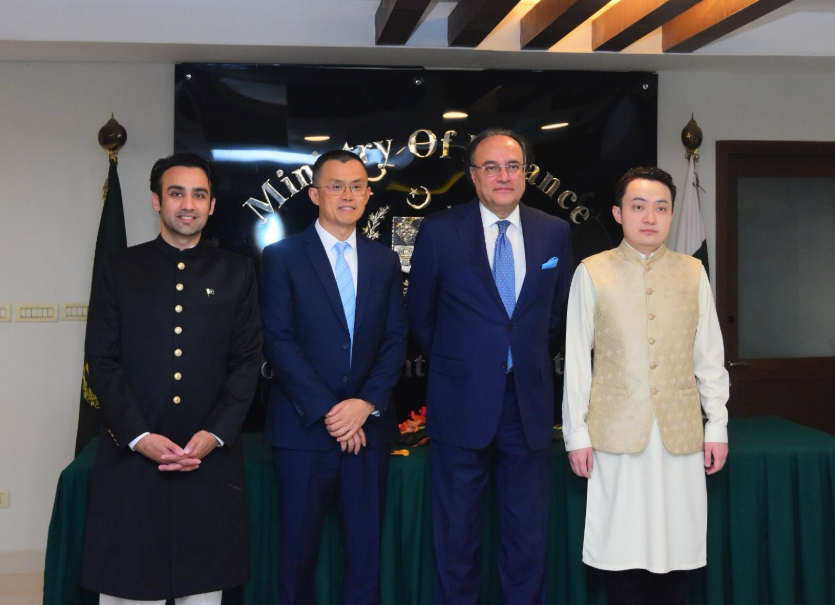
PVARA chairman Bilal bin Saqib, Binance co-founder Changpeng Zhao, Finance Minister Muhammad Aurangzeb and HTX adviser Justin Young (from left to right). Source: PVARA

“A meaningful milestone for Binance in Pakistan,” Binance CEO Teng said in a post on X, adding that the exchange has obtained an AML registration from PVARA, moving it closer to full licensing and deeper local collaboration.

“Looking forward to building a safe, transparent and future-ready digital-asset ecosystem together,” he added.

Related: Coinbase mounts a cautious comeback in India, two years after exit

PVARA’s announcement came months after the authority held its first board meeting in August, proposing an initial licensing framework as well as taxation policies and international engagement.

The authority’s progress has been contributed Pakistan Crypto Council (PCC), a regulatory body that lists CZ as one of its advisors.

PVARA chairman Saqib, who serves as the Minister of State for Digital Assets, has urged the country’s authorities to take Bitcoin (BTC) and blockchain seriously as potential foundations for Pakistan’s future financial infrastructure.

“We see Bitcoin, digital assets, and blockchain not just as speculation but as infrastructure. Not as noise, but as a foundation of a new financial rail for the global south,” Saqib stated at the Bitcoin MENA Conference on Tuesday.



Related Reads

You Should Still Believe in Crypto

The article "You Should Still Believe in Crypto" addresses the growing sense of burnout and disillusionment within the cryptocurrency industry, sparked by a post from Aevo co-founder Ken Chan titled "I Wasted 8 Years of My Life in Crypto." It acknowledges the collective fatigue many feel due to the industry's fast-paced, often speculative nature, where narratives shift rapidly, and projects frequently fail or disappear. However, the piece argues that the core value of crypto remains vital. It references Nic Carter’s response, highlighting crypto’s potential to create a more robust monetary system, encode business logic via smart contracts, establish true digital property rights, improve capital market efficiency, and enhance global financial inclusion. The article revisits Bitcoin’s origin as a peer-to-peer electronic cash system born from the 2008 financial crisis, emphasizing its purpose as a trustless, decentralized alternative to traditional finance. It points to real-world adoption in high-inflation countries like Argentina and Turkey, where Bitcoin and stablecoins serve as essential financial tools, and notes increasing institutional embrace from firms like BlackRock and Fidelity. Finally, it draws a parallel to the early internet era, arguing that despite chaos, failed projects, and speculative excess, the crypto industry—like the internet—is laying foundational groundwork for future technological and financial evolution. The conclusion is a call to persevere, recognizing that the collective efforts of developers, researchers, and builders worldwide are contributing to a transformative global shift.

marsbit1h ago

You Should Still Believe in Crypto

marsbit1h ago

Trading

Spot
Futures
活动图片