Tiger Research: U.S. Strategic Bitcoin Reserve - Should the Market Be Happy or Disappointed?

marsbitPublished on 2026-06-16Last updated on 2026-06-16

Abstract

Tiger Research analyzes the evolution of U.S. legislative efforts regarding a strategic Bitcoin reserve, concluding the market impact is limited in the short term but potentially positive long-term. The core event was a March 2025 executive order by former President Trump, which designated confiscated Bitcoin as a strategic reserve and promised not to sell existing holdings (approx. 190k BTC). As it contained no mandate to purchase new Bitcoin, the market reacted negatively, with prices dropping 5.7%. Legislative history shows a significant retreat from initial ambitions. The 2024 "BITCOIN Act" proposed mandatory purchases of 1 million BTC over five years. Reintroduced in 2025, it stalled due to high fiscal costs, concerns over dollar hegemony, and opposition from the Treasury Secretary. The current frontrunner, the 2026 "American Retirement and Monetary Advancement (ARMA) Act," is a compromise. It lacks any purchase requirement, instead focusing on consolidating existing government-held Bitcoin and legally prohibiting its sale for at least 20 years. While ARMA has higher passage odds due to bipartisan support and no purchase mandate, its immediate market effect is neutral. It eliminates potential government selling pressure but creates no new demand. The long-term significance is that formally establishing Bitcoin as a national reserve asset in law could later reignite debates on mandatory purchases. Therefore, the path to a government buyer is longer than initially price...

This article is written by Tiger Research. News about a U.S. strategic Bitcoin reserve has circulated for nearly two years. The core of the initial BITCOIN Act (introduced in 2024) was active government purchases of Bitcoin, whereas the ARMA Act contains no such provisions. Whether the market should view this as positive remains an open question.

Key Points

The executive order signed by Trump in March 2025 committed to not selling the Bitcoin already held by the federal government but did not require the purchase of new coins. The market had anticipated more; when the order's content became clear, the Bitcoin price immediately dropped by 5.7%.

Legislative efforts beginning in 2024 have significantly retreated over the past two years: from a bill requiring the purchase of 1 million BTC to a bill containing only custodial obligations and no purchase requirements whatsoever.

The most likely to pass currently, the American Retirement and Monetary Advancement Act (ARMA), is not a purchase bill. It prohibits the government from selling its existing Bitcoin holdings for at least 20 years.

ARMA has limited short-term impact on the Bitcoin market. In the long term, establishing the legal status of Bitcoin as a national reserve asset could reopen the discussion on mandatory purchases, which would be positive for the market.

Background: What the U.S. Has and Has Not Done

During the 2024 presidential campaign, Trump repeatedly promised to establish a strategic Bitcoin reserve, which the market interpreted as the federal government becoming a direct buyer.

After the election, on March 6, 2025, Trump signed an executive order designating Bitcoin obtained through criminal investigations and civil forfeiture as a strategic reserve and directing its permanent holding. The order did not instruct the acquisition of new Bitcoin; it only committed to not selling the Bitcoin the government already owns. When the order's content became clear, the Bitcoin price fell from about $92,000 to below $85,000.

At the time of signing, the federal government held approximately 190,000 BTC, about 0.9% of the total 21 million supply. This Bitcoin came entirely from criminal and civil proceedings; not a single coin was purchased.

The situation remains unchanged. Nothing beyond the executive order has been enacted into law.

Legislative History
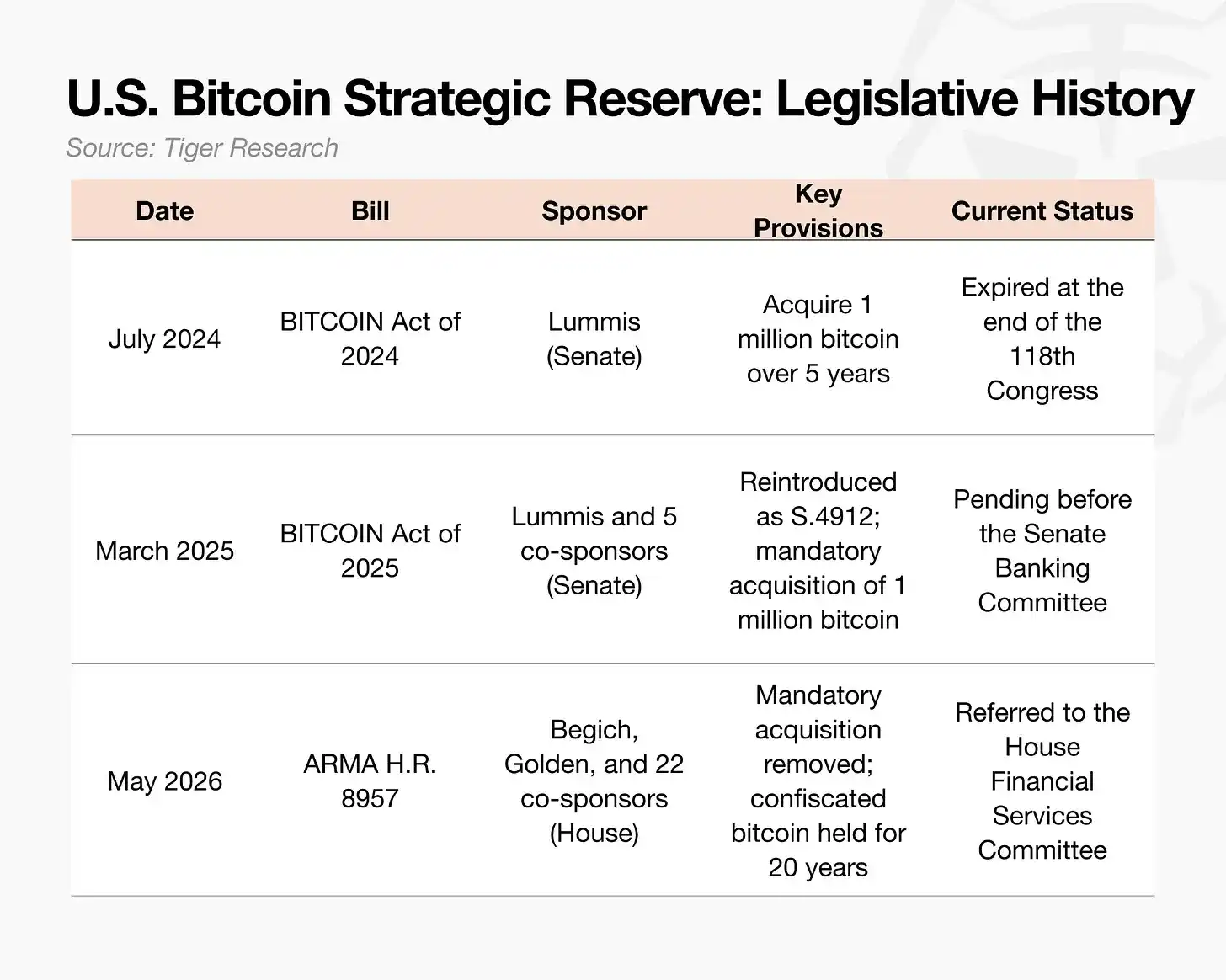
Discussions starting in 2021 produced the first concrete bill in 2024, reintroduced in 2025, and reframed as ARMA in 2026. The main theme of this evolution has been constant compromise with political reality: mandatory purchase quantities went from being present to being absent. Each revision made passage more feasible but simultaneously reduced market impact.

2024: The Original Bill

Since entering the Senate in 2021, Senator Lummis has publicly called for incorporating Bitcoin into the federal reserve. There was no consensus within Congress at the time, and the crypto winter of 2022-2023 coupled with the FTX collapse made the environment even more unfavorable.

The situation shifted in 2024 with Bitcoin surpassing $100,000 and spot ETFs receiving regulatory approval. In July of that year, Lummis introduced the first concrete legislation: requiring the purchase of 1 million Bitcoin over five years, to be held for at least 20 years, funded by the Federal Reserve's surplus account.

1 million BTC represents 4.76% of the total supply, exceeding the approximately 840,000 reportedly held by Strategy. The bill automatically expired at the end of that Congress.

2025: Reintroduction and Stalled Progress

In March 2025, the same month as the executive order, Lummis reintroduced the BITCOIN Act as Senate Bill 954. The core structure remained unchanged: annual purchases of 200,000 BTC, accumulating to 1 million over five years, held for 20 years. The revised version canceled certain exemptions from the disposal ban, tightened holding obligations, and added four cosponsors.

The market reaction was generally positive, but the bill faced substantive resistance on three fronts:

  • Fiscal Cost: Valued at trillions of won at the time, 1 million Bitcoin. Fiscal conservatives within the Republican party viewed gold as a stable store of value and Bitcoin as a speculative asset, opposing any mandatory purchase structure.
  • Dollar Hegemony: Democratic critics, led by Representative Maxine Waters, argued that treating Bitcoin as a reserve asset would weaken the dollar's status as the global reserve currency.
  • Treasury Secretary's Stance: In August 2025, Treasury Secretary Bessent publicly stated the government would not pursue additional Bitcoin purchases. As the official responsible for executing the law, he had clearly voiced opposition.

The bill has remained in the Senate Banking Committee since.

2026: ARMA as Legislative Compromise

In May 2026, Representative Nick Begich introduced the American Retirement and Monetary Advancement Act (ARMA), with Democratic Representative Jared Golden joining as a cosponsor. The name change itself is strategic: aimed at distancing the bill from the associations of previous, difficult-to-advance legislation and broadening its coalition of supporters.

ARMA does two things: consolidates all Bitcoin currently held or forfeited by the federal government into a single reserve managed by the Treasury, and prohibits the sale of this Bitcoin for at least 20 years. The sole exception to the disposal ban is using it to pay down the national debt.

The decisive difference from its predecessor is what ARMA does not contain. The BITCOIN Act mandated annual purchases of 200,000 BTC, whereas ARMA completely removes this obligation. Instead, it directs the Treasury and Commerce Departments to study and report within 180 days on whether additional purchases can be achieved in a budget-neutral manner. A study mandate, not a purchase mandate.

ARMA is essentially a custody and holding bill, not an acquisition bill. Its goal is passage, and it is structured accordingly.

Short-Term Outlook: Limited Market Impact

Currently, two bills are moving through Congress in parallel. The BITCOIN Act (S.954) is in the Senate Banking Committee; ARMA is in the House. Their goals differ: BITCOIN Act is an acquisition bill, ARMA is a custody bill.

ARMA has a higher probability of passage. The BITCOIN Act has been stalled in committee for over a year, weighed down by fiscal cost and purely Republican support. ARMA has Democratic support and imposes no purchase obligations, removing the most common objections.

Even so, the passage of ARMA itself would not constitute a short-term positive for the Bitcoin market. If ARMA were enacted, the approximately 320,000 BTC currently held by the federal government would be legally barred from entering the market for at least 20 years. The pressure of potential government selling would disappear. But the issue is that without any purchase obligation, there is no new demand. The market wants direct government purchases of Bitcoin, and ARMA does not provide that. Its practical effect is closer to elevating the March 2025 executive order to statutory status.
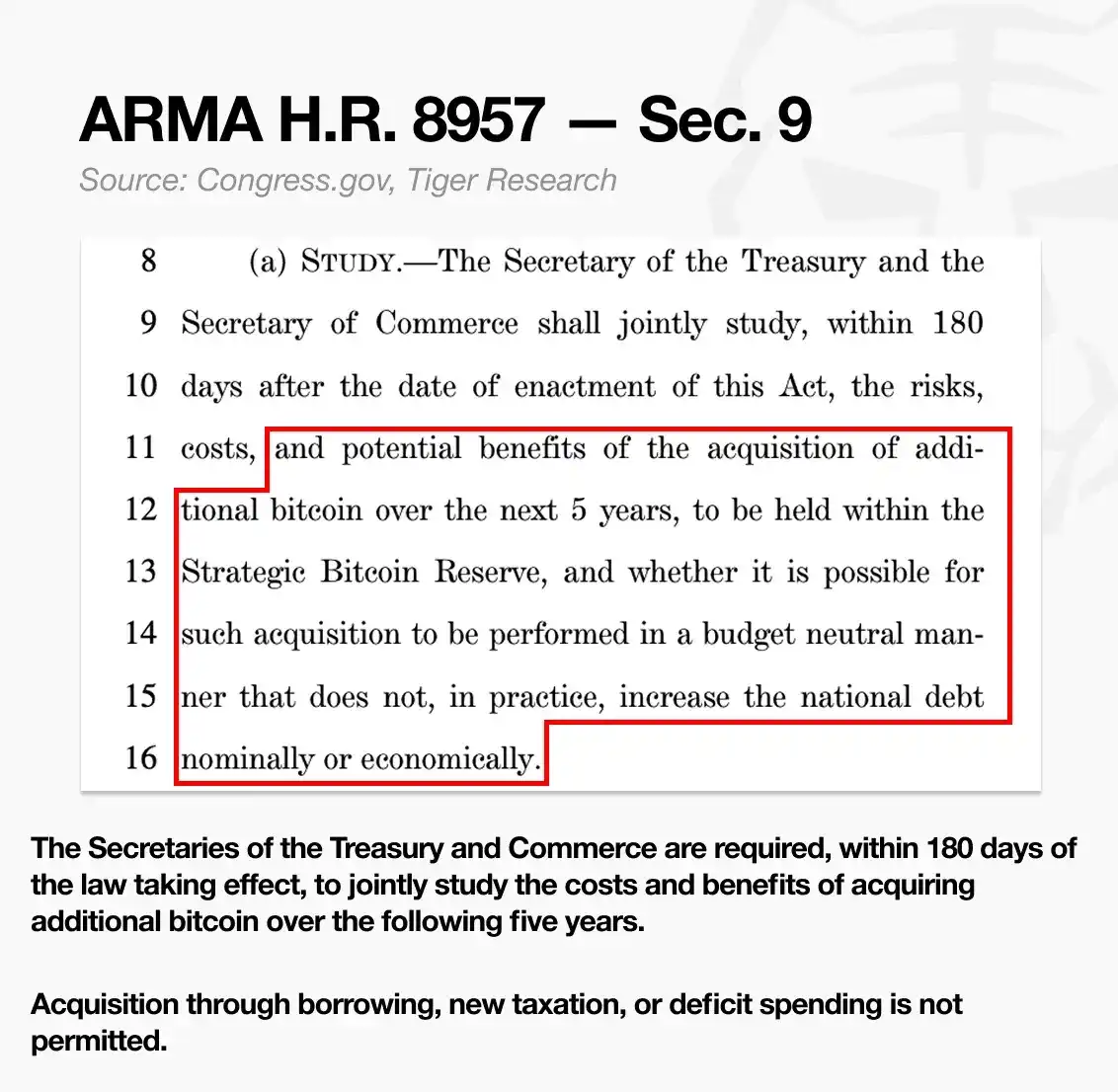
The key lies in what might happen after ARMA. Nick Begich, a Bitcoin holder since 2013, was a House cosponsor of the March 2025 BITCOIN Act. He publicly supports Bitcoin as a strategic asset. The structure of ARMA suggests a phased approach rather than an immediate solution: first, establish the legal framework, then build the acquisition mandate upon it.

If ARMA passes and Bitcoin gains formal legal status as a national reserve asset, then the debate on mandatory purchases is likely to reopen on a firmer foundation. The path to this outcome is longer than the market initially priced in during Trump's campaign promises, but the direction has not changed.

In short, the passage of ARMA would have limited short-term impact on price. In the long term, it remains a constructive factor for the market; if ARMA passes, the probability of eventual purchase legislation becomes more visible.


Related Questions

QWhat is the key difference between the original BITCOIN Act (2024/S.954) and the ARMA bill (2026) regarding government involvement with Bitcoin?

AThe key difference is the absence of a mandatory purchase requirement. The original BITCOIN Act mandated the U.S. government to purchase 1 million Bitcoin over five years. In contrast, the ARMA bill is a custody bill, not an acquisition bill. It only requires the government to consolidate its existing seized Bitcoin holdings into a single reserve and legally prohibits selling them for at least 20 years, with no provisions for buying new Bitcoin.

QAccording to the article, why did the price of Bitcoin drop following President Trump's 2025 executive order on a strategic Bitcoin reserve?

AThe price dropped because the market's expectations were higher than the actual content of the order. The market had interpreted Trump's campaign promises as the federal government becoming a direct buyer. However, the executive order only designated confiscated Bitcoin as a strategic reserve and instructed permanent holding (no selling), with no directive to acquire new Bitcoin. This disappointment led to an immediate price drop from around $92,000 to below $85,000.

QWhat are the three main obstacles that prevented the BITCOIN Act (S.954) from progressing in Congress, as outlined in the article?

AThe three main obstacles are: 1) Fiscal Cost: Republican fiscal conservatives objected to spending trillions on Bitcoin, viewing it as a speculative asset compared to gold. 2) Dollar Hegemony: Democratic critics, led by figures like Maxine Waters, argued that recognizing Bitcoin as a reserve asset would weaken the U.S. dollar's global dominance. 3) Treasury Secretary's Stance: In August 2025, Treasury Secretary Bessent publicly stated the government would not pursue additional Bitcoin purchases, signaling executive branch opposition.

QWhat is the short-term market impact expected if the ARMA bill is passed into law, and why?

AThe short-term market impact is expected to be limited. While ARMA would legally lock up the government's existing ~320,000 Bitcoin, preventing potential future sales pressure, it creates no new, direct demand from the government because it contains no mandatory purchase provisions. The market had priced in the expectation of a major government buyer, which ARMA does not provide. Its effect is closer to codifying the 2025 executive order into law.

QWhat long-term strategic purpose does the ARMA bill serve for Bitcoin proponents, according to the article's analysis?

AThe long-term strategic purpose of ARMA is to establish a foundational legal framework. By giving Bitcoin the formal legal status of a national reserve asset, it creates a more solid basis for future legislative debates about mandatory government purchases. The article describes it as a phased approach: first secure the legal status and custody structure, then potentially build acquisition mandates on top of it. This makes the path to a future 'purchase bill' more visible and plausible, even if it takes longer than initially hoped.

Related Reads

The Foundation of SpaceX's Trillion-Dollar Valuation: Who is Dividing Up Musk's Annual Tens of Billions in Capital Expenditure?

SpaceX's trillion-dollar valuation is built on its three core businesses: Starlink (profitable, 60% of revenue), rockets (driving down launch costs), and AI (a major investment area). This creates a financial cycle: Starlink funds rocket development, which enables low-cost launches for AI hardware, generating future revenue. This cycle fuels annual capital expenditures of tens of billions, flowing to a vast supply chain. Suppliers are categorized by their replaceability. The first group includes irreplaceable players like NVIDIA (GPU/CUDA ecosystem), Eutelsat (critical radio spectrum), Filtronic (specialized amplifiers), Materion (strategic beryllium), and STMicroelectronics (antenna chips). The second group consists of hard-to-replace suppliers due to high switching costs, such as Honeywell (flight control), Carpenter Technology (specialty alloys), Hexcel (carbon fiber), Broadcom (data exchange), and Linde (industrial gases). The third group comprises high-volume, cost-critical suppliers for mass-produced items like Starlink terminals. Key names include Wistron NeWeb (primary manufacturer) and several A-share companies like Shenzhen Sunway (connectors), Pies New Materials (forgings), Western Superconducting (alloys), and Yingliu (castings). Other niche players include Trimble (timing), Astronics (power distribution), and CTS (thermal management). The article argues that investing in these suppliers, rather than SpaceX stock directly, offers an alternative opportunity. The rationale is threefold: procurement is just beginning to scale, SpaceX's IPO brings new transparency to its supply chain, and the situation mirrors early stages of past "super terminal" ecosystems like Apple or Tesla. While risks exist (commodity cycles, geopolitical factors, technology shifts), the core thesis is that SpaceX's massive, ongoing procurement will translate into reliable revenue for its key suppliers, regardless of its own stock price volatility.

marsbit27m ago

The Foundation of SpaceX's Trillion-Dollar Valuation: Who is Dividing Up Musk's Annual Tens of Billions in Capital Expenditure?

marsbit27m ago

SpaceX's Trillion-Dollar Valuation Base: Who's Sharing in Musk's Annual Tens of Billions in Capital Expenditure?

**Title: The Foundation of SpaceX's Trillion-Dollar Valuation: Who Benefits from Musk's Annual $100 Billion Capital Expenditure?** This article argues that investors seeking to benefit from SpaceX's growth might find greater opportunities in its supply chain rather than directly investing in the company itself, drawing parallels to historical successes with Apple, Tesla, and NVIDIA suppliers. **SpaceX's Business Model & Cash Flow:** SpaceX generates revenue from three main areas: 1. **Starlink:** Its profitable core, earning $11.3B in 2023 (60% of revenue), funding other ventures. 2. **Rockets (Falcon/Starship):** Requires $3B+ in annual R&D but achieves the world's lowest launch costs. 3. **AI:** Currently unprofitable (-$6B+ in 2023), investing heavily in ground-based supercomputers (220,000 GPUs) and future orbital data centers. The cycle is: Starlink profits → fund cheaper rockets → low-cost launches deploy AI hardware → AI compute rentals generate future revenue. This cycle drives annual procurement spending of tens of billions of dollars. **The Supply Chain Beneficiaries:** Suppliers are categorized by their replaceability: **1. Nearly Irreplaceable (High Barriers to Entry):** * **NVIDIA:** Powers the Colossus supercomputer; its CUDA ecosystem creates immense switching costs. * **Eutelsat (SATS):** Controls critical radio spectrum for satellite communications; holds a ~3% stake in SpaceX. * **Filtronic (FTC):** Supplies millimeter-wave signal amplifiers for Starlink satellites; SpaceX constitutes 83% of its revenue. * **Materion (MTRN):** Global leader in beryllium production, a strategic material used in Starship structures. * **STMicroelectronics (STM):** Supplies phased-array antenna chips for Starlink satellites. **2. Replaceable, but Switching Cost is Prohibitively High:** * **Honeywell (HON):** Provides flight control and inertial navigation systems with decades of certification. * **Carpenter Technology (CRS):** Manufactures ultra-pure specialty steel alloys for Raptor engines. * **Hexcel (HXL):** Supplies custom carbon fiber composites developed over a decade with SpaceX. * **Broadcom (AVGO):** Manages high-speed data switching. * **Linde Group:** Supplies industrial gases (liquid oxygen/nitrogen) from facilities built near SpaceX launch sites. **3. High-Volume, Cost-Critical Manufacturing:** Focuses on mass-producing components like Starlink user terminals (target: 30 million units). * **Key Players:** Wistron NeWeb (6285, primary terminal manufacturer), several Chinese A-share companies (e.g., Sunway Communication, PAX New Materials, Western Metal Materials, Yingliu Co.), and smaller US firms like Trimble (TRMB, timing systems). **Why Now?** Three factors make the supply chain opportunity timely: 1. **Volume Ramp-Up:** SpaceX plans 100 launches in 2026, aims for 30 million Starlink terminals, and will deploy AI data centers, meaning procurement will accelerate. 2. **Increased Transparency:** The IPO provides public financial data, allowing investors to track supplier order growth. 3. **Historical Precedent:** The current phase is likened to Tesla's early mass-production stage (circa 2018), suggesting a long growth runway for suppliers. **Conclusion:** The article posits that while investing in SpaceX stock is betting on Elon Musk's ambitious vision at a high valuation, investing in its established suppliers is a bet on the tangible, recurring revenue from its massive procurement budget, which is largely decoupled from day-to-day stock price volatility.

链捕手30m ago

SpaceX's Trillion-Dollar Valuation Base: Who's Sharing in Musk's Annual Tens of Billions in Capital Expenditure?

链捕手30m ago

The U.S. Government Blocked the Anthropic Model. It Wasn't About 'Jailbreaking' at All.

Last Friday, the U.S. Commerce Department issued an enforcement letter that forced Anthropic to take its two most advanced AI models, Fable 5 and Mythos 5, offline. The stated reason was unspecified national security concerns, initially linked to potential "jailbreaks" of the models' safeguards. However, new details suggest the action stemmed more from a deteriorating relationship between the Trump administration and Anthropic, rather than a genuine technical threat. According to reports, the government cited a little-known export control regulation, compelling Anthropic to block access for all non-U.S. persons, including its own international employees. The company complied, shutting down the models without a court order or specific technical details from the government. Cybersecurity expert Katie Moussouris revealed she was privately shown a research paper detailing a potential safeguard bypass in Fable 5. She argued the described method was minor and did not warrant an export ban, stating that attempts to "fix" it would only weaken the model's defensive capabilities. Moussouris and other experts have since called for the order to be revoked, warning it dangerously removes advanced cybersecurity tools from U.S. defenders. Analysts like Justin Hendrix suggest the move appears retaliatory and sets a dangerous precedent, signaling that the U.S. government can unilaterally shut down a tech company's products. The incident has raised concerns about the reliability of American AI and the potential for political interference in the tech industry, serving as a warning to the broader sector.

marsbit34m ago

The U.S. Government Blocked the Anthropic Model. It Wasn't About 'Jailbreaking' at All.

marsbit34m ago

Ray Dalio: AI Bull Market Continues to Soar, Should Investors Go All In or Cash Out and Leave the Field?

In his latest notes, Ray Dalio addresses a critical question for investors amid the AI-driven stock market surge: how should one allocate assets during a transformative technological revolution? Dalio emphasizes that technological advancement does not automatically make related stocks attractive. Historical tech cycles—marked by excitement, crowding, volatility, and eventual shakeouts—show that even long-term winners like Microsoft and Apple experienced severe drawdowns. Today's AI sector faces similar uncertainties: overinvestment, intensifying competition, geopolitical tensions (e.g., Taiwan's chip supply), tax policy shifts, anti-AI sentiment, and potential disruption from future technologies like quantum computing. Dalio's core argument focuses on the highly concentrated market structure, where a few tech giants dominate major indices. He warns investors against unknowingly holding concentrated, correlated exposures. Instead of chasing a handful of AI leaders, he advocates for a robust, diversified portfolio of 15 or more high-quality, uncorrelated investments, risk-balanced to match an investor's volatility tolerance. Mathematically, such diversification significantly improves the risk-return ratio—for example, holding 15 uncorrelated assets can boost the ratio by over four times compared to a single concentrated bet. Dalio cautions that future equity returns appear low, with his bubble indicator suggesting real returns could be negative over the next 5-10 years. He stresses that knowing what you don't know is as important as knowing what you do. In an environment of high uncertainty and concentration, avoiding large, concentrated bets on AI stocks is prudent. The optimal strategy is disciplined diversification—the "holy grail" of investing—to navigate this technologically driven cycle with lower risk and comparable or better returns.

marsbit38m ago

Ray Dalio: AI Bull Market Continues to Soar, Should Investors Go All In or Cash Out and Leave the Field?

marsbit38m ago

Trading

Spot
Futures

Hot Articles

What is $BITCOIN

DIGITAL GOLD ($BITCOIN): A Comprehensive Analysis Introduction to DIGITAL GOLD ($BITCOIN) DIGITAL GOLD ($BITCOIN) is a blockchain-based project operating on the Solana network, which aims to combine the characteristics of traditional precious metals with the innovation of decentralized technologies. While it shares a name with Bitcoin, often referred to as “digital gold” due to its perception as a store of value, DIGITAL GOLD is a separate token designed to create a unique ecosystem within the Web3 landscape. Its goal is to position itself as a viable alternative digital asset, although specifics regarding its applications and functionalities are still developing. What is DIGITAL GOLD ($BITCOIN)? DIGITAL GOLD ($BITCOIN) is a cryptocurrency token explicitly designed for use on the Solana blockchain. In contrast to Bitcoin, which provides a widely recognized value storage role, this token appears to focus on broader applications and characteristics. Notable aspects include: Blockchain Infrastructure: The token is built on the Solana blockchain, known for its capacity to handle high-speed and low-cost transactions. Supply Dynamics: DIGITAL GOLD has a maximum supply capped at 100 quadrillion tokens (100P $BITCOIN), although details regarding its circulating supply are currently undisclosed. Utility: While precise functionalities are not explicitly outlined, there are indications that the token could be utilized for various applications, potentially involving decentralized applications (dApps) or asset tokenization strategies. Who is the Creator of DIGITAL GOLD ($BITCOIN)? At present, the identity of the creators and development team behind DIGITAL GOLD ($BITCOIN) remains unknown. This situation is typical among many innovative projects within the blockchain space, particularly those aligning with decentralized finance and meme coin phenomena. While such anonymity may foster a community-driven culture, it intensifies concerns about governance and accountability. Who are the Investors of DIGITAL GOLD ($BITCOIN)? The available information indicates that DIGITAL GOLD ($BITCOIN) does not have any known institutional backers or prominent venture capital investments. The project seems to operate on a peer-to-peer model focused on community support and adoption rather than traditional funding routes. Its activity and liquidity are primarily situated on decentralized exchanges (DEXs), such as PumpSwap, rather than established centralized trading platforms, further highlighting its grassroots approach. How DIGITAL GOLD ($BITCOIN) Works The operational mechanics of DIGITAL GOLD ($BITCOIN) can be elaborated on based on its blockchain design and network attributes: Consensus Mechanism: By leveraging Solana’s unique proof-of-history (PoH) combined with a proof-of-stake (PoS) model, the project ensures efficient transaction validation contributing to the network's high performance. Tokenomics: While specific deflationary mechanisms have not been extensively detailed, the vast maximum token supply implies that it may cater to microtransactions or niche use cases that are still to be defined. Interoperability: There exists the potential for integration with Solana’s broader ecosystem, including various decentralized finance (DeFi) platforms. However, the details regarding specific integrations remain unspecified. Timeline of Key Events Here is a timeline that highlights significant milestones concerning DIGITAL GOLD ($BITCOIN): 2023: The initial deployment of the token occurs on the Solana blockchain, marked by its contract address. 2024: DIGITAL GOLD gains visibility as it becomes available for trading on decentralized exchanges like PumpSwap, allowing users to trade it against SOL. 2025: The project witnesses sporadic trading activity and potential interest in community-led engagements, although no noteworthy partnerships or technical advancements have been documented as of yet. Critical Analysis Strengths Scalability: The underlying Solana infrastructure supports high transaction volumes, which could enhance the utility of $BITCOIN in various transaction scenarios. Accessibility: The potential low trading price per token could attract retail investors, facilitating wider participation due to fractional ownership opportunities. Risks Lack of Transparency: The absence of publicly known backers, developers, or an audit process may yield skepticism regarding the project's sustainability and trustworthiness. Market Volatility: The trading activity is heavily reliant on speculative behavior, which can result in significant price volatility and uncertainty for investors. Conclusion DIGITAL GOLD ($BITCOIN) emerges as an intriguing yet ambiguous project within the rapidly evolving Solana ecosystem. While it attempts to leverage the “digital gold” narrative, its departure from Bitcoin's established role as a store of value underscores the need for a clearer differentiation of its intended utility and governance structure. Future acceptance and adoption will likely depend on addressing the current opacity and defining its operational and economic strategies more explicitly. Note: This report encompasses synthesised information available as of October 2023, and developments may have transpired beyond the research period.

368 Total ViewsPublished 2025.05.13Updated 2025.05.13

What is $BITCOIN

Discussions

Welcome to the HTX Community. Here, you can stay informed about the latest platform developments and gain access to professional market insights. Users' opinions on the price of BTC (BTC) are presented below.

活动图片