Stablecoins Don’t Meet Core Requirements Of Money, BIS Says

bitcoinistPublished on 2026-04-21Last updated on 2026-04-21

Abstract

The Bank for International Settlements (BIS) General Manager, Pablo Hernández de Cos, stated that existing stablecoins fail to meet the core requirements of money, specifically "singleness" and "interoperability." Singleness refers to the need for different forms of money to be interchangeable at par value, which is ensured by central banks in traditional finance but not in decentralized stablecoins. Interoperability means seamless cross-platform transactions, which stablecoins currently lack due to fragmentation across multiple blockchains. These shortcomings limit stablecoins' network effects and widespread acceptance, keeping them a "niche" payment instrument. However, de Cos acknowledged their potential to improve cross-border payments, though he also warned of risks to financial stability and monetary policy. Despite a bearish crypto market, the stablecoin market cap has reached a new all-time high of over $320 billion.

The BIS General Manager has said that existing stablecoins fall short of the requirements for a widely accepted and used payment instrument.

Stablecoins Remain A “Niche” Payment Instrument

Pablo Hernández de Cos, General Manager at the Bank for International Settlements (BIS), spoke on the topic of stablecoins at a Bank of Japan seminar in Tokyo on Monday. The BIS is an international financial institution that serves as a bank for central banks. It’s owned by constituent central banks, of which there are 63 in total at the moment. The institution has been vocal about its concerns regarding stablecoins in the past.

Stablecoins are cryptocurrencies that have their price tied to a fiat currency. In recent years, these tokens have gained popularity, inviting regulation from major economic hubs.

Since stables run on blockchain technology, they naturally offer relatively cheap 24/7 transactions. This has made their main use, besides being a store of value, as a mode of payments.

Stablecoins try to mimic fiat currencies, but do they count as “money”? de Cos has discussed the two features that decide the “moneyness” of an instrument: singleness and interoperability.

First, singleness is the idea that different forms of money should be perfectly substitutable at par across financial intermediaries and platforms. In fiat economics, this is facilitated by central banks. For the decentralized stablecoins, there is no such central settlement so deviations can emerge.

Though, these differences tend to be relatively modest. “Yet confidence shocks can widen discounts abruptly and, when they do, users may refuse to accept certain stablecoins, as seen on several occasions in the past,” said de Cos.

The other property, interoperability, means that users can send and receive funds seamlessly across platforms and networks. Today, stablecoins are distributed across a wide range of blockchains, so even versions of the same token that run on different blockchains aren’t interoperable by default.

The BIS General Manager explained:

Together, these features undermine the network effects that are key to money – the use of money begets its acceptance, and acceptance begets wider use. It is therefore conceivable that under current designs stablecoins remain a “niche” instrument.

While current stablecoin systems may fall short of the requirements of a widely accepted payment instrument, de Cos noted that they have the potential to significantly enhance cross-border payments. But the opportunities provided by fiat-tied cryptocurrencies don’t come without challenges; the BIS head cautioned that these assets can affect credit supply, financial stability, and monetary and fiscal policy.

The wider digital asset sector has faced bearish winds since Q4 2025, but the stablecoin market has managed to hold up relatively well as its market cap has seen a slight uptrend in this period, according to data from DefiLlama.
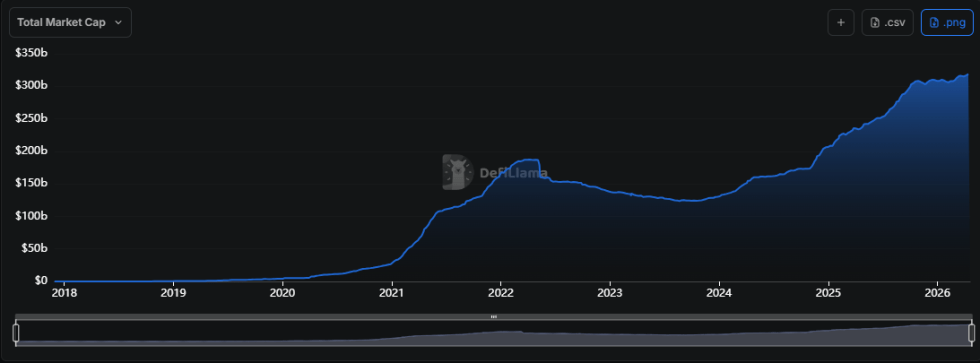
The trend in the stablecoin market cap over the last few years | Source: DefiLlama

Currently, the fiat-pegged coins have a combined valuation of over $320 billion, which is a new all-time high.

Bitcoin Price

At the time of writing, Bitcoin is trading around $75,000, up more than 6% over the past week.

The price of the coin seems to have retraced from its Friday high | Source: BTCUSDT on TradingView


Related Questions

QAccording to the BIS General Manager, what are the two key features that determine the 'moneyness' of an instrument like a stablecoin?

AThe two key features are singleness and interoperability.

QWhat is the main reason the BIS believes stablecoins currently remain a 'niche' payment instrument?

ABecause they lack the network effects that are key to money, as their design undermines singleness and interoperability, which prevents wider acceptance and use.

QDespite their shortcomings, what potential benefit of stablecoins did the BIS General Manager acknowledge?

AHe noted that stablecoins have the potential to significantly enhance cross-border payments.

QWhat is the current total market capitalization of all stablecoins as mentioned in the article?

AThe combined valuation is over $320 billion, which is a new all-time high.

QWhat are the two specific risks that the BIS head cautioned stablecoins could pose?

AThey can affect credit supply, financial stability, and monetary and fiscal policy.

Related Reads

Trading

Spot
Futures

Hot Articles

How to Buy CORE

Welcome to HTX.com! We've made purchasing CORE (CORE) simple and convenient. Follow our step-by-step guide to embark on your crypto journey.Step 1: Create Your HTX AccountUse your email or phone number to sign up for a free account on HTX. Experience a hassle-free registration journey and unlock all features.Get My AccountStep 2: Go to Buy Crypto and Choose Your Payment MethodCredit/Debit Card: Use your Visa or Mastercard to buy CORE (CORE) instantly.Balance: Use funds from your HTX account balance to trade seamlessly.Third Parties: We've added popular payment methods such as Google Pay and Apple Pay to enhance convenience.P2P: Trade directly with other users on HTX.Over-the-Counter (OTC): We offer tailor-made services and competitive exchange rates for traders.Step 3: Store Your CORE (CORE)After purchasing your CORE (CORE), store it in your HTX account. Alternatively, you can send it elsewhere via blockchain transfer or use it to trade other cryptocurrencies.Step 4: Trade CORE (CORE)Easily trade CORE (CORE) on HTX's spot market. Simply access your account, select your trading pair, execute your trades, and monitor in real-time. We offer a user-friendly experience for both beginners and seasoned traders.

4.7k Total ViewsPublished 2024.03.29Updated 2025.03.21

How to Buy CORE

Discussions

Welcome to the HTX Community. Here, you can stay informed about the latest platform developments and gain access to professional market insights. Users' opinions on the price of CORE (CORE) are presented below.

活动图片