By Semiconductor Industry Review
"I solemnly promise here and now that from this moment forward, Nexperia China will reward customer support with brand-new, cost-effective 12-inch wafer products and a stable, controllable supply chain." Today, Nexperia China CEO Zhang Qiuming made this commitment at the global launch event for new products, providing a product roadmap: launch over 900 products based on the 12-inch wafer platform in Q3, followed by over 1,700 more in Q4, steadily progressing towards full category coverage on the 12-inch platform and 100% domestic substitution. Starting today, new products will be continuously added weekly, freeing customers from worries about component selection and stockpiling.
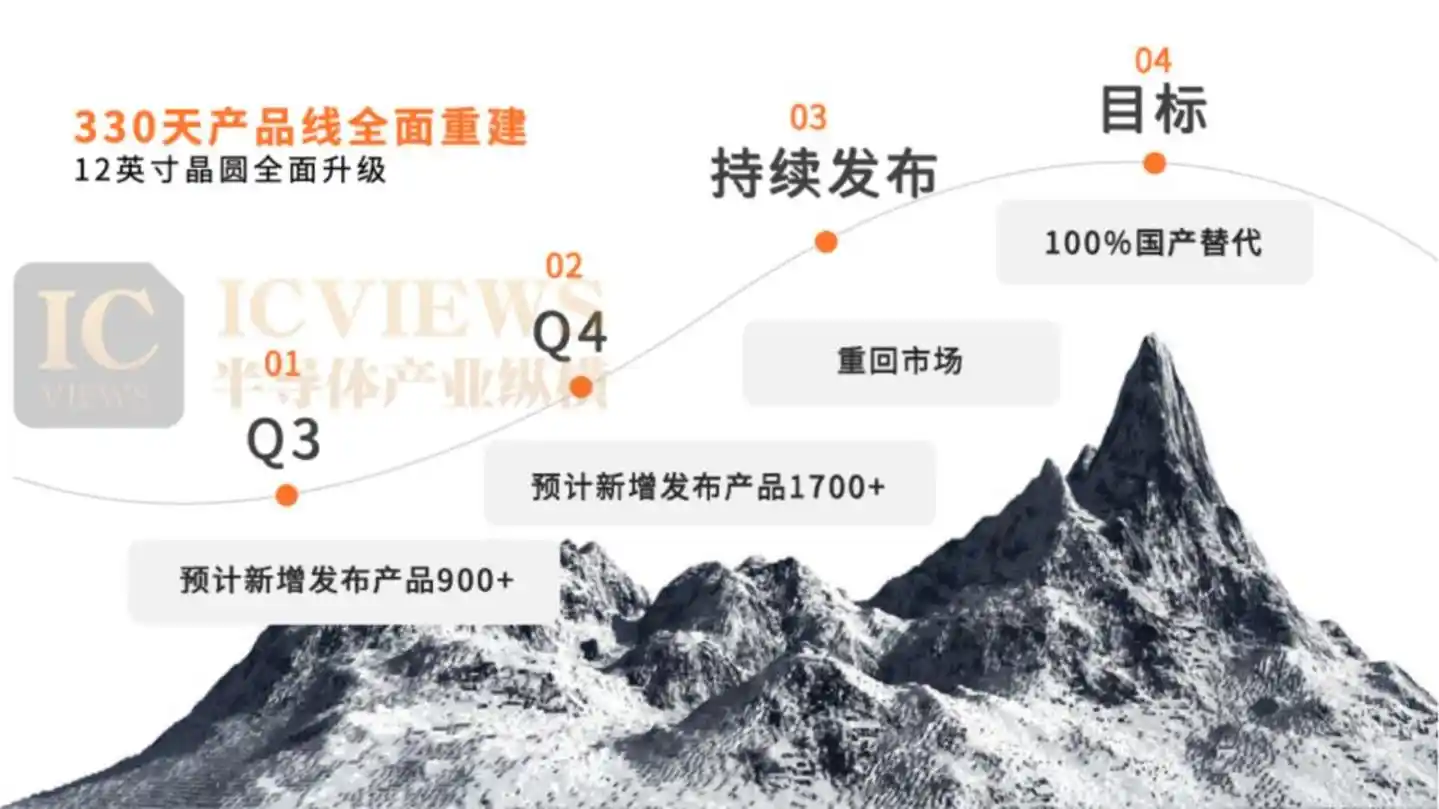
After 330 days of being cut off, Nexperia returns. At the launch event, Semiconductor Industry Review exclusively obtained more information.
01 Globalization Loses Its Certainty
Rewind to September 30, 2025. Administrative and judicial intervention from the Netherlands restricted the control rights of Nexperia's overseas-related entities, followed by the suspension of overseas wafer supply. The previously normally functioning global IDM system was abruptly severed, impacting the production continuity of Nexperia China and posing severe challenges to its normal operations.
Recalling at the launch, Zhang Qiuming said after the wafer supply was cut off, "The system suddenly went offline; data from overseas headquarters was inaccessible. We had orders, customers, trust, but simply no wafers to process. Automotive manufacturers, industrial equipment manufacturers were waiting for Nexperia's chips, yet Nexperia was waiting for a wafer that would never arrive."
Nexperia was once a classic example of global semiconductor division of labor. Wafers were manufactured at bases like Hamburg, Germany, and Manchester, UK, while the Chinese base handled large-scale packaging and testing, with R&D, sales, and customer service spread across different markets. This arrangement, with centralized front-end and back-end and globally dispatched capacity, operated for years, granting economies of scale to a vast number of low-unit-price devices. Nexperia delivers over 110 billion products annually worldwide, primarily diodes, transistors, MOSFETs, logic, and ESD protection devices. Though low-priced, they are embedded on every circuit board in cars, servers, and industrial equipment; with many part numbers, long lifetimes, and lengthy certification cycles, once on a BOM (Bill of Materials), supply relationships often last over a decade, making last-minute replacements unrealistic. Past rounds of automotive chip shortages have shown that what truly halts production lines are often these basic devices on mature process nodes.
The impact of this supply cut quickly extended beyond Nexperia China: global power device supply lost a key node, forcing automakers and industrial equipment manufacturers to reassess inventory and seek alternative parts. A deeper tremor was that the previously most stable capacity coordination within a multinational corporation could also be directly severed by administrative and judicial power, cracking the trust upon which globalized industrial chains operate.
Nexperia is not a young company that can pivot lightly. Starting in 1920, it has been both a participant in and beneficiary of globalization, turning its standard product business into global industrial chain infrastructure. A century of accumulation became a historical burden to bear during the supply cut, but also a starting point for a fresh beginning. As the shadow of external intervention loomed, Nexperia China did not choose to retreat or wait, but embarked on a more difficult path.
Zhang Qiuming said, "How easy is it to start from scratch?" Precisely because they understood customers' difficulties during the supply chain rupture, Nexperia China had to step up, "covering all uncertainties with certainty," using domestically-led R&D, production manufacturing, systems, sales channels, and supply chain to once again secure market demand for customers.
The past globalization built efficiency on full trust: wafers within the same company would be shipped as planned to packaging and testing plants, and signed orders would be delivered on schedule. The upheaval Nexperia faced shows this division of labor is not obsolete, but the certainty underpinning it is no longer a given. Beyond efficiency, customers are now re-evaluating whether supply sources are single, whether the manufacturing chain is complete, and if a second path exists in extreme scenarios. Therefore, instead of waiting for wafer supply to resume, Nexperia China restructured the organization, inventoried stock, and redeployed production line personnel. Within a month, supply support for domestic customers resumed, and the service system for overseas automotive clients was rebuilt. Over the past 11 months, Nexperia China has delivered over 40 billion chips to thousands of global customers.
02 330 Days, Forging a New Path
Today, Nexperia China officially announced: MOSFETs and logic ICs have achieved a full domestic closed-loop supply chain; 12-inch Bipolar has achieved small-volume mass production; over 100 new products developed on the 12-inch platform, such as SGT T2X Automotive-Grade MOSFETs and HCS high-speed logic products, have been simultaneously launched.
What does 12-inch signify? Currently, mainstream power device manufacturing still primarily uses 8-inch wafers, with some low-power discrete devices even using 5-inch or 6-inch wafers. This time, Nexperia China has moved automotive-grade high-voltage MOSFETs, Bipolar, and logic products together onto 12-inch wafers. SGT T2X fills the platform gap for 12-inch automotive-grade high-voltage MOSFETs, while HCS connects this mature device production line to the high-speed signal chain of AI servers. This represents a very significant leap.
Why choose 12-inch? Nexperia China's answer: 12-inch brings not just larger wafers, but a set of improvements that directly impact product competitiveness.
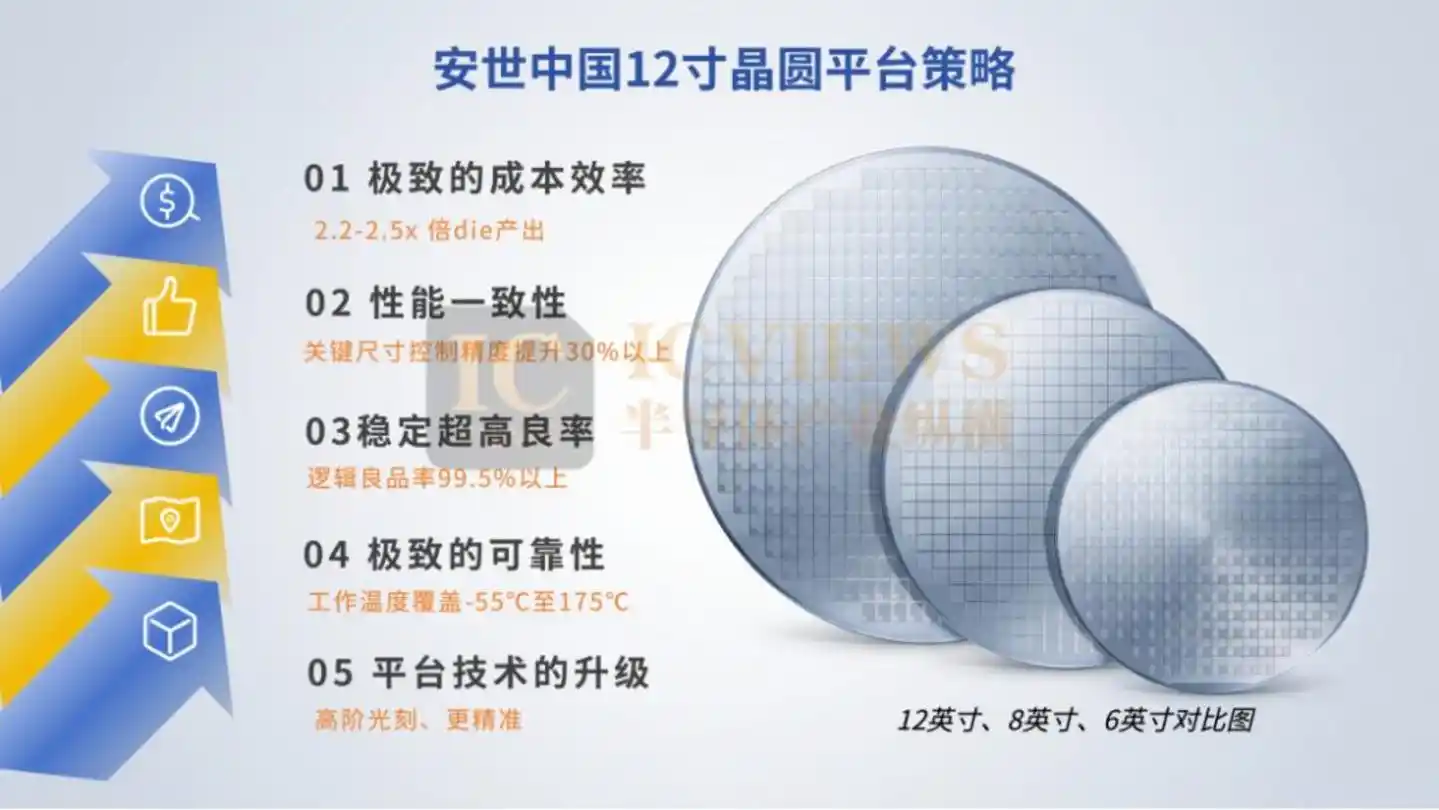
First, extreme cost efficiency. The effective area of a 12-inch wafer is about 4 times that of a 6-inch and 2.25 times that of an 8-inch, allowing more effective chips per wafer and spreading fixed costs across more products. According to industry information, the effective chip output per 12-inch wafer increases by about 5.7 times compared to 5-inch, about 4 times compared to 6-inch, and about 2.2-2.4 times compared to 8-inch; corresponding per-chip costs decrease by about 70% vs. 5-inch, about 60% vs. 6-inch, and about 50% vs. 8-inch. Depending on product mix, comprehensive cost savings range from 10% to 30%.
Second, consistent performance. New lithography, polishing, and process control equipment improve critical dimension accuracy by about 30% compared to 8-inch, narrowing intra-wafer parameter variation for some devices from about 10% to about 5%. For automotive customers, consistent device performance across different batches and temperatures is true quality.
Third, stable, exceptionally high yield. The 12-inch platform employs automated handling and stricter cleanliness control, reducing process defect density by about 20%. Yield for mature process products improves by an average of 5 to 10 percentage points, with recent mass-produced products achieving or exceeding 99% manufacturing yield. Stable yield ensures guaranteed capacity and delivery timelines.
Fourth, extreme reliability. AEC-Q and IATF 16949 standards run through the production process, product operating temperatures cover -55℃ to 175℃, and every wafer is traceable. For automotive and industrial devices, these are not marketing terms but thresholds for customers to include products in their BOMs.
Fifth, platform technology upgrade. New lithography, ion implantation, and thinning processes allow power devices to achieve lower thermal resistance and stronger surge immunity, and logic devices to achieve lower latency and static power consumption. Thus, 12-inch is not just about today's products but also determines whether the next generation of products can continue to advance.
Semiconductor Industry Review exclusively learned that Nexperia China's 12-inch project was not a hastily initiated contingency plan post-supply cut. The migration of power MOSFETs, IGBTs, and logic ICs to 12-inch began years ago; after the supply cut, the team also incorporated low-power Bipolar devices, which primarily used 5-inch and 6-inch wafers, into this platform.
Regarding the choice to move to 12-inch, Pang Yibing, General Manager of Nexperia China's Bipolar Division, revealed three underlying practical reasons: First, product standards. While 5-inch and 6-inch can still produce, meeting requirements for performance, reliability, and long-term consistency simultaneously is increasingly constrained within old wafer sizes. Second, manufacturing conditions. Chinese partners already possess 12-inch wafer and supporting capabilities, giving Nexperia China the opportunity to place products directly on a new, more efficient platform rather than continuing to patch old production lines. Finally, product portfolio. Nexperia China concurrently has MOSFETs, ICs, and discrete devices; several product categories can share the 12-inch manufacturing platform, providing enough part numbers and orders to run the production line, truly unleashing economies of scale. Therefore, Nexperia China's choice of 12-inch is not simply moving old products onto larger silicon wafers, but leveraging a reconstruction after a supply cut to advance product standards, manufacturing efficiency, and supply chain capabilities together. Its goal is not to return to the pre-supply-cut Nexperia, but to build a new Nexperia in China that can supply products with higher performance, higher reliability, and more cost competitiveness.
With front-end wafers moving to 12-inch, back-end packaging must also be completely redesigned. We further learned that power MOSFET packaging capacity has expanded to 4 times its original size, with packaging frames increasing from 100 units to 360 units, using higher-density packaging in the back-end to accommodate increased wafer output from the front-end. Simultaneously, materials like 12-inch substrates and epitaxial wafers were adapted within months, and Bipolar device equipment was redeveloped according to new process requirements, even adjusting parameters like power-on speed and inrush current.
It's worth noting that Nexperia China's 12-inch Bipolar R&D and mass production platform is the world's first of its kind, taking only about 11 months from initiation to small-volume mass production. Achieving mass production in 11 months didn't come from simply scaling up an 8-inch process but from simultaneous transformation of materials, equipment, processes, and packaging, with back-end higher-density packaging also needing to absorb increased front-end wafer output. If reliance were placed on European, Japanese, or Korean equipment suppliers, not only might obtaining equipment be uncertain, but also receiving customized support for Bipolar 12-inch processes would be difficult; even entering purchase queues could entail delivery cycles measured in years. The fact that Nexperia completed this in 11 months demonstrates China speed! It shows that domestic wafer, material, equipment, packaging and testing, and engineering services can now coordinate and respond in parallel around a product. This is not just about adding one more 12-inch production line; it signifies that China's supply chain is beginning to possess the collaborative capability to complete complex manufacturing migrations.
Currently, Nexperia has restored supply for approximately 1,300 logic device products, compressing product iteration cycles from about 36 months to 9-12 months, with the fastest new products completed in 3 months; domestic delivery lead times have shortened from 12-16 weeks to 4-6 weeks. The Bipolar Division plans to complete development and mass production of over 400 varieties by the end of this year, covering over 80% of market demand, increasing to about 95% by the second half of next year.
In 330 days, Nexperia China reconnected the shattered manufacturing chain: from materials, equipment, wafers to packaging and testing, forming a sustainable closed-loop within China.
03 Unlimited Supply, Nexperia Remakes Itself
At a time when the market faces the most severe shortages, Nexperia China offers not a round of futures pricing but a batch of available inventory for immediate order, explicitly promising unlimited supply. Nexperia returns to center stage, Nexperia remakes itself!
First, the most competitive price support and inventory guarantee. Since 2026, sustained demand from AI data centers, new energy vehicles, and industrial automation continues to squeeze 8-inch mature capacity, with lead times for some power devices exceeding 30 weeks and overseas giants raising prices consecutively. For downstream customers, pressure comes not only from rising quotes but also from uncertainty in receiving ordered goods on time. The 8 power MOSFET products launched by Nexperia China this time are priced up to 30% lower than last year's peaks, with 4 general-purpose logic products reduced by over 20%, and some general-purpose Bipolar devices priced about 10% lower than mainstream market products.
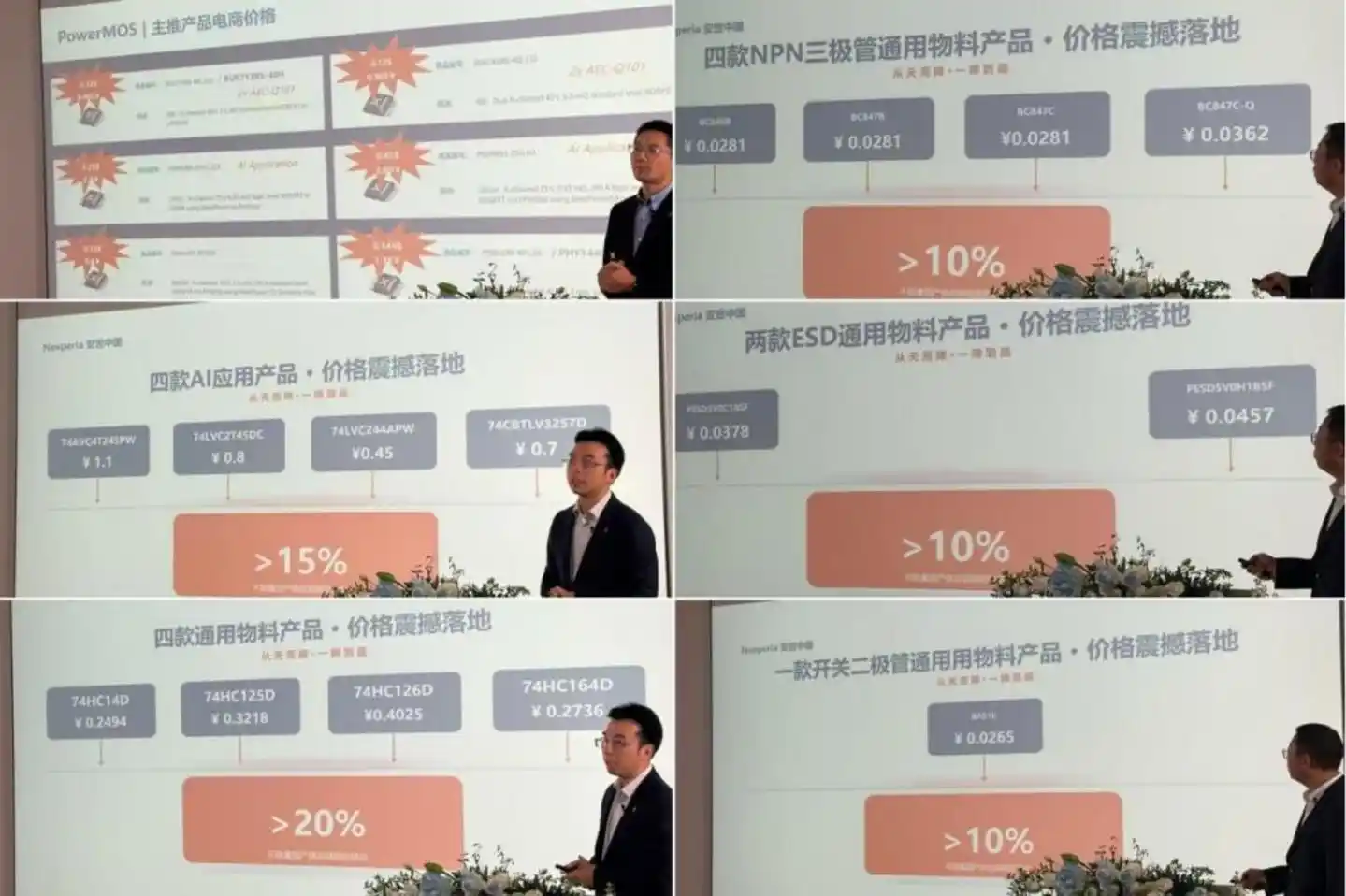
Price reduction is not just a slogan; specific models and prices were given at the launch event: 74HC14D reduced to 0.25 RMB, 74HC125D to 0.32 RMB, 74HC126D to 0.40 RMB, 74HC164D to 0.27 RMB, representing an overall reduction of over 20% compared to last year. Eight power MOSFETs targeting automotive, AI servers, and industrial motor control were simultaneously launched, with some NPN transistors and ultra-low capacitance ESD products also priced over 10% lower than market prices; four AI logic devices were priced as low as 0.45 RMB. Nexperia China CEO Zhang Qiuming stated, "This price differential is not subsidized; it's the industrial upgrade dividend brought by the 12-inch platform and domestic supply chain." This dividend is directly passed to customers: lower prices on one side, and available inventory with unlimited supply on the other, freeing customers from repeatedly stockpiling against shortages during price hike cycles. The 12-inch platform increases per-wafer output, advanced processes shrink chip size, and yield and consistency further dilute manufacturing costs. With R&D, wafers, packaging and testing, and customer delivery all completed within China, costs associated with cross-border shipping, inventory, and multi-layered distribution are also reduced. Efficiency once retained within the industrial chain now returns to customers through price and available inventory.
Second, rooted in China, serving globally, launching e-commerce services. In the traditional distribution model, original manufacturers struggle to directly see end-customers' component selection, inventory, and price feedback; after passing through multiple channel layers, costs and prices become less transparent. After the supply cut, to quickly connect with and serve customers, Nexperia China launched its self-operated Nexperia Mall and integrated online ecosystem partners. New products debut on the Mall, where customers can directly check inventory, select components, view prices, and receive shipments as fast as 24 hours after ordering, handling everything from R&D samples and small-to-medium batch procurement to large-scale orders online. This isn't merely adding another sales channel. Nexperia Mall brings products, prices, and inventory directly face-to-face with the market for the first time, turning the cost space released by the 12-inch shift into visible, purchasable inventory for customers. For clients who have experienced supply cuts and shortages, this change carries more weight than a simple promise of "stable supply." Nexperia China returns, bringing an online + offline dual marketing and service system, responding to the market on the run, serving customers!
04 New Globalization, Starting from China
Globalization once distributed Nexperia's R&D, wafers, packaging and testing, and customer delivery across different countries and regions. Such division of labor brought efficiency but also built corporate stability on cross-border coordination. Now, Nexperia China sets out with a new posture: taking China as the innovation and manufacturing headquarters, rooted in an autonomous and controllable industrial chain, participating in global competition with an open attitude.
"China for China, China for Global" is not about confining Nexperia to China, but making China the new starting point for Nexperia facing the world. R&D, manufacturing, and supply chain are re-established in China, delivering products to clients worldwide according to global standards. This is another understanding of globalization from a Chinese enterprise: openness remains crucial, but not at the cost of losing manufacturing capability; cooperation remains vital, but must be built on a foundation of sustainable delivery.
The value of Nexperia to China's semiconductor industry is not merely completing a 12-inch migration. It proves that China's supply chain can collaboratively complete materials, equipment, processes, packaging and testing, and customer validation, and can continue delivering products even when the global supply chain fluctuates.
As Zhang Qiuming said: "The change in Nexperia China is not confrontation; it is more about protection." Protecting customers, protecting the industry, protecting employees, and also protecting the possibility for globalization to continue.
330 days later, Nexperia stands firm, Nexperia China returns to the market, returns to center stage! It faces the world, but starts from China; it chooses self-reliance, not to sever ties with anyone, but so that when the next supply chain storm arrives, customers still have someone to turn to, goods available, and the industry still has a path forward.
The new Nexperia starts from China.