Journalists Point to a Shift of Crypto-Treasury Companies Towards AI

cryptonews.ruPublished on 2026-07-27Last updated on 2026-07-27

Abstract

At least a dozen companies previously focused on acquiring digital assets for their treasuries have pivoted toward AI-related businesses in recent months, according to a Bloomberg report. This strategic shift, however, has failed to revive investor interest. The stocks of these US and Canadian data-asset treasury (DAT) firms have fallen a median 43% year-to-date, with many trading below their net asset value as management teams exit. Examples of this transformation include K Wave Media Ltd., which switched from accumulating Bitcoin to developing data centers, seeing its shares drop 71% since its May relaunch. Lixte Biotechnology Holdings Inc. and AlphaTON Capital (rebranded as Alpha Compute) also saw significant declines after strategic shifts. Analysts link the sector's weakness directly to the poor performance of the digital assets themselves. Legal experts note the term "crypto treasury" has become a "dirty word" for investors. The pivot to AI is seen as a logical move to attract the large capital flowing into tech infrastructure, driven by spending from giants like Alphabet and Microsoft and startups like OpenAI. While attempts to capitalize on the AI boom extend beyond crypto—exemplified by shoe maker Allbirds rebranding as Smartbird—bitcoin miners like CoreWeave, Hut 8, Iren, and TeraWulf have seen more success by repurposing their data centers for high-performance computing. Investors remain interested in other blockchain applications but have largely abandoned the ...

The stocks of DAT-structured companies continue to decline.

At least 12 companies that built their businesses around purchasing digital assets have recently shifted their focus to AI-related areas. Bloomberg emphasized that the change in strategy has not yet helped restore investor interest.

The stocks of DAT firms tracked by the publication in the US and Canada have shown a median decline of 43% since the beginning of the year. Many are trading below the net value of the assets they own, and management teams are exiting the business.
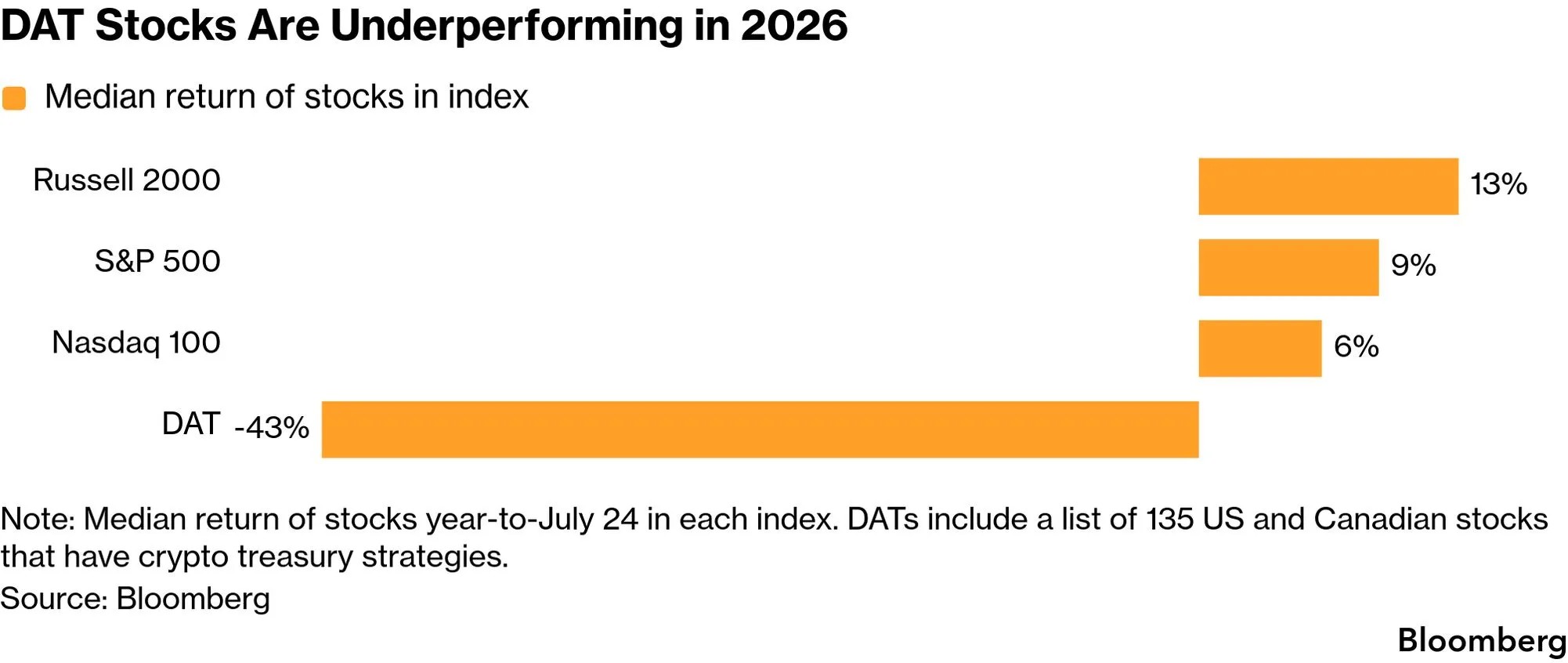
Source: Bloomberg.

The journalists provided specific examples of business "transformation." For instance, Bitcoin-accumulating K Wave Media Ltd. switched to developing data centers—since its relaunch in May, its stock has fallen by 71%.

The shares of Lixte Biotechnology Holdings Inc. dropped by 33% after the company agreed to merge with a firm from the energy sector in June. AlphaTON Capital, which holds altcoins on its balance sheet, lost 33% after rebranding to Alpha Compute in April.

Bloomberg directly links the weakness of the DAT sector to the dynamics of the assets themselves.

Gregory Sichenzia, founder of the law firm Sichenzia Ross Ference Carmel LLP, succinctly described the change in sentiment: if last year nothing bad was expected from crypto-treasuries, this year the phrase itself has become a "dirty word."

In his opinion, the shift to AI looks logical—that is where major capital is currently flowing. The spending by tech giants like Alphabet and Microsoft, as well as startups OpenAI and Anthropic, on computing infrastructure has made companies related to data centers the best-performing stocks in major indices.

Nearly all firms in the top 10 by performance in the S&P 500 index produce products for data centers: among them are SanDisk, whose stock has risen more than 500%, as well as Dell Technologies, Intel, and Micron Technology.

Attempts to capitalize on the AI hype extend far beyond the crypto market. Bloomberg cites the example of shoe manufacturer Allbirds, which shifted toward computing infrastructure after its own stock plummeted and rebranded to Smartbird.

Among companies in the crypto industry, Bitcoin miners are currently having more success than DAT firms in reorienting towards AI. CoreWeave switched to cloud computing, which positively impacted its stock.

The quotes of Hut 8, Iren, and TeraWulf are also recovering after retooling their data centers for data centers.

Partner at Lowenstein Sandler Daniel Forman emphasized that investors are not completely abandoning the blockchain theme: interest remains in other areas of the technology, but not in the digital treasury model in its current form.

Recall that Coinbase CEO Brian Armstrong called the shift of crypto projects to AI a mistake.

end-content

Related Questions

QAccording to the article, what is the current trend among many companies that were built around acquiring digital assets?

AAt least 12 such companies have reoriented their strategies towards AI-related directions in recent months, moving away from their original digital asset focus.

QHow have the stock prices of these reorienting DAT companies performed in general, based on the article's data?

ATheir stocks have shown a median decline of 43% since the beginning of the year, with many trading below the net value of their assets.

QWhat major reason does the article cite for the poor performance of the DAT sector despite the shift to AI?

ABloomberg directly links the weakness of the DAT sector to the poor performance dynamics of the digital assets themselves.

QWhy does the founder of Sichenzia Ross Ference Carmel LLP, Gregory Sichenzia, believe the shift to AI is logical for these companies?

AHe believes it is logical because that is where major capital is currently flowing, driven by heavy spending on computing infrastructure by tech giants and AI startups.

QWhich segment within the crypto industry has reportedly had more success in pivoting to AI compared to DAT firms, according to the article?

ABitcoin miners have reportedly had better success. For example, CoreWeave's shift to cloud computing positively impacted its stock, and miners like Hut 8 are recovering after repurposing their data centers.

Related Reads

The Quantum Computing Threat Approaches, Cryptocurrency May Be Exposed to Risks Before Banks

Quantum computing poses a significant threat to all cryptographic systems, including banks and governments, but decentralized cryptocurrencies with public ledgers like Bitcoin are likely the first practical target. Experts warn that a cryptographically relevant quantum computer (CRQC), capable of running Shor's algorithm to break the elliptic curve cryptography securing most crypto wallets, could emerge around 2029. Recent research shows the required quantum resources for such attacks are shrinking dramatically, potentially enabling key extraction in minutes. The core vulnerability for cryptocurrencies is not the cryptography itself—post-quantum standards are being developed—but the slow, decentralized governance required to implement upgrades. Unlike centralized banks that can swiftly transition, Bitcoin needs near-unanimous consensus among its global network, a historically difficult process as seen in past upgrades. Estimates suggest migrating all vulnerable Bitcoin funds could take at least 76 days of dedicated network time, and it must be completed before a CRQC exists to prevent "now-or-never" attacks on exposed keys. The threat is not binary; it begins when a quantum computer can decrypt data before it loses value, not necessarily in real-time. A significant portion of Bitcoin (estimated at millions of coins) already has public keys permanently exposed on-chain, making them vulnerable to eventual "static attacks." While technical solutions exist, the race is against time for decentralized networks to coordinate a defensive transition, serving as an early warning for the broader financial system.

marsbit7m ago

The Quantum Computing Threat Approaches, Cryptocurrency May Be Exposed to Risks Before Banks

marsbit7m ago

On the First Day of Listing, Changxin Technology's Market Value Exceeds 3 Trillion Yuan, Which Securities Firm Has the Largest Floating Profit?

On July 27th, Changxin Technology, the largest-ever IPO on China's STAR Market, debuted with its share price soaring 465.82% to close at 49 yuan. Its market capitalization reached 3.28 trillion yuan, instantly making it the most valuable A-share company. The stellar performance delivered substantial gains for involved securities firms, primarily through equity investments rather than underwriting fees. China Merchants Securities emerged as the biggest winner. Its direct investment subsidiary, Zhaozheng Investment, alone holds a 0.54% pre-issue stake, translating to a paper profit exceeding 155 billion yuan based on the first-day closing price—surpassing the firm's entire 2025 net profit of 123.5 billion yuan. Other major beneficiaries include Huaan Securities, with an estimated profit of around 123 billion yuan from its 0.44% stake, and the lead underwriters, CICC and CITIC Securities, which each gained approximately 46 billion yuan from mandatory follow-on investments. Firms like Founder Securities, Haitong Securities, and GF Securities also reported significant holdings valued in the billions. Despite these paper gains, shares of some brokerages like Huaan and China Merchants fell on the listing day, reflecting broader market pressures. Analysts remain bullish on Changxin's long-term prospects, citing the AI-driven demand surge for DRAM (Dynamic Random-Access Memory) and a supportive supply-demand dynamic with projected shortages through 2028. As China's largest and most advanced integrated DRAM designer and manufacturer, Changxin is poised to capture growth from domestic substitution and global market shifts, potentially challenging the current "big three" oligopoly (Samsung, SK Hynix, Micron). The IPO proceeds, focused on capacity upgrades and R&D, are expected to accelerate China's semiconductor self-sufficiency.

marsbit37m ago

On the First Day of Listing, Changxin Technology's Market Value Exceeds 3 Trillion Yuan, Which Securities Firm Has the Largest Floating Profit?

marsbit37m ago

Will Changxin Technology Continue to Rise Today?

Changxin Technology made a historic debut on the stock market, with its share price soaring 465.82% to close at 49 yuan. Its market capitalization reached 3.28 trillion yuan, surpassing Industrial and Commercial Bank of China to become the largest company by market cap on the A-share market. Daily trading volume exceeded 140 billion yuan, a first in A-share history. This created a moment of realization for 7.7 million investors who won the lottery for its shares. On the first day, investor strategies varied: some sold immediately and later regretted missing intraday highs, others secured profits to avoid future volatility, while a third group held or even bought more shares, betting on long-term growth. The staggering IPO, massive public enthusiasm, and debut during a peak industry cycle led some to compare Changxin to PetroChina's 2007 listing, which was followed by a long decline. Key similarities noted include comparable fundraising scales (approx. 666 billion yuan for Changxin vs. 668 billion for PetroChina) and both companies listing at a perceived high point in their respective commodity cycles (oil then, memory chips now). However, analysts caution against over-simplifying the comparison. They highlight core differences: Changxin operates in the high-growth semiconductor sector with strong "domestic substitution" tailwinds. Brokerages like Huaxi Securities project significant revenue and profit growth from 2026 to 2028, driven by DDR5 adoption, product mix optimization, and economies of scale. Nomura Securities issued a "buy" rating with a 116 yuan target price, citing AI-driven demand for DRAM, tight supply as major players shift to HBM production, and Changxin's vast room for market share growth. Some analysts position the current memory cycle, fueled by AI, as just beginning, contrasting with the mature energy cycle PetroChina entered. The article concludes that for investors, monitoring the memory cycle's progression and Changxin's breakthroughs in high-end technologies like HBM will be crucial, rather than relying on superficial historical parallels.

marsbit1h ago

Will Changxin Technology Continue to Rise Today?

marsbit1h ago

Claude Designer Lags Behind Engineers, Fires Back by Creating a Million-User Tool

The article tells the story of Nate Parrott, a designer at Anthropic who created Claude Design as a side project to keep pace with his engineering teammates. When Anthropic released Opus 4.5 in November 2025, the two engineers on Parrott's Claude Code team significantly increased their output using the new AI capabilities. Parrott, the sole designer, found himself struggling to match their speed, becoming a bottleneck in the workflow. To catch up, he began experimenting in his spare time. He initially tried prompting Claude to generate designs from text descriptions and screenshots, with limited success. His breakthrough came when he shifted focus from asking Claude to "design" to asking it to generate HTML. He realized HTML could be a rich visual canvas for creating everything from slides and interactive prototypes to full web pages. He built a simple interface with a chat panel on the left and a live HTML preview on the right. The key to making the output useful was incorporating Anthropic's brand system—fonts, colors, assets, and design principles—into the prompts. This ensured generated designs were immediately on-brand. He shared an internal prototype with his team, and other product designers quickly adopted it for creating clickable prototypes, a task traditionally requiring manually drawing every state. The project's "official" turning point came during an Anthropic Labs offsite, where Parrott noticed many attendees were using his tool to build presentation slides on the fly, sometimes right before their turn to speak. This organic adoption convinced the Labs team to formally staff the project, turning the side project into a real product. Claude Design is positioned as a "pre-production" tool for visual communication and exploration—handling slides, landing pages, PDFs, emails, and social media graphics. It integrates with tools like Canva, Adobe, and Vercel. Its core value is accelerating the early stages of design: exploring directions, building consensus, and establishing systems. For actual production code, Anthropic still recommends Claude Code. The story highlights how AI disrupts workflows unevenly and how individuals can respond by building new tools to create their own advantages. Parrott's tool, born from necessity, eventually gained over a million users in its first week.

marsbit1h ago

Claude Designer Lags Behind Engineers, Fires Back by Creating a Million-User Tool

marsbit1h ago

Trading

Spot
活动图片