Ethereum's Ballmer Moment: As Everyone Is Bearish, the Circulating Supply Is Disappearing

marsbitPublished on 2026-06-04Last updated on 2026-06-04

Abstract

"Ethereum's Ballmer Moment: Circulation Shrinks Amid Bearish Sentiment" Amid widespread bearish sentiment, with prominent figures like Bankless founder David Hoffman selling ETH and young developers flocking to Solana, some argue Ethereum is entering its "Ballmer era"—akin to Microsoft's perceived stagnation under Steve Ballmer. While surface-level criticisms about slow protocol development, cautious leadership, and competitive pressure are valid, underlying fundamentals tell a different story. Approximately 30% of ETH is staked, major holders like BitMine are accumulating, and spot ETFs continue to absorb supply. Regulatory clarity, including the SEC/CFTC's March ruling on staking rewards and the potential passage of the CLARITY Act, is transforming crypto from a regulatory threat into a legitimized framework. This institutionalization, alongside a shrinking circulating supply (with net issuance around 0.23% annually), creates significant buy-side pressure independent of fee-based value capture. The broader crypto total addressable market is expanding through regulated stablecoins, tokenized assets, and institutional adoption. While public chains face competition from permissioned alternatives, the winning model appears to be permissioned assets settling on public chains like Ethereum and Solana. The author advocates a non-maximalist, barbell strategy: holding ETH for its institutional role and supply squeeze, SOL for consumer/throughput trends, BTC as a macro hedge, and...

Author: Ben Lakoff

Translation: Deep Tide TechFlow

Deep Tide Guide: When Bankless founder sold all ETH and 19-year-old developers flocked to Solana, the bearish narrative for Ethereum became consensus. However, Ben Lakoff, a partner at BanklessVC, believes this is a repeat of Microsoft's "Ballmer Era"—superficially the narrative is bearish, but underlying fundamentals are steadily growing. A 30% staking rate, ETF accumulation, and clearer regulations are compressing the circulating supply. While crypto regulation is shifting from an existential threat to a legal framework, it's precisely the time to get in.

Welcome to the May trading flow summary.

This month's thesis section is a bit longer, so I've put it upfront. All financing rounds, fund raises, and hackathon results are placed afterward.

Ethereum's Ballmer Era

Last month, David Hoffman sold all his ETH at $2,070 and wrote a thoughtful article explaining why. It spread all over X (Twitter).

David subsequently joined the Chopping Block podcast, and I really enjoyed that conversation. Tarun said Ethereum is "ossifying" because no 19-year-olds want to build there. Max Resnick called the Ethereum Foundation "risk-averse." The bullish Haseeb gave the entire bearish sentiment a name: this is Ethereum's Ballmer Era. That phrase resonated with me.

This framework is too good to let go.

Yes, I'm bullish on "crypto," I'm bullish on BTC, I'm bullish on ETH... I'm bullish on the trend. But pretending the bearish thesis is weak is just self-deception, so I want to elaborate further on my position. These are my views, not necessarily representing BanklessVC's views, and certainly not investment advice.

The Bearish Thesis Has a Name, and It's Not Wrong

The substance is real. In fact, we've dropped another 10% since that article was published.

David's argument: ETH as money was always a long-term bet, and the rollup-centric roadmap makes it even longer. Ethereum is a "giver, not a taker"... it's designed to distribute block space at cost. L2s capture 98% margins on blob revenue. The gas limit is gradually increasing to 100M+. The BPO fork aggressively expands blob supply. The $30B to $163B stablecoin surge creates value for Circle and Tether, not ETH. Meanwhile, SOL, NEAR, BNB, and TRX have repriced as fee-driven comparables. He's mechanically correct. The protocol is designed for abundant block space, the exact opposite of the fee-driven value capture you want.

Tarun's "ossification" view is the cultural version of the same thing. Talent follows founder energy, and that energy is now on Solana, Monad, Hyperliquid, and whatever comes next (maybe not Ethereum, not crypto). Resnick's "risk-averse EF" is the institutional version. The foundation is devoutly focused on protecting network integrity at a moment when it needs to stay competitive.

Haseeb is right. A "Ballmer Era." Slow product cadence. Botched transitions. Sharper competitors with killer instinct. Loud critics who are right on the points.

What Microsoft Actually Did During the Ballmer Era

Ballmer ran Microsoft from 2000 to 2014. The joke: wasted 14 years. Missed mobile, missed search, missed social, shipped Vista, threw a few chairs.

That's the joke I remember, but what does the joke miss? MSFT stock went sideways for over a decade, while the enterprise franchise compounded relentlessly underneath. Dividends did most of the work. Office and Windows licenses printed money the entire "Microsoft is dead" narrative period. Then Satya took over, and MSFT went 10x.

The lesson (at least in the Microsoft version) is that deeply embedded, enterprise-loved, time-tested infrastructure tends to keep compounding through its own bearish narrative. The bearish narrative is often correct on the surface. Just not enough to short.

Ethereum is still the largest credibly neutral public chain for tokenized assets. BUIDL launched there. ~66% of USDC supply is there. The deepest DeFi liquidity is there.

But the lead is shrinking fast. BUIDL isn't just on Ethereum (~40%), down from ~85% a year ago. USDC exists on 34 chains. Western Union chose Solana over Ethereum for USDPT. The institutional default is shifting from singular "Ethereum" to plural "public chains."

Still bullish for the incumbent. Just not a monopoly anymore. Whether 19-year-olds want to build there is a real long-term concern. But it's not what decides the next two years.

Beneath the Noise: The Circulating Supply Is Collapsing

This is the part most bearish takes miss.

~30% of ETH is staked. Treasury corps hold another 6%+ and growing. BitMine alone holds 4.47% of the supply and is publicly targeting 5%. Spot ETFs keep absorbing more. The SEC/CFTC March 17 ruling classifying staking rewards as non-securities unlocked the entire staking ETF pipeline. Five other issuers (Fidelity, Franklin, Invesco, 21Shares, VanEck) have staking amendments pending Q2 decisions.

Every ETH staked through an ETF is ETH that cannot be sold on price impulse. Net issuance is ~0.23% annualized. The float is shrinking faster than that, and on most days these intake sides are bidding. The math doesn't care if ETH is boring.

So David is right, ETH won't reprice from fee burn. The roadmap chose abundance. But ETH can reprice from float compression, staking yield demand, and institutional Schelling point premium without winning the fee war. At least near-term.

Crypto's TAM Keeps Rising

Zooming out a bit from ETH. The real story of the last 12 months is crypto regulation shifting from an existential threat to a legal framework.

The GENIUS Act is now law. Payment stablecoins have a federal regime. The CLARITY Act passed the House in July, passed the Senate Banking Committee on May 14, and structurally looks likely to pass before midterms. Stablecoin circulating supply is over $2.8T and compounding. Tokenized treasuries are scaling. Spot ETFs exist for a growing list of assets.

This isn't the crypto-dies phase. This is the crypto-becomes-a-regulated-trillion-dollar-slice-of-the-financial-system phase where boring institutions are mandated to plug in.

In prior bears, we genuinely worried whether this ecosystem would exist in the future. But, with some caveats, and they matter.

First: Crypto winning vs. decentralized crypto winning are not the same thing. The truly scary bear case isn't David's fee math. It's "blockchain winning" eventually looking like Canton, JPM Onyx, DTCC's permissioned ledgers and a few Avalanche subnets, with the public crypto asset complex capturing basically none of the real value.

That world exists (and is concerning), but I'd bet on the public chain side for a few reasons. Pure permissioned chains as the institutional answer have been pitched for a decade and keep losing adoption (maybe this time is different?). The architecture actually winning is permissioned assets on public chain rails: BUIDL, BENJI, Ondo's USDY. Tokens execute KYC and transfer restrictions; settlement runs on Ethereum, Solana, and other public infrastructure. The empirical record of KYC pools coexisting with open public pools (Aave Arc, Compound Treasury) is that they fail.

That's still bullish for public chains, including ETH, as settlement layers. But it's weaker than full DeFi composability. Permissioned assets cannot freely compose with open pools, but the gated-access version is the mode winning.

Second: The question is no longer whether crypto adoption happens. It's which crypto captures it. The honest answer is, not all goes to ETH, but the institutionalized, regulated, "needs credibly neutral" giant chunk almost certainly. Because the alternative is asking tier-1 banks to settle tokenized assets on chains run like startups... unlikely.

This is where the Ballmer framework underrates the bull case. It only works if the underlying market keeps growing. Crypto's underlying market is growing fast in the most regulator-blessed, institutionalized way.

Barbell Strategy: Bullish on the Trend, Not Extremism

The bear thesis I take seriously isn't the fee analysis. It's leadership and competition. EF might indeed need its Satya moment. The killer instinct vacuum is real. Solana, Monad, and Hyperliquid aren't slowing down. ETH/BTC and ETH/SOL could go sideways or lower for a while before turning.

The way to position around this is simple: stop being an extremist.

Hold ETH for the time-tested/institutionalized/float compression trade. Hold SOL for the consumer/throughput/distribution trade. Hold BTC for macro hedge. Hold a small basket of next-gen L1s and application-layer winners where the cultural energy is actually flowing.

I know. ETH is a $250B asset, impacted by macro trends, and your capital allocation always involves trade-offs. I'm not an extremist, but I'm still bullish on ETH. Summarizing why:

The float is shrinking faster than issuance.

Q2 staking ETF approvals are a live, dated catalyst.

CLARITY Act passage broadly unleashes institutional crypto. Clearer rules let regulated capital deploy at scale across the asset class. ETH's moat is incumbent network effects plus credible neutrality, making it the default public chain settlement layer for tokenized assets, even as the lead shrinks.

The bear thesis is so loud it's now consensus. The historical hit rate of consensus bear at $2K after a 60% drawdown is low.

The optionality value of a "Satya moment" isn't priced in. If EF gets reorged, or a more aggressive entity emerges to lead protocol development, that's pure upside no bear model includes.

I see this trade as "David is partially right and ETH still works." Microsoft worked under Ballmer. Crypto adoption is winning. The assets you most want to own are the ones most deeply embedded in the part of crypto the US government just spent two years writing rules for.

Zoom out on what regulators are actually saying. The SEC and CFTC are telling you they want to rebuild finance on-chain. Bring dollars on-chain. In that world, how is this not insanely bullish? Maybe if you're a cypherpunk, this isn't the world you envisioned... gated assets, KYC rails, everything requiring permission. But for public chains as settlement infrastructure? Unquestionably bullish.

That's the crux of where we are in the cycle. AI is the center of attention, full stop. It's hot, parabolic, and as an early-stage investor, that's exactly the problem. You want to deploy capital where it's not hot. When a sector is this overheated, it's hard to put capital to work anywhere but the earliest pre-seed stage without paying a premium.

Crypto, right now, is not hot. The bear thesis is consensus. The energy is elsewhere. That's the setup you want, not the one you run from.

On a long enough timeline, everything becomes AI, everything becomes blockchain. One of these is priced like it already happened. The other just got a two-year head start written into law, and everyone is looking the other way.

Buckle up. Now turning to the rest of crypto/web3 financings :)

Top 10 Crypto Financing Rounds

Kalshi | Series F | Prediction Markets | $1B | 2026-05-07

Led by Coatue, with participation from Sequoia, a16z, IVP, Paradigm, Morgan Stanley, and ARK Invest. This $1B round values Kalshi at $22B, double the $11B valuation just five months prior. Annualized trading volume tripled in six months to $178B, with institutional volume up 800%. Kalshi is CFTC-regulated and not crypto-native, so call it the asterisk on this list, but it now has >90% of US prediction market activity, and prediction markets are one of the cleanest on-ramp stories crypto has right now.

Dunamu (Upbit) | Strategic Investment | Centralized Exchange | $408M | 2026-05-28

Three Samsung-affiliated companies (Samsung Securities, Samsung SDS, Samsung Card) agreed to purchase ~4% of Dunamu, operator of South Korea's largest crypto exchange Upbit, for ~$408M (612.8B KRW). Each buyer mentioned positioning for KRW-pegged stablecoins, tokenized securities, and on-chain settlement ahead of Korea's Digital Asset Basic Act. This is part of a May sprint transferring ~14% of Dunamu to Korean giants like Hana and Hanwha. Closing June 19.

Circle (Arc) | Token Presale | Infrastructure/Stablecoins | $222M | 2026-05-11

Circle raised $222M (FDV $3B) for Arc, its institutional L1 for stablecoin settlement and tokenized assets. a16z crypto put in $75M, with participation from BlackRock, Apollo, ICE, Standard Chartered Ventures, SBI, Janus Henderson, General Catalyst, Marshall Wace, ARK, Haun, and Bullish. This is the clearest "TradFi is picking rails" signal of 2026. A regulated stablecoin issuer is building its own chain, with the largest asset manager on the cap table.

Ripple (Ripple Prime) | Debt Financing | Infrastructure/Prime Brokerage | $200M | 2026-05-11

Ripple secured $200M in debt financing from a fund managed by Neuberger Specialty Finance to expand lending capacity for its multi-asset prime brokerage, Ripple Prime. Existing institutional loans serve as collateral. Ripple Prime revenue is up 3x YoY since Ripple acquired the platform in 2025. Traditional finance credit backing crypto prime brokerage loan books.

Elliptic | Series D | Compliance/AI x Crypto | $120M | 2026-05-12

Led by One Peak in this $120M round (valuation $670M), with participation from Nasdaq Ventures, Deutsche Bank, and British Business Bank. This is the largest pure equity VC round of the month. Elliptic is building agentic AML/compliance tooling. Reading with post-April lens: this is the ops/compliance layer DeFi keeps being reminded it needs, now with TradFi capital behind it.

Fun | Series A | Payments/Consumer | $72M | 2026-05-01

Co-led by Multicoin Capital and SignalFire, with participation from Infinity Ventures, Pharsalus Capital, and Justin Mateen. Fun is a crypto/fiat on-ramp powering financial platforms like Polymarket. Largest consumer/payments VC round of the month, a clean bet on the prediction market and consumer crypto heatwave track.

Fasset | Series B | Stablecoins/Payments | $51M | 2026-05-14

Led by SBI Group in this $51M raise, with Investcorp and Arz Portföy participating. Fasset is a stablecoin-powered neobank for emerging markets, with ~$32B annualized transaction volume. Real proof-of-concept for the stablecoin-as-payments thesis, and in the places that matter most: the corners of the world where dollar rails are genuinely life-changing.

Variational | Series A | DeFi/Derivatives/RWA | $50M | 2026-05-20

Led by Dragonfly, with participation from Bain Capital Crypto and Coinbase Ventures. Variational operates an RFQ-style platform for on-chain perpetuals on real-world assets: oil, gold, silver, copper. The team's call is that RWA perps could surpass BTC and ETH perps within a year. Most thesis-heavy small trade of the month.

OpenTrade | Strategic/Growth | Stablecoins/RWA | $17M | 2026-05-06

Mercury Fund and Notion Capital backed OpenTrade's $17M raise to scale its yield infrastructure for stablecoins backed by real-world assets. Another data point for the month's dominant theme: the interest-bearing stablecoin track with underlying RWA collateral.

Cycles | Seed | Infrastructure/Clearing | $6.4M | 2026-05-21

Led by Blockchange Ventures, with participation from Coinbase Ventures, Compound VC, and Primitive Ventures. Small in size, but this is exactly the kind of institutional-grade plumbing that must exist before the "next $10T inflow" story comes true.

Click here to view all financing rounds for May
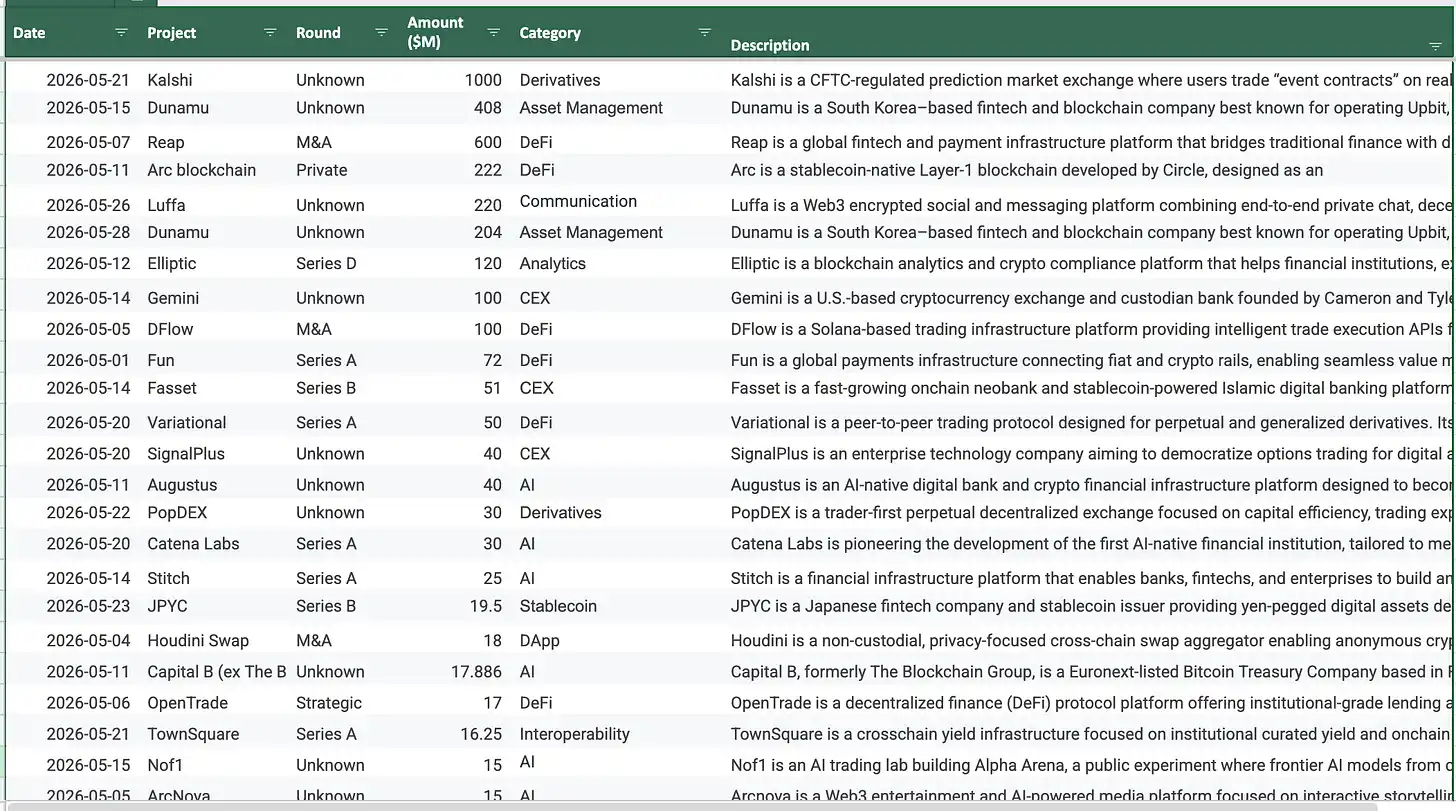
May Crypto VC Fund Raise Announcements

A quieter month for new fund announcements after a busy April, but two big moves...

Haun Ventures | Fund II $1B | May 2026

Katie Haun's firm raised $1B across an early-stage fund and a later-stage companion fund, pushing AUM above $2B. Top three priority themes: next-gen financial infrastructure, asset tokenization and new markets, and the "agent economy" where AI systems transact on behalf of humans. Capital will be deployed over the next 2-3 years.

a16z crypto | Crypto Fund V $2.2B | May 2026

The fund we flagged in March as targeting ~$2B closed officially at $2.2B. All stages, 10-year investment horizon, focused on real-world utility: stablecoins, payments, financial services, perps, lending, prediction markets, asset tokenization. a16z's framing is that crypto fundamentals are "at all-time highs."

Reminder, if you're interested in learning more about Bankless Ventures Fund II, please fill out this form and we'll be in touch!

ETHGlobal New York 2026 | June 12-14, 2026

NYC, in-person. Preceded by ETHConf NYC (June 8-10) and Pragma NYC.

Base Onchain Summer Hackathon | ~June 2026 (Date TBD)

Virtual. Base's flagship on-chain hackathon; last one attracted 7,500+ builders, sponsors included Stripe, Shopify, Farcaster, and Zora. (2026 dates not confirmed yet, please verify on Devfolio.)

ETHGlobal Lisbon 2026 | July 24-26, 2026

Lisbon, Portugal, in-person. Pragma Lisbon July 25.

Solana Frontier Hackathon | Apr 6 - May 11, 2026

Virtual. Crypto's largest startup competition, ~2,857 submissions over five weeks. Prizes: $30K grand champion, $10K each for 20 standout teams, plus $2.5M in venture funding and accelerator admission from Colosseum. Winners not announced by month-end; judging in progress, watch blog.colosseum.com early to mid-June.

ETHPrague 2026 | May 8-10, 2026

Prague, Czech Republic (City Hall). Fifth edition; conference plus hackathon, focused on Ethereum's "solarpunk" future.

Solana Mobile Hackathon | April 2026

Virtual. Concluded, 400+ app submissions from builders in 66 countries.

Solana Frontier Demo Day | June 2026 (Date TBD)

Virtual. Final demos for Frontier hackathon teams, expected after winners announcement.

ETHGlobal New York Showcase Day | June 14, 2026

NYC. Project judging and showcases on final day of hackathon.

ETHPrague 2026 Closing Showcase | May 10, 2026

Prague. Demos and judging on final day of ETHPrague hackathon.

Accelerator Applications Open

Solana Incubator (Cohort 5) | Apps Open / Early Deadline ~June 5

NYC. 3-month program starting Sept 2026; rolling review, preference for early applicants. Looking for 4-6 teams (existing Solana teams, web3 teams considering Solana, or web2 teams adding web3).

Alliance DAO (ALL18) | Apps Open / Rolling Review

Virtual + in-person retreats. ALL18 starts Sept 7, 2026; interview decisions ~2 weeks post-application. ~5% acceptance rate; median graduate raise $3.5M at $25M valuation.

a16z Crypto Startup Accelerator (CSX) | Apps Open (Please verify next cohort)

In-person, 9-week program, hosted twice annually in different cities. $500K for 7% equity; ~3% acceptance rate.

Outlier Ventures Base Camp | Rolling Applications

Virtual + in-person. 12-week accelerator, accepting early applications for 2026 DeAI, DeFi, RWA, and DePIN tracks.

Techstars Web3 | Apps Open

Virtual + in-person. Reportedly open for 2026 applications.

That's a wrap for May!

Thanks everyone, and good luck!

Ben Lakoff, CFA

https://twitter.com/benlakoff

Related Questions

QWhat does the author mean by 'Ethereum's Ballmer moment'?

AThe author uses the term 'Ethereum's Ballmer moment' to draw a parallel between Microsoft's period under CEO Steve Ballmer (2000-2014) and Ethereum's current state. During Ballmer's tenure, Microsoft stock was seen as stagnant and the company was criticized for missing key trends (like mobile and search), while its core enterprise business (like Office and Windows) continued to grow steadily underneath the surface negative narrative. Similarly, despite current bearish narratives about Ethereum (e.g., slow product pace, competition, lack of young developer interest), the author argues its core fundamentals—like institutional adoption, staking, and regulatory clarity—are strengthening beneath the noise, setting the stage for potential future growth.

QWhat are the main bearish arguments against Ethereum mentioned in the article?

AThe main bearish arguments cited in the article are: 1) Ethereum's roadmap prioritizes abundant, low-cost block space over high fee capture, which limits its value accrual as a fee-driven asset. 2) Cultural 'ossification' and a lack of 'killer instinct,' with younger developers and entrepreneurial energy flowing to chains like Solana, Monad, and Hyperliquid instead. 3) The Ethereum Foundation is seen as overly cautious and risk-averse, focused on protecting network integrity rather than aggressively competing. 4) Ethereum's lead in areas like tokenized assets and stablecoins is narrowing as alternatives gain adoption.

QAccording to the author, why is Ethereum's circulating supply shrinking despite the bearish narrative?

AThe author argues that Ethereum's circulating supply is shrinking due to several factors: 1) Approximately 30% of ETH is staked and locked. 2) Treasury corporations (like BitMine) hold over 6% and are accumulating more. 3) Spot ETFs are continuously absorbing supply. 4) The SEC/CFTC ruling in March classified staking rewards as non-securities, paving the way for staking ETFs, which would lock up even more ETH (as staked ETH via ETFs cannot be sold on price impulses). With a net annual issuance of only ~0.23%, the buying pressure from these sources is causing the circulating supply to contract faster than new ETH is issued.

QHow has the regulatory landscape for crypto changed in the last 12 months, according to the article?

AThe article states that over the past 12 months, crypto regulation has shifted from being an 'existential threat' to a 'statutory framework.' Key developments include: the GENIUS Act becoming law, creating a federal regime for payment stablecoins; the CLARITY Act passing the House and advancing in the Senate; stablecoin circulation surpassing $2.8 trillion and growing; tokenized Treasury products scaling; and spot ETFs being approved for more assets. This transition signifies crypto is becoming a regulated, trillion-dollar slice of the financial system, inviting institutional capital that was previously hesitant.

QWhat is the author's recommended investment strategy regarding major crypto assets?

AThe author recommends a 'barbell strategy' of not being a maximalist for any single asset. Specifically: 1) Hold ETH for the 'timeless/institutional/circulating supply crunch' trade. 2) Hold SOL for the 'consumer/throughput/distribution' trade. 3) Hold BTC as a macro hedge. 4) Hold a small basket of next-generation L1s and application-layer winners where the cultural and entrepreneurial energy is actually flowing. This diversified approach allows investors to capture growth across different thematic trends within the expanding crypto ecosystem.

Related Reads

Ten-Thousand-Word Analysis: From $10 to $290, MRVL Wins the Entire AI Era by 'Not Making GPUs'

Marvell Technology's stock price surged from under $10 in 2016 to a record $290 in June 2026, fueled not by making GPUs, but by dominating AI infrastructure connectivity. This analysis argues the market misvalues MRVL as merely a smaller Broadcom in custom AI chips, overlooking its true, unique position. Marvell's core strength lies in enabling high-speed data flow for AI clusters through three interconnected businesses. First, it holds a commanding ~70% market share in high-speed optical DSPs (essential for data center light modules), a deep-moat business with accelerating growth. Second, its custom AI chip design business serves hyperscalers like AWS, Microsoft, and Google, with a significant revenue pipeline despite lower margins. Third, stable cash flows come from Ethernet switch chips and enterprise storage controllers. Together, they form a full-stack "AI data movement" platform. CEO Matt Murphy's transformative leadership since 2016, involving strategic divestments, key acquisitions (like Inphi for optical DSPs), and securing long-term agreements with major cloud providers, repositioned the company. A pivotal $2 billion strategic investment from NVIDIA in 2026 underscored Marvell's critical role in the AI ecosystem, particularly through collaborations like NVLink Fusion. While Marvell faces risks—including client concentration (losing the Amazon Trainium3 design), lower-margin business mix, competitive threats, insider selling, and complex supply chains—its fundamentals remain strong. The optical interconnect moat is widening with the acquisition of Celestial AI (photonics fabric), and financial metrics show accelerating revenue growth and operating leverage. With a PEG ratio suggesting undervaluation relative to its growth, the thesis is that the market undervalues Marvell's monopolistic position in AI "plumbing" while overemphasizing its competitive custom chip segment. The story transcends investing, symbolizing how in any complex system—from the internet to AI—the value of "connection" ultimately surpasses that of individual "nodes."

marsbit26m ago

Ten-Thousand-Word Analysis: From $10 to $290, MRVL Wins the Entire AI Era by 'Not Making GPUs'

marsbit26m ago

AI Relay Stations Spark Heated Debate on Zhihu: Behind Cheap Tokens, What Are Users Really Worried About?

A discussion on Zhihu about "AI relay stations" shifted the niche developer topic of "cheap tokens" into broader user awareness. Users moved beyond simply questioning the legitimacy of these services to focus on practical concerns: Where do cheap tokens truly come from? Is the model being accessed the real one? Can relay stations see prompts, code, and API keys? For occasional users, are the risks worth it? The core debate centered less on price and more on trust. A primary worry is model authenticity—the risk of "model swapping," where users paying for a premium model might be routed to a cheaper one, creating an information asymmetry. Others argued that cost comparisons matter; while cheaper than official pay-as-you-go APIs, relay stations may not be the lowest-cost option versus subscriptions, domestic models, or free tiers, making user needs assessment crucial. Speculation about token sources ranged from legitimate bulk discounts to gray-area methods like account sharing or exploiting regional pricing. This opacity makes risk assessment difficult for users. Data security emerged as a critical concern, especially for enterprise use. When processing sensitive information like code, contracts, or client data, the inability to verify a relay station's data handling, retention, or access policies poses significant compliance and confidentiality risks. The evolving consensus suggests relay stations can be used cautiously for low-sensitivity, disposable tasks (e.g., summarizing public info, simple translation). However, they should not be the default for sensitive, professional, or production workflows involving proprietary data, Agents, or automated systems. Recommendations include avoiding large prepayments, not relying on a single service, using test prompts to monitor quality, anonymizing data where possible, and keeping official channels as backups. Ultimately, the discussion framed tokens not just as a billing unit but as a measure of real cost encompassing price, model integrity, data security, and service stability. The popularity of relay stations highlights user demand for affordable access, but the debate underscores a key trade-off: the savings from cheap tokens may come at the price of trust, transparency, and control over one's data and AI experience.

marsbit56m ago

AI Relay Stations Spark Heated Debate on Zhihu: Behind Cheap Tokens, What Are Users Really Worried About?

marsbit56m ago

In-Depth Research Report on TradFi: The Convergence Wave of Crypto and Traditional Finance

In 2026, the crypto industry is undergoing a profound infrastructure-level transformation—TradFi assets are migrating on-chain at an unprecedented pace. According to CoinGecko's Q1 2026 report, the total value locked (TVL) of tokenized real-world assets (RWA) has surpassed $31 billion, a nearly 4x increase from $7.8 billion at the beginning of 2025, with the sector’s aggregate market capitalization reaching $19.3 billion. Among these, the market cap of tokenized stocks surged from $2 million to $486 million, with Q1 spot trading volume reaching $15.1 billion—a single quarter already surpassing the entire second half of 2025. RWA perpetual contract Q1 trading volume reached a staggering $524.8 billion, far exceeding the $313 billion for all of 2025. Meanwhile, BlackRock's BUIDL fund has reached $2.3 billion in scale and has filed for two new tokenized funds, signaling that the world's largest asset manager's tokenization strategy is evolving from pilot to product suite expansion. HTX, as a core participant in the crypto exchange sector, officially launched TradFi perpetual futures products including NVDA, AAPL, MSFT, META, and SPY in 2026, enabling crypto users to gain 24/7 trading access to core U.S. equities. Boston Consulting Group predicts that global tokenized asset scale could reach $16 trillion by 2030, while McKinsey offers a conservative estimate of approximately $2 trillion. The on-chain migration of TradFi assets is no longer a "future narrative" but a structural transformation unfolding in real time, as crypto exchanges evolve from single crypto asset trading platforms toward "multi-asset-class trading infrastructure."

HTX Learn59m ago

In-Depth Research Report on TradFi: The Convergence Wave of Crypto and Traditional Finance

HTX Learn59m ago

Trading

Spot
Futures

Hot Articles

What is SONIC

Sonic: Pioneering the Future of Gaming in Web3 Introduction to Sonic In the ever-evolving landscape of Web3, the gaming industry stands out as one of the most dynamic and promising sectors. At the forefront of this revolution is Sonic, a project designed to amplify the gaming ecosystem on the Solana blockchain. Leveraging cutting-edge technology, Sonic aims to deliver an unparalleled gaming experience by efficiently processing millions of requests per second, ensuring that players enjoy seamless gameplay while maintaining low transaction costs. This article delves into the intricate details of Sonic, exploring its creators, funding sources, operational mechanics, and the timeline of significant events that have shaped its journey. What is Sonic? Sonic is an innovative layer-2 network that operates atop the Solana blockchain, specifically tailored to enhance the existing Solana gaming ecosystem. It accomplishes this through a customised, VM-agnostic game engine paired with a HyperGrid interpreter, facilitating sovereign game economies that roll up back to the Solana platform. The primary goals of Sonic include: Enhanced Gaming Experiences: Sonic is committed to offering lightning-fast on-chain gameplay, allowing players and developers to engage with games at previously unattainable speeds. Atomic Interoperability: This feature enables transactions to be executed within Sonic without the need to redeploy Solana programmes and accounts. This makes the process more efficient and directly benefits from Solana Layer1 services and liquidity. Seamless Deployment: Sonic allows developers to write for Ethereum Virtual Machine (EVM) based systems and execute them on Solana’s SVM infrastructure. This interoperability is crucial for attracting a broader range of dApps and decentralised applications to the platform. Support for Developers: By offering native composable gaming primitives and extensible data types - dining within the Entity-Component-System (ECS) framework - game creators can craft intricate business logic with ease. Overall, Sonic's unique approach not only caters to players but also provides an accessible and low-cost environment for developers to innovate and thrive. Creator of Sonic The information regarding the creator of Sonic is somewhat ambiguous. However, it is known that Sonic's SVM is owned by the company Mirror World. The absence of detailed information about the individuals behind Sonic reflects a common trend in several Web3 projects, where collective efforts and partnerships often overshadow individual contributions. Investors of Sonic Sonic has garnered considerable attention and support from various investors within the crypto and gaming sectors. Notably, the project raised an impressive $12 million during its Series A funding round. The round was led by BITKRAFT Ventures, with other notable investors including Galaxy, Okx Ventures, Interactive, Big Brain Holdings, and Mirana. This financial backing signifies the confidence that investment foundations have in Sonic’s potential to revolutionise the Web3 gaming landscape, further validating its innovative approaches and technologies. How Does Sonic Work? Sonic utilises the HyperGrid framework, a sophisticated parallel processing mechanism that enhances its scalability and customisability. Here are the core features that set Sonic apart: Lightning Speed at Low Costs: Sonic offers one of the fastest on-chain gaming experiences compared to other Layer-1 solutions, powered by the scalability of Solana’s virtual machine (SVM). Atomic Interoperability: Sonic enables transaction execution without redeployment of Solana programmes and accounts, effectively streamlining the interaction between users and the blockchain. EVM Compatibility: Developers can effortlessly migrate decentralised applications from EVM chains to the Solana environment using Sonic’s HyperGrid interpreter, increasing the accessibility and integration of various dApps. Ecosystem Support for Developers: By exposing native composable gaming primitives, Sonic facilitates a sandbox-like environment where developers can experiment and implement business logic, greatly enhancing the overall development experience. Monetisation Infrastructure: Sonic natively supports growth and monetisation efforts, providing frameworks for traffic generation, payments, and settlements, thereby ensuring that gaming projects are not only viable but also sustainable financially. Timeline of Sonic The evolution of Sonic has been marked by several key milestones. Below is a brief timeline highlighting critical events in the project's history: 2022: The Sonic cryptocurrency was officially launched, marking the beginning of its journey in the Web3 gaming arena. 2024: June: Sonic SVM successfully raised $12 million in a Series A funding round. This investment allowed Sonic to further develop its platform and expand its offerings. August: The launch of the Sonic Odyssey testnet provided users with the first opportunity to engage with the platform, offering interactive activities such as collecting rings—a nod to gaming nostalgia. October: SonicX, an innovative crypto game integrated with Solana, made its debut on TikTok, capturing the attention of over 120,000 users within a short span. This integration illustrated Sonic’s commitment to reaching a broader, global audience and showcased the potential of blockchain gaming. Key Points Sonic SVM is a revolutionary layer-2 network on Solana explicitly designed to enhance the GameFi landscape, demonstrating great potential for future development. HyperGrid Framework empowers Sonic by introducing horizontal scaling capabilities, ensuring that the network can handle the demands of Web3 gaming. Integration with Social Platforms: The successful launch of SonicX on TikTok displays Sonic’s strategy to leverage social media platforms to engage users, exponentially increasing the exposure and reach of its projects. Investment Confidence: The substantial funding from BITKRAFT Ventures, among others, emphasizes the robust backing Sonic has, paving the way for its ambitious future. In conclusion, Sonic encapsulates the essence of Web3 gaming innovation, striking a balance between cutting-edge technology, developer-centric tools, and community engagement. As the project continues to evolve, it is poised to redefine the gaming landscape, making it a notable entity for gamers and developers alike. As Sonic moves forward, it will undoubtedly attract greater interest and participation, solidifying its place within the broader narrative of blockchain gaming.

1.6k Total ViewsPublished 2024.04.04Updated 2024.12.03

What is SONIC

What is $S$

Understanding SPERO: A Comprehensive Overview Introduction to SPERO As the landscape of innovation continues to evolve, the emergence of web3 technologies and cryptocurrency projects plays a pivotal role in shaping the digital future. One project that has garnered attention in this dynamic field is SPERO, denoted as SPERO,$$s$. This article aims to gather and present detailed information about SPERO, to help enthusiasts and investors understand its foundations, objectives, and innovations within the web3 and crypto domains. What is SPERO,$$s$? SPERO,$$s$ is a unique project within the crypto space that seeks to leverage the principles of decentralisation and blockchain technology to create an ecosystem that promotes engagement, utility, and financial inclusion. The project is tailored to facilitate peer-to-peer interactions in new ways, providing users with innovative financial solutions and services. At its core, SPERO,$$s$ aims to empower individuals by providing tools and platforms that enhance user experience in the cryptocurrency space. This includes enabling more flexible transaction methods, fostering community-driven initiatives, and creating pathways for financial opportunities through decentralised applications (dApps). The underlying vision of SPERO,$$s$ revolves around inclusiveness, aiming to bridge gaps within traditional finance while harnessing the benefits of blockchain technology. Who is the Creator of SPERO,$$s$? The identity of the creator of SPERO,$$s$ remains somewhat obscure, as there are limited publicly available resources providing detailed background information on its founder(s). This lack of transparency can stem from the project's commitment to decentralisation—an ethos that many web3 projects share, prioritising collective contributions over individual recognition. By centring discussions around the community and its collective goals, SPERO,$$s$ embodies the essence of empowerment without singling out specific individuals. As such, understanding the ethos and mission of SPERO remains more important than identifying a singular creator. Who are the Investors of SPERO,$$s$? SPERO,$$s$ is supported by a diverse array of investors ranging from venture capitalists to angel investors dedicated to fostering innovation in the crypto sector. The focus of these investors generally aligns with SPERO's mission—prioritising projects that promise societal technological advancement, financial inclusivity, and decentralised governance. These investor foundations are typically interested in projects that not only offer innovative products but also contribute positively to the blockchain community and its ecosystems. The backing from these investors reinforces SPERO,$$s$ as a noteworthy contender in the rapidly evolving domain of crypto projects. How Does SPERO,$$s$ Work? SPERO,$$s$ employs a multi-faceted framework that distinguishes it from conventional cryptocurrency projects. Here are some of the key features that underline its uniqueness and innovation: Decentralised Governance: SPERO,$$s$ integrates decentralised governance models, empowering users to participate actively in decision-making processes regarding the project’s future. This approach fosters a sense of ownership and accountability among community members. Token Utility: SPERO,$$s$ utilises its own cryptocurrency token, designed to serve various functions within the ecosystem. These tokens enable transactions, rewards, and the facilitation of services offered on the platform, enhancing overall engagement and utility. Layered Architecture: The technical architecture of SPERO,$$s$ supports modularity and scalability, allowing for seamless integration of additional features and applications as the project evolves. This adaptability is paramount for sustaining relevance in the ever-changing crypto landscape. Community Engagement: The project emphasises community-driven initiatives, employing mechanisms that incentivise collaboration and feedback. By nurturing a strong community, SPERO,$$s$ can better address user needs and adapt to market trends. Focus on Inclusion: By offering low transaction fees and user-friendly interfaces, SPERO,$$s$ aims to attract a diverse user base, including individuals who may not previously have engaged in the crypto space. This commitment to inclusion aligns with its overarching mission of empowerment through accessibility. Timeline of SPERO,$$s$ Understanding a project's history provides crucial insights into its development trajectory and milestones. Below is a suggested timeline mapping significant events in the evolution of SPERO,$$s$: Conceptualisation and Ideation Phase: The initial ideas forming the basis of SPERO,$$s$ were conceived, aligning closely with the principles of decentralisation and community focus within the blockchain industry. Launch of Project Whitepaper: Following the conceptual phase, a comprehensive whitepaper detailing the vision, goals, and technological infrastructure of SPERO,$$s$ was released to garner community interest and feedback. Community Building and Early Engagements: Active outreach efforts were made to build a community of early adopters and potential investors, facilitating discussions around the project’s goals and garnering support. Token Generation Event: SPERO,$$s$ conducted a token generation event (TGE) to distribute its native tokens to early supporters and establish initial liquidity within the ecosystem. Launch of Initial dApp: The first decentralised application (dApp) associated with SPERO,$$s$ went live, allowing users to engage with the platform's core functionalities. Ongoing Development and Partnerships: Continuous updates and enhancements to the project's offerings, including strategic partnerships with other players in the blockchain space, have shaped SPERO,$$s$ into a competitive and evolving player in the crypto market. Conclusion SPERO,$$s$ stands as a testament to the potential of web3 and cryptocurrency to revolutionise financial systems and empower individuals. With a commitment to decentralised governance, community engagement, and innovatively designed functionalities, it paves the way toward a more inclusive financial landscape. As with any investment in the rapidly evolving crypto space, potential investors and users are encouraged to research thoroughly and engage thoughtfully with the ongoing developments within SPERO,$$s$. The project showcases the innovative spirit of the crypto industry, inviting further exploration into its myriad possibilities. While the journey of SPERO,$$s$ is still unfolding, its foundational principles may indeed influence the future of how we interact with technology, finance, and each other in interconnected digital ecosystems.

54 Total ViewsPublished 2024.12.17Updated 2024.12.17

What is $S$

What is AGENT S

Agent S: The Future of Autonomous Interaction in Web3 Introduction In the ever-evolving landscape of Web3 and cryptocurrency, innovations are constantly redefining how individuals interact with digital platforms. One such pioneering project, Agent S, promises to revolutionise human-computer interaction through its open agentic framework. By paving the way for autonomous interactions, Agent S aims to simplify complex tasks, offering transformative applications in artificial intelligence (AI). This detailed exploration will delve into the project's intricacies, its unique features, and the implications for the cryptocurrency domain. What is Agent S? Agent S stands as a groundbreaking open agentic framework, specifically designed to tackle three fundamental challenges in the automation of computer tasks: Acquiring Domain-Specific Knowledge: The framework intelligently learns from various external knowledge sources and internal experiences. This dual approach empowers it to build a rich repository of domain-specific knowledge, enhancing its performance in task execution. Planning Over Long Task Horizons: Agent S employs experience-augmented hierarchical planning, a strategic approach that facilitates efficient breakdown and execution of intricate tasks. This feature significantly enhances its ability to manage multiple subtasks efficiently and effectively. Handling Dynamic, Non-Uniform Interfaces: The project introduces the Agent-Computer Interface (ACI), an innovative solution that enhances the interaction between agents and users. Utilizing Multimodal Large Language Models (MLLMs), Agent S can navigate and manipulate diverse graphical user interfaces seamlessly. Through these pioneering features, Agent S provides a robust framework that addresses the complexities involved in automating human interaction with machines, setting the stage for myriad applications in AI and beyond. Who is the Creator of Agent S? While the concept of Agent S is fundamentally innovative, specific information about its creator remains elusive. The creator is currently unknown, which highlights either the nascent stage of the project or the strategic choice to keep founding members under wraps. Regardless of anonymity, the focus remains on the framework's capabilities and potential. Who are the Investors of Agent S? As Agent S is relatively new in the cryptographic ecosystem, detailed information regarding its investors and financial backers is not explicitly documented. The lack of publicly available insights into the investment foundations or organisations supporting the project raises questions about its funding structure and development roadmap. Understanding the backing is crucial for gauging the project's sustainability and potential market impact. How Does Agent S Work? At the core of Agent S lies cutting-edge technology that enables it to function effectively in diverse settings. Its operational model is built around several key features: Human-like Computer Interaction: The framework offers advanced AI planning, striving to make interactions with computers more intuitive. By mimicking human behaviour in tasks execution, it promises to elevate user experiences. Narrative Memory: Employed to leverage high-level experiences, Agent S utilises narrative memory to keep track of task histories, thereby enhancing its decision-making processes. Episodic Memory: This feature provides users with step-by-step guidance, allowing the framework to offer contextual support as tasks unfold. Support for OpenACI: With the ability to run locally, Agent S allows users to maintain control over their interactions and workflows, aligning with the decentralised ethos of Web3. Easy Integration with External APIs: Its versatility and compatibility with various AI platforms ensure that Agent S can fit seamlessly into existing technological ecosystems, making it an appealing choice for developers and organisations. These functionalities collectively contribute to Agent S's unique position within the crypto space, as it automates complex, multi-step tasks with minimal human intervention. As the project evolves, its potential applications in Web3 could redefine how digital interactions unfold. Timeline of Agent S The development and milestones of Agent S can be encapsulated in a timeline that highlights its significant events: September 27, 2024: The concept of Agent S was launched in a comprehensive research paper titled “An Open Agentic Framework that Uses Computers Like a Human,” showcasing the groundwork for the project. October 10, 2024: The research paper was made publicly available on arXiv, offering an in-depth exploration of the framework and its performance evaluation based on the OSWorld benchmark. October 12, 2024: A video presentation was released, providing a visual insight into the capabilities and features of Agent S, further engaging potential users and investors. These markers in the timeline not only illustrate the progress of Agent S but also indicate its commitment to transparency and community engagement. Key Points About Agent S As the Agent S framework continues to evolve, several key attributes stand out, underscoring its innovative nature and potential: Innovative Framework: Designed to provide an intuitive use of computers akin to human interaction, Agent S brings a novel approach to task automation. Autonomous Interaction: The ability to interact autonomously with computers through GUI signifies a leap towards more intelligent and efficient computing solutions. Complex Task Automation: With its robust methodology, it can automate complex, multi-step tasks, making processes faster and less error-prone. Continuous Improvement: The learning mechanisms enable Agent S to improve from past experiences, continually enhancing its performance and efficacy. Versatility: Its adaptability across different operating environments like OSWorld and WindowsAgentArena ensures that it can serve a broad range of applications. As Agent S positions itself in the Web3 and crypto landscape, its potential to enhance interaction capabilities and automate processes signifies a significant advancement in AI technologies. Through its innovative framework, Agent S exemplifies the future of digital interactions, promising a more seamless and efficient experience for users across various industries. Conclusion Agent S represents a bold leap forward in the marriage of AI and Web3, with the capacity to redefine how we interact with technology. While still in its early stages, the possibilities for its application are vast and compelling. Through its comprehensive framework addressing critical challenges, Agent S aims to bring autonomous interactions to the forefront of the digital experience. As we move deeper into the realms of cryptocurrency and decentralisation, projects like Agent S will undoubtedly play a crucial role in shaping the future of technology and human-computer collaboration.

700 Total ViewsPublished 2025.01.14Updated 2025.01.14

What is AGENT S

Discussions

Welcome to the HTX Community. Here, you can stay informed about the latest platform developments and gain access to professional market insights. Users' opinions on the price of S (S) are presented below.

活动图片