Bitcoin Short-Term Bullish Structure Validated, HYPE Accumulation Window Opens | Guest Analysis

marsbitPublished on 2026-06-15Last updated on 2026-06-15

Abstract

**Bitcoin and HYPE Market Analysis: Short-Term Outlook and Trading Strategies** This market analysis examines Bitcoin (BTC) and HYPE amid volatile conditions, providing short-term outlooks and specific trading strategies. **Key Outlooks:** * **Bitcoin (BTC):** Focus is on whether BTC's recent move above $65,000 holds. A successful breakout could lead to a test of the $69,500-$70,500 resistance zone, where medium-term short positions are considered. A failure, breaking below $65,000, may trigger a decline towards the $59,000-$60,000 support area. * **HYPE:** The token completed a four-wave correction and is now rebounding. The key resistance zone is $62.5-$64.57. The trading strategy is "buy on dips," looking for entry opportunities near the $52-$54.5 or deeper $47-$49 support zones, pending confirmation from proprietary models. **BTC Trading Strategy:** * **Medium-term:** Primarily looking to establish short positions (up to 60% allocated capital) if price rallies to the $69,500-$70,500 resistance area and shows signs of reversal. Alternative plans involve initiating shorts on a breakdown below $65,000. * **Short-term:** Allocate up to 30% capital for intraday "spread" trades based on support/resistance levels on 30/60-minute charts. **HYPE Trading Strategy:** * **Short-term:** Adopt a dip-buying approach. Consider light long positions (under 30% capital) when price tests key support levels ($52-$54.5 or $47-$49) and shows stabilization, confirmed by proprietary...

This week's market environment is exceptionally complex—the unexpected finalization of the US-Iran agreement and the unblocking of the Strait of Hormuz have triggered intense global asset repricing. Such times of extreme emotional volatility are precisely when structural analysis is most valuable. The greater the noise, the more important the framework.

This week, we focus on two main themes: the outcome of BTC's pullback and confirmation after breaking above $65,000, which will determine its subsequent direction; and whether HYPE, after completing a four-stage correction, will offer new short-term opportunities as it faces the resistance zone of $62.5~$64.57.

Detailed analysis of the complete price structure, market predictions, and trading strategies can be found in the main text.

Summary of This Week's Core Trading Views:

• BTC Hourly Timeframe Structure Analysis. (Detailed in Part One)

• BTC Market Outlook and Medium/Short-Term Trading Strategies for This Week. (Detailed in Part Two)

• HYPE Hourly Timeframe Structure Analysis. (Detailed in Part Three)

• HYPE Market Outlook and Short-Term Trading Strategies for This Week. (Detailed in Part Four)

Last Week's Trading Strategy & Core Views Market Verification:

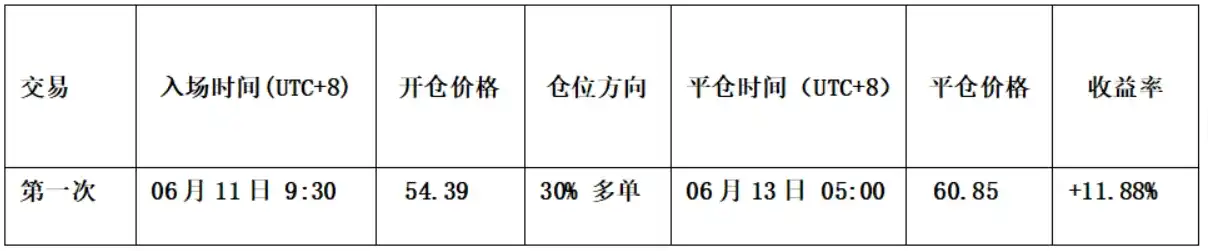
• HYPE Short-Term Trade Performance: Successfully executed one short-term long position (1x leverage) last week, achieving a profit of approximately 11.88%. (Detailed in Table One)

• BTC Market Prediction Verification: Last week's article noted that after an instantaneous dip below the $60,000 threshold, the price would find support and stage a short-term rebound to confirm the validity of the break below the key level. Current market movements have validated our previous prediction.

• HYPE Market Prediction Verification: Last week's article noted that when HYPE price retested the key support zone of $55-57, showing signs of stopping its decline and stabilizing, and combined with bottom signals triggered by two major models, a light long position could be considered. Current market movements are highly consistent with our predicted view.

One: In-Depth Analysis of Bitcoin's Hourly Timeframe Structure

Bitcoin _ 4-Hour Candlestick Chart
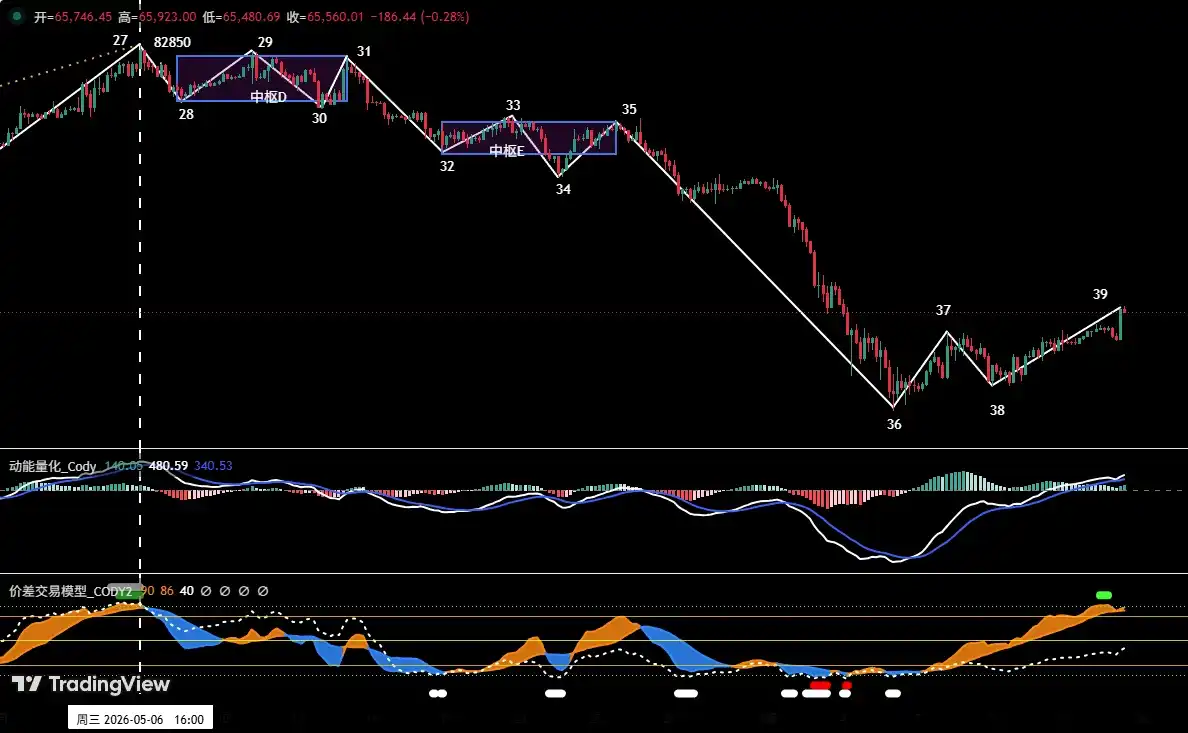
Figure One

1. As shown in (Figure One), since the high of $82,850 on May 6th, the correction in the 4-hour chart can be subdivided into a 12-stage adjustment structure. This includes two descending pivots: Pivot D and Pivot E. The overall structure is clear, presenting a typical complex correction pattern.

2. From the 4-hour structural perspective, the market is currently in the 38-39 segment rebound. The price has now broken above $65,000. If the subsequent breakout is confirmed as valid, the next key resistance for the rebound will be in the $69,500~$70,500 zone.

Two: Bitcoin's Market Outlook and Trading Strategies for This Week

1. BTC Market Outlook for This Week:

Core View This Week: Focus on the result of the price's pullback confirmation after breaking above $65,000.

• If the pullback fails to hold this level, the market may retest the core support range of $60,000~$62,000.

• If it effectively stabilizes above, it will challenge the core resistance zone of $69,500~$70,500. This area will be a key region for us to plan medium-term short positions.

2. Core Resistance Levels:

• First Resistance Zone: $69,500~$70,500 area (previous high-volume consolidation zone)

• Second Resistance Zone: $72,500~$74,500 area (previous high-volume consolidation zone)

3. Core Support Levels:

• First Support Level: Around $65,000

• Second Support Level: $59,000~$60,000 area (previous key support level)

• Third Support Level: Around $55,000 (previous key support level)

4. Trading Strategy for This Week (Excluding Impact of Sudden News)

1. Medium-Term Strategy:

Bitcoin _ Daily Candlestick Chart: (Position Monitoring Model)
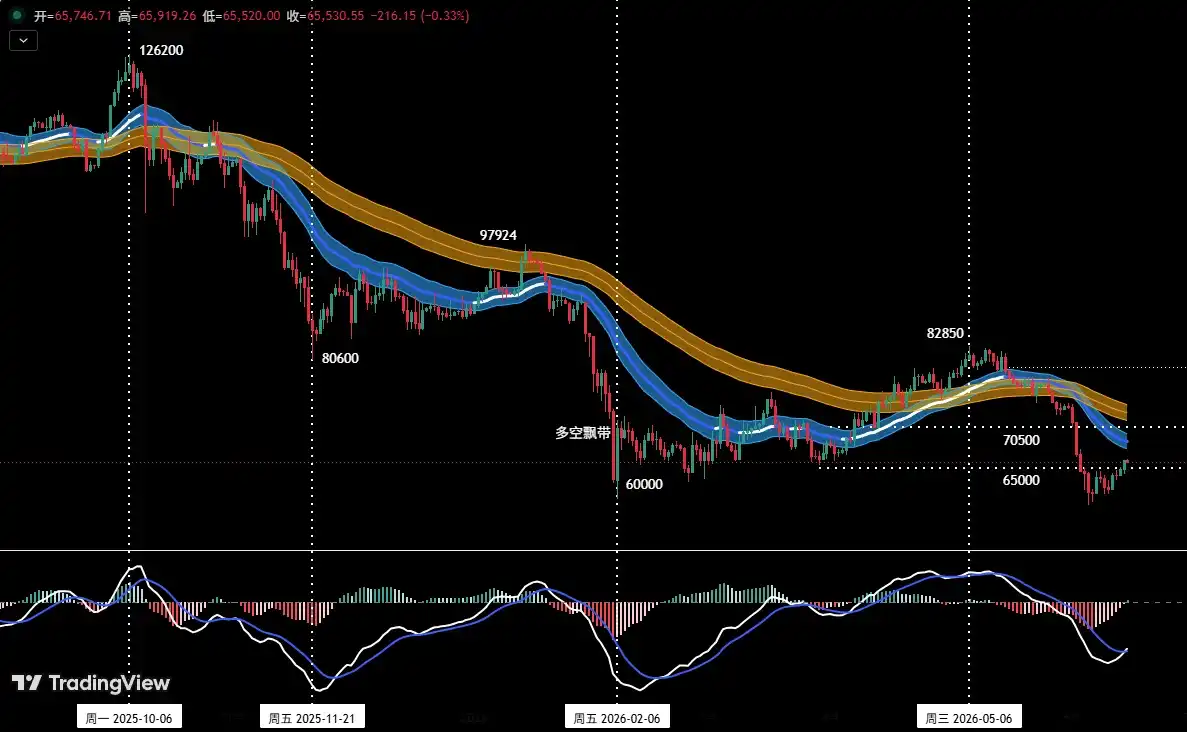
Figure Two

Position Monitoring Model: As shown in (Figure Two), the price has effectively broken below the "Bull-Bear Channel," indicating the technical structure has shifted to a bear-dominated pattern. The market did not meet our planned (short) entry conditions last week, so the medium-term position remains empty for now.

This week, based on the outcome of the battle between bulls and bears around $65,000, medium-term short positions can be built gradually according to the following three-level strategy:

Add at Strong Resistance: If the price successfully stabilizes in the $65,000 area and subsequently rallies to the $69,500~$70,500 zone, showing clear signs of resistance, consider initiating a medium-term (short) position, with total exposure controlled below 60%.

• Short on Support Break: If the price loses the $65,000 support and shows signs of a valid breakdown, preliminarily establish a 30% medium-term short position.

Short on Further Breakdown: If the price loses the $65,000 support and effectively breaks below the $59,000~$60,000 support zone, add to the short position accordingly, with total exposure controlled below 60%.

2. Short-Term Strategy: Utilize 30% of capital, set stop-losses, and seek "spread" trading opportunities based on support and resistance levels. (Using 30-minute/60-minute as the operational timeframe).

3. For dynamic response to complex market changes in short-term operations, we have prepared two specific operational plans in advance: Plan A/B.

Plan A: Enter at Strong Resistance.

• Entry: If the price successfully stabilizes in the $65,000 area and subsequently rallies near $69,500~$70,500 showing signs of stalling, combined with quantitative model top signals, consider entering a short position with exposure below 30%.

• Risk Control: Set an initial stop-loss.

• Exit: Gradually close the position for profit when the price adjusts near key support levels, combined with model signals.

Plan B: Short on Valid Support Break.

• Entry: If the price loses the $65,000 support and shows signs of a valid breakdown, consider entering a short position with exposure below 30%.

• Risk Control: Set an initial stop-loss.

• Exit: Gradually close the position for profit when the price declines to key support levels, combined with model signals.

Three: HYPE Hourly Timeframe Structure Analysis

HYPE_ 4-Hour Candlestick Chart
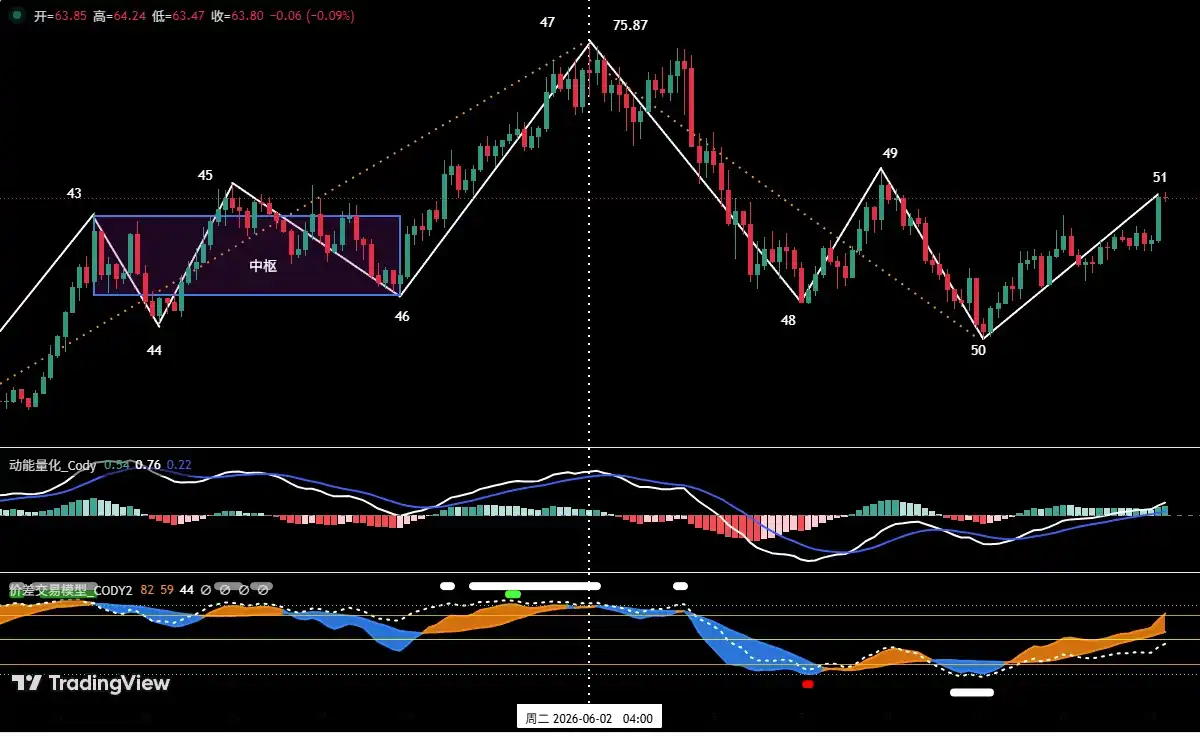
Figure Three

1. As shown in (Figure Three), in the 4-hour timeframe, HYPE's correction since the high of $75.87 on June 2nd can be subdivided into a four-stage adjustment structure: (47-48), (48-49), (49-50), (50-51).

2. Currently, HYPE price has stabilized and rebounded from the support area around $52 and is in the rebound process of segment (50-51). Its overhead resistance lies in the $62.5 to $64.57 zone. If (Endpoint 51) forms a high in this area (it is highly probable the overall structure will form a "descending pivot" here), the price will likely continue downward to seek stronger support.

Four: HYPE Market Outlook and Short-Term Trading Strategies for This Week

1. HYPE Market Outlook for This Week:

1. Core Resistance Levels:

• First Resistance Level: $62.5-64.57 area;

• Second Resistance Level: $68-70 area;

2. Core Support Levels:

• First Support Level: $52-55.5 area;

• Second Support Level: $47-49 area;

Core View on HYPE This Week:

• Observe the resistance effect in the $62.5-64.57 area and the price level at which "Endpoint 51" forms a high.

2. HYPE Short-Term Trading Strategy for This Week: (Long on Support)

This week's HYPE short-term trading should adhere to the strategy of "accumulate on dips, avoid chasing rallies."

Short-Term Strategy: Test Long on Support Zone Stabilization

When HYPE price retests the key support areas of $52-54.5 or the deeper $47-49, showing signs of stopping its decline and stabilizing, and combined with bottom signals triggered by the two major models, consider testing a light long position. Exposure must be controlled below 30%, with strict stop-loss discipline.

Five: HYPE Trade Review

1. Short-Term Trade Review: (See Table One)

We strictly followed the operational plan. Based on trading signals from our proprietary "Spread Trading Model" and "Momentum Quant Model," we executed one short-term (long) trade last week, achieving a profit of 11.88%.

2. HYPE Short-Term Trade Details Summary: (Leverage*1x)
3. Short-Term Trade Review: (See Figure Four)

1. Entry Strategy:

• A relatively complete downtrend correction structure had already occurred;

• Our proprietary "Spread Trading Model" had issued strong bottom warning signals in advance (red and white dots in the chart);

• Our proprietary "Momentum Quant Model" had issued a momentum bottom divergence signal;

Based on the above three points, we entered a 30% long position around $54.39.

2. Exit Strategy:

• The price encountered resistance when approaching $62.5;

• Our proprietary "Spread Trading Model" had issued top warning signals in advance (white dots in the chart);

• Our proprietary "Momentum Quant Model" had issued a momentum top divergence signal;

Therefore, we closed the entire position around $60.85.

3. Summary: This trade successfully yielded a profit of approximately 11.88%.

HYPE_ 30-Minute Candlestick Chart: (Momentum Quant Model + Spread Trading Model)
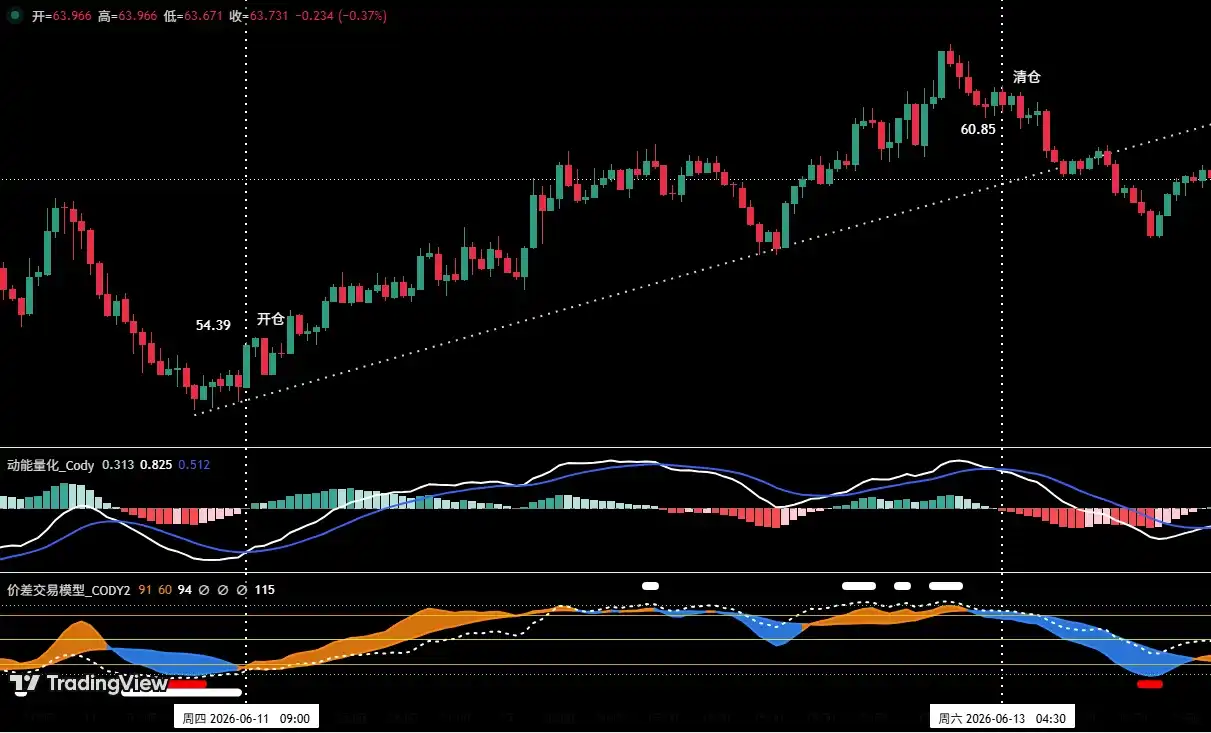
Figure Four (Short-Term Trade Illustration)

Six: Special Notes:

1. When entering a position: Immediately set an initial stop-loss.

2. When profit reaches 1%: Move the stop-loss to the entry price (breakeven point) to ensure capital safety.

3. When profit reaches 2%: Move the stop-loss to the 1% profit level.

4. Continuous Tracking: Thereafter, for every additional 1% profit, move the stop-loss up by 1% accordingly, dynamically protecting and locking in profits.

Financial markets change rapidly; all market analysis and trading strategies require dynamic adjustment. All views, analytical models, and operational strategies mentioned herein are derived from personal technical analysis, intended solely for personal trading log purposes, and do not constitute any investment advice or operational basis. The market carries risks; investment requires caution. Do not make decisions based solely on this content.


Related Questions

QAccording to the article, what is the crucial level for Bitcoin this week that will determine its subsequent direction?

AAccording to the article, the crucial level for Bitcoin this week is $65,000. The core view is to focus on the result of the price's retest and confirmation after breaking above $65,000. If it holds above this level effectively, it may challenge the $69,500-$70,500 resistance zone. If it fails and falls back below, the market may test the $60,000-$62,000 core support zone again.

QWhat is the recommended trading strategy for HYPE in the short term, as outlined in the article?

AThe recommended short-term trading strategy for HYPE is to 'buy on dips and avoid chasing rallies.' Specifically, when the HYPE price retests key support areas like $52-$54.5 or the deeper $47-$49 zone, if it shows signs of stopping the decline and stabilizing, and this is combined with bottom signals from the two proprietary models mentioned, one can consider lightly testing a long position. The position size must be controlled below 30% with strict stop-loss discipline.

QWhat two proprietary models did the analyst use for the HYPE trade execution and复盘 described in the article?

AThe analyst used two proprietary models for the HYPE trade execution and review: the 'Spread Trading Model' and the 'Dynamic Quantitative Model'.

QBased on the Bitcoin analysis, what are the two main pressure zones identified above the $65,000 level?

ABased on the Bitcoin analysis, the two main pressure zones identified above the $65,000 level are: First Pressure Zone: $69,500-$70,500 (a previous筹码密集成交区 / high-volume transaction area). Second Pressure Zone: $72,500-$74,500 (another previous筹码密集成交区 / high-volume transaction area).

QWhat is the core principle the article emphasizes for managing risk in a trade, specifically regarding stop-loss placement?

AThe article emphasizes a dynamic trailing stop-loss principle for risk management. Key steps include: 1) Set an initial stop-loss immediately upon opening a position. 2) When profit reaches 1%, move the stop-loss to the entry price (breakeven point). 3) When profit reaches 2%, move the stop-loss to lock in a 1% profit. 4) Continuously track the price, and for every additional 1% profit gained, move the stop-loss up by 1% to dynamically protect and lock in profits.

Related Reads

Blockchain Has Finally Started to Sail into the Mainstream After 18 Years

Blockchain Finds Its True Path After 18 Years: Becoming the Financial Backbone for AI Agents and Autonomy This analysis explores a pivotal shift in the blockchain and crypto investment landscape, driven by the dominance of AI. Major venture capital firms, including Variant, Paradigm, Haun Ventures, and YZi Labs, are moving beyond pure "crypto" investment theses. They are expanding their focus to AI, robotics, and frontier tech, signaling that blockchain is no longer seen as a standalone sector but as an underlying infrastructure layer. The core argument is that blockchain's killer application may not be user-facing apps, but rather providing the economic rails for the coming wave of AI agents, autonomous robots, and automated systems. Key capabilities like self-custody wallets, programmable stablecoins for micropayments, on-chain identity, and verifiable smart contracts are positioned as essential for a future where machines conduct economic activity. The recent $1.4 billion investment by Tether (via its venture arm) in German robotics company NEURA Robotics exemplifies this, aiming to embed Tether's wallet tools directly into robots for autonomous transactions. While many "AI + Crypto" projects remain superficial, the article concludes that true value lies where crypto is a necessary component—enabling machine-to-machine payments, agent autonomy, verifiable data provenance, and open financial settlement for the AI era. For crypto venture capital, this convergence with AI represents both an adaptation to shifting capital flows and a potential path to unlocking the large-scale, non-speculative utility the industry has long sought.

marsbit4m ago

Blockchain Has Finally Started to Sail into the Mainstream After 18 Years

marsbit4m ago

Blockchain has finally begun sailing toward the main channel after 18 years

After 18 years of development, blockchain technology is beginning to move from a specialized niche into mainstream adoption, according to a recent industry analysis. The shift is reflected in the changing strategies of major crypto venture capital firms, which are expanding their focus beyond pure "digital ownership" towards broader themes like "autonomy." The report highlights that leading VC firms like Variant, Paradigm, Haun Ventures, and YZi Labs are broadening their investment mandates to include not only crypto but also artificial intelligence (AI), robotics, biotech, and other frontier technologies. This reflects a recognition that the isolated "crypto investment" narrative is losing appeal to limited partners (LPs) as capital and attention increasingly flow toward AI and other high-growth tech sectors. A key emerging thesis is that blockchain's most significant future application may not be as a consumer-facing product, but as the underlying economic and settlement infrastructure for the AI era. As AI agents and autonomous systems become more prevalent, they will require programmable, global, and low-cost payment networks (like stablecoins), verifiable digital identities, and secure wallets to manage transactions and assets on behalf of users. The investment by stablecoin issuer Tether into robotics company NEURA, with plans to integrate its wallet technology, is cited as a prime example of this convergence. However, the article cautions that simply labeling projects as "AI + Crypto" is insufficient. True value lies in integrations where blockchain technology is essential—such as enabling machine-to-machine micropayments, verifiable data provenance for AI, or transparent governance for autonomous organizations—rather than being a superficial marketing add-on. In conclusion, while AI currently dominates the tech narrative and capital flows, it may ultimately create the real-world, high-frequency demand that the crypto industry has long sought. For crypto VCs and projects, the path forward is to position blockchain not as a competing sector, but as a critical foundational layer powering autonomy and economic activity in an AI-driven future.

链捕手10m ago

Blockchain has finally begun sailing toward the main channel after 18 years

链捕手10m ago

Y Combinator Co-founder: How to Make a Billion Dollars?

The Y Combinator co-founder argues that becoming a billionaire by founding a successful startup is not only possible but demonstrably achievable without unfair or unethical practices. He disputes a politician's claim to the contrary, using the example of a founder whose company grew at 93% monthly solely through creating a product users loved and recommended. The core mechanism is exponential growth. A conservative 15% monthly growth rate compounds to a 4384x increase over five years, which can easily lead to billion-dollar valuations and founder wealth. The process depends on two key variables: the growth rate and the duration it can be sustained. A high growth rate stems from a great product that users naturally promote, while a long duration requires a large enough market. For aspiring founders, especially young ones, the simplest path is to build something they and their friends genuinely need. Young people's current needs often predict future mass-market trends. He advises against actively "searching" for ideas, as this tends to filter out unconventional but promising ones. Instead, inspiration should come from working on interesting projects with friends, as many iconic companies (e.g., Apple, Facebook) started this way. Ultimately, building a massively valuable startup is not about exploitation but empathy: deeply understanding a user group and building a product that significantly improves their lives. This, powered by exponential growth in a large market, is the legitimate path to immense wealth creation.

Foresight News13m ago

Y Combinator Co-founder: How to Make a Billion Dollars?

Foresight News13m ago

The 800V Voltage Standard Championed by Nvidia: Which Infrastructure Providers Stand to Benefit?

NVIDIA is actively promoting the 800VDC architecture as a key direction for its next-generation AI factories and high-power racks, particularly for the upcoming Rubin and Kyber platforms. The primary driver is the rapidly increasing power density of AI racks, with designs like GB200/GB300 NVL72 reaching 120-140kW and future systems potentially hitting 180-220kW. At such high power levels, traditional low-voltage power delivery becomes inefficient due to massive current, leading to significant copper use, cable bulk, heat, and power loss. The 800VDC standard aims to increase efficiency by transmitting power at higher voltage and lower current to the rack before stepping it down locally for GPUs. NVIDIA claims this can improve efficiency by up to 5%, reduce total cost of ownership (TCO) by up to 30%, and cut copper usage by approximately 45%. This shift redefines infrastructure roles, pushing power engineering to the forefront alongside GPU performance. Key beneficiaries and ecosystem partners highlighted include: 1. **Power Infrastructure Providers:** Companies like Vertiv, Schneider Electric, Delta Electronics (台达电), and Korean firms LS Electric and HD Hyundai Electric are involved in designing next-gen AI factory power distribution, rack power supplies, and backup systems. 2. **Power Semiconductors:** Suppliers of SiC/GaN devices, such as Infineon and STMicroelectronics, are better suited for high-voltage, high-efficiency conversion in this new architecture. 3. **Connectivity & Structure:** The focus shifts to high-reliability components like busbars, high-voltage connectors, and advanced PCBs that meet stricter insulation and safety requirements. 4. **Liquid Cooling & Rack ODM:** As power and heat density rise, liquid cooling becomes critical. Full-rack system integrators (e.g., Dell, Wiwynn, Wistron) must now demonstrate robust pre-delivery testing capabilities, including burn-in testing under full load, requiring significant power and cooling infrastructure in their factories. The transition is not immediate for all data centers but is targeted at high-density AI factories. NVIDIA’s 800VDC ecosystem is in a preparatory phase, with full-scale production expected to align with the 2027 launch of Kyber rack-scale systems. The investment thesis revolves around which companies can demonstrate proven product integration, customer validation, and reliable delivery of complete, high-power AI rack systems, making power, cooling, and testing capabilities new critical variables in the AI infrastructure value chain alongside GPUs.

marsbit33m ago

The 800V Voltage Standard Championed by Nvidia: Which Infrastructure Providers Stand to Benefit?

marsbit33m ago

Did 'Unlimited Minting' Actually Happen? Zcash Founder Responds to Four Major Market Concerns

The Orchard shielding pool in the privacy cryptocurrency Zcash was recently found to have contained a critical counterfeiting vulnerability that existed for four years. This discovery caused significant market panic and a sharp drop in the price of ZEC, though it has since recovered partially. Zcash founder Zooko Wilcox addressed four key questions raised by the vulnerability. First, while it's unknown if the bug was exploited, he believes it likely was not, citing advanced, targeted discovery methods, a rapid response to freeze the pool, and the typical "smash-and-grab" nature of past crypto exploits. Second, he states that if no exploitation occurred, all legitimate user funds in Orchard are recoverable. However, cautious users moving funds should be aware of privacy trade-offs and other risks involved in transferring to transparent or Sapling pools. Third, users currently cannot independently verify that the total ZEC supply hasn't been inflated due to this bug. However, the proposed "Ironwood" network upgrade will restore this ability by permanently sealing the Orchard pool. This will prevent any counterfeit funds from circulating and allow anyone running a node to cryptographically verify that the supply cap has not been breached. Finally, regarding other undiscovered vulnerabilities, Wilcox notes that intensive ongoing audits by multiple teams, including using advanced AI-assisted tools, have so far found no other counterfeiting bugs. This provides increased, though not absolute, confidence. In conclusion, while assessments suggest the bug was likely unused and funds are safe, the core issue was the loss of user-verifiable supply integrity. The Ironwood upgrade is presented as the solution, aiming to restore trust by allowing users to independently verify Zcash's supply security without relying on third-party assurances.

marsbit34m ago

Did 'Unlimited Minting' Actually Happen? Zcash Founder Responds to Four Major Market Concerns

marsbit34m ago

Trading

Spot
Futures

Hot Articles

What is $BITCOIN

DIGITAL GOLD ($BITCOIN): A Comprehensive Analysis Introduction to DIGITAL GOLD ($BITCOIN) DIGITAL GOLD ($BITCOIN) is a blockchain-based project operating on the Solana network, which aims to combine the characteristics of traditional precious metals with the innovation of decentralized technologies. While it shares a name with Bitcoin, often referred to as “digital gold” due to its perception as a store of value, DIGITAL GOLD is a separate token designed to create a unique ecosystem within the Web3 landscape. Its goal is to position itself as a viable alternative digital asset, although specifics regarding its applications and functionalities are still developing. What is DIGITAL GOLD ($BITCOIN)? DIGITAL GOLD ($BITCOIN) is a cryptocurrency token explicitly designed for use on the Solana blockchain. In contrast to Bitcoin, which provides a widely recognized value storage role, this token appears to focus on broader applications and characteristics. Notable aspects include: Blockchain Infrastructure: The token is built on the Solana blockchain, known for its capacity to handle high-speed and low-cost transactions. Supply Dynamics: DIGITAL GOLD has a maximum supply capped at 100 quadrillion tokens (100P $BITCOIN), although details regarding its circulating supply are currently undisclosed. Utility: While precise functionalities are not explicitly outlined, there are indications that the token could be utilized for various applications, potentially involving decentralized applications (dApps) or asset tokenization strategies. Who is the Creator of DIGITAL GOLD ($BITCOIN)? At present, the identity of the creators and development team behind DIGITAL GOLD ($BITCOIN) remains unknown. This situation is typical among many innovative projects within the blockchain space, particularly those aligning with decentralized finance and meme coin phenomena. While such anonymity may foster a community-driven culture, it intensifies concerns about governance and accountability. Who are the Investors of DIGITAL GOLD ($BITCOIN)? The available information indicates that DIGITAL GOLD ($BITCOIN) does not have any known institutional backers or prominent venture capital investments. The project seems to operate on a peer-to-peer model focused on community support and adoption rather than traditional funding routes. Its activity and liquidity are primarily situated on decentralized exchanges (DEXs), such as PumpSwap, rather than established centralized trading platforms, further highlighting its grassroots approach. How DIGITAL GOLD ($BITCOIN) Works The operational mechanics of DIGITAL GOLD ($BITCOIN) can be elaborated on based on its blockchain design and network attributes: Consensus Mechanism: By leveraging Solana’s unique proof-of-history (PoH) combined with a proof-of-stake (PoS) model, the project ensures efficient transaction validation contributing to the network's high performance. Tokenomics: While specific deflationary mechanisms have not been extensively detailed, the vast maximum token supply implies that it may cater to microtransactions or niche use cases that are still to be defined. Interoperability: There exists the potential for integration with Solana’s broader ecosystem, including various decentralized finance (DeFi) platforms. However, the details regarding specific integrations remain unspecified. Timeline of Key Events Here is a timeline that highlights significant milestones concerning DIGITAL GOLD ($BITCOIN): 2023: The initial deployment of the token occurs on the Solana blockchain, marked by its contract address. 2024: DIGITAL GOLD gains visibility as it becomes available for trading on decentralized exchanges like PumpSwap, allowing users to trade it against SOL. 2025: The project witnesses sporadic trading activity and potential interest in community-led engagements, although no noteworthy partnerships or technical advancements have been documented as of yet. Critical Analysis Strengths Scalability: The underlying Solana infrastructure supports high transaction volumes, which could enhance the utility of $BITCOIN in various transaction scenarios. Accessibility: The potential low trading price per token could attract retail investors, facilitating wider participation due to fractional ownership opportunities. Risks Lack of Transparency: The absence of publicly known backers, developers, or an audit process may yield skepticism regarding the project's sustainability and trustworthiness. Market Volatility: The trading activity is heavily reliant on speculative behavior, which can result in significant price volatility and uncertainty for investors. Conclusion DIGITAL GOLD ($BITCOIN) emerges as an intriguing yet ambiguous project within the rapidly evolving Solana ecosystem. While it attempts to leverage the “digital gold” narrative, its departure from Bitcoin's established role as a store of value underscores the need for a clearer differentiation of its intended utility and governance structure. Future acceptance and adoption will likely depend on addressing the current opacity and defining its operational and economic strategies more explicitly. Note: This report encompasses synthesised information available as of October 2023, and developments may have transpired beyond the research period.

364 Total ViewsPublished 2025.05.13Updated 2025.05.13

What is $BITCOIN

Discussions

Welcome to the HTX Community. Here, you can stay informed about the latest platform developments and gain access to professional market insights. Users' opinions on the price of BTC (BTC) are presented below.

活动图片