In a recently published study aptly titled 'Do You Even Crypto, Bro? Cryptocurrencies in Household Finance,' based on the results of multiple large-scale surveys of U.S. households, the Federal Reserve Bank of Cleveland found that Bitcoin and other cryptoassets are understood less than other financial assets, and that this very knowledge gap appears to represent an opportunity for their adoption.
Reasons for (Not) Owning $BTC
For example, respondents still cite a lack of information about this asset class as the top reason why people do not own cryptoassets, with the second most common reason being that they consider it a bad investment.
However, the reasons for owning 'cryptocurrency' also do not indicate a deep understanding of this asset class and technology. Here, the two main reasons for owning $BTC or other cryptoassets are the pursuit of profitable investment and diversification of an investment portfolio, rather than the opportunities opened up by the technology itself, including independence from banks.
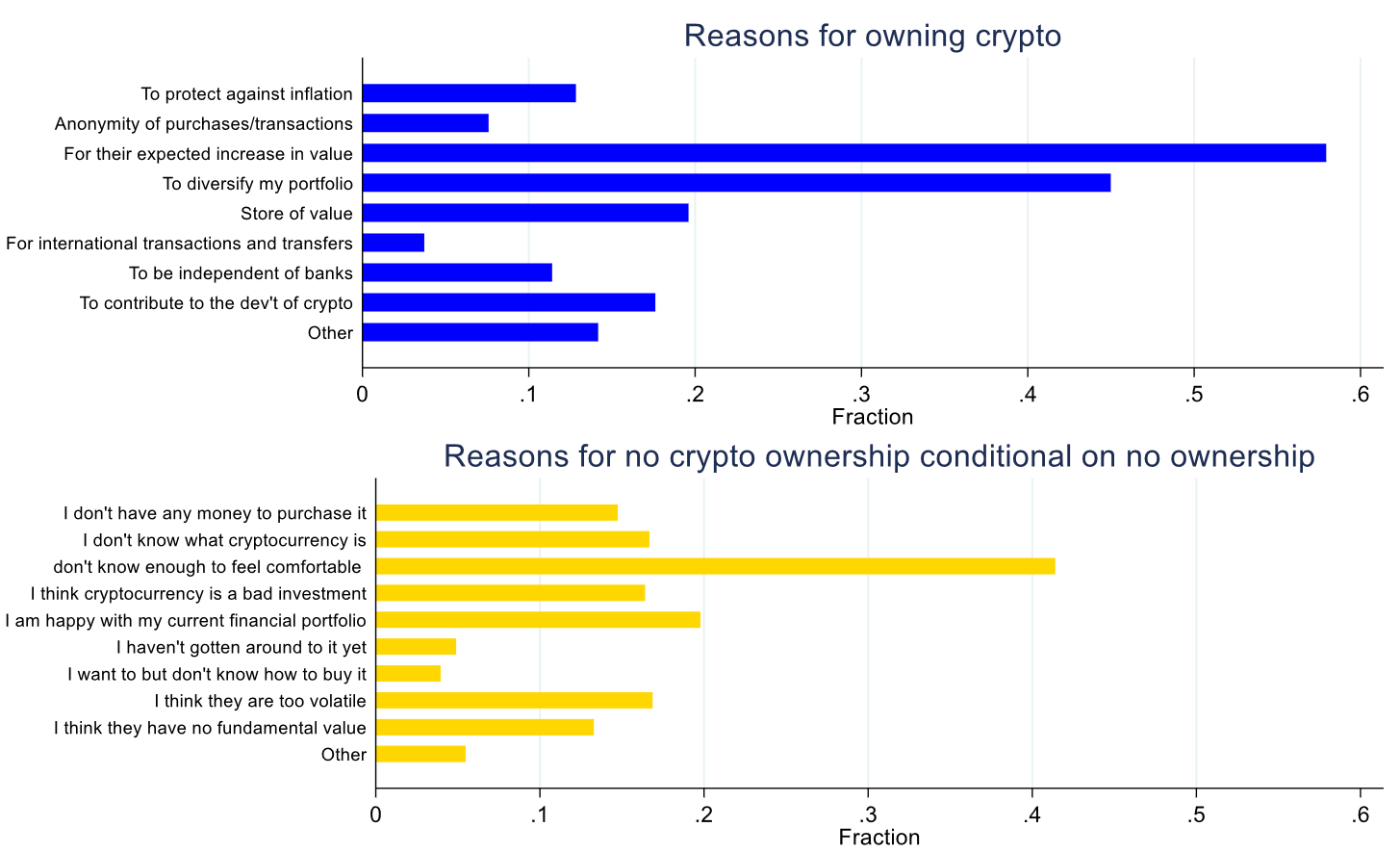
This is also supported by other findings of the study. The authors randomly showed people information about $BTC's returns over the previous 12 months, which increased the desired share of Bitcoin in their portfolio by about 47% and also raised their expected returns by several percentage points. That is, their willingness to invest in Bitcoin was driven not so much by an understanding of what they were investing in, but by $BTC's past performance.
The Crypto Lottery
However, this is also quite understandable, given that, according to the survey, returns from $BTC appear to be perceived more like a lottery win than traditional wealth.
"Therefore, realized cryptocurrency returns lead only to immediate, temporary, and one-off purchases of expensive goods, rather than a sustained increase in overall spending, which aligns with the idea that investors view crypto gains as gambling income, not as an increase in permanent income," the paper states.
Nevertheless, existing holders of $BTC and cryptocurrencies seem more convinced that their 'gamble' will pay off, despite having virtually no idea what the returns might be.
Among respondents willing to rate the risk of cryptoassets, about 63% of those who do not own cryptocurrencies assigned them the highest risk score, while among owners of such assets, this figure was about 45%. At the same time, cryptoasset owners also showed greater uncertainty about their bet. 84% of respondents answered 'don't know' when asked about their forecast for cryptocurrency returns over 12 months, compared to 68% for stocks, 74% for bonds, and 78% for gold.
Bitcoin's Meaning and Price Determination
These findings should not be surprising, as in the case of Bitcoin — both as a network and blockchain, and as an asset itself — there is still no consensus on what they are and how it all can be valued. Various interpretations appear and disappear, different camps continue to clash, analysts constantly come up with new metrics and discard old ones, while the market as a whole does not seem very interested in what developers are building.
Further complicating matters, Bitcoin does not have a CEO or a marketing director who could define what this technology and this asset represent. However, the fact that Bitcoin can be many things is also considered a strength by some analysts.
In any case, this ambiguity in perception directly affects Bitcoin's price volatility.
"The absence of uniform information and beliefs about cryptocurrencies among investors suggests that price volatility will remain one of the most characteristic features of this new asset for the foreseeable future," concluded the Federal Reserve Bank of Cleveland. In turn, as the Bitcoin community makes efforts to close knowledge gaps, these efforts, along with rising prices, could turn today's uninformed non-owners into holders of $BTC.
end-content