How To Play The Bitcoin 4-Year Cycle For The Most Gains In The Bull Market

bitcoinistPublished on 2026-05-25Last updated on 2026-05-25

Abstract

A crypto analyst argues that Bitcoin's four-year cycle is still active, despite recent market debates suggesting it may be over. By examining past cycles from 2011-2014, 2015-2018, and 2019-2022, the analyst identifies a consistent pattern: a "Buy" year with declining prices, a "Hold" year of rising prices, a "Sell" year near the peak, and a final "Bear" year of market crash. The analyst applies this model to the current cycle, positioning 2023 as the Buy phase, 2024 as Hold, 2025 as Sell, and 2026 as the ongoing Bear phase, explaining Bitcoin's recent sideways and declining price action. Looking ahead, the analyst predicts the 2027-2030 cycle will follow the same pattern, with the next major accumulation opportunity potentially arriving in 2027. The conclusion is that the four-year cycle structure remains intact and is playing out as expected.

A crypto analyst is raising questions over whether the famous four-year cycle theory that has governed Bitcoin’s (BTC) market trajectory in the past is now dead. The expert has shared BTC’s price movements and investor trends to prove that the cycle theory is still very much alive and playing out in the current market cycle.

Analyst Says Bitcoin’s 4-Year Cycle Is Still Active

In an X post on May 23, Mags, a crypto analyst, has raised concerns about whether “the 4-year cycle is over” for Bitcoin. This debate has been spreading across the market for months now, with some experts, such as Strategy CEO Michael Saylor, stating that the four-year cycle has ended, while others believe it is still active.

Many crypto community members, in response to Mags’ post, also compared this cycle to past ones. They noted that the current BTC market is markedly different from previous cycles, due to the emergence of Spot ETFs, increased institutional flows, and broader adoption.

However, after examining and comparing these cycles himself, Mags noted that each one corresponds almost perfectly to the next. The analyst pointed to the 2011-2014 four-year cycle on his accompanying chart, highlighting how the market moved through distinct stages of investor activity and price movement during that period.
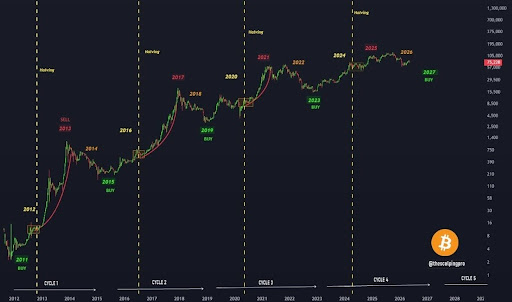
Source: Chart from Mags on X

In 2011, Bitcoin prices were declining, presenting a buying opportunity for investors. In the second year, Bitcoin began to rise, and investors simply held onto their tokens to allow them to grow. By 2013, prices had climbed to near peak levels, which the analyst noted was when most investors began selling their BTC. The fourth and final year of that cycle saw the market crash, and prices fall sharply. Mags described this as the bear market stage, marking the final stage before a fresh bull cycle began.

Notably, the same four-stage yearly trend was observed during the 2015-2018 and 2019-2022 cycles. Mags also stated that the cyclical theory is actively running in the current cycle, noting that Bitcoin has already moved through its Buy stage in 2023, Hold in 2024, and Sell phase in 2025. Based on this, Mags said that BTC is now in its bear market phase, coinciding with the cryptocurrency’s recent sideways movements and ongoing price declines.

What The Theory Says About The 2027-2030 Cycle

In his analysis, Mags went further to predict what the next cycle could look like after the current one ends. He suggested that the 2027-2030 cycle could follow a similar pattern, with Bitcoin potentially experiencing the same Buy, Hold, Sell, Bear market phases across each year.

He noted that if this structure holds, the next major accumulation window for investors and traders would arrive in 2027, a year ahead of the next anticipated bull run. Mags has pushed back against the speculation that the four-year cycle is dead, declaring that the structure “is still on track and everything is playing out perfectly.”

BTC trading at $77,435 on the 1D chart | Source: BTCUSDT on Tradingview.com

Related Questions

QIs Bitcoin's 4-year cycle theory still active according to the crypto analyst Mags?

AYes, Mags states that the 4-year cycle theory is still active and is playing out perfectly in the current market cycle.

QWhat are the four distinct yearly stages described in the analyst's interpretation of the Bitcoin cycle?

AThe four distinct yearly stages are: Buy (Year 1 - price decline/buying opportunity), Hold (Year 2 - price rise/accumulation), Sell (Year 3 - near peak levels/most investors sell), and Bear Market (Year 4 - market crash/price decline).

QAccording to Mags' analysis, what phase is Bitcoin currently in within the 2023-2026 cycle?

AAccording to Mags, Bitcoin is currently in its Bear Market phase for the 2023-2026 cycle, coinciding with recent sideways movements and price declines.

QWhen does Mags predict the next major accumulation window for Bitcoin investors will occur?

AMags predicts the next major accumulation window for investors and traders will arrive in 2027.

QWhy are some in the crypto community debating if the 4-year cycle is over for Bitcoin?

ASome believe the current Bitcoin market is markedly different from past cycles due to factors like the emergence of Spot ETFs, increased institutional flows, and broader adoption, leading to the debate about the cycle's validity.

Related Reads

To Those Ordinary People Who Haven't Invested in AI: You Think You're Late, You're Just Lacking Your Own Worldview

**Summary:** The article argues that ordinary investors feeling FOMO over missing the AI investment boom lack not timing, but their own independent worldview. Most people chase "what to buy" based on others' opinions (FOMO, envy) rather than fundamental analysis. This leads to costly mistakes: not knowing when to exit winning trades or cut losses on losing ones. The core solution is to develop a personal, long-term (5-10 year) worldview about societal shifts and technological bottlenecks. For most, building this from scratch (Path A) is too demanding. A practical alternative (Path B) is to follow the **capital expenditures (capex)** and strategic investments of visionary leaders, as their money reveals true conviction more reliably than their words. Five key figures to track for different AI perspectives are highlighted: Jensen Huang (NVIDIA, infrastructure), Elon Musk (Tesla/SpaceX/xAI, capex signals), Sam Altman (OpenAI, commercialization, but beware hype), Dario Amodei (Anthropic, technical/safety focus), and Liang Wenfeng (DeepSeek, efficiency/anti-consensus view). The article details how to read capex signals from hyperscalers' financial reports, NVIDIA's revenue breakdown, and strategic investments. It maps the complete AI产业链 (supply chain) from raw materials/energy to models/applications, explaining value flow and inter-dependencies (e.g., how a model release triggers demand across chips, memory, and optics). Finally, it provides an action plan: secure personal finances first, allocate a limited portfolio percentage (max 25%) to the theme, prefer broad ETFs (like QQQ), use dollar-cost averaging over 6-12 months, and write down strict investment rules beforehand to combat emotional errors during market volatility. The conclusion is that a stable, personally-held worldview enables disciplined, long-term investment far more than chasing short-term trends.

marsbit33m ago

To Those Ordinary People Who Haven't Invested in AI: You Think You're Late, You're Just Lacking Your Own Worldview

marsbit33m ago

Microsoft Halts Vibe Coding: "Burning Tokens" Is Now More Expensive Than Employees

Microsoft has halted the widespread internal use of Claude Code, withdrawing licenses from most employees by the end of its fiscal year, June 30, 2026. This reversal comes just six months after actively promoting the AI coding tool to boost productivity via "vibe coding"—where developers describe intent in natural language and let the LLM generate code. The core issue isn't the tool's effectiveness; internal reports suggest employees preferred Claude Code over Microsoft's own Copilot CLI. The problem is financial: the "copilot mode" adds a variable, consumption-based token cost on top of existing employee salaries without a proportional revenue increase. As usage grew, the token bills became unsustainable, leading to what sources describe as a cost-structure failure. Similar overruns have been reported at other firms like Uber. The article contrasts this with the approach of AI-native startups, exemplified by Y Combinator's philosophy. Here, high token consumption is strategic—it replaces, rather than supplements, human labor. Startups operate with tiny teams where AI agents handle work previously done by many, making the high token bill financially viable as it offsets much larger personnel costs. The conclusion is that "vibe coding" isn't dead, but its economics fail within traditional corporate structures that treat AI as a productivity add-on for existing staff. Success requires a foundational shift to an AI-native organization, where processes are built to be "legible to AI," and the company's core knowledge and assets reside in documented, AI-accessible systems rather than solely in employees' minds. The future divide will be between companies that merely add AI tools and those that redesign their organizations around them.

marsbit52m ago

Microsoft Halts Vibe Coding: "Burning Tokens" Is Now More Expensive Than Employees

marsbit52m ago

Trading

Spot
Futures

Hot Articles

How to Buy 4

Welcome to HTX.com! We've made purchasing 4 (4) simple and convenient. Follow our step-by-step guide to embark on your crypto journey.Step 1: Create Your HTX AccountUse your email or phone number to sign up for a free account on HTX. Experience a hassle-free registration journey and unlock all features.Get My AccountStep 2: Go to Buy Crypto and Choose Your Payment MethodCredit/Debit Card: Use your Visa or Mastercard to buy 4 (4) instantly.Balance: Use funds from your HTX account balance to trade seamlessly.Third Parties: We've added popular payment methods such as Google Pay and Apple Pay to enhance convenience.P2P: Trade directly with other users on HTX.Over-the-Counter (OTC): We offer tailor-made services and competitive exchange rates for traders.Step 3: Store Your 4 (4)After purchasing your 4 (4), store it in your HTX account. Alternatively, you can send it elsewhere via blockchain transfer or use it to trade other cryptocurrencies.Step 4: Trade 4 (4)Easily trade 4 (4) on HTX's spot market. Simply access your account, select your trading pair, execute your trades, and monitor in real-time. We offer a user-friendly experience for both beginners and seasoned traders.

4.1k Total ViewsPublished 2025.10.20Updated 2025.10.29

How to Buy 4

Discussions

Welcome to the HTX Community. Here, you can stay informed about the latest platform developments and gain access to professional market insights. Users' opinions on the price of 4 (4) are presented below.

活动图片