Microsoft Halts Vibe Coding: "Burning Tokens" Is Now More Expensive Than Employees

marsbitPublished on 2026-05-26Last updated on 2026-05-26

Abstract

Microsoft has halted the widespread internal use of Claude Code, withdrawing licenses from most employees by the end of its fiscal year, June 30, 2026. This reversal comes just six months after actively promoting the AI coding tool to boost productivity via "vibe coding"—where developers describe intent in natural language and let the LLM generate code. The core issue isn't the tool's effectiveness; internal reports suggest employees preferred Claude Code over Microsoft's own Copilot CLI. The problem is financial: the "copilot mode" adds a variable, consumption-based token cost on top of existing employee salaries without a proportional revenue increase. As usage grew, the token bills became unsustainable, leading to what sources describe as a cost-structure failure. Similar overruns have been reported at other firms like Uber. The article contrasts this with the approach of AI-native startups, exemplified by Y Combinator's philosophy. Here, high token consumption is strategic—it replaces, rather than supplements, human labor. Startups operate with tiny teams where AI agents handle work previously done by many, making the high token bill financially viable as it offsets much larger personnel costs. The conclusion is that "vibe coding" isn't dead, but its economics fail within traditional corporate structures that treat AI as a productivity add-on for existing staff. Success requires a foundational shift to an AI-native organization, where processes are built to be "legible...

May 14, 2026, Microsoft has begun revoking internal licenses for Claude Code for most employees. The deadline is June 30th—also the last day of Microsoft's fiscal year.

Just six months ago, Microsoft was doing the exact opposite. In December 2025, it opened up Claude Code to thousands of employees, including engineers, product managers, and designers, encouraging everyone to reshape their workflows using vibe coding. Employees loved the tool. Perhaps, too much.

But six months later, Microsoft pulled back on its own.

Almost in the same week, YC partner Tom Blomfield said something else during a batch talk: "If your API bill doesn't make your heart ache, you're not burning enough."

In the same spring, Silicon Valley is giving two completely opposite answers to the same question—is using AI ultimately more expensive than humans?

01 The Scene of Vibe Coding's Failure

Microsoft isn't canceling the Claude model itself. Anthropic's models will continue to be available to Microsoft employees through Copilot CLI. What it's canceling is the product entry point for Claude Code itself.

The department most affected is "Experiences + Devices"—the engineering teams behind Windows, Microsoft 365, Outlook, Teams, and Surface. EVP Rajesh Jha packaged the decision as "toolchain unification" in an internal memo, but Microsoft insiders cited by The Verge were more blunt: employees generally found Claude Code better to use than Copilot CLI. The popularity of Anthropic's tool within Microsoft even led to Microsoft's own Copilot CLI being "neglected."

In other words, Microsoft removed Claude Code not because it was ineffective, but because it was too effective.

That June 30th deadline is no coincidence—it's the last day of the fiscal year. Cutting off a tool employees widely preferred, switching back to its own product, timing it at the fiscal year's end—how much of this is product judgment versus financial consideration, everyone understands.

Microsoft is not an isolated case.

A month ago, Uber CTO Praveen Neppalli Naga revealed to The Information: the company's entire 2026 budget for AI coding tools was burned through in the first four months. Uber had previously even created internal leaderboards, using competitions to incentivize employees to use AI more—the result was a budget blowout.

More direct was what NVIDIA's VP of Applied Deep Learning, Bryan Catanzaro, said in an interview with Axios: "For my team, compute costs far exceed employee costs." This came from an executive at a hardware company—a company whose core product is selling compute power.

Fortune strung these clues together, giving its article a very Fortune-esque title: "Microsoft's report exposes AI's real cost problem—using this thing is more expensive than raising employees."

If you only read this far, the conclusion is simple: vibe coding failed, the story of AI replacing humans can be shelved.

But that conclusion is premature.

02 The Copilot Model Has "Hit a Wall"

To explain Microsoft's retreat, we first need to clarify what vibe coding is.

This term was proposed by Andrej Karpathy in early 2025—he described a new way of programming: developers no longer write code line by line, but use natural language to describe intent, letting the LLM generate code. Developers might not even read the code, just look at the results—accept it if it runs, have AI fix it if it doesn't.

This is one of the most enticing productivity promises of the AI era. It means: an engineer who doesn't know Rust can have AI write Rust for them; a product manager can have AI build a prototype; a designer can have AI write runnable code. The target audience for Microsoft's December 2025 opening of Claude Code—engineers, PMs, designers—happens to be exactly these three types. This is no coincidence; it's the classic landing posture for vibe coding.

But when vibe coding lands in a large company, it becomes something structurally awkward.

Suppose Microsoft has an engineer with an annual salary of $300,000. After equipping him with Claude Code, his output increases by 20%—this is the ideal state of vibe coding. But at the same time, the token cost he burns through each month is $200, $500, or $2,000? This number will monotonically increase as his dependence on AI deepens.

What's more troublesome is, he won't be laid off because he "uses AI"—his $300K salary remains, his benefits remain, his desk remains.

In other words, Microsoft's total cost structure becomes "original employee wages + new token bill." This formula only goes in one direction—costs skyrocket.

And does "employee output +20%" translate to "revenue +20%" financially? No. It translates to "revenue remains unchanged, but the cost structure now includes an AI bill"—because the output of most employees does not directly correspond to new revenue; him writing faster doesn't mean the company sells more.

This is the real meaning behind Catanzaro's statement "compute is more expensive than employees." It's not saying AI is dumb; it's saying that when you attach AI to existing employees, you can't make the math work.

This logic also has data support.

In a recent Gartner forecast: by 2030, the inference cost for a trillion-parameter large model will drop by nearly 90% compared to 2025. It sounds like AI is getting cheaper, but Gartner's real conclusion is: this won't make the total AI bill for enterprises cheaper. Gartner senior director analyst Will Sommer said something—"CPOs should not confuse 'deflation of commodity-level tokens' with 'the commoditization of cutting-edge inference capabilities.'"

Goldman Sachs's prediction is more direct: by 2030, agentic AI will drive a 24-fold increase in token consumption, reaching 120 quadrillion per month. A 90% drop in per-token price, a 24-fold increase in consumption—the result is the total bill still rises.

Jensen Huang has an even more radical version. He said publicly a few months ago that in the future, every NVIDIA employee will have 100 AI agents working alongside them.

It sounds beautiful. But if you're the CFO, what you hear? It's 100 token-burning furnaces, burning non-stop 24/7.

The problem isn't that AI is too expensive. The problem is the assumption itself of "giving each employee an AI copilot."

This posture has a popular name in tech circles—"copilot mode." Its core assumption is: the human remains in the driver's seat, AI sits in the passenger seat giving suggestions. It doesn't replace you, it just makes you faster.

This assumption is very gentle on the surface—"AI won't take your job, AI is just helping you." But financially, its implicit meaning is: all original wages remain unchanged, but an additional token fee is added.

And tokens aren't a fixed cost; they're billed based on consumption. The more employees use, the more the company pays—this happens to be the cost structure enterprises least want to see: variable, uncapped, inversely amplifying with productivity.

When Microsoft opened up Claude Code in December 2025, it might not have fully realized this. It likely thought: let employees try it, see how much AI can boost work efficiency. But six months later, employees really got addicted, Claude Code became too popular inside Microsoft—the result was a token bill far exceeding expectations, surpassing the extra output Microsoft could recoup from this popularity.

Microsoft pulled back. But it's not pulling back on AI—it's pulling back on the structure of "employees remain in the driver's seat, AI in the passenger seat."

This is a structural failure. It won't disappear because models get cheaper, nor will it disappear because employees get more skilled—it will become more severe as employees become more proficient with AI.

03 Burning Tokens Because It's Not Burning Headcount

Almost in the same week as Microsoft's retreat, Tom Blomfield presented a completely different perspective at a YC batch talk. He didn't discuss "how AI should be used"—he discussed "what a company in the AI era should look like."
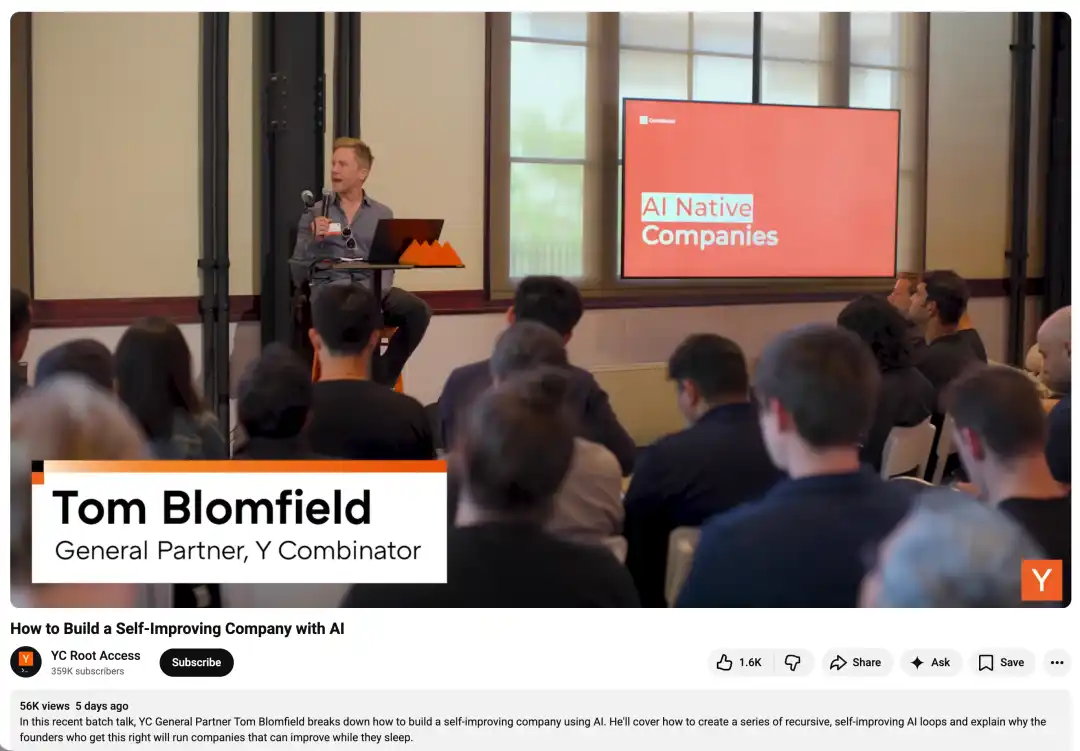
Blomfield's judgment was direct: most companies today still have a "Roman legion" structure—information flows up the chain, commands flow down, people are the core of coordination. Attaching AI to this structure is like giving firearms to Roman infantry—they'll use them more intensely, but the tactics won't change.

A truly AI-native company should look different.

Blomfield used a very specific description: every action should produce a recordable, callable artifact, making everything legible to AI; the company should be designed as a "self-improving AI loop," a system that can sense the environment, make decisions, call tools, receive feedback, and self-correct.

Humans in such a company are left with only two roles. First, individual contributors—everyone, regardless of department, is a builder and operator, bringing prototypes to meetings, not just ideas. Second, DRI (Directly Responsible Individual)—every output has a clear responsible person, "can't hide behind AI."

Then Blomfield said that golden line: "If your API bill doesn't make your heart ache, you're not burning enough."

If this sentence appeared in Microsoft's CFO office, it would be considered a joke; but in front of a room full of startup founders at YC, no one thought it was crazy.

Why?

Another YC partner, Diana Hu, gave the answer in early May at Startup School. She said something—"Maximize not headcount, but token consumption." She had an even blunter version: "One person equipped with AI tools equals what used to be a large engineering team."

Note the key word here: "equals." Not "comparable to," not "similar to"—replaces.

In YC's P26 Spring 2026 batch, there are already several companies using 5 or 6 people to do what used to require 20 or 30 people. Their token bills are certainly high, but their personnel bills are extremely low—the overall calculation shows a profit.

A more radical case is Block. This fintech company under Jack Dorsey recently laid off 40% of its employees. This isn't "cost-cutting and efficiency improvement" in the traditional sense—Block simultaneously increased internal investment in AI tools. The new structure is exactly what Diana Hu described: IC + DRI + AI agent.

In YC's context, burning tokens isn't an expense; it's a replacement. It replaces not costs outside of AI, but headcount wages. The math works because the company simultaneously removed the positions that would have burned salary money.

This is the fundamental reason why Microsoft and YC see the same thing but give opposite answers—they aren't burning the same kind of token at all. Microsoft's token is refueling the copilot for the original crew, YC's token is replacing the original driver.

04 True Assets Are Being Redefined

In his talk, Tom Blomfield also said another more intriguing line—"People are transient; context documentation is what's important."

This is an accounting-level judgment.

How is a traditional company's balance sheet written? On the left: fixed assets, accounts receivable, goodwill, IP. On the right: liabilities and shareholders' equity. Employees aren't in the asset column—employees are a cost. But every company knows internally that employees are the real assets: customer relationships are in the salesperson's mind, business intuition in the product manager's mind, technical know-how in the engineer's mind.

The characteristic of this kind of "asset" is that it walks away. Employees leave, the asset runs away.

What Blomfield describes for an AI-native company is doing one thing: extracting all these assets that originally existed only in human minds, turning them into "context assets" that are AI-readable, callable, and iterative.

What form does this take? It's detailed requirement documentation; it's process documentation that captures every decision, every email exchange, every Slack discussion; it's open MCP interfaces and APIs; it's the artifacts produced by every internal tool—all these things constitute a company's new, inheritable, non-evaporative layer of assets that won't disappear when employees leave.

Humans in such a company instead become the "variable"—they can be quickly onboarded or quickly depart, because the company's core assets aren't in human minds, they're in the documentation.
If this structure holds, it doesn't just mean a new organizational model—it means the company's balance sheet is being rewritten. A 6-person, AI-native company burning a staggering token bill might appear financially unhealthy, but its true assets could be thicker than a 60-person traditional company—it's just that current accounting standards haven't yet learned how to calculate this type of asset.

In other words, vibe coding isn't dead. It just doesn't belong to traditional companies.

The day Microsoft withdrew Claude Code was not the day AI economics failed—it was the day a posture of attaching AI to old organizations falsified itself.

And in that room of startup companies at YC, another posture is growing—they're small, they're burning, they don't have "employee AI usage rate" on their KPI sheets, their CFOs also don't panic when token bills skyrocket—because what they're burning is not "employees' copilots," it's "replacements for employees."

In the coming years, all medium-sized companies still urging employees to "use a bit more AI" will hit the wall Microsoft hit—a structurally bound-to-rise token bill.

But the real reason for hitting the wall isn't that AI is too expensive—it's that the organization hasn't changed.

And the vast majority of companies probably won't change anytime soon.

Related Questions

QWhat is 'vibe coding' and why is it considered a 'structurally awkward' fit for large companies like Microsoft?

A'Vibe coding' refers to a programming style where developers use natural language to describe their intent to a Large Language Model (LLM), which then generates the code. The developer primarily judges the result, asking for revisions if it doesn't work. It's considered structurally awkward for large companies because it follows a 'copilot mode,' adding variable, usage-based token costs on top of existing fixed employee salaries without a proportional increase in revenue, leading to a 'structurally guaranteed increase' in overall costs.

QAccording to the article, what is the fundamental difference between how Microsoft and YC startups view and use AI, leading to opposite conclusions about its cost?

AThe fundamental difference lies in what the AI is meant to replace. Microsoft used AI as a 'copilot' for existing employees, adding token costs to unchanged salary costs. YC startups and similar AI-native companies use AI as a replacement for employees. They build small teams where individuals, aided by AI agents, can do the work of much larger traditional teams. Their high token bill is offset by a drastically lower personnel bill, making the overall economics viable.

QWhat does Tom Blomfield mean by saying, 'If your API bill doesn't hurt, you're not burning enough' in the context of an AI-native company?

AIn the context of an AI-native company, Tom Blomfield's statement means that a high API/token bill should be viewed as a strategic investment, not just an expense. It signifies that the company is aggressively leveraging AI to automate tasks and processes, effectively replacing what would otherwise require many more human employees. The 'pain' of the bill is acceptable because it directly corresponds to a massive reduction in traditional, fixed personnel costs, fundamentally changing the company's cost structure and scalability.

QHow does the article suggest the definition of a company's 'core assets' is changing in the AI era, as described by Blomfield and the concept of 'context assets'?

AThe article suggests that in the AI era, a company's core assets are shifting from the tacit knowledge held in employees' minds to explicit, machine-readable 'context assets.' These include comprehensive documentation, decision logs, communication archives, open APIs, and tool artifacts. This documented context becomes the company's permanent, inheritable, and scalable asset layer. Employees become more variable components who can work effectively within this documented system, as the critical operational knowledge resides in the system itself, not solely in human memory.

QWhat is the 'structural failure' the article identifies with the 'copilot mode' of AI adoption, and why won't cheaper models solve it?

AThe 'structural failure' of the 'copilot mode' is its inherent cost formula: 'original employee salary + new token bill.' This creates a variable cost (token usage) that increases with productivity, layered on top of a large fixed cost (salaries). Cheaper token prices won't solve this because, as predicted by Gartner and Goldman Sachs, while per-token costs may fall, total consumption will rise exponentially (e.g., driven by agentic AI), keeping the total bill high. The core issue is the organizational assumption that AI is an additive tool for an unchanged workforce, not a transformative force that requires a redesigned, leaner human-AI system.

Related Reads

After Three Consecutive Quarters of Decline, Can the Crypto Market Find a Window for Stabilization in Q3?

The cryptocurrency market has just concluded its worst-performing quarter since 2022, with total capitalization dropping 12.6% to $2.1 trillion. All core metrics indicate capital is leaving the sector, not just rotating within it. Bitcoin fell 14.2% and Ethereum dropped 25.4% in Q2, breaking their previous correlation with US tech stocks. A key driver is the reversal in US spot Bitcoin ETF flows, which saw a net outflow of approximately $4.67 billion in Q2, including a record monthly outflow near $4.5 billion in June. While recent data suggests long-term holders are accumulating again, sustained ETF outflows mean continued selling pressure. Market focus is now singularly on the Federal Reserve. The upcoming July FOMC meeting is seen as the most critical event for Q3. A dovish signal could support Bitcoin reclaiming a $68,000-$84,000 range, while a hawkish stance might establish a new trading band around $50,000-$56,000. Additionally, regulatory uncertainty persists, with the progress of the crucial *CLARITY Act* stalling in the Senate, reducing its perceived 2026 passage probability to 40-45%. Despite the broad downturn, a few sectors showed growth. Prediction markets saw nominal volume surge 48.7% year-over-year to $113.8 billion, and tokenized collectibles transaction volume rose 143% quarterly to $1.4 billion. The Real-World Asset (RWA) tokenization sector also continued steady growth, now representing ~$28.1 billion in on-chain value. The market's foundation for an extreme crash appears limited, with Bitcoin price hovering near its 200-week moving average. However, the trading paradigm has shifted from narrative-driven speculation to decisions based on price action, policy developments, and interest rate expectations, making a broad sentiment-driven rally unlikely in the near term.

marsbit4h ago

After Three Consecutive Quarters of Decline, Can the Crypto Market Find a Window for Stabilization in Q3?

marsbit4h ago

BIT Trading Moment: BTC Still Suppressed by Weekly 200 EMA, Rejection May Restart Decline; Storage and Semiconductors that Surged Last Night Begin Falling in Evening Trading

**Crypto & Stock Market Wrap: Bitcoin Tests Resistance, Stocks Retreat After AI Surge** Bitcoin consolidates around $66,000, facing key resistance near $68,000—an area seen as a major psychological and technical hurdle where previous rallies have failed. Analysts note the cryptocurrency is caught between its 200-week moving average (~$63,333) and 200-week EMA (~$68,328). A clear break above $68k is needed to signal a stronger bullish trend, while a rejection could lead to a retest of $63k support. Market sentiment remains cautious, with low futures open interest pointing to a low-liquidity rebound rather than a full bull market. Bitcoin spot ETFs saw another $203 million inflow. US stock futures pointed lower after a strong Tuesday session led by a massive rebound in semiconductors and memory stocks. The rally was fueled by renewed optimism about AI-driven hardware demand, with Micron, SanDisk, and SK Hynix surging. However, those gains reversed in pre-market trading. Super Micro Computer (SMCI) soared over 20% after hours on strong guidance and a record backlog. Other standouts included Rocket Lab and nuclear energy plays Oklo and X-Energy. Rising oil prices (Brent above $91) and climbing Treasury yields (10-year near 4.64%), however, are reigniting inflation concerns and acting as a headwind for equities. In Asia, markets were mixed. South Korea's KOSPI pared early gains to close slightly higher as semiconductor stocks like SK Hynix gave back initial surges. Japan's Nikkei edged lower as the yen hit a fresh 38-year low against the dollar, raising fears of potential market intervention. Key events to watch include the Samsung Galaxy launch, AMD's AI event, and a slew of major tech earnings from Alphabet, Tesla, and IBM after the close on Wednesday, followed by the ECB meeting and Intel's earnings on Thursday.

marsbit5h ago

BIT Trading Moment: BTC Still Suppressed by Weekly 200 EMA, Rejection May Restart Decline; Storage and Semiconductors that Surged Last Night Begin Falling in Evening Trading

marsbit5h ago

Former CFTC Chairman, Circle President Tarbert: Preaching Long-Termism While Cashing Out $30 Million Himself

Former CFTC Chairman and Circle President Heath Tarbert has consistently advocated for a long-term vision in public, urging patience from investors as Circle’s stock price has fallen significantly from its peak. However, it has been revealed that since Circle’s IPO, Tarbert has continuously sold his CRCL shares through pre-arranged trading plans, cashing out approximately $30 million, without making any public market purchases. This contrast between his public messaging and personal actions has drawn criticism. Tarbert joined Circle in July 2023 as Chief Legal Officer, leveraging his regulatory experience to help guide the company through its IPO and expansion. Despite promoting stablecoins as long-term infrastructure, he established a 10b5-1 trading plan just before Circle went public, leading to substantial stock sales over the following year. In March 2026, he initiated another plan to sell more shares. His career trajectory highlights a pattern of moving between high-level regulatory roles and influential positions in the financial sector. After resigning as CFTC Chairman in early 2021, he joined Citadel Securities as Chief Legal Officer just 27 days later, during a period of intense regulatory scrutiny for the firm. He later joined Circle, aiding its efforts to navigate regulatory challenges for its public listing. While Tarbert's expertise in policy and compliance is valuable to companies like Circle, his actions—advocating long-term confidence while personally divesting—raise questions about the alignment between his public statements and his private financial decisions, leaving investors who followed his advice to bear the market risks.

marsbit5h ago

Former CFTC Chairman, Circle President Tarbert: Preaching Long-Termism While Cashing Out $30 Million Himself

marsbit5h ago

Gate Research Institute: The 'Wall Street-ization' Wave of Crypto Financial Products – Competition or Integration?

The article titled "Gate Research Institute: Are Crypto Financial Products Sparking a 'Wall Street' Wave—Competition or Convergence?" explores the evolving relationship between the crypto ecosystem and traditional finance (TradFi). The piece begins by reflecting on Bitcoin's original 2009 vision of decentralization, disintermediation, and moving away from banks. It then contrasts this with the 2024 landscape, where key crypto assets like Bitcoin are increasingly held through Wall Street products like ETFs issued by giants like BlackRock. The article questions whether this signifies that TradFi is systematically taking over the rights to issue, price, custody, and distribute crypto financial assets. The core argument is that this is not a zero-sum takeover but rather a bidirectional convergence where each side addresses the other's weaknesses. Crypto offers 24/7 global markets, programmable settlement, and open access but lacks compliant channels, institutional-grade custody, deep fiat liquidity, and mainstream distribution. TradFi possesses these but is constrained by legacy systems, limited operating hours, and slow settlement. Two primary convergence paths are highlighted: * **Path A (CEX to TradFi):** Exemplified by Gate, which has progressed from offering tokenized stocks and CFDs to providing direct, real stock trading (US, Hong Kong, South Korea) within its platform, using USDT. * **Path B (TradFi to Crypto):** Exemplified by Robinhood, which has integrated crypto trading, acquired exchanges like Bitstamp, and is moving traditional assets like stocks onto the blockchain via tokenization and its own Layer 2. Both paths are ultimately competing to become the next-generation, unified financial account—a "super account" where users can seamlessly trade cryptocurrencies, stocks, ETFs, RWA (Real World Assets), and tokenized treasury products in one interface. The growth of RWA and tokenized treasuries (e.g., BlackRock's BUIDL) is presented as the asset-layer fusion, providing stable, yield-bearing assets on-chain and acting as a bridge between the two worlds. In conclusion, the "Wall Street-ization" of crypto is framed as a mutual transformation. Decentralized ideals persist in the protocol layer, while at the application layer, a more efficient, global, and accessible unified capital market is emerging from this convergence. The future competition lies not between crypto exchanges and stockbrokers, but between platforms vying to offer the most comprehensive asset coverage, liquidity, and user experience within a single account.

marsbit5h ago

Gate Research Institute: The 'Wall Street-ization' Wave of Crypto Financial Products – Competition or Integration?

marsbit5h ago

Trading

Spot
活动图片





