Analyst Who Predicted The Bitcoin Crash from $82,000 Reveals What’s Next

bitcoinistPublished on 2026-06-03Last updated on 2026-06-03

Abstract

A crypto analyst known as Tony, who previously predicted Bitcoin's drop from around $82,000, shares his outlook for the leading cryptocurrency. He asserts that Bitcoin is currently in a bear cycle and is likely to decline further, potentially setting new lows this year. Tony points to technical factors like the 200-day moving average and Fibonacci levels as resistance. He outlines a potential scenario where Bitcoin could see a fake breakout above $85,000 to trap retail traders before falling to new lows. His chart analysis suggests possible declines to around $50,000 by July, with a cycle bottom potentially below $40,000. Tony notes that while short-term bounces, possibly from the $67,000 region, could occur, the main trend remains downward. Another analyst, Colin, suggests the $65,000-$66,000 range might offer short-term support for a bounce but reiterates that a retest of $60,000 and lower is still likely, as Bitcoin has not yet seen the typical >70% decline from its peak observed in past bear cycles. Bitcoin is currently trading around $66,300.

Crypto analyst Tony, who predicted the Bitcoin crash from the local top of around $82,000, has revealed what’s next for the leading crypto. He also explained why BTC is likely to set new lows over the coming months before potentially bottoming in this bear cycle.

Analyst Who Predicted The Bitcoin Crash Reveals What’s Next

In an X post, Tony stated that Bitcoin crashed from $82,000 for a reason, as the 200 MA has always been an important resistance level during bear markets. He also pointed to the 0.5 and 0.618 Fibonacci levels, where BTC was trading at. As for what’s next, the analyst indicated that Bitcoin is likely to decline further, noting a high probability it will set a new low during the summer months.

He also pointed to an alternative trap scenario where Bitcoin sees a fake breakout above $85,000 to lure retail traders in, followed by the same dump and a break to new lows. Whatever scenario plays out, Tony noted, it will not change the fact that BTC is in a bear cycle and will make new lows this year.
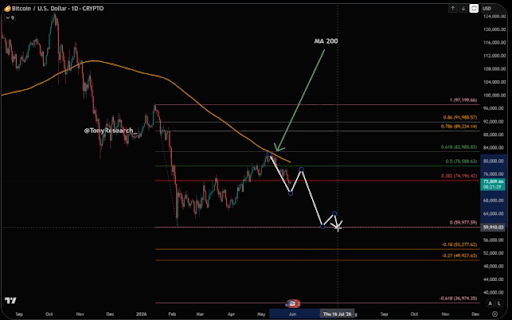
Source: Chart from Tony on X

His accompanying chart showed that Bitcoin could still drop to around $50,000 by July, and also signaled that BTC could decline below $40,000 before it bottoms in this cycle. Meanwhile, in another X post commenting on the current price action, Tony noted that BTC has broken the ascending channel and is trading below the Ichimoku Cloud, a bearish signal.

Tony said that he is expecting a bounce from the $67,000 region into the $74,000 area, followed by a move to make new lows below $60,000. He further remarked that the bear trap is likely over and that the main trend is still down, which is why he expects new lows this year. He added that short-term bounces are possible, but a bull market is unlikely to happen anytime soon.

A Short-Term Bounce Could Occur Around This Region

In an X post, crypto analyst Colin stated that the range between $65,000 and $66,000 appears to be a reasonable support level for a short-term bounce. He noted that the bounce duration could be for weeks or a couple of months. However, the analyst added that BTC retesting $60,000 is still highly likely and that breaking low this year is still a possibility.

Colin stated that the February low of $60,000 is unlikely to be Bitcoin’s bottom in this bear cycle. He explained that BTC has always suffered losses of over 70% in past bear cycles, but the leading crypto has yet to record such a loss in this cycle from its October high of $126,000.

At the time of writing, the Bitcoin price is trading at around $66,300, down over 6% in the last 24 hours, according to data from CoinMarketCap.

BTC trading at $67,211 on the 1D chart | Source: BTCUSDT on Tradingview.com

Related Questions

QAccording to analyst Tony, what is the main reason why Bitcoin crashed from around $82,000?

AAccording to analyst Tony, Bitcoin crashed from around $82,000 because the 200-day Moving Average (200 MA) has always been an important resistance level during bear markets, and it was trading near the 0.5 and 0.618 Fibonacci levels at that time.

QWhat are the two possible scenarios for Bitcoin's price action that Tony describes, and what is the common outcome for both?

AThe two scenarios are: 1) Bitcoin continues to decline further and sets a new low. 2) Bitcoin experiences a fake breakout above $85,000 to lure in retail traders, followed by a dump and a break to new lows. The common outcome for both scenarios is that Bitcoin is in a bear cycle and will make new lows this year.

QBased on Tony's chart analysis, to what price level could Bitcoin potentially drop by July, and what is the possible bottom for this cycle?

ABased on Tony's chart analysis, Bitcoin could drop to around $50,000 by July. The chart also signals that Bitcoin could decline below $40,000 before it bottoms in this cycle.

QWhat key technical levels does analyst Colin identify as a potential support zone for a short-term Bitcoin bounce?

AAnalyst Colin identifies the range between $65,000 and $66,000 as a reasonable support level for a potential short-term bounce.

QWhy does Colin believe the February low of $60,000 is unlikely to be the bottom for Bitcoin in this bear cycle?

AColin believes this because Bitcoin has historically suffered losses of over 70% in past bear cycles. From its October high of $126,000, Bitcoin has not yet recorded such a significant loss in the current cycle, making the $60,000 low unlikely to be the final bottom.

Related Reads

AI Trading Cools, South Korean Stocks Plunge 1.8%, Spot Gold Rises 1%, Bitcoin Dives

A sell-off in AI-related stocks, triggered by Broadcom's disappointing earnings forecast, sent shockwaves through global markets. South Korea's KOSPI led Asia's decline, plunging 1.8% as the risks from concentrated chip stock gains and surging leveraged investments came to the fore. The tech-heavy Nasdaq 100 futures fell 0.5% following Broadcom's 14% after-hours plunge, which signaled a slower-than-expected transition to AI clients. This pullback extended Wall Street's weakness, halting the S&P 500's nine-day rally amid hawkish Fed signals and renewed Middle East tensions. South Korean authorities convened an emergency meeting, pledging "immediate measures" against market volatility and warning of record-high stock margin debt. The adjustment rippled across assets: Bitcoin fell to around $64,000, its lowest since February, while safe-haven gold rose 1% on bargain hunting. Oil prices dipped on Middle East ceasefire news. Market analysts noted the sell-off was driven by profit-taking after massive gains, particularly in chip stocks like Samsung and SK Hynix, which now dominate the KOSPI. Wall Street banks are divided on Korea's outlook, with Goldman Sachs raising its target while Citigroup and others warn of overvaluation and a potential bubble. Bridgewater's Ray Dalio noted that great technological shifts often create bubbles. Meanwhile, Fed officials' hints at potential future rate hikes added to the cautious mood ahead of key U.S. jobs data.

华尔街日报27m ago

AI Trading Cools, South Korean Stocks Plunge 1.8%, Spot Gold Rises 1%, Bitcoin Dives

华尔街日报27m ago

Seeking Alpha's Hot Article: Why Might the U.S. Stock Market Crash in June?

In a recent Seeking Alpha article, financial professor and analyst Damir Tokic argues that the US stock market may be poised for a significant crash in June 2026. The core thesis centers on a "mega-bubble" in equities, particularly within the technology sector, which has driven the S&P 500 to near-record valuations, with a Shiller P/E ratio exceeding 40—a level comparable to the 2000 dot-com bubble. Tokic identifies two primary catalysts for a potential collapse. First, he points to unsustainable market exuberance fueled by what he terms the "Trump Stimulus"—massive AI capital expenditure by tech giants, which he believes is politically driven and cannot last. Second, and more urgently, he highlights the escalating Iran war as a critical threat. The ongoing closure of the Strait of Hormuz has created a severe global energy supply crunch. Strategic petroleum reserves are projected to hit critically low operational levels by June, potentially causing oil prices to spike above $200 per barrel and triggering a severe, supply-driven inflationary shock. This scenario, Tokic warns, would force the Federal Reserve's hand. Despite currently maintaining a dovish bias, the Fed would likely be compelled to officially pivot to a hawkish stance at its June FOMC meeting to combat soaring inflation and bond yields. He contends that such a shift—or even a failure to act, which would destroy Fed credibility—could be the trigger that punctures the market bubble. The resulting downturn, he concludes, could rival the bear markets of 2000 and 2008, advising investors to prepare for a major correction.

marsbit49m ago

Seeking Alpha's Hot Article: Why Might the U.S. Stock Market Crash in June?

marsbit49m ago

AI PC Battle: Bet on the Toll Booth, Not the Camp

**Title:** The AI PC Battle: Don't Bet on Sides, Bet on the Tollbooth **Summary:** The AI PC competition is moving beyond simple "x86 vs. Arm" narratives. The core investment thesis should focus on identifying which players can sustain margins, cash flow, and pricing power throughout the upgrade cycle, rather than backing a particular architecture. The opportunity is analyzed in three layers: 1. **The Advanced Foundry Tollbooth:** TSMC is positioned to collect "tolls" regardless of which chip designer wins, due to its dominant ~70% share in advanced semiconductor manufacturing, which is essential for high-end AI PC chips. 2. **Compute & Platform Spillover:** AMD represents an offensive in the x86 CPU+GPU space, while NVIDIA leverages its GPU and CUDA software stack dominance. Both benefit from the demand for increased local AI compute. 3. **Architecture Diffusion & Turnaround Plays:** ARM and Intel offer potential for significant upside (elasticity), but investments here require stricter discipline due to higher execution risks and competitive challenges. The industry is transitioning from concept to shipment validation. While short-term forecasts for AI PC adoption have been revised down slightly due to tariffs and procurement delays, the long-term trend towards AI becoming a standard PC feature remains intact. The key driver for upgrade cycles will be whether compelling enterprise applications (e.g., privacy-sensitive computing, low-latency inference) emerge beyond consumer-focused features like meeting summarization. Investment strategy should prioritize companies with platform-level advantages and recurring revenue streams. TSMC offers high certainty as the foundational tollbooth. AMD presents a strong offensive play within the established ecosystem. ARM and Intel are higher-risk, higher-potential-reward turnaround bets. The report cautions against chasing short-term hype and emphasizes a disciplined, long-term approach focused on buying ecosystem strength and cash-flow certainty after market enthusiasm subsides. **Key Risks:** Underwhelming AI PC applications slowing upgrade cycles; slow improvement in Windows on Arm compatibility; macro/tariff impacts on PC demand; potential advanced node supply-demand mismatches affecting TSMC; high overall AI sector valuations making stocks vulnerable to a risk-off shift in markets.

marsbit1h ago

AI PC Battle: Bet on the Toll Booth, Not the Camp

marsbit1h ago

Ten-Thousand-Word Analysis: From $10 to $290, MRVL Wins the Entire AI Era by 'Not Making GPUs'

Marvell Technology's stock price surged from under $10 in 2016 to a record $290 in June 2026, fueled not by making GPUs, but by dominating AI infrastructure connectivity. This analysis argues the market misvalues MRVL as merely a smaller Broadcom in custom AI chips, overlooking its true, unique position. Marvell's core strength lies in enabling high-speed data flow for AI clusters through three interconnected businesses. First, it holds a commanding ~70% market share in high-speed optical DSPs (essential for data center light modules), a deep-moat business with accelerating growth. Second, its custom AI chip design business serves hyperscalers like AWS, Microsoft, and Google, with a significant revenue pipeline despite lower margins. Third, stable cash flows come from Ethernet switch chips and enterprise storage controllers. Together, they form a full-stack "AI data movement" platform. CEO Matt Murphy's transformative leadership since 2016, involving strategic divestments, key acquisitions (like Inphi for optical DSPs), and securing long-term agreements with major cloud providers, repositioned the company. A pivotal $2 billion strategic investment from NVIDIA in 2026 underscored Marvell's critical role in the AI ecosystem, particularly through collaborations like NVLink Fusion. While Marvell faces risks—including client concentration (losing the Amazon Trainium3 design), lower-margin business mix, competitive threats, insider selling, and complex supply chains—its fundamentals remain strong. The optical interconnect moat is widening with the acquisition of Celestial AI (photonics fabric), and financial metrics show accelerating revenue growth and operating leverage. With a PEG ratio suggesting undervaluation relative to its growth, the thesis is that the market undervalues Marvell's monopolistic position in AI "plumbing" while overemphasizing its competitive custom chip segment. The story transcends investing, symbolizing how in any complex system—from the internet to AI—the value of "connection" ultimately surpasses that of individual "nodes."

marsbit1h ago

Ten-Thousand-Word Analysis: From $10 to $290, MRVL Wins the Entire AI Era by 'Not Making GPUs'

marsbit1h ago

Trading

Spot
Futures

Hot Articles

What is $BITCOIN

DIGITAL GOLD ($BITCOIN): A Comprehensive Analysis Introduction to DIGITAL GOLD ($BITCOIN) DIGITAL GOLD ($BITCOIN) is a blockchain-based project operating on the Solana network, which aims to combine the characteristics of traditional precious metals with the innovation of decentralized technologies. While it shares a name with Bitcoin, often referred to as “digital gold” due to its perception as a store of value, DIGITAL GOLD is a separate token designed to create a unique ecosystem within the Web3 landscape. Its goal is to position itself as a viable alternative digital asset, although specifics regarding its applications and functionalities are still developing. What is DIGITAL GOLD ($BITCOIN)? DIGITAL GOLD ($BITCOIN) is a cryptocurrency token explicitly designed for use on the Solana blockchain. In contrast to Bitcoin, which provides a widely recognized value storage role, this token appears to focus on broader applications and characteristics. Notable aspects include: Blockchain Infrastructure: The token is built on the Solana blockchain, known for its capacity to handle high-speed and low-cost transactions. Supply Dynamics: DIGITAL GOLD has a maximum supply capped at 100 quadrillion tokens (100P $BITCOIN), although details regarding its circulating supply are currently undisclosed. Utility: While precise functionalities are not explicitly outlined, there are indications that the token could be utilized for various applications, potentially involving decentralized applications (dApps) or asset tokenization strategies. Who is the Creator of DIGITAL GOLD ($BITCOIN)? At present, the identity of the creators and development team behind DIGITAL GOLD ($BITCOIN) remains unknown. This situation is typical among many innovative projects within the blockchain space, particularly those aligning with decentralized finance and meme coin phenomena. While such anonymity may foster a community-driven culture, it intensifies concerns about governance and accountability. Who are the Investors of DIGITAL GOLD ($BITCOIN)? The available information indicates that DIGITAL GOLD ($BITCOIN) does not have any known institutional backers or prominent venture capital investments. The project seems to operate on a peer-to-peer model focused on community support and adoption rather than traditional funding routes. Its activity and liquidity are primarily situated on decentralized exchanges (DEXs), such as PumpSwap, rather than established centralized trading platforms, further highlighting its grassroots approach. How DIGITAL GOLD ($BITCOIN) Works The operational mechanics of DIGITAL GOLD ($BITCOIN) can be elaborated on based on its blockchain design and network attributes: Consensus Mechanism: By leveraging Solana’s unique proof-of-history (PoH) combined with a proof-of-stake (PoS) model, the project ensures efficient transaction validation contributing to the network's high performance. Tokenomics: While specific deflationary mechanisms have not been extensively detailed, the vast maximum token supply implies that it may cater to microtransactions or niche use cases that are still to be defined. Interoperability: There exists the potential for integration with Solana’s broader ecosystem, including various decentralized finance (DeFi) platforms. However, the details regarding specific integrations remain unspecified. Timeline of Key Events Here is a timeline that highlights significant milestones concerning DIGITAL GOLD ($BITCOIN): 2023: The initial deployment of the token occurs on the Solana blockchain, marked by its contract address. 2024: DIGITAL GOLD gains visibility as it becomes available for trading on decentralized exchanges like PumpSwap, allowing users to trade it against SOL. 2025: The project witnesses sporadic trading activity and potential interest in community-led engagements, although no noteworthy partnerships or technical advancements have been documented as of yet. Critical Analysis Strengths Scalability: The underlying Solana infrastructure supports high transaction volumes, which could enhance the utility of $BITCOIN in various transaction scenarios. Accessibility: The potential low trading price per token could attract retail investors, facilitating wider participation due to fractional ownership opportunities. Risks Lack of Transparency: The absence of publicly known backers, developers, or an audit process may yield skepticism regarding the project's sustainability and trustworthiness. Market Volatility: The trading activity is heavily reliant on speculative behavior, which can result in significant price volatility and uncertainty for investors. Conclusion DIGITAL GOLD ($BITCOIN) emerges as an intriguing yet ambiguous project within the rapidly evolving Solana ecosystem. While it attempts to leverage the “digital gold” narrative, its departure from Bitcoin's established role as a store of value underscores the need for a clearer differentiation of its intended utility and governance structure. Future acceptance and adoption will likely depend on addressing the current opacity and defining its operational and economic strategies more explicitly. Note: This report encompasses synthesised information available as of October 2023, and developments may have transpired beyond the research period.

363 Total ViewsPublished 2025.05.13Updated 2025.05.13

What is $BITCOIN

Discussions

Welcome to the HTX Community. Here, you can stay informed about the latest platform developments and gain access to professional market insights. Users' opinions on the price of BTC (BTC) are presented below.

活动图片