Cardano Founder Says Monero Is ‘What Bitcoin Should Have Been’

bitcoinistPublished on 2026-05-14Last updated on 2026-05-14

Abstract

Cardano founder Charles Hoskinson argues that Monero represents the "privacy-preserving cryptocurrency Bitcoin should have been," praising its technical design and steadfast commitment to cypherpunk principles. In an interview, he highlighted Monero's use of advanced features like ASIC-resistant puzzles, full-chain membership proofs, and ring signatures, calling it a pioneer in privacy at scale. Hoskinson noted that while privacy systems are often complex and built by specialists, Monero has successfully balanced strong privacy guarantees with usability without compromising its decentralized ethos. He emphasized the importance of such uncompromising projects in the broader crypto ecosystem, comparing different cryptocurrency communities to a "Justice League" where each member, like Monero, plays a distinct and vital role.

Cardano founder Charles Hoskinson said Monero represents the kind of privacy-preserving cryptocurrency Bitcoin might have become if stronger cryptographic tooling had been available at the time, praising the project’s technical design and its refusal to dilute its cypherpunk principles.

Speaking in an interview with David Gokhstein, the Cardano founder framed Monero not as a marginal privacy coin, but as one of the sector’s more important ideological and technical reference points. His comments centered less on price or market structure than on a broader debate over privacy, usability and what role uncompromising projects should play in crypto’s long-term direction.

“Honestly speaking, Monero is what Bitcoin should have been,” Hoskinson said. “They just didn’t have the technology at the time, and it’s a lot more complicated to run a privacy-preserving system. But there’s a lot to love in Monero, like the ASIC-resistant puzzles, the full-chain membership proofs, how they handle the view keys.”

Cardano Founder Praises Monero

Hoskinson’s argument was that privacy at scale is inherently harder to implement than transparent settlement. In his telling, Monero’s contribution is not limited to a single feature, but to a stack of design choices built around keeping privacy central while still maintaining a usable network.

He cited Monero’s work around ring signatures and privacy-preserving architecture as examples of a project that pushed crypto beyond transparent ledgers without abandoning decentralization. “These are smart things,” he said, adding that Monero “was a pioneer in ring signatures” and “a pioneer in a lot of privacy at scale.”

The praise is notable because it comes from one of the most visible founders in the broader crypto industry and touches on a recurring fault line in the sector: whether cryptocurrencies should prioritize auditability and regulatory legibility, or stronger default privacy for users. Hoskinson’s comments placed Monero firmly on the side of the latter, while acknowledging that this comes with trade-offs in complexity.

He also drew a distinction between cryptographic rigor and product usability, arguing that privacy systems are often built by specialists whose threat models can make products difficult for ordinary users to navigate.

“Because the thing about privacy is it’s built usually by cryptographers, and cryptographers are super weird paranoid people living in basements with no friends,” Hoskinson said. “And the reason they became a cryptographer is they think everybody’s out to get them.”

The line was delivered jokingly, but it supported a more serious point. According to Hoskinson, the challenge for privacy-focused systems is not only to achieve strong guarantees, but to make those guarantees accessible without weakening the underlying ethos.

“What the Monero community did, and they pioneered, was figuring out how to make it more usable, but they never violated once their cypherpunk ethos,” he said. “So you still mine it, and there’s still that decentralized mindset and all these other things.”

That framing matters because Monero has long occupied a distinct position in crypto. It is not merely a privacy feature bolted onto a larger smart-contract ecosystem; its identity is tied to default privacy, mining, and a community culture that tends to resist compromise. Hoskinson suggested that this kind of hardline position remains necessary, even in an industry increasingly shaped by institutions, compliance demands and public-chain analytics.

“You need people like that in the space to be part of that conversation and to be uncompromising in that conversation,” he said.

Hoskinson then used a superhero analogy to describe how different crypto communities can serve different functions. Not every project, in his view, needs to solve the same problem or make the same trade-offs. Some may focus on scalability, others on smart contracts, settlement, identity or privacy. The important point, he argued, is that privacy maximalists should have a seat in the room.

“What you want to do is you bring them together like a justice league,” Hoskinson said. “Everybody’s welcome in the Justice League. So there’s a Justice League of Privacy, and Monero is definitely part of that Justice League, and they’ve always had an important role, which should never be discounted.”

At press time, Monero traded at $394.45.
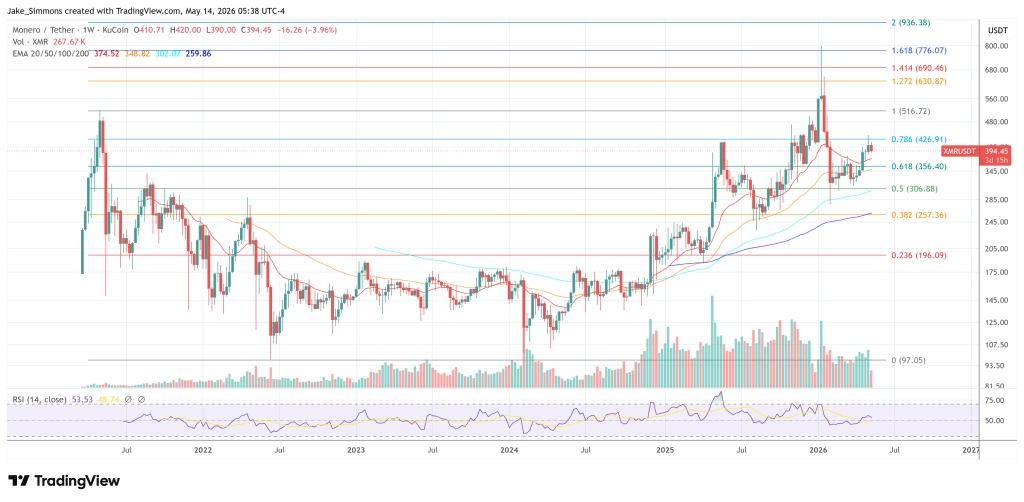
Monero faces the 0.786 Fib, 1-week chart | Source: XMRUSDT on TradingView.com

Related Questions

QWhat does Charles Hoskinson, the founder of Cardano, say Monero represents?

AHe says Monero represents the kind of privacy-preserving cryptocurrency Bitcoin might have become if stronger cryptographic tools had been available at its inception.

QAccording to Hoskinson, what is a key technical challenge that Monero tackled?

AHe states that implementing privacy at scale is inherently harder than transparent settlement, and Monero pushed crypto beyond transparent ledgers with technologies like ring signatures.

QWhat does Hoskinson identify as a common trade-off for privacy-focused systems like Monero?

AHe notes that while achieving strong privacy guarantees, these systems often come with increased complexity, which can make them more difficult for ordinary users to navigate.

QWhat aspect of the Monero community does Hoskinson specifically praise?

AHe praises the Monero community for figuring out how to make strong privacy more usable without ever violating their cypherpunk ethos, maintaining decentralization and principles like mining.

QWhat analogy does Charles Hoskinson use to describe the role of different crypto projects like Monero?

AHe uses a 'Justice League' analogy, stating that different projects serve different functions (like privacy, scalability, smart contracts) and all are welcome, with Monero being a key member of the 'Justice League of Privacy'.

Related Reads

No Coding Required: Build Your First AI Agent in 2 Days (Complete Tutorial)

A No-Code Guide to Building Your First AI Agent in a Weekend This article presents a weekend, zero-code tutorial for beginners to build a functional AI Agent using tools like Claude. It clarifies the core difference between a chatbot, which responds to queries, and an Agent, which autonomously plans and executes multi-step tasks using tools to deliver a final result. The process is broken into four stages over two days: 1. **Saturday Morning: Understanding Agents.** Learn that an Agent requires a clear Goal, a Plan, necessary Tools, and an execution Loop. Identify a simple, multi-step task from your own work/life as your first project. 2. **Saturday Afternoon: Building with Claude.** Create a one-page "Agent Blueprint" answering: the Goal, sequential Steps, required Tools, the desired Output format, and error-handling rules. Implement this blueprint in Claude (Desktop Cowork or web Projects) and run the Agent for the first time. 3. **Sunday Morning: Debugging & Optimization.** Review the initial (often 60-70% accurate) output. Identify flaws, trace them back to vague instructions in your blueprint, and refine it with more specific criteria and error handling. Iterate this run-review-refine cycle 3-4 times to reach ~90% reliability. 4. **Sunday Afternoon: Expansion.** Apply the learned workflow to quickly build a second, different Agent (e.g., for research, content repurposing, or meeting prep), experiencing the compounding efficiency gains. The core skill is not writing a perfect blueprint initially, but rapidly iterating based on output. By the end of the weekend, you'll have built two usable Agents, moving beyond just chatting with AI to automating multi-step workflows, fundamentally changing how you approach repetitive tasks.

marsbit1h ago

No Coding Required: Build Your First AI Agent in 2 Days (Complete Tutorial)

marsbit1h ago

Trading

Spot
Futures

Hot Articles

What is $BITCOIN

DIGITAL GOLD ($BITCOIN): A Comprehensive Analysis Introduction to DIGITAL GOLD ($BITCOIN) DIGITAL GOLD ($BITCOIN) is a blockchain-based project operating on the Solana network, which aims to combine the characteristics of traditional precious metals with the innovation of decentralized technologies. While it shares a name with Bitcoin, often referred to as “digital gold” due to its perception as a store of value, DIGITAL GOLD is a separate token designed to create a unique ecosystem within the Web3 landscape. Its goal is to position itself as a viable alternative digital asset, although specifics regarding its applications and functionalities are still developing. What is DIGITAL GOLD ($BITCOIN)? DIGITAL GOLD ($BITCOIN) is a cryptocurrency token explicitly designed for use on the Solana blockchain. In contrast to Bitcoin, which provides a widely recognized value storage role, this token appears to focus on broader applications and characteristics. Notable aspects include: Blockchain Infrastructure: The token is built on the Solana blockchain, known for its capacity to handle high-speed and low-cost transactions. Supply Dynamics: DIGITAL GOLD has a maximum supply capped at 100 quadrillion tokens (100P $BITCOIN), although details regarding its circulating supply are currently undisclosed. Utility: While precise functionalities are not explicitly outlined, there are indications that the token could be utilized for various applications, potentially involving decentralized applications (dApps) or asset tokenization strategies. Who is the Creator of DIGITAL GOLD ($BITCOIN)? At present, the identity of the creators and development team behind DIGITAL GOLD ($BITCOIN) remains unknown. This situation is typical among many innovative projects within the blockchain space, particularly those aligning with decentralized finance and meme coin phenomena. While such anonymity may foster a community-driven culture, it intensifies concerns about governance and accountability. Who are the Investors of DIGITAL GOLD ($BITCOIN)? The available information indicates that DIGITAL GOLD ($BITCOIN) does not have any known institutional backers or prominent venture capital investments. The project seems to operate on a peer-to-peer model focused on community support and adoption rather than traditional funding routes. Its activity and liquidity are primarily situated on decentralized exchanges (DEXs), such as PumpSwap, rather than established centralized trading platforms, further highlighting its grassroots approach. How DIGITAL GOLD ($BITCOIN) Works The operational mechanics of DIGITAL GOLD ($BITCOIN) can be elaborated on based on its blockchain design and network attributes: Consensus Mechanism: By leveraging Solana’s unique proof-of-history (PoH) combined with a proof-of-stake (PoS) model, the project ensures efficient transaction validation contributing to the network's high performance. Tokenomics: While specific deflationary mechanisms have not been extensively detailed, the vast maximum token supply implies that it may cater to microtransactions or niche use cases that are still to be defined. Interoperability: There exists the potential for integration with Solana’s broader ecosystem, including various decentralized finance (DeFi) platforms. However, the details regarding specific integrations remain unspecified. Timeline of Key Events Here is a timeline that highlights significant milestones concerning DIGITAL GOLD ($BITCOIN): 2023: The initial deployment of the token occurs on the Solana blockchain, marked by its contract address. 2024: DIGITAL GOLD gains visibility as it becomes available for trading on decentralized exchanges like PumpSwap, allowing users to trade it against SOL. 2025: The project witnesses sporadic trading activity and potential interest in community-led engagements, although no noteworthy partnerships or technical advancements have been documented as of yet. Critical Analysis Strengths Scalability: The underlying Solana infrastructure supports high transaction volumes, which could enhance the utility of $BITCOIN in various transaction scenarios. Accessibility: The potential low trading price per token could attract retail investors, facilitating wider participation due to fractional ownership opportunities. Risks Lack of Transparency: The absence of publicly known backers, developers, or an audit process may yield skepticism regarding the project's sustainability and trustworthiness. Market Volatility: The trading activity is heavily reliant on speculative behavior, which can result in significant price volatility and uncertainty for investors. Conclusion DIGITAL GOLD ($BITCOIN) emerges as an intriguing yet ambiguous project within the rapidly evolving Solana ecosystem. While it attempts to leverage the “digital gold” narrative, its departure from Bitcoin's established role as a store of value underscores the need for a clearer differentiation of its intended utility and governance structure. Future acceptance and adoption will likely depend on addressing the current opacity and defining its operational and economic strategies more explicitly. Note: This report encompasses synthesised information available as of October 2023, and developments may have transpired beyond the research period.

363 Total ViewsPublished 2025.05.13Updated 2025.05.13

What is $BITCOIN

Discussions

Welcome to the HTX Community. Here, you can stay informed about the latest platform developments and gain access to professional market insights. Users' opinions on the price of BTC (BTC) are presented below.

活动图片