Solana Takes Aim At Hyperliquid With Push For Fully Onchain Perps

bitcoinistPublished on 2026-06-02Last updated on 2026-06-02

Abstract

The Solana Foundation has announced a new initiative to actively support teams building fully onchain perpetual futures (perps) on Solana. This move directly challenges the current market structure, exemplified by platforms like Hyperliquid, where much of the derivatives volume still relies on centralized exchanges or hybrid models with offchain components. Solana argues that its high-performance blockchain makes fully onchain perps viable without sacrificing speed or user experience, aiming to shift a lucrative trading segment entirely onchain. The Foundation seeks to back projects that prioritize onchain price discovery (like order books or RFQ systems) over pool-based models, require projects to be "Solana-first" with revenue routed back to the chain, and mandate open-source development. The support includes distribution, technical assistance, and capital for core perps protocols as well as complementary infrastructure.

Solana Foundation is moving to back teams building fully onchain perpetual futures, setting up a clear challenge to the market structure that has powered Hyperliquid’s rapid rise. The initiative targets one of crypto’s most lucrative trading segments: perps, where volume still sits largely on centralized exchanges or hybrid venues.

Solana Vs. Hyperliquid

The Foundation framed the push as a bid to move derivatives execution more fully onto Solana, without relying on the offchain components that still underpin much of the sector. “Perpetuals are one of the most important financial primitives in crypto,” the Foundation wrote on X. “Solana makes it viable to run them fully onchain, without sacrificing the performance real participants and institutions require.”

The timing is notable. Hyperliquid has become the reference point for onchain derivatives, turning perpetual futures into one of the strongest product-market-fit stories in crypto. While Solana did not name Hyperliquid in its announcement, the competitive subtext is hard to miss.

In its post, the Foundation argued that most perp volume still flows through centralized exchanges or through hybrid architectures that use offchain sequencers and matching engines. “We view that as a transitional state, not a permanent one,” the Foundation said. “We want to support teams building onchain perps, other derivatives, and the applications around them, that prioritize price discovery infrastructure. Our support takes several forms: distribution, technical assistance, and above all, capital.”

That language matters because it draws a line between merely settling crypto trades onchain and running the entire execution path onchain. The foundation said it wants to support systems where every order submission, oracle update, match, cancellation and settlement happens onchain. For a chain that has long marketed itself around high throughput and low latency, perps are an obvious stress test: the product requires fast updates, deep liquidity, competitive market making and credible settlement.

The Foundation also made clear that it is not looking for pool-based pricing models as the center of this effort. It said it is interested in “models where price is set based on two-sided flow, not pool-based or as a function of deposits,” including orderbooks, RFQ systems with genuinely competing makers, or alternative designs where active participants set bids and offers against each other.

That is where the Hyperliquid comparison becomes especially relevant. Hyperliquid’s success has shown that crypto traders will use onchain or semi-onchain derivatives venues when the trading experience is fast, liquid and expressive enough.

Solana Wants Revenue Back Onchain

The announcement also included a more ecosystem-specific requirement: teams should build “Solana-first.” The Foundation said it wants projects optimized for SOL’s design and culture, with application revenue structurally routed back to the chain, preferably at the protocol level from launch rather than left to future governance decisions.

That is a pointed detail. In the current perps market, the battle is not only over where traders execute, but where fees, order flow and liquidity incentives accrue. A successful Solana-native perps venue would not merely add another DeFi app; it could become a recurring source of transaction activity, MEV-adjacent flow, validator economics and ecosystem-level liquidity.

The Foundation also said it is open to teams that have already built offchain or hybrid perps products and want to migrate to a fully onchain model. “We’ll support existing teams with a live product that are willing to explore a fully onchain, on-Solana model,” it said.

Open source is another filter. “Onchain integrity means little if the code behind it can’t be inspected,” Solana Foundation wrote. “Contributing to Solana culturally means contributing in the open.”

The initiative is not limited to core perps protocols. Solana said it also wants complementary infrastructure, including frontend integrations, vaults, structured products, aggregators, advanced trading interfaces, market making operations and social trading applications. Grants may be available through Solana Foundation funding channels or local Superteam chapters.

At press time, SOL traded at $79.54.
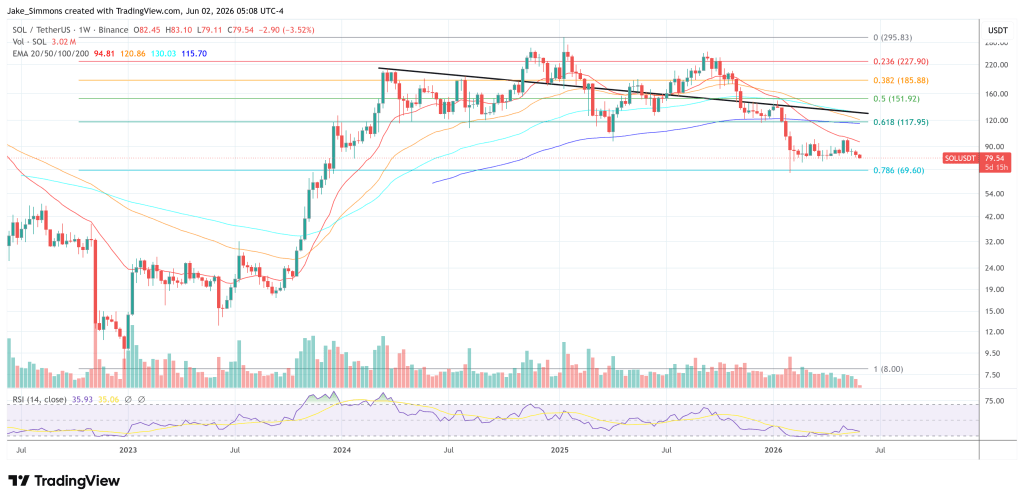
SOL remains in sideways trend, 1-week chart | Source: SOLUSDT on TradingView.com

Related Questions

QWhat is the primary goal of the Solana Foundation's new initiative as described in the article?

AThe primary goal of the Solana Foundation's initiative is to support teams building fully onchain perpetual futures and other derivatives on Solana. It aims to move derivatives execution more fully onto the blockchain without relying on offchain components, capturing revenue for the Solana ecosystem, and supporting models based on two-sided flow for price discovery.

QAccording to the article, which platform is positioned as the main competitive reference point for Solana's onchain perps push?

AThe main competitive reference point is Hyperliquid. The article states that Hyperliquid has become the reference point for onchain derivatives, and Solana's initiative sets up a clear challenge to the market structure that powered Hyperliquid's rapid rise.

QWhat specific type of pricing models is the Solana Foundation NOT interested in supporting for this initiative?

AThe Solana Foundation is not looking for pool-based pricing models as the center of this effort. It is interested in models where price is set based on two-sided flow, such as orderbooks, RFQ systems with competing makers, or designs where active participants set bids and offers against each other.

QBesides the core perps protocols, what other types of complementary infrastructure does Solana want to support through this initiative?

ASolana also wants to support complementary infrastructure including frontend integrations, vaults, structured products, aggregators, advanced trading interfaces, market making operations, and social trading applications.

QWhat are the key requirements or filters mentioned for teams interested in the Solana Foundation's support?

AKey requirements include building 'Solana-first' (optimized for SOL's design and culture), structuring application revenue to route back to the chain, being open to teams migrating from offchain/hybrid models, and committing to open-source development ('contributing in the open').

Related Reads

Robots Begin to 'Consume Data': The Hidden Production Chain from Indian Data Factories to Billion-Dollar Humanoid Robots

Robots have started to 'consume data,' driving the formation of a new industrial supply chain focused on producing training data for embodied AI. Unlike large language models, which are trained on vast internet text corpora, embodied AI models face a 'data desert' in the physical world. This has created a massive demand for first-person perspective video data (Ego Data), captured by workers wearing cameras in places like Indian garment factories. Companies like Neocambrian AI are establishing 'data factories' where workers perform standardized tasks (e.g., sorting clothes, kitchen organization) to generate thousands of hours of video. Research, such as NVIDIA's EgoScale, demonstrates that scaling this human demonstration data predictably improves robot performance, particularly for dexterous manipulation. This has validated a training path combining large-scale human data for pre-training with smaller amounts of robot-specific data for fine-tuning. The value of different data types varies significantly, forming a 'data pyramid.' The base consists of low-cost, large-scale internet and Ego Data. Higher layers include more expensive motion-capture data (e.g., from data gloves), simulation/synthetic data, and the most costly and scarce layer: real robot teleoperation data. This demand has spawned a layered ecosystem of data suppliers: low-cost data factories, motion capture and alignment specialists, robot-native teleoperation service providers, simulation data companies, and platforms aiming for data standardization. Robot companies themselves are adopting a 'layered procurement' strategy: outsourcing generic Ego Data while building in-house capabilities for robot-specific adaptation data and the critical deployment/failure data generated in real-world applications. The industry is shifting focus from hardware and basic mobility to the data pipelines required for general-purpose capability. While parallels exist to data labeling companies like Scale AI in the LLM boom, the physical complexity of robot data—involving action success ambiguity and sim-to-real gaps—requires more integrated solutions for data collection, annotation, and a continuous feedback loop. The race is on to build the data engines that will teach robots to operate reliably in the unstructured real world.

marsbit2h ago

Robots Begin to 'Consume Data': The Hidden Production Chain from Indian Data Factories to Billion-Dollar Humanoid Robots

marsbit2h ago

Spicy Commentary | Michael Saylor's 'Player Talk'; 60-Year-Old Aunt Liquidated After 'Scamming a Young Man'

**"Spicy Commentary": Three Tales of Crypto's Wild Week** This week's "Spicy Commentary" column highlights three dramatic stories from the cryptocurrency world. First, **MicroStrategy's Michael Saylor** addressed the controversy over his company potentially selling Bitcoin. At the BTC Prague event, he clarified, "I never said the company can't sell Bitcoin. I told *you* never to sell *your* Bitcoin." This "do as I say, not as I do" stance was criticized by netizens as peak linguistic gymnastics, noting a history of him previously stating the company would "never" sell. Second, a **bizarre fraud case** emerged from Beijing. A 60-year-old woman, obsessed with getting rich from crypto but unwilling to risk her own savings, posed online as the 20-something "god-daughter" of a high-ranking official. She catfished a young man, convincing him to give her over 200,000 yuan for fabricated emergencies. She then invested all the stolen money into cryptocurrency with 10x leverage, only to lose everything in a market crash. The woman was sentenced to four years in prison for fraud. Finally, a **sobering trader's tale** surfaced on Reddit. A user posted "Tale of a crypto trader," confessing their net worth had plummeted from a peak of $45 million to roughly $17,200, primarily due to holding meme coins too long. The post, described as a crypto "book of confessions," sparked reactions ranging from sympathy to critique about greed, poor risk management, and the perils of treating meme coins as long-term investments instead of taking profits. The column concludes that this week featured masterful rhetoric, elaborate scams, and extreme financial volatility, stitching together another chapter in crypto's unpredictable theater.

Foresight News2h ago

Spicy Commentary | Michael Saylor's 'Player Talk'; 60-Year-Old Aunt Liquidated After 'Scamming a Young Man'

Foresight News2h ago

Tremble Humans, AI Continues Its Accelerated Sprint

Trembling, Humans: AI Continues Its Accelerated Sprint Yes, AI is still rapidly accelerating. While deep learning seemed to stall quickly in its early years, large models after years of development show no sign of hitting their ceiling. At the Zhiyuan Conference 2026, the focus is on enabling AI to move from the digital world into the physical world. Scaling Law remains effective, continuing to drive advancements in both large language models and multimodal models. The industry is now entering a phase of pursuing World Models, though unresolved technical paths and data issues mean this exploration may take 3-5 more years. Concurrently, breakthroughs in Agents are accelerating AI's real-world application in fields like healthcare and meetings. Making Agents truly useful requires key hardware-software co-design, evident from the strong presence of chip vendors at the conference. We stand at a new historical threshold where AI is becoming a foundational force reshaping the world. The first day of the conference highlighted AI's evolution from "knowing how to chat" to "knowing how to work." Scaling Law persists, World Models are the next key battleground, and Agents are transitioning from usable to好用 (user-friendly). Scaling Law is not ending but diversifying. New models like Anthropic's Fable 5 demonstrate scaling through parameter size, synthetic data, and reinforcement learning. Advancements in AI Coding and Agent deployment are enabling a trend of AI self-evolution, potentially allowing AI to take over digital world iterations. World Models represent the next frontier for large models extending into the physical realm, but no current model is truly impressive at solving real-world problems. Technical consensus is lacking, with debates on data sources (video, simulation, real-world). Different approaches are emerging: language-centric, pixel-centric, 3D-structure-centric, and visual-representation-centric models. Zhiyuan Institute is exploring a fifth path: unified latent space modeling fusing language and visual representations, and introduced its own under-development World Model, Physis-v0.1. On the product side, Agents are key to bringing AI into daily life. Since 2025, the "Year of the Agent," products have become more proactive and capable of complex tasks. Zhiyuan showcased four vertical Agents for cardiac diagnosis, autonomous research, meeting summarization, and protein risk discovery. However, technical challenges remain, particularly in context engineering like memory and orchestration. "Harness" – the engineering framework around an Agent – is crucial for maximizing its capabilities by clarifying intent, designing workflows, and incorporating validation and feedback. In summary, AI's breakneck pace continues on multiple fronts: foundational model scaling, the ambitious pursuit of World Models for physical understanding, and the ongoing refinement of practical Agents. The journey from capable to truly reliable and useful AI systems is well underway.

marsbit3h ago

Tremble Humans, AI Continues Its Accelerated Sprint

marsbit3h ago

The Backside of Musk's Trillion-Dollar Fortune: 85% Can't Be Sold

Elon Musk becomes the world's first trillionaire, driven by SpaceX's IPO valuing the company at $1.77 trillion. However, his vast wealth is largely illiquid: he holds over 85% voting control, likely through super-voting shares that are subject to lock-ups and selling restrictions. While his net worth surpasses $1 trillion across SpaceX, Tesla, and private holdings, only a tiny fraction (potentially under 2% annually) could be converted to cash without jeopardizing control and market confidence. SpaceX's IPO also creates paper millionaires for roughly 4,400 employees, but their holdings face lock-up periods, exercise costs, and taxes, delaying and reducing actual cash proceeds. Only 4.2% of total shares are initially available for public trading, making the stock price highly sensitive to limited net buying or selling pressure. A major test will come when lock-ups expire for the remaining 96% of shares. The article contrasts SpaceX's wealth distribution with potential AI IPOs. Anthropic and OpenAI could generate employee wealth pools 20 times larger than SpaceX's in paper value, due to their higher valuations relative to revenue and potentially more distributed ownership. However, sustaining those high price-to-sales multiples post-IPO is uncertain. A key financial puzzle for SpaceX investors is its xAI unit. While it has locked in an estimated $26 billion in annual compute revenue from clients like Anthropic and Google, the unit reported a $6.4 billion loss in 2025. More critically, estimated annual capital expenditures of ~$30.8 billion exceed that revenue. The long-term viability of SpaceX's AI narrative hinges on whether this compute income can eventually cover the unit's massive ongoing investments and losses.

链捕手3h ago

The Backside of Musk's Trillion-Dollar Fortune: 85% Can't Be Sold

链捕手3h ago

Trading

Spot
Futures

Hot Articles

How to Buy PUSH

Welcome to HTX.com! We've made purchasing Push Protocol (PUSH) simple and convenient. Follow our step-by-step guide to embark on your crypto journey.Step 1: Create Your HTX AccountUse your email or phone number to sign up for a free account on HTX. Experience a hassle-free registration journey and unlock all features.Get My AccountStep 2: Go to Buy Crypto and Choose Your Payment MethodCredit/Debit Card: Use your Visa or Mastercard to buy Push Protocol (PUSH) instantly.Balance: Use funds from your HTX account balance to trade seamlessly.Third Parties: We've added popular payment methods such as Google Pay and Apple Pay to enhance convenience.P2P: Trade directly with other users on HTX.Over-the-Counter (OTC): We offer tailor-made services and competitive exchange rates for traders.Step 3: Store Your Push Protocol (PUSH)After purchasing your Push Protocol (PUSH), store it in your HTX account. Alternatively, you can send it elsewhere via blockchain transfer or use it to trade other cryptocurrencies.Step 4: Trade Push Protocol (PUSH)Easily trade Push Protocol (PUSH) on HTX's spot market. Simply access your account, select your trading pair, execute your trades, and monitor in real-time. We offer a user-friendly experience for both beginners and seasoned traders.

3.7k Total ViewsPublished 2024.03.29Updated 2026.06.02

How to Buy PUSH

Discussions

Welcome to the HTX Community. Here, you can stay informed about the latest platform developments and gain access to professional market insights. Users' opinions on the price of PUSH (PUSH) are presented below.

活动图片