ETFs Are Just the Ticket: The True Institutionalization of Bitcoin Is Happening Where You Can't See It

marsbitPublished on 2026-06-15Last updated on 2026-06-15

Abstract

Beyond the Bitcoin ETF spotlight, a deeper institutionalization is underway, leveraging Bitcoin as a foundational financial primitive. Institutions are using Bitcoin for purposes long reserved for assets like U.S. Treasuries and gold: as collateral for loans, insurance reserves, and the backbone of rated bonds. Examples include a Barbados-based insurer capitalizing with $40M in Bitcoin reserves and Ledn's $188M securitization of Bitcoin-backed loans, which received the first-ever investment-grade rating (BBB-) from S&P for a digital asset-backed security. This structure was stress-tested during a 27% price drop in early 2026, triggering automatic liquidations that functioned as designed but revealed the systemic risk of synchronized selling across leveraged positions. Infrastructure is evolving to support this, with platforms like Anchorage Digital's Atlas network enabling secure, institutional-grade settlement and collateral management. Strategies like basis trades and corporate treasuries (exemplified by companies like MicroStrategy issuing billions in equity and debt to fund Bitcoin acquisitions) further integrate Bitcoin into financial mechanics. While ETFs solved "how to own" Bitcoin, these developments answer "what to do with it," embedding the asset into the working machinery of finance—as collateral upon which loans, derivatives, and structured products are built. The real, enduring institutional shift is happening in these largely invisible plumbing and financing ...

Author: Andjela Radmilac

Compiled by: Deep Tide TechFlow

Deep Tide TechFlow Introduction: ETFs only solve "how to buy Bitcoin," but few have noticed that Wall Street is already using it to do what U.S. Treasuries and gold have done for years: collateralizing loans, insurance reserves, and rating bonds. The liquidation wave in February proved this system can withstand pressure but also exposed the fatal flaw of a collective stampede in the leverage chain.

Everyone knows about ETFs, but almost no one knows that while ETFs are capturing all the attention, dozens of institutional products built around Bitcoin are quietly emerging—from a $40 million insurance reserve in Barbados to S&P-rated bonds being sold to Wall Street investors by Jefferies.

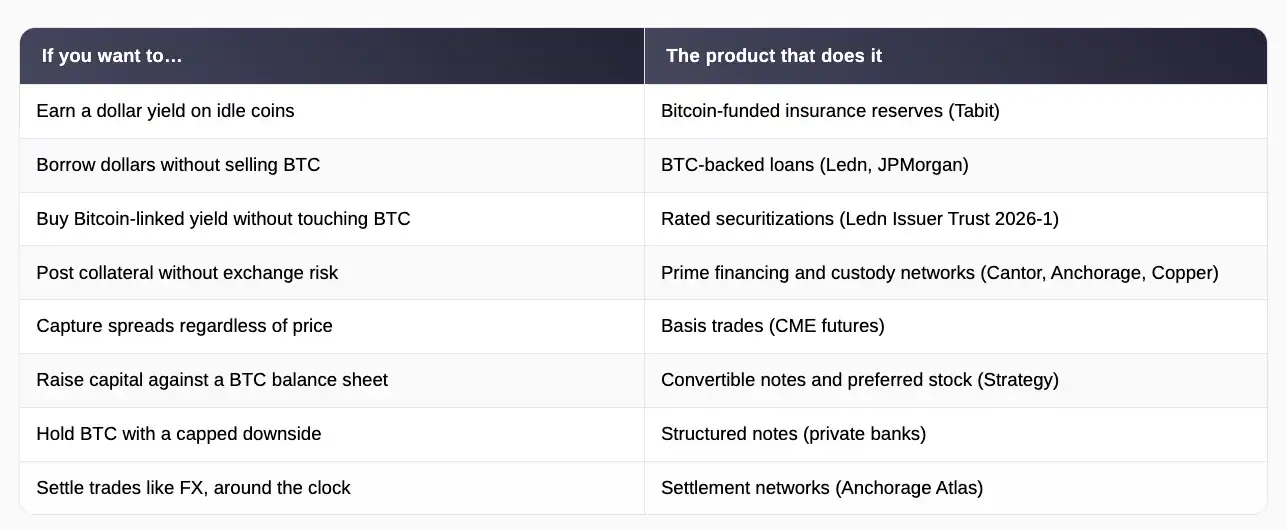
ETFs answered only one question: how ordinary investors and institutions can hold Bitcoin within a regulated wrapper. The products in this article answer a different, arguably more important question: once you own Bitcoin, what can you do with it?

The answer: exactly what the financial industry has always done with U.S. Treasuries and gold. You can use it as collateral to borrow money, post it as margin for trades, backstop insurance policies as reserves, or build a corporate balance sheet on top of it.

Assets capable of doing all these things simultaneously are sometimes called financial primitives, a fancy term for "building blocks": things that are widely accepted and easily valued, upon which the rest of the financial system can stack loans, bonds, and derivatives. Treasuries earned this status because everyone agrees on their value and how to seize them if a trade goes wrong.

Bitcoin is now undergoing the same test. Early results explain why some of the biggest players in this market genuinely don't care whether the price goes up or down.

Insurance Reserves, Consumer Credit, and the First Rated Bitcoin Bond

In March 2025, Tabit Insurance, a Barbados-licensed insurer founded by former Bittrex executives, capitalized a property and casualty insurance entity with $40 million funded entirely by Bitcoin.

Essentially, Bitcoin holders surrendered their holdings to back real insurance policies covering storm damage and lawsuits against company directors. In return, they earned a near 10% dollar-denominated yield. Policies and premiums remained in dollars, so clients never touched cryptocurrency, while Bitcoin served as the reserve to pay claims if problems arose.

Tabit holds a Class 2 license from the Barbados Financial Services Commission and is structured as a segregated accounts company. This means each investor fund pool is legally isolated from others, so losses in one account don't drain capital from another.

Regulators and auditors can also check the reserves on the blockchain in real-time, providing more transparency than traditional insurers offer in their quarterly reports. CEO Stephen Stonberg noted that the entire global reinsurance industry runs on roughly $800 billion in capital, while Bitcoin is a multi-trillion-dollar asset class. Thus, even a small portion of this wealth flowing into underwriting would be felt across the entire industry.

While insurance reserves are indeed an unexpected use case for Bitcoin, lending is where things get serious. Bitcoin-collateralized loans work in a straightforward way: you pledge your coins to a lender, receive dollars, and when you repay, you get your coins back.

Holders do this because selling triggers taxable gains and ends their exposure to future price appreciation, while borrowing against coins gives them cash without relinquishing any holdings.

Transaction volume across platforms reached about $2 billion in 2025. Toronto-based Ledn alone reported issuing over $9.5 billion since 2018. Major banks like JPMorgan Chase have also launched similar products for their own clients.

In February 2026, this lending business entered the mainstream bond market. Ledn completed a $188 million securitization, meaning it bundled 5,441 loans into a pool and sold bonds whose interest payments come from borrower repayments.

The bonds were split into two tranches: $160 million in senior notes that get paid first, rated BBB- by S&P Global Ratings (an investment-grade rating, the first ever assigned to a digital asset-backed security), and $28 million in riskier subordinate notes rated B-, which absorb first losses in exchange for higher yields.

By crypto standards, the underlying numbers are conservative. The 2,914 U.S. borrowers in the pool owe $199.1 million but have pledged around 4,079 BTC, worth $356.9 million. This translates to a loan-to-value ratio of 55.8%, meaning they pledged nearly $2 worth of Bitcoin for every $1 borrowed.

Ledn CEO Adam Reeds stated that this structure creates a "direct pipeline" between Bitcoin holders seeking liquidity and the world's deepest pools of institutional capital. Bitwise's European Head of Research, Andre Dragosch, added that the deal proves traditional finance now views Bitcoin as legitimate, even pristine, collateral.

The structure was almost immediately stress-tested, revealing both the model's strength and its fragility. Bitcoin fell about 27% from mid-January to February 2026, pushing up the loan-to-value ratio across the pool and triggering margin calls—automatic demands for borrowers to either add more collateral or watch the lender sell it.

Ledn eventually liquidated roughly a quarter of the loans originally intended for the deal. The sale still went through, partly because these automatic liquidations worked exactly as designed, and Ledn never suffered a loss when selling collateral due to default.

The perverse consequence to remember: when many lenders run the same triggers on the same volatile asset, a sharp price drop forces them to sell simultaneously, and this selling further depresses the price, triggering more sales. The system passed its first real test, but it also revealed where it would break under sufficient stress.

Collateral Networks, Carry Trades, and Corporate Balance Sheets

Beneath these products, the market's fundamental mechanics are being rebuilt to resemble currency and bond markets more closely, where the entity holding your assets, the platform you trade on, and the system settling the trades are three separate things.

Anchorage Digital, which operates the only federally chartered crypto bank in the U.S., launched its Atlas settlement network in April 2024. This allows institutions to settle trades directly with each other without parking funds in custody accounts or pre-funding exchanges.

By March 2026, Atlas had connected nearly 600 participants, four times the number from a year earlier, processed hundreds of billions in settlements, and expanded to managing collateral. This means the bank now monitors loan positions, issues margin calls, and handles liquidations on behalf of lenders.

Cantor Fitzgerald chose Anchorage and Copper.co to play this role for its global Bitcoin financing business in March 2025. Copper's ClearLoop system lets trading firms lock their coins in custody while still trading across multiple exchanges, so a repeat of the FTX collapse wouldn't take client assets.

All of this makes posting Bitcoin as margin as routine and safe as posting Treasuries—a prerequisite for the expansion of everything else mentioned in this article.

A significant portion of the institutional capital flowing through these mechanisms has absolutely no view on Bitcoin's price. The basis trade has been one of the most popular institutional strategies since the ETF launch, exploiting the fact that Bitcoin futures typically trade slightly above the spot price: funds buy spot Bitcoin or ETF shares while simultaneously selling futures contracts at a higher price, profiting from the spread regardless of where the price goes next, as gains on one leg offset losses on the other.

After ETFs gave funds an easy way to hold the spot side, hedge funds built record short positions in CME futures, where open interest climbed from around 30,000 contracts in early 2024 to a peak near 45,000 in November of that year.

This trade became large enough that its unwinding can now move the market on its own. CME open interest fell below $10 billion in April 2026 as these paired positions closed, mechanically selling pressure and depressing prices regardless of anyone's sentiment.

CME continues to build for this crowd, adding 24/7 trading in May 2026 and launching Bitcoin volatility index futures in June, allowing institutions to bet on or hedge the severity of price swings rather than its direction.

Corporate treasuries take this idea the furthest. As of late May 2026, MicroStrategy holds 843,738 BTC. The company has issued $6.7 billion in convertible notes (bonds convertible to stock if the share price rises), plus $15.5 billion in preferred stock across five different instruments—securities paying fixed dividends that sit between debt and common stock—to fund its aggressive BTC purchases.

In 2025 alone, it raised $25.3 billion, making it the largest U.S. equity issuer that year, accounting for about 8% of all issuance. It markets its preferred securities as "digital credit," a full-fledged fixed-income product line whose dividends are ultimately serviced by the Bitcoin balance sheet.

Shareholders effectively get leveraged Bitcoin exposure through the stock; dividend investors get double-digit yields backed by the coins. From Tokyo-listed Metaplanet to Semler Scientific, imitators are copying Michael Saylor's risk playbook.

Private banks run parallel assembly lines for wealthy clients, packaging structured notes that cap the downside of Bitcoin exposure in exchange for giving up some upside, allowing conservative portfolios to hold an asset that would otherwise be too volatile for them.
This brings us full circle to the opening paradox.

ETFs answered how institutions can own Bitcoin. The products described in this article answer what they own it for. An asset that simultaneously capitalizes Caribbean reinsurers, backs investment-grade bonds, posts margin for CME derivatives, and services preferred stock dividends has moved far beyond speculative adoption and into the working machinery of finance.

Historians of this market may ultimately see ETFs as the visible first layer of institutionalization, while the lasting change happened in the plumbing of funding and settlement systems, where Bitcoin is doing the work Treasuries and gold have done for generations: serving as collateral upon which everything else is built.

The risks are real, as proven by the February liquidation wave, and they grow with leverage. But the direction seems set. Bitcoin's most important institutional role may never appear on a fund flows chart because it is becoming part of the machinery itself.

Related Questions

QAccording to the article, what is a key limitation of Bitcoin ETFs, and what more fundamental change is occurring behind the scenes?

AThe key limitation of Bitcoin ETFs is that they only solve the problem of 'how to buy Bitcoin' in a regulated wrapper for institutions and ordinary investors. The more fundamental change happening behind the scenes is Bitcoin's evolution into a 'financial primitive,' where it is increasingly used within the financial system's plumbing for purposes like collateral for loans, insurance reserves, and backing rated bonds, similar to the roles of U.S. Treasuries and gold.

QWhat was the significance of the $188 million securitization deal led by Ledn in February 2026, as mentioned in the article?

AThe $188 million securitization deal led by Ledn was significant because it packaged 5,441 Bitcoin-backed loans into bonds that were sold to institutional investors. Crucially, S&P Global Ratings assigned an investment-grade rating of BBB- to the senior tranche of these bonds. This marked the first time a security backed by digital assets ever received an investment-grade rating, signaling traditional finance's growing acceptance of Bitcoin as legitimate collateral.

QThe article describes how Bitcoin's use as collateral poses a systemic risk. What specific event in February 2026 highlighted this vulnerability, and how did it manifest?

AThe vulnerability was highlighted in February 2026 when Bitcoin's price fell by approximately 27%. This drop increased the loan-to-value ratios across many lending platforms, triggering widespread margin calls. The systemic risk manifested as a 'collective stampede,' where many lenders were forced to liquidate collateral (sell Bitcoin) simultaneously to cover loans. These automated sales further depressed the price, potentially triggering more liquidations in a vicious cycle, exposing the fragility of highly leveraged systems built on volatile collateral.

QBeyond lending and bonds, what are two other institutional use cases for Bitcoin described in the article, and how do they function?

ATwo other institutional use cases described are: 1) Insurance Reserves: Companies like Tabit Insurance use a pool of Bitcoin as capital to back traditional property and casualty insurance policies. Policyholders pay premiums in dollars, and Bitcoin acts as the reserve to pay claims if needed, offering investors a yield. 2) Corporate Treasury Strategy: Companies like Strategy (and followers like Metaplanet) use their balance sheets to hold Bitcoin, financing purchases by issuing corporate debt (e.g., convertible notes, preferred shares). This allows shareholders to get leveraged Bitcoin exposure and fixed-income investors to earn yields ultimately serviced by the Bitcoin holdings.

QWhat infrastructure development, mentioned in the article, is crucial for enabling Bitcoin to be used as routine collateral like U.S. Treasuries?

AThe development of new settlement and collateral management networks is crucial. Specifically, the article highlights Anchorage Digital's Atlas network and Copper's ClearLoop system. These platforms allow institutions to settle trades directly with each other and manage collateral (like monitoring loans and issuing margin calls) without having to pre-fund exchange accounts. This separation of custody, trading, and settlement makes using Bitcoin as collateral safer and more routine, mirroring the infrastructure of traditional bond and money markets.

Related Reads

How Will the Price Move Before SpaceX's Next Share Unlock?

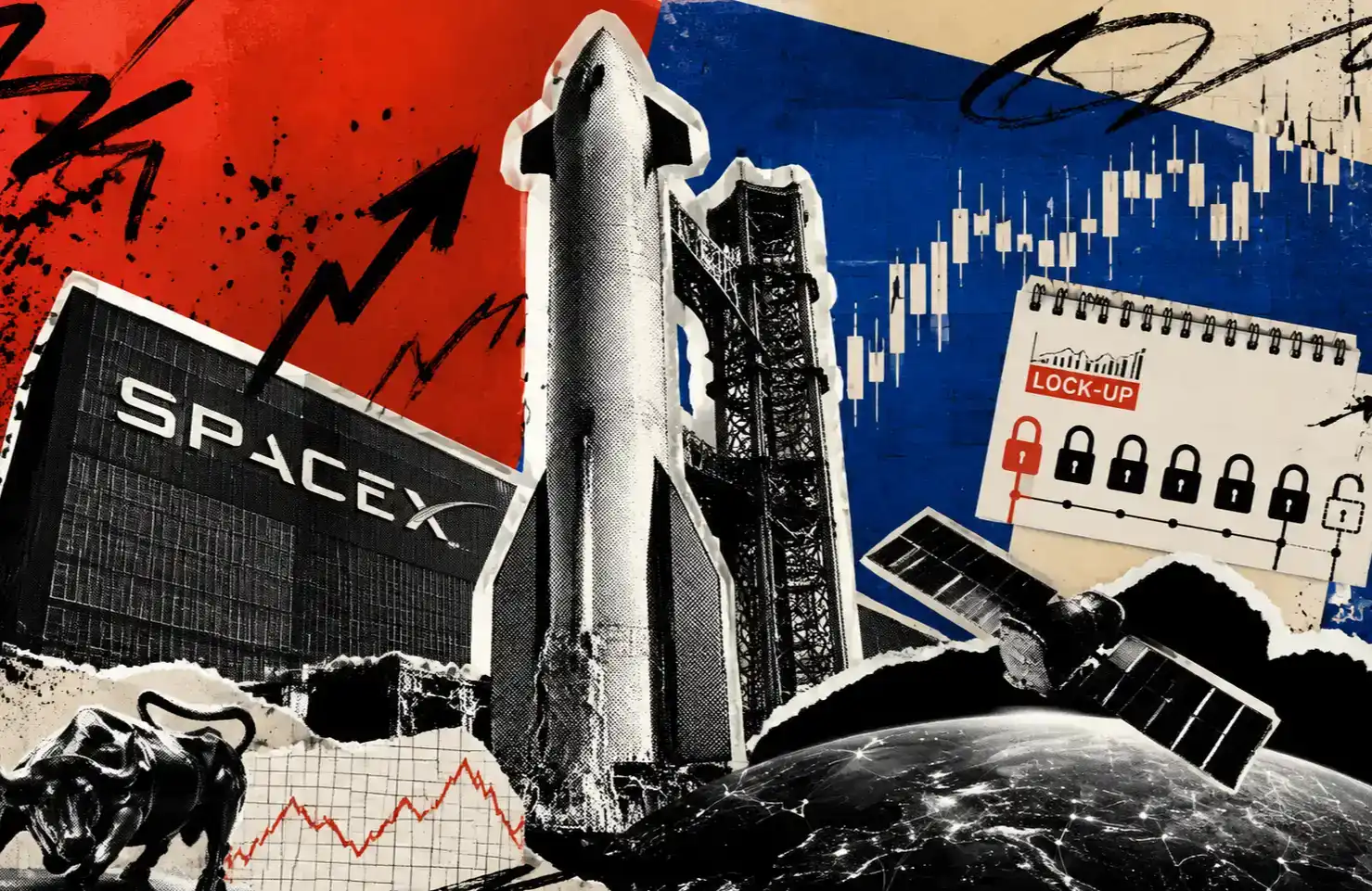
TL;DR Investors buying SPCX after SpaceX's IPO are not simply investing in a typical tech stock. It’s a high-valuation asset driven by Musk's narrative, Starlink, and space transport potential, but with a key twist: a very small initial float of ~4% has led to significant post-listing price appreciation. The current price action reflects a timing gap. Before the first lock-up expiration (estimated around August, subject to official confirmation), scarcity and high demand could continue to push prices up. Short-term bulls focus on low float, FOMO, and potential index inclusion. However, bears point to the supply dynamics that will change post-lockup. Existing shareholders still hold over 95% of shares, which will be released in stages starting from the first unlock window. This introduces future selling pressure from low-cost holders. The upcoming Q2 earnings report is a critical catalyst before the unlock. It will test whether the company's fundamentals can justify the current ~$2.1T valuation. Strong results could support the pre-unlock momentum, while weak figures could amplify concerns about future supply. The trading thesis is shifting from immediate scarcity ("can't buy enough") to evaluating future absorption capacity ("who will buy when more supply hits"). The path ahead hinges on the specifics of the unlock schedule, Q2 earnings performance, and whether anticipated passive index buying materializes.

marsbit20m ago

How Will the Price Move Before SpaceX's Next Share Unlock?

marsbit20m ago

Bitcoin Short-Term Bullish Structure Validated, HYPE Low-Entry Window Opens | Guest Analysis

**Market Analysis Summary (Week of June 2026)** **Overall Market Context:** The market environment is exceptionally complex, with the unexpected US-Iran agreement and the reopening of the Strait of Hormuz triggering a global asset repricing and significant volatility. This heightened noise underscores the importance of a structured analytical framework. **Bitcoin (BTC) Analysis & Strategy:** * **Current Status:** The price has climbed above $65,000, currently in a rebound phase (segment 38-39) following a complex 12-segment correction from the May high of $82,850. * **Key Levels:** * **Primary Resistance:** $69,500–$70,500. A successful breakout above $65,000 targets this zone. * **Primary Support:** $65,000 (immediate), followed by $59,000–$60,000 and $55,000. * **Weekly Outlook & Strategy:** The focus is on the confirmation of the $65,000 level. * **Bullish Scenario (Hold $65K):** A move toward the $69.5K–$70.5K resistance zone is anticipated, which is a potential area for initiating medium-term short positions. * **Bearish Scenario (Break below $65K):** A retest of the $60,000–$62,000 support range is likely. * **Medium-Term Strategy:** Currently neutral. Plan to establish short positions (up to 60% allocation) either in the $69.5K–$70.5K resistance zone upon signs of rejection, or on a confirmed breakdown below $65,000 and further below $59K–$60K. * **Short-Term Strategy:** Utilize 30% capital for scalping opportunities based on support/resistance levels, using 30/60-minute charts. **HYPE Analysis & Strategy:** * **Current Status:** The price has stabilized around $52 after a four-segment decline from the June high of $75.87 and is now in a rebound (segment 50-51). * **Key Levels:** * **Primary Resistance:** $62.50–$64.57. Watch for potential rejection here to form a lower high. * **Primary Support:** $52–$55.50, followed by $47–$49. * **Weekly Outlook & Strategy:** Adopt a "buy on dips, avoid chasing rallies" approach. * **Core View:** Monitor the price action and potential formation of a lower high ("endpoint 51") in the $62.50–$64.57 resistance zone. * **Short-Term Strategy:** Consider light long positions (max 30% allocation) if the price finds support and shows reversal signals in the $52–$54.50 or deeper $47–$49 support zones, confirmed by proprietary quantitative bottom signals. **Trade Review:** Last week's HYPE short-term long trade, executed based on proprietary "Price Difference" and "Momentum" model signals, yielded a profit of approximately 11.88%. The entry was near $54.39 and exit near $60.85. **Risk Management Reminder:** Always set an initial stop-loss upon entry. Move stop-loss to breakeven at +1% profit, then trail it upwards to lock in gains as the trade progresses. *Disclaimer: All analysis, models, and strategies are based on personal technical analysis for educational purposes only, not investment advice. The market carries inherent risk.*

Odaily星球日报25m ago

Bitcoin Short-Term Bullish Structure Validated, HYPE Low-Entry Window Opens | Guest Analysis

Odaily星球日报25m ago

Bitcoin Short-Term Bullish Structure Validated, HYPE Accumulation Window Opens | Guest Analysis

**Bitcoin and HYPE Market Analysis: Short-Term Outlook and Trading Strategies** This market analysis examines Bitcoin (BTC) and HYPE amid volatile conditions, providing short-term outlooks and specific trading strategies. **Key Outlooks:** * **Bitcoin (BTC):** Focus is on whether BTC's recent move above $65,000 holds. A successful breakout could lead to a test of the $69,500-$70,500 resistance zone, where medium-term short positions are considered. A failure, breaking below $65,000, may trigger a decline towards the $59,000-$60,000 support area. * **HYPE:** The token completed a four-wave correction and is now rebounding. The key resistance zone is $62.5-$64.57. The trading strategy is "buy on dips," looking for entry opportunities near the $52-$54.5 or deeper $47-$49 support zones, pending confirmation from proprietary models. **BTC Trading Strategy:** * **Medium-term:** Primarily looking to establish short positions (up to 60% allocated capital) if price rallies to the $69,500-$70,500 resistance area and shows signs of reversal. Alternative plans involve initiating shorts on a breakdown below $65,000. * **Short-term:** Allocate up to 30% capital for intraday "spread" trades based on support/resistance levels on 30/60-minute charts. **HYPE Trading Strategy:** * **Short-term:** Adopt a dip-buying approach. Consider light long positions (under 30% capital) when price tests key support levels ($52-$54.5 or $47-$49) and shows stabilization, confirmed by proprietary "Price Spread" and "Momentum Quant" models. **Trade Recap:** The analysis reviews a successful HYPE long trade from the previous week, executed at ~$54.39 and closed at ~$60.85 for an ~11.88% gain, based on signals from the aforementioned models. **Risk Management Emphasis:** The article stresses strict capital allocation (under 30-60%), immediate initial stop-loss placement, and a trailing stop-loss protocol to lock in profits as trades move favorably. ***Disclaimer:** All analysis, models, and strategies are for educational purposes based on technical analysis, not investment advice. Markets are volatile; trade with caution.*

marsbit27m ago

Bitcoin Short-Term Bullish Structure Validated, HYPE Accumulation Window Opens | Guest Analysis

marsbit27m ago

Trading

Spot
Futures

Hot Articles

What is $BITCOIN

DIGITAL GOLD ($BITCOIN): A Comprehensive Analysis Introduction to DIGITAL GOLD ($BITCOIN) DIGITAL GOLD ($BITCOIN) is a blockchain-based project operating on the Solana network, which aims to combine the characteristics of traditional precious metals with the innovation of decentralized technologies. While it shares a name with Bitcoin, often referred to as “digital gold” due to its perception as a store of value, DIGITAL GOLD is a separate token designed to create a unique ecosystem within the Web3 landscape. Its goal is to position itself as a viable alternative digital asset, although specifics regarding its applications and functionalities are still developing. What is DIGITAL GOLD ($BITCOIN)? DIGITAL GOLD ($BITCOIN) is a cryptocurrency token explicitly designed for use on the Solana blockchain. In contrast to Bitcoin, which provides a widely recognized value storage role, this token appears to focus on broader applications and characteristics. Notable aspects include: Blockchain Infrastructure: The token is built on the Solana blockchain, known for its capacity to handle high-speed and low-cost transactions. Supply Dynamics: DIGITAL GOLD has a maximum supply capped at 100 quadrillion tokens (100P $BITCOIN), although details regarding its circulating supply are currently undisclosed. Utility: While precise functionalities are not explicitly outlined, there are indications that the token could be utilized for various applications, potentially involving decentralized applications (dApps) or asset tokenization strategies. Who is the Creator of DIGITAL GOLD ($BITCOIN)? At present, the identity of the creators and development team behind DIGITAL GOLD ($BITCOIN) remains unknown. This situation is typical among many innovative projects within the blockchain space, particularly those aligning with decentralized finance and meme coin phenomena. While such anonymity may foster a community-driven culture, it intensifies concerns about governance and accountability. Who are the Investors of DIGITAL GOLD ($BITCOIN)? The available information indicates that DIGITAL GOLD ($BITCOIN) does not have any known institutional backers or prominent venture capital investments. The project seems to operate on a peer-to-peer model focused on community support and adoption rather than traditional funding routes. Its activity and liquidity are primarily situated on decentralized exchanges (DEXs), such as PumpSwap, rather than established centralized trading platforms, further highlighting its grassroots approach. How DIGITAL GOLD ($BITCOIN) Works The operational mechanics of DIGITAL GOLD ($BITCOIN) can be elaborated on based on its blockchain design and network attributes: Consensus Mechanism: By leveraging Solana’s unique proof-of-history (PoH) combined with a proof-of-stake (PoS) model, the project ensures efficient transaction validation contributing to the network's high performance. Tokenomics: While specific deflationary mechanisms have not been extensively detailed, the vast maximum token supply implies that it may cater to microtransactions or niche use cases that are still to be defined. Interoperability: There exists the potential for integration with Solana’s broader ecosystem, including various decentralized finance (DeFi) platforms. However, the details regarding specific integrations remain unspecified. Timeline of Key Events Here is a timeline that highlights significant milestones concerning DIGITAL GOLD ($BITCOIN): 2023: The initial deployment of the token occurs on the Solana blockchain, marked by its contract address. 2024: DIGITAL GOLD gains visibility as it becomes available for trading on decentralized exchanges like PumpSwap, allowing users to trade it against SOL. 2025: The project witnesses sporadic trading activity and potential interest in community-led engagements, although no noteworthy partnerships or technical advancements have been documented as of yet. Critical Analysis Strengths Scalability: The underlying Solana infrastructure supports high transaction volumes, which could enhance the utility of $BITCOIN in various transaction scenarios. Accessibility: The potential low trading price per token could attract retail investors, facilitating wider participation due to fractional ownership opportunities. Risks Lack of Transparency: The absence of publicly known backers, developers, or an audit process may yield skepticism regarding the project's sustainability and trustworthiness. Market Volatility: The trading activity is heavily reliant on speculative behavior, which can result in significant price volatility and uncertainty for investors. Conclusion DIGITAL GOLD ($BITCOIN) emerges as an intriguing yet ambiguous project within the rapidly evolving Solana ecosystem. While it attempts to leverage the “digital gold” narrative, its departure from Bitcoin's established role as a store of value underscores the need for a clearer differentiation of its intended utility and governance structure. Future acceptance and adoption will likely depend on addressing the current opacity and defining its operational and economic strategies more explicitly. Note: This report encompasses synthesised information available as of October 2023, and developments may have transpired beyond the research period.

363 Total ViewsPublished 2025.05.13Updated 2025.05.13

What is $BITCOIN

Discussions

Welcome to the HTX Community. Here, you can stay informed about the latest platform developments and gain access to professional market insights. Users' opinions on the price of BTC (BTC) are presented below.

活动图片