Bitcoin Could Strengthen US National Security, Top Military Commander Says

bitcoinistPublished on 2026-04-22Last updated on 2026-04-22

Abstract

US lawmakers advocate for domestic Bitcoin mining equipment production, citing national security risks from foreign hardware dependence. Admiral Samuel Paparo, commander of US Indo-Pacific Command, testified to the Senate Armed Services Committee that Bitcoin is a tool for "power projection" and cybersecurity. He emphasized Bitcoin's proof-of-work system as a costly deterrent against network attacks, aligning it with US national power instruments. This echoes earlier military perspectives, like US Space Force's Jason Lowery, who argued Bitcoin's utility beyond finance. The hearing also addressed cyber threats, including North Korea's crypto theft for weapons funding. While the US leads in Bitcoin holdings and mining, reliance on overseas-manufactured mining hardware remains a vulnerability.

US lawmakers are pushing to bring Bitcoin mining equipment manufacturing back to American soil — a move driven by growing concern that the country’s dependence on foreign-made hardware puts national security at risk.

That concern formed part of the backdrop when a four-star Navy admiral took a rare public stance on Bitcoin last Tuesday, telling a Senate committee it belongs in the same conversation as US military power.

Mining, Hardware, And The Supply Chain Problem

Admiral Samuel Paparo, commander of US Indo-Pacific Command, told the Senate Armed Services Committee that Bitcoin functions as a tool for “power projection.”

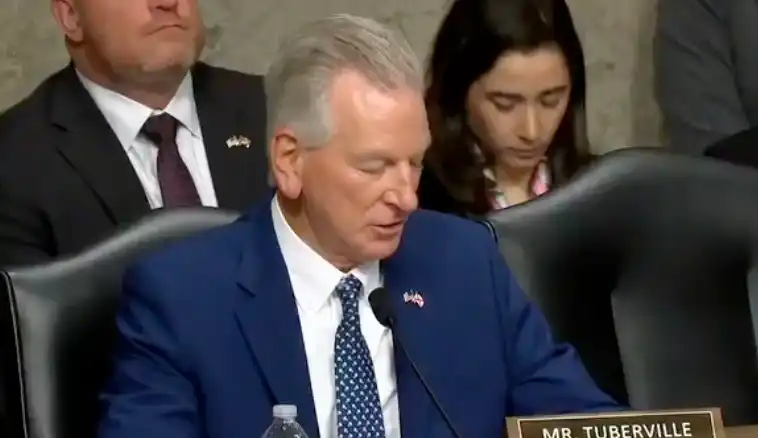
His remarks were prompted by a question from Senator Tommy Tuberville, who pointed out that China’s top monetary think tank has begun treating Bitcoin as a strategic asset and asked how Congress should respond.

Paparo didn’t answer that directly. What he did say was direct enough: “Bitcoin is a reality. It is a peer-to-peer zero-trust transfer of value. Anything that supports all instruments of national power for the United States of America is to the good.”

Beyond its role as a currency, Paparo argued that Bitcoin’s proof-of-work system carries real weight as a cybersecurity mechanism. The design of that system, he said, forces anyone trying to attack the network to spend enormous resources — making intrusions significantly more expensive.

“Outside of the economic formulation of it, it has got really important computer science applications for cybersecurity,” he told the committee.

Admiral Samuel Paparo called Bitcoin a valuable computer science tool for power projection during a Senate Armed Services Committee hearing.

Not The First Voice From The Military

Paparo is not the first person in uniform to make this case. In December 2023, US Space Force member Jason Lowery argued that proof-of-work technology could be applied well beyond finance — used to protect data, messages, and command signals from hostile actors.

Lowery said at the time that treating Bitcoin purely as a financial tool understates what it can do for national security. The difference now is the rank of the person making the argument.

BTCUSD trading at $78,062 on the 24-hour chart: TradingView

The hearing covered a wide range of security threats, including China’s military buildup, the war in Ukraine, the conflict in the Middle East, and ongoing aggression from North Korea.

Cybercrime was woven through much of that discussion. North Korea’s Lazarus Group, for instance, has stolen billions in crypto over the past decade, with proceeds allegedly funneled into the country’s weapons program.

A Push To Manufacture Domestically

The US currently holds more Bitcoin than any other national government and controls the largest share of the global mining network. But that position comes with a vulnerability: the physical machines used to mine Bitcoin are largely manufactured overseas.

Featured image from Meta, chart from TradingView

Related Questions

QWhy are US lawmakers pushing to bring Bitcoin mining equipment manufacturing back to the US?

ABecause they are concerned that the country's dependence on foreign-made hardware poses a risk to national security.

QWhat did Admiral Samuel Paparo say Bitcoin functions as during the Senate hearing?

AHe stated that Bitcoin functions as a tool for 'power projection' and is a peer-to-peer zero-trust transfer of value that supports all instruments of national power for the United States.

QAccording to the admiral, what is a key cybersecurity benefit of Bitcoin's proof-of-work system?

AHe argued that its design forces anyone trying to attack the network to spend enormous resources, making intrusions significantly more expensive and thus serving as an important cybersecurity mechanism.

QWho was the first US military member to argue that Bitcoin's proof-of-work has applications beyond finance?

AUS Space Force member Jason Lowery, who in December 2023 argued the technology could be used to protect data, messages, and command signals from hostile actors.

QWhat is the specific vulnerability the US faces despite controlling the largest share of the global Bitcoin mining network?

AThe physical machines (mining equipment) used to mine Bitcoin are largely manufactured overseas, creating a supply chain risk.

Related Reads

Polymarket's "2028 Presidential Election" Volume King Is... LeBron James???

An article from Odaily Planet Daily, authored by Azuma, discusses a peculiar phenomenon observed on the prediction market platform Polymarket regarding the "2028 US Presidential Election" event. Despite having a real-time probability of less than 1%, unlikely candidates such as NBA star LeBron James (with $48.41 million in trading volume), celebrity Kim Kardashian ($33.84 million), and even ineligible figures like Elon Musk ($23.14 million) and New York City Mayor Zohran Mamdani ($18.39 million) account for approximately 70% of the total trading volume. In contrast, high-probability candidates like Vice President JD Vance ($10.58 million), California Governor Gavin Newsom ($15.71 million), and Secretary of State Marco Rubio ($9.32 million) have significantly lower trading activity. The article explains that this counterintuitive trend is not driven by irrational speculation but by rational strategies. Polymarket offers a 4% annualized holding reward for certain markets, including the 2028 election, to maintain long-term pricing accuracy. This yield exceeds the current 5-year US Treasury rate (3.98%), attracting large investors ("whales") to hold "NO" shares on low-probability candidates for risk-free returns. Additionally, some users utilize a platform feature that allows converting a set of "NO" shares into corresponding "YES" shares for better liquidity or pricing efficiency, rather than directly buying "YES" shares for their preferred candidates. Thus, the seemingly absurd trading activity is strategically motivated.

marsbit1h ago

Polymarket's "2028 Presidential Election" Volume King Is... LeBron James???

marsbit1h ago

Trading

Spot
Futures

Hot Articles

What is $BITCOIN

DIGITAL GOLD ($BITCOIN): A Comprehensive Analysis Introduction to DIGITAL GOLD ($BITCOIN) DIGITAL GOLD ($BITCOIN) is a blockchain-based project operating on the Solana network, which aims to combine the characteristics of traditional precious metals with the innovation of decentralized technologies. While it shares a name with Bitcoin, often referred to as “digital gold” due to its perception as a store of value, DIGITAL GOLD is a separate token designed to create a unique ecosystem within the Web3 landscape. Its goal is to position itself as a viable alternative digital asset, although specifics regarding its applications and functionalities are still developing. What is DIGITAL GOLD ($BITCOIN)? DIGITAL GOLD ($BITCOIN) is a cryptocurrency token explicitly designed for use on the Solana blockchain. In contrast to Bitcoin, which provides a widely recognized value storage role, this token appears to focus on broader applications and characteristics. Notable aspects include: Blockchain Infrastructure: The token is built on the Solana blockchain, known for its capacity to handle high-speed and low-cost transactions. Supply Dynamics: DIGITAL GOLD has a maximum supply capped at 100 quadrillion tokens (100P $BITCOIN), although details regarding its circulating supply are currently undisclosed. Utility: While precise functionalities are not explicitly outlined, there are indications that the token could be utilized for various applications, potentially involving decentralized applications (dApps) or asset tokenization strategies. Who is the Creator of DIGITAL GOLD ($BITCOIN)? At present, the identity of the creators and development team behind DIGITAL GOLD ($BITCOIN) remains unknown. This situation is typical among many innovative projects within the blockchain space, particularly those aligning with decentralized finance and meme coin phenomena. While such anonymity may foster a community-driven culture, it intensifies concerns about governance and accountability. Who are the Investors of DIGITAL GOLD ($BITCOIN)? The available information indicates that DIGITAL GOLD ($BITCOIN) does not have any known institutional backers or prominent venture capital investments. The project seems to operate on a peer-to-peer model focused on community support and adoption rather than traditional funding routes. Its activity and liquidity are primarily situated on decentralized exchanges (DEXs), such as PumpSwap, rather than established centralized trading platforms, further highlighting its grassroots approach. How DIGITAL GOLD ($BITCOIN) Works The operational mechanics of DIGITAL GOLD ($BITCOIN) can be elaborated on based on its blockchain design and network attributes: Consensus Mechanism: By leveraging Solana’s unique proof-of-history (PoH) combined with a proof-of-stake (PoS) model, the project ensures efficient transaction validation contributing to the network's high performance. Tokenomics: While specific deflationary mechanisms have not been extensively detailed, the vast maximum token supply implies that it may cater to microtransactions or niche use cases that are still to be defined. Interoperability: There exists the potential for integration with Solana’s broader ecosystem, including various decentralized finance (DeFi) platforms. However, the details regarding specific integrations remain unspecified. Timeline of Key Events Here is a timeline that highlights significant milestones concerning DIGITAL GOLD ($BITCOIN): 2023: The initial deployment of the token occurs on the Solana blockchain, marked by its contract address. 2024: DIGITAL GOLD gains visibility as it becomes available for trading on decentralized exchanges like PumpSwap, allowing users to trade it against SOL. 2025: The project witnesses sporadic trading activity and potential interest in community-led engagements, although no noteworthy partnerships or technical advancements have been documented as of yet. Critical Analysis Strengths Scalability: The underlying Solana infrastructure supports high transaction volumes, which could enhance the utility of $BITCOIN in various transaction scenarios. Accessibility: The potential low trading price per token could attract retail investors, facilitating wider participation due to fractional ownership opportunities. Risks Lack of Transparency: The absence of publicly known backers, developers, or an audit process may yield skepticism regarding the project's sustainability and trustworthiness. Market Volatility: The trading activity is heavily reliant on speculative behavior, which can result in significant price volatility and uncertainty for investors. Conclusion DIGITAL GOLD ($BITCOIN) emerges as an intriguing yet ambiguous project within the rapidly evolving Solana ecosystem. While it attempts to leverage the “digital gold” narrative, its departure from Bitcoin's established role as a store of value underscores the need for a clearer differentiation of its intended utility and governance structure. Future acceptance and adoption will likely depend on addressing the current opacity and defining its operational and economic strategies more explicitly. Note: This report encompasses synthesised information available as of October 2023, and developments may have transpired beyond the research period.

363 Total ViewsPublished 2025.05.13Updated 2025.05.13

What is $BITCOIN

Discussions

Welcome to the HTX Community. Here, you can stay informed about the latest platform developments and gain access to professional market insights. Users' opinions on the price of BTC (BTC) are presented below.

活动图片