Bitcoin ETFs Post $1.42B Weekly Outflows To Close May Bloodbath

bitcoinistPublished on 2026-06-01Last updated on 2026-06-01

Abstract

U.S. Bitcoin Spot ETFs experienced significant net outflows of $1.42 billion in the final week of May, extending a negative trend throughout most of the month. This capital flight coincided with Bitcoin's price struggling to break the $82,000 resistance. Outflows were led by BlackRock's IBIT ($966.42 million), followed by Fidelity's FBTC and Grayscale's GBTC. Other funds like BITB also saw moderate outflows, while several issuers recorded zero net flows. Daily data from May 26-29 showed consistent outflows, contributing to a total monthly net outflow of $2.43 billion for May—the highest in 2026 and the largest since November 2025. Only 6 of the month's 20 trading days saw positive flows. Despite this recent pressure, the overall market remains resilient with cumulative net inflows of $55.66 billion since launch and total net assets of $94.17 billion. Bitcoin's price was at $74,012 at the time of writing.

US Bitcoin Spot ETFs reported net outflows of $1.42 billion in the final week of May, extending the persistent negative trend observed throughout most of the month. The bearish performance by these investment funds aligns with Bitcoin’s price struggles, when the premier cryptocurrency failed to breach the key resistance of $82,000 around May before slipping into another correction.

Bitcoin ETFs See Persistent Red Across Second Half Of May

In analyzing the individual fund performances over the week, it is observed, in typical fashion, that selling pressure was concentrated among the largest issuers. According to data from SoSoValue, BlackRock’s IBIT led the outflows by a wide margin, with withdrawals exceeding deposits by $966.42 million.

Behind the market leader, Fidelity’s FBTC and Grayscale’s GBTC also registered significant capital flight, posting net outflows of $169.15 million and $175.09 million, respectively. Bitwise’s BITB also recorded moderate net outflows of $46.30 million, while other mid-tier funds such as Grayscale’s secondary product BTC and ARK Invest/21Shares’ ARKB saw smaller but negative flow balances in the $20–30 million range.

Meanwhile, minor net outflows of $5.59 million were observed in Valkyrie Investments’ BRRR, while Morgan Stanley posted a negligible withdrawal of around $966,650. On the other hand, several issuers, including VanEck’s HODL, Invesco’s BTCO, Franklin Templeton’s EZBC, WisdomTree’s BTCW, and Hashdex’s DEFI, recorded no net flows, indicating a pause in both buying and selling activity.
Source: SoSoValue

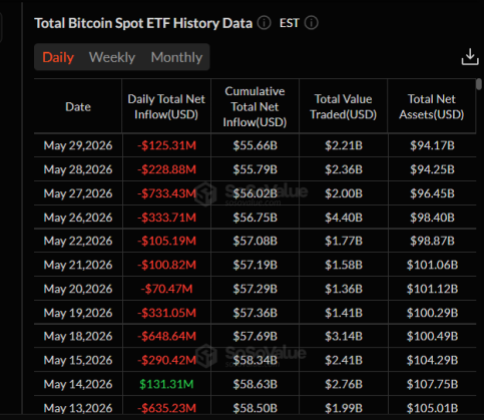
From a daily flow perspective, the situation appears strongly bearish, with withdrawals consistently outpacing deposits. Between May 26 and 29, the Bitcoin spot ETFs saw net outflows of $333.71 million on Tuesday, $733.43 million on Wednesday, $228.88 million on Thursday, and $125.31 million on Friday.

This pattern reflects a broader monthly weakness as only 6 of 20 trading days in May recorded positive flows, while 14 closed in the red. Notably, every trading session in the second half of the month posted outflows, culminating in a total negative flow balance of $2.43 billion, the highest monthly net outflow recorded in 2026 and the largest since November 2025.

Nevertheless, the Bitcoin Spot ETFs market remains in a strong, resilient position, with cumulative net inflows of $55.66 billion since their launch in 2024. Meanwhile, their total net assets are valued at $94.17 billion, representing 6.38% of the Bitcoin market cap.

Related Reading: Banks Vs. Crypto Law: JPMorgan CEO Doubles Down On CLARITY Opposition

Bitcoin Price Overview

At the time of writing, Bitcoin trades at $74,012, reflecting a slight gain of 1.07% in the past day. Meanwhile, daily trading volume has dropped by 47.55% and is valued at $18.12 billion.

BTC trading at $73,817 on the daily chart | Source: BTCUSDT chart on Tradingview.com

Related Questions

QHow much net outflows did US Bitcoin Spot ETFs report in the final week of May?

AUS Bitcoin Spot ETFs reported net outflows of $1.42 billion in the final week of May.

QWhich Bitcoin ETF issuer experienced the largest net outflows during the week, and how much was it?

ABlackRock's IBIT experienced the largest net outflows during the week, amounting to $966.42 million.

QHow did Bitcoin spot ETF flows perform on a daily basis from May 26 to May 29?

AFrom May 26 to 29, Bitcoin spot ETFs saw net outflows of $333.71 million on Tuesday, $733.43 million on Wednesday, $228.88 million on Thursday, and $125.31 million on Friday.

QWhat were the cumulative net inflows for Bitcoin Spot ETFs since their launch, and what is their total net asset value?

ASince their launch in 2024, Bitcoin Spot ETFs have cumulative net inflows of $55.66 billion, with total net assets valued at $94.17 billion.

QWhat was Bitcoin's trading price and daily trading volume at the time the article was written?

AAt the time of writing, Bitcoin traded at $74,012, with a daily trading volume valued at $18.12 billion.

Related Reads

Trading Reflection: Why Does Trading Cryptocurrencies Become More Miserable the Longer You Do It? In Fact, Your Brain Has Been 'Damaged' by Stress.

Trading Reflection: Why Does Trading Cryptocurrency Become More Miserable Over Time? Your Brain Might Be Damaged by Stress This article explores the often-overlooked yet crucial psychological aspect of trading. It argues that long-term success depends less on intellect and more on the survival capacity of one's nervous system. The core issue is that sustained trading pressure disrupts normal brain chemistry. While initial hope and occasional wins provide dopamine-driven pleasure, repeated losses and constant market exposure trigger chronic cortisol release. This stress hormone, meant for short-term survival, keeps the trader in a perpetual "fight-or-flight" mode. Over time, this erodes sleep quality, depletes patience, and fuels emotional, impulsive decision-making. The author describes a dangerous cycle: fear of missing out leads to overtrading and lowered standards. As losses mount (30%, 50%), trading shifts from a pursuit of profit to a psychological battle for survival. The brain begins to associate prolonged stress with the occasional reward, trapping the trader in an addictive loop. Anxiety becomes a baseline state, and trading turns into a compulsive need to feel something—where green candles offer relief and red ones spark self-loathing. The most powerful move a trader can make, the article concludes, is sometimes to stop entirely—to avoid revenge trading, chasing losses, or seeking dopamine fixes. The key is to step back long enough to ask: is this still about passion, or is it a cage of stress hormones? The market and its opportunities will always return, but a trader who is mentally broken will have nothing left to capitalize on them. The best traders are not necessarily the smartest, but those who preserve their mental well-being long enough to stay in the game. Ultimately, the chase may not be for money, but for relief from the very pressure the game creates.

marsbit1h ago

Trading Reflection: Why Does Trading Cryptocurrencies Become More Miserable the Longer You Do It? In Fact, Your Brain Has Been 'Damaged' by Stress.

marsbit1h ago

Issued Two Work Badges to Unitree

At the keynote of his speech at the Taipei Music Center, Jensen Huang introduced a humanoid robot named Isaac GR00T. This robot, described as a 'reference design,' is a collaboration: its body comes from Unitree Robotics' H2 Plus, its hands from Singapore's Sharpa, and its 'brain'—the chip and full software stack—is from Nvidia, powered by the Jetson Thor. Huang positioned it as a turnkey solution for universities and researchers, aimed at drastically reducing setup time for experiments. On the same day as this reveal, Unitree Robotics passed its IPO review in Shanghai, seeking to raise 4.2 billion yuan, with a significant portion earmarked for developing its own embodied AI model—its own 'brain.' The article draws a parallel to the smartphone industry, where Qualcomm's 'reference design' led to homogenized hardware and concentrated profits in chips and software. It suggests Nvidia's GR00T initiative follows a similar playbook: by open-sourcing the model and framework, it aims to establish the industry standard, potentially relegating hardware makers to low-margin roles. While currently a body supplier for Nvidia's project, Unitree is actively pursuing its own AI brain, having open-sourced initial models and tested a more advanced one. The company faces a critical window to develop a competitive proprietary system before GR00T becomes the default. The article contrasts this with Tesla's vertically integrated approach for its Optimus robot, which uses in-house chips and benefits from its automotive data and manufacturing scale. It concludes that while the robot body still holds technical value and differentiation, the race for the 'brain' will ultimately define the industry's profit centers and power dynamics.

marsbit1h ago

Issued Two Work Badges to Unitree

marsbit1h ago

Trading

Spot
Futures

Hot Articles

What is $BITCOIN

DIGITAL GOLD ($BITCOIN): A Comprehensive Analysis Introduction to DIGITAL GOLD ($BITCOIN) DIGITAL GOLD ($BITCOIN) is a blockchain-based project operating on the Solana network, which aims to combine the characteristics of traditional precious metals with the innovation of decentralized technologies. While it shares a name with Bitcoin, often referred to as “digital gold” due to its perception as a store of value, DIGITAL GOLD is a separate token designed to create a unique ecosystem within the Web3 landscape. Its goal is to position itself as a viable alternative digital asset, although specifics regarding its applications and functionalities are still developing. What is DIGITAL GOLD ($BITCOIN)? DIGITAL GOLD ($BITCOIN) is a cryptocurrency token explicitly designed for use on the Solana blockchain. In contrast to Bitcoin, which provides a widely recognized value storage role, this token appears to focus on broader applications and characteristics. Notable aspects include: Blockchain Infrastructure: The token is built on the Solana blockchain, known for its capacity to handle high-speed and low-cost transactions. Supply Dynamics: DIGITAL GOLD has a maximum supply capped at 100 quadrillion tokens (100P $BITCOIN), although details regarding its circulating supply are currently undisclosed. Utility: While precise functionalities are not explicitly outlined, there are indications that the token could be utilized for various applications, potentially involving decentralized applications (dApps) or asset tokenization strategies. Who is the Creator of DIGITAL GOLD ($BITCOIN)? At present, the identity of the creators and development team behind DIGITAL GOLD ($BITCOIN) remains unknown. This situation is typical among many innovative projects within the blockchain space, particularly those aligning with decentralized finance and meme coin phenomena. While such anonymity may foster a community-driven culture, it intensifies concerns about governance and accountability. Who are the Investors of DIGITAL GOLD ($BITCOIN)? The available information indicates that DIGITAL GOLD ($BITCOIN) does not have any known institutional backers or prominent venture capital investments. The project seems to operate on a peer-to-peer model focused on community support and adoption rather than traditional funding routes. Its activity and liquidity are primarily situated on decentralized exchanges (DEXs), such as PumpSwap, rather than established centralized trading platforms, further highlighting its grassroots approach. How DIGITAL GOLD ($BITCOIN) Works The operational mechanics of DIGITAL GOLD ($BITCOIN) can be elaborated on based on its blockchain design and network attributes: Consensus Mechanism: By leveraging Solana’s unique proof-of-history (PoH) combined with a proof-of-stake (PoS) model, the project ensures efficient transaction validation contributing to the network's high performance. Tokenomics: While specific deflationary mechanisms have not been extensively detailed, the vast maximum token supply implies that it may cater to microtransactions or niche use cases that are still to be defined. Interoperability: There exists the potential for integration with Solana’s broader ecosystem, including various decentralized finance (DeFi) platforms. However, the details regarding specific integrations remain unspecified. Timeline of Key Events Here is a timeline that highlights significant milestones concerning DIGITAL GOLD ($BITCOIN): 2023: The initial deployment of the token occurs on the Solana blockchain, marked by its contract address. 2024: DIGITAL GOLD gains visibility as it becomes available for trading on decentralized exchanges like PumpSwap, allowing users to trade it against SOL. 2025: The project witnesses sporadic trading activity and potential interest in community-led engagements, although no noteworthy partnerships or technical advancements have been documented as of yet. Critical Analysis Strengths Scalability: The underlying Solana infrastructure supports high transaction volumes, which could enhance the utility of $BITCOIN in various transaction scenarios. Accessibility: The potential low trading price per token could attract retail investors, facilitating wider participation due to fractional ownership opportunities. Risks Lack of Transparency: The absence of publicly known backers, developers, or an audit process may yield skepticism regarding the project's sustainability and trustworthiness. Market Volatility: The trading activity is heavily reliant on speculative behavior, which can result in significant price volatility and uncertainty for investors. Conclusion DIGITAL GOLD ($BITCOIN) emerges as an intriguing yet ambiguous project within the rapidly evolving Solana ecosystem. While it attempts to leverage the “digital gold” narrative, its departure from Bitcoin's established role as a store of value underscores the need for a clearer differentiation of its intended utility and governance structure. Future acceptance and adoption will likely depend on addressing the current opacity and defining its operational and economic strategies more explicitly. Note: This report encompasses synthesised information available as of October 2023, and developments may have transpired beyond the research period.

363 Total ViewsPublished 2025.05.13Updated 2025.05.13

What is $BITCOIN

Discussions

Welcome to the HTX Community. Here, you can stay informed about the latest platform developments and gain access to professional market insights. Users' opinions on the price of BTC (BTC) are presented below.

活动图片