WEEX 'Joker Card' Total Prizes Exceed 750,000 USDT, Advance to Higher Prize Pools in the Fourth Phase to Share Rewards

marsbitPublished on 2026-08-10Last updated on 2026-08-10

Abstract

Since its launch in February, WEEX's gamified trading series "Poker Party" has successfully completed three rounds and is now in its fourth edition. Combining trading with card collection mechanics, the event has attracted over 300,000 participants, generating approximately 420,000 trades and more than $30.9 billion in contract trading volume. Total rewards distributed have exceeded 757,209 USDT. The ongoing fourth round (July 21 - August 16, 2026, UTC+8) introduces a new tiered prize pool system. Users advance to higher-level pools by increasing their trading volume, unlocking the potential for greater rewards. It retains popular features like card draws, Lucky Cards, and bonus multipliers. For transparency, a real-time leaderboard displays the top 500 users' scores and estimated rewards. Beyond this event, WEEX offers a diversified trading ecosystem through WEEX TradFi, allowing users to trade cryptocurrencies, stocks, ETFs, gold, and other assets within a single account. The fourth "Poker Party" is approaching its finale, with participants competing for a share of the million-USDT prize pool.

Since its initial launch in February this year, WEEX's innovative gamified trading event series 'Joker Card' has consecutively held four phases. With the innovative 'Trading + Cards' gameplay, rich random reward mechanisms, and continuously upgraded interactive experiences, 'Joker Card' has gradually become one of WEEX's most representative brand activities, attracting numerous users to actively participate.

Data shows that the total number of registrations for the first three phases of the 'Joker Card' activity exceeded 300,000, with approximately 420,000 trading instances, generating a cumulative contract trading volume of over 30.9 billion USDT, and distributing a total of 757,209 USDT in rewards. From the launch of the first phase to now, WEEX has consistently rewarded users with substantial funds, continuously optimizing the activity rules and reward mechanisms, allowing more users to experience the fun of gamified interaction during trading.

From introducing the innovative 'Trading + Cards' gameplay in the first phase, to lowering the participation threshold and expanding the prize pool scale in the second phase, and further upgrading the lucky buffs and random reward mechanisms in the third phase, WEEX has always focused on continuous iteration around user experience, enabling 'Joker Card' to evolve from a single innovative event into a popular series of brand activities on the platform.

Currently, WEEX's 'Joker Card' Fourth Phase is in full swing (Activity Period: July 21, 2026, 12:00 – August 16, 23:59:59, UTC+8). Compared to previous phases, the fourth phase introduces a progressive level-based prize pool mechanism. Users grow through continuous trading, advancing to higher-level prize pools based on trading volume. The more they trade, the higher the prize pool level they can challenge, and the more substantial the rewards they can share. Simultaneously, the activity retains classic features like card draw buffs, today's lucky card, and point multipliers, making each card draw and each play filled with strategy and surprises.

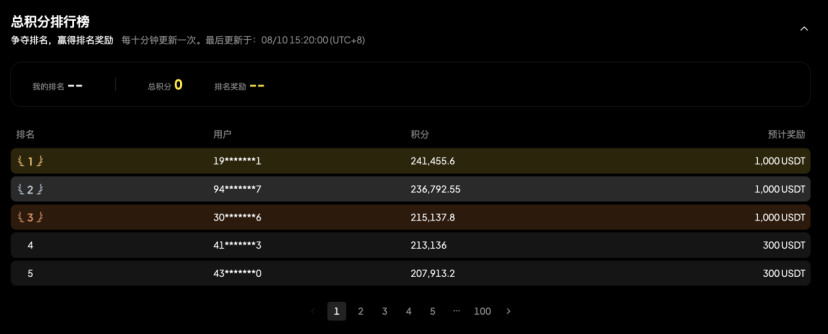
To ensure fairness and transparency, WEEX's official website publishes a real-time Top 500 user points leaderboard and estimated reward amounts. As of 12:00 on August 10 (UTC+8), the top three users on the points leaderboard will each receive a 1,000 USDT reward.
In addition to the continuous upgrade of gamified features, WEEX is also constantly enriching its platform's trading ecosystem. Currently, users can not only trade Crypto assets but can also trade diversified assets such as stocks, ETFs, gold, silver, crude oil, etc., through WEEX TradFi, achieving global core asset allocation within one account.

Whether you prefer cryptocurrencies or focus on traditional financial markets like US stocks and gold, you can choose your preferred trading targets on WEEX and simultaneously participate in the fourth phase of 'Joker Card.' While completing daily trades, collect cards and challenge higher-level prize pools to share in the million-USDT reward pool.

The fourth phase of 'Joker Card' is entering its final countdown. Click to register: https://www.weex.com/zh-CN/events/flip/poker-party-series-four, seize the last chance to get on board, and participate in sharing the million USDT prize pool!


Related Questions

QWhat is the total cumulative value of rewards distributed in the WEEX 'Joker Card' series activities up to the latest reporting period?

AThe total cumulative rewards distributed across the first three phases of the WEEX 'Joker Card' series is 757,209 USDT.

QWhat is the major new feature introduced in the fourth phase of the 'Joker Card' event compared to previous phases?

AThe major new feature in the fourth phase is the addition of a growth-based tiered prize pool mechanism. Users can progress to higher-level prize pools by increasing their trading volume, with larger rewards available at higher tiers.

QAccording to the article, what key statistic demonstrates the event's scale of participation?

AThe article highlights that the cumulative number of participants in the first three phases exceeded 300,000, with approximately 420,000 trading sessions.

QHow does WEEX ensure fairness and transparency in the 'Joker Card' event's reward distribution?

AWEEX ensures fairness and transparency by publicly displaying a real-time Top 500 user points ranking list and estimated reward amounts on its official website.

QBeyond crypto assets, what other types of assets can users trade on the WEEX platform?

AThrough WEEX TradFi, users can trade a variety of traditional financial assets including stocks, ETFs, gold, silver, and crude oil, enabling global asset allocation from a single account.

Related Reads

How Singapore's Retail Giant Masters the Gold Trade: Selling Thousands of Pounds Monthly Without Betting on Price, Gold Leasing Inspires RWA Income Design on Chain

A Singapore retail giant, Mustafa Centre, sells around 1,100 pounds of gold jewelry monthly, holding nearly a ton of inventory valued over $100 million, yet avoids gold price speculation. They achieve this by maintaining a constant inventory—buying back the exact amount of gold sold each day, earning only from sales margins, not price movements. This practice is enabled by the century-old gold leasing market. Retailers borrow physical gold to meet inventory needs without tying up capital or bearing price risk, paying a lease rate. Lenders earn yield on otherwise idle gold. This real-economy demand, driven by operational needs rather than speculation, provides a stable income stream. The article highlights how this traditional leasing model inspires on-chain Real World Asset (RWA) protocols like thUSD and thGOLD. These protocols channel gold lease yields—generated from borrowers like Mustafa—to token holders. The key challenge has been access, not yield availability. Platforms like Libeara, with institutional backing (e.g., SC Ventures), facilitate this by tokenizing funds (e.g., the MG 999 Gold Fund) that lend to vetted commercial borrowers, making this off-chain yield accessible on-chain. Thus, gold leasing demonstrates a proven, non-speculative revenue source for crypto protocols seeking sustainable "real yield," connecting physical trade finance to decentralized finance.

marsbit12m ago

How Singapore's Retail Giant Masters the Gold Trade: Selling Thousands of Pounds Monthly Without Betting on Price, Gold Leasing Inspires RWA Income Design on Chain

marsbit12m ago

Artemis: A Review of Figma's Q2 Earnings, Optimistic About Current Market Pricing

**Summary of "Artemis: Figma Q2 Earnings Review, Bullish on Current Market Pricing"** Following Figma's strong Q2'26 earnings report (revenue of $370.1M, up 48% YoY), the stock price fell 17%. The article argues this market reaction is mistaken, as it underestimates Figma's transformation from a tool for designers to the foundational design layer for all software creation in the AI era. Key supporting arguments are: 1. **Rise of the "Product Engineer":** AI is lowering coding barriers, leading to the emergence of hybrid "product engineers" who handle both engineering and design. As engineering teams are historically larger than design teams, this role significantly expands Figma's potential user base. 2. **AI Agents as Users:** The future SaaS model will charge not only for human users ("seats") but also for the work done by AI agents on their behalf. These agents will consume computational resources within Figma (e.g., editing components, converting designs to code), creating a new revenue stream. 3. **Margin Expansion:** While AI inference initially pressured gross margins, Figma's introduction of paid credits for AI usage (like Figma Make) has allowed its non-GAAP gross margin to recover to 85% in Q2'26. Monetizing its AI products further will likely drive continued margin improvement. The article acknowledges the long-term risk that AI tools like Claude could bypass the "design-to-code" workflow entirely. However, Figma's established customer base, integrated workflows, and embedded design systems act as strong moats for the foreseeable future. The author contends the market is mispricing Figma by viewing it as just a design software company. With sustained high growth (40%+ YoY revenue growth), strong Net Dollar Retention (136%), and its strategic positioning for the AI-driven future, Figma's Total Addressable Market (TAM) is much larger than currently priced. The future narrative involves more creators using Figma, more AI agents operating on its platform, and effective monetization of that AI usage.

marsbit20m ago

Artemis: A Review of Figma's Q2 Earnings, Optimistic About Current Market Pricing

marsbit20m ago

When POAP Also Reaches Its End: The Crypto Industry's 'Closure Wave' Hits, How Should Ordinary Users Cope?

The crypto industry is currently experiencing a wave of project shutdowns and closures. Notable examples include long-standing entities like the BitMEX exchange and the POAP (Proof of Attendance Protocol) project. This trend highlights a key shift: beyond major hacks or scams, many projects with real users and functional products are failing due to an inability to find sustainable business models. This signifies a structural correction, moving away from growth fueled by speculation and incentives toward projects with genuine, revenue-generating utility. For ordinary users, this "slowdown" presents new risks. The principle of "Not your keys, not your coins" addresses control but not the complete picture of asset safety. Assets in a self-custodied wallet can represent different things: native assets (e.g., ETH), protocol deposit tokens, LP tokens, or bridged/wrapped assets. If the underlying protocol, bridge, or even blockchain shuts down, the ability to redeem or exit these assets can be lost, even with the private key. The article outlines three key considerations for users: 1. **Understanding Exit Rights:** Evaluate if you can withdraw funds directly via smart contracts if a project's front-end shuts down (as with dYdX v3). 2. **Distinguishing Assets from Claims:** Recognize that tokens like renBTC are claims on assets held elsewhere; their value depends on the solvency and operation of the issuing bridge or protocol. 3. **Assessing Network Viability:** If an entire L1/L2 blockchain halts, private keys alone cannot facilitate transactions. To navigate this environment, users are advised to look beyond token prices and monitor: * **Financial Sustainability:** Is there real, non-incentivized demand and protocol revenue? * **Project Activity:** Is development active (GitHub), or is the project only maintained on social media? * **Exit Channels:** Know the exact nature, location (chain, contract), and redemption process for your holdings. In conclusion, while project lifecycles ending is a sign of industry maturation, users must develop a more nuanced understanding of self-custody. It involves not just holding private keys but also critically assessing what an asset truly represents and ensuring a viable path to exit, independent of any single project's continued operation.

marsbit23m ago

When POAP Also Reaches Its End: The Crypto Industry's 'Closure Wave' Hits, How Should Ordinary Users Cope?

marsbit23m ago

Trading

Spot
活动图片