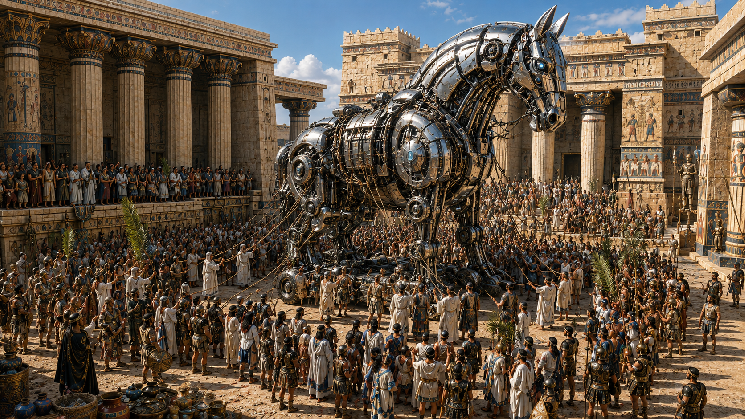
The crypto industry seems to have entered a period of intense farewells recently.
From BitMEX, which operated for 11 years and once defined perpetual contract trading in crypto, to Satori Finance, which secured investments from top institutions like Polychain and Coinbase Ventures, familiar names are ceasing operations one after another, officially reaching their end. This spans multiple directions including exchanges, DeFi, wallets, NFTs, and infrastructure.
Among these, the departure of POAP is undoubtedly particularly poignant.
If you experienced the previous crypto cycle, especially attending events like Devcon, ETHDenver, hackathons, DAO community activities, or various online/offline Meetups, you can probably find a few POAPs in your wallet. They might be from a major conference, an online talk, or just a community event whose specific content is now a bit fuzzy.
Most of these POAPs aren't worth much money, but precisely because of that, they might be closer to the original meaning of "collection" than many NFTs that were once expensively priced.
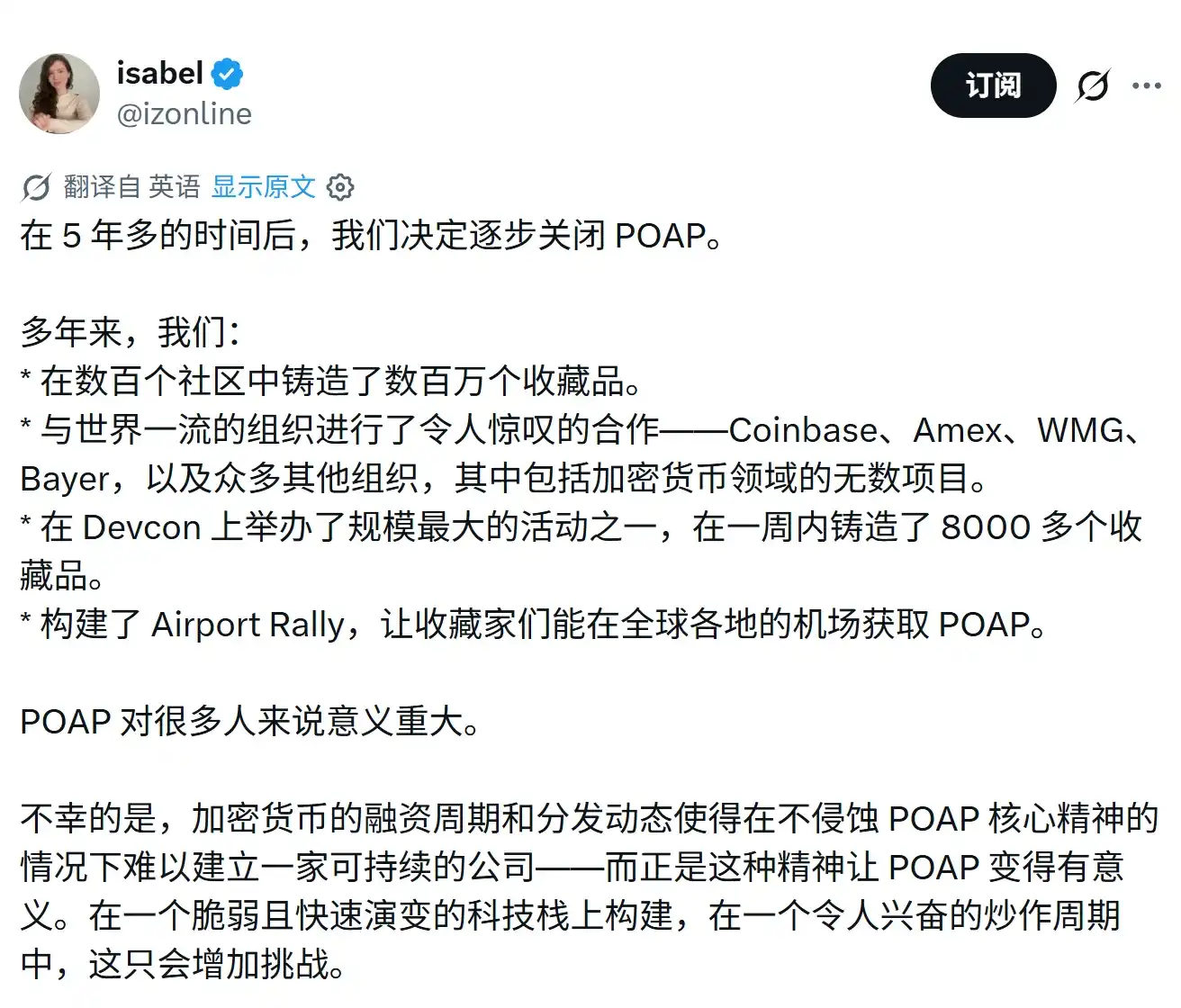
This is also why POAP's farewell feels particularly representative.
It didn't suddenly go to zero because of a hack, nor did an anonymous team abscond with funds. It didn't even issue a native token that required constantly maintaining price expectations. Simply put, it had real users, a clear use case, and high brand recognition, yet ultimately failed to find a business model sustainable enough to support the company long-term.
This precisely reflects the changes happening in the crypto industry today.
In the past, we were more accustomed to discussing how a project was born; from now on, we may need to get increasingly used to discussing how a project dies.
And this isn't necessarily a bad thing. But as ordinary users, we need to know how to avoid being affected by the aftershocks of the bear market.
I. A New Form of "Shutdown Wave" Sweeps Web3
During the last expansion phase of the crypto industry, it wasn't particularly difficult for a project to prove it was "established."
Complete funding, launch the mainnet, issue tokens/airdrops, and pair it with a round of liquidity incentives—that was often enough to attract the first batch of users. TVL, address count, and transaction volume could grow rapidly. For a surprisingly long time, whether a project actually had revenue wasn't even the most pressing issue.
But when the cycle reversed, and token prices and liquidity could no longer sustain the funding function, this model exposed a simple fundamental question: If no new money comes in, can this project sustain itself?
The truly noteworthy aspect of the 2026 wave of project shutdowns lies here.
Because many of the disappearing projects weren't vaporware from the start, but projects that had already secured funding, launched, gained real users, and were even technically running well.
For example, on July 23, BitMEX announced it would officially shut down its trading platform on September 23, 2026.
Founded in 2014, this exchange was once one of the most representative companies in the entire crypto derivatives market. Perpetual contracts, 100x leverage, and an entire set of trading products later widely adopted across the industry were all closely tied to BitMEX's early development.
It even emphasized in its official shutdown announcement that "during over 11 years of operation, BitMEX has never lost user funds due to a hack." Yet, this didn't make it a permanently operating piece of infrastructure.
Similar stories have unfolded in the DeFi and infrastructure sectors.
Botanix, a Bitcoin L2 project under construction for nearly four years, according to its own disclosed data, maintained 100% uptime and zero security incidents since its mainnet launch. It processed approximately 25 million transactions, saw 200,000 wallet addresses, attracted tens of millions of dollars in assets into its network, and integrated with infrastructure and DeFi products like Chainlink and Morpho.
Looking at traditional Crypto KPIs alone, it's hard to call it a project that "accomplished nothing"—the chain was built, the product was usable, users came, and significant money flowed in. Yet, Botanix ultimately decided to shut down its network. In its post-mortem, it stated that real transaction demand was insufficient to generate enough fee revenue to cover the infrastructure costs required for the long-term operation of an independent network.
Ultimately, Crypto has been too accustomed to measuring an ecosystem by TVL, address count, and transaction numbers, rarely asking that final question: How much real revenue did these users actually create?
As the industry enters a more mature phase, projects that lack real usage, have long-term absence of revenue, and face persistent maintenance costs gradually exiting is more akin to a structural clearing-out rather than the entire industry suddenly losing value.
One could even argue that a project, upon confirming it cannot continue, proactively stopping new business, publishing a timeline, and giving users an asset migration window is often more responsible than losing development capability while pretending to still operate.
II. Under "Chronic Demise," What Should Ordinary Users Pay Attention To?
This leads to a problem easily overlooked.
There's a long-standing security principle in the crypto industry: "Not your keys, not your coins." Consequently, many naturally believe that as long as assets are in a wallet where they control the private keys, they've solved the core security issue.
This statement is, of course, correct, but it only solves half the problem. Because holding your own private keys resolves account control, but doesn't automatically guarantee the asset itself always remains redeemable and withdrawable.
The reason is simple: the "assets" displayed in a wallet could represent completely different things. For example, you might have assets worth $10,000 in your wallet:
- One is native ETH on Ethereum;
- One is a deposit receipt from a lending protocol;
- One is an LP Token;
- One is a BTC-pegged asset minted via a cross-chain bridge;
They all appear in the wallet and require the user's private key signature to transfer, but if the underlying protocol or even the base network ceases operation, the outcomes could be entirely different.
Scenario One: The Project Stops Service, But Users Can Still Withdraw From the Contract
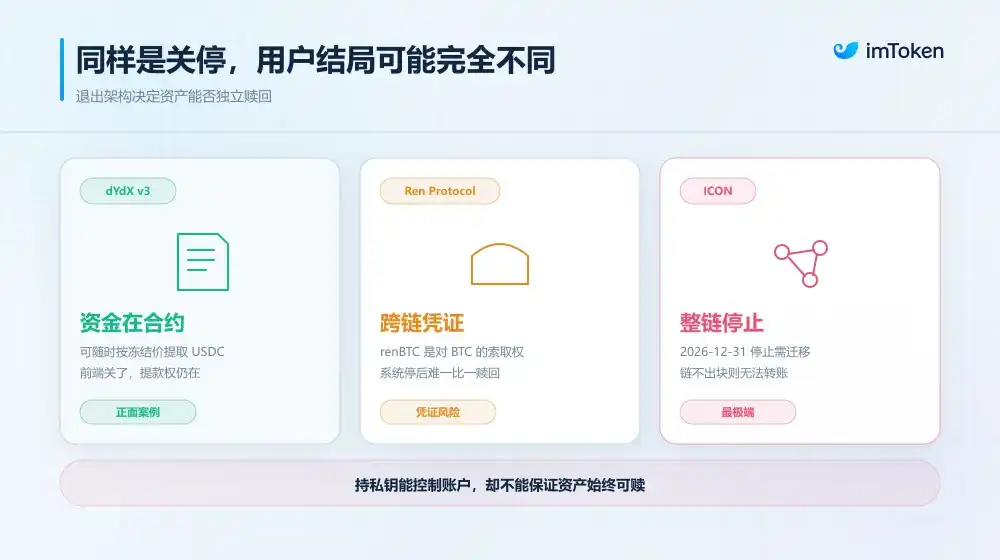
The shutdown of dYdX v3 is a relatively ideal example.
In 2024, dYdX decided to discontinue v3 and shift development focus to the new dYdX Chain. Subsequently, dYdX proactively required users to close positions and withdraw USDC. After product shutdown, the relevant contracts entered a frozen state but retained withdrawal methods for users who hadn't yet removed their funds.
This case showcases a near-perfect example of a "walkaway test"—the team can stop providing the product, but users' right to withdraw funds isn't entirely dependent on the team continuing operations.
This is also a practical standard for measuring how "non-custodial" a DeFi protocol truly is: if the development team one day stops maintaining the product, can ordinary users rely on the on-chain contracts to retrieve their money? (Extended reading: "The Turning Point of a Decade-Long Debate: Will Ethereum End the 'Impossible Trinity' Controversy?")
Scenario Two: The Coin Is Indeed in Your Wallet, But It's Just a "Receipt" for Another Asset
The story of Ren Protocol illustrates the opposite side.
Those who played with DeFi in the last cycle are likely familiar with it. Ren was once a crucial BTC cross-chain infrastructure. When users transferred BTC to Ethereum via Ren, they would receive the wrapped token renBTC, which could then be used as collateral for yield farming, lending, and other operations within Ethereum's DeFi protocols.
In theory, renBTC could be held in your own wallet, you control the private keys, and the blockchain indeed records that renBTC.
The problem is, renBTC itself isn't BTC on the Bitcoin network; it represents a claim to redeem the BTC backing the Ren cross-chain system.
Therefore, in 2022, after Alameda Research's collapse led Ren to lose critical financial support, the Ren 1.0 network began shutting down. Subsequently, projects including BadgerDAO urgently warned users to exit renBTC exposure, because once Ren 1.0 ceased operation, renBTC holders would no longer be able to redeem their assets back to Bitcoin mainnet BTC via the original bridging system.
In other words, although you still have renBTC in your wallet and no one can destroy or transfer it away, you cannot, by your private key alone, make the already defunct Ren network cross-chain swap it back to real BTC for you.
The same principle applies to a vast number of cross-chain assets, wrapped assets, LP Tokens, lending receipts, and some staking derivatives.
Users control this "receipt." Whether the receipt can ultimately be redeemed for the underlying asset depends on whether the backend smart contracts, reserve assets, oracles, cross-chain validators, liquidity, and redemption systems are still functioning.
Scenario Three: If Even the Underlying Network Shuts Down, Private Keys Can't Keep a Chain Producing Blocks
Going one level deeper, the issue becomes even more direct.
Some chains will directly shut down or become virtually abandoned (unable to guarantee stable block production), like Eclipse and AO, which the author personally experienced. If the entire network stops running, users can still retain that private key string and the record in historical blocks proving how many tokens they own, but they may not be able to freely send assets as before.
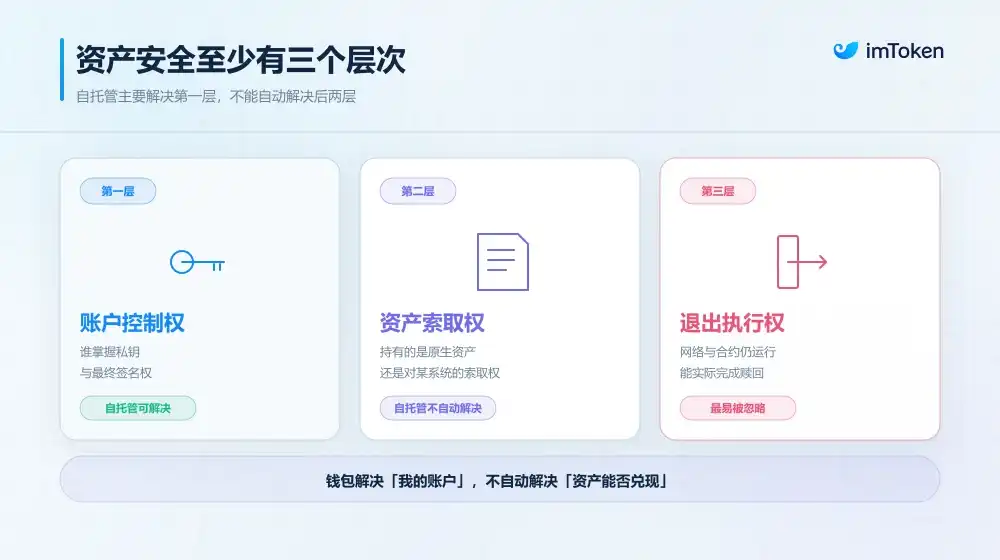
Therefore, breaking down "asset control" more comprehensively reveals it consists of at least three layers:
- First Layer: Account Control—Who holds the private keys and seed phrase?
- Second Layer: Asset Claim—Does the wallet hold a native asset or a receipt issued by some protocol, bridge, custodian, or asset pool?
- Third Layer: Exit Execution—When a user truly decides to leave, do the underlying network, smart contracts, liquidity, and necessary infrastructure still allow this asset to be redeemed and migrated?
"Not your keys, not your coins" primarily addresses the first layer.
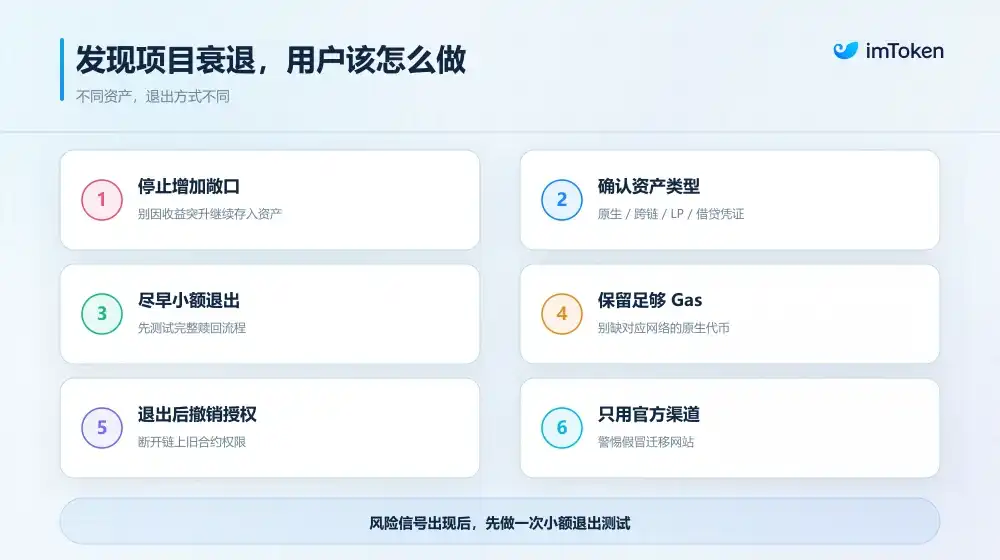
When a project begins to decline, stops maintenance, or even heads towards closure, the problems often lie precisely in the latter two layers. This is why, facing an ongoing industry-wide structural clearing-out, we need to focus more on: If this project stops operating tomorrow, can I still take my assets out intact today?
III. Comprehensively and Accurately Understanding the Meaning of "Self-Custody"
In reality, most projects don't suddenly jump from "fully operational" to "completely dead" in a single day.
Actual decline typically unfolds over a long period.
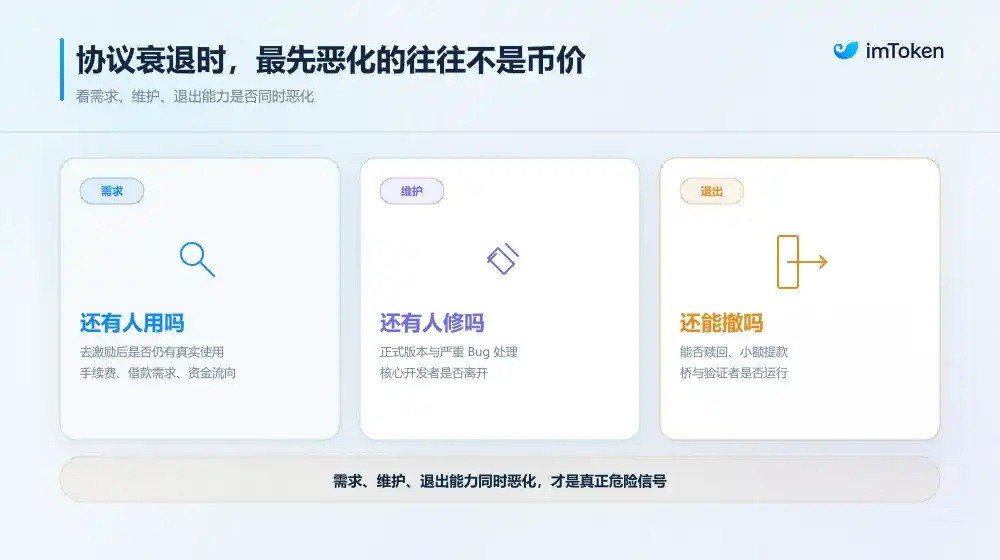
A relatively practical method of judgment is to not just watch the token, but also look at the people, the money, the code, and the exit channels simultaneously.
- First, look at the money, especially whether there is real demand after liquidity incentives are removed. After all, higher TVL doesn't equal safer, and more transactions don't necessarily mean more valuable. The key is, after removing token rewards, how many people continue using it? Can protocol revenue cover team survival and other costs?
- Then, look at the people, especially if the project is only updating social media. Many projects won't formally announce they've stopped development (the officially announced projects mentioned above already show some sense of responsibility). A more common state is: no core code updates on GitHub for six months, serious bugs unanswered long-term, roadmaps repeatedly delayed, and communities unmaintained.
- Finally, the exit channel. This is the step ordinary users most easily overlook but is potentially most valuable. For a relatively important on-chain asset, you should at least know which chain it's on, its contract address, whether what's displayed in the wallet is a native asset or a receipt, how to redeem it for the most basic asset, and if there are other ways to interact if the official front-end goes down.
Therefore, as the industry experiences more structural clearing-out, the concept of "self-custody" needs to be understood more comprehensively. For long-term held foundational assets, keeping them in a wallet where you control the private keys remains one of the most critical security baselines.
But after participating in DeFi, cross-chain, staking, and other on-chain products, you need to ask one more step: Where exactly did my assets go?
Depositing ETH into a protocol and receiving a token in your wallet doesn't mean that ETH is still sitting in the original address. Seeing a BTC L2 after cross-chaining BTC doesn't mean you're still holding real BTC. Seeing a balance after transferring assets into an LP, Vault, or lending market doesn't guarantee you can withdraw the exact amount shown on the screen upon exit.
In Conclusion
The reason POAP's departure resonates with many veteran users is that it reminds players still in Web3 that a product can have no token, no massive financial game, and can even be genuinely liked by many, yet still might have a day when it ceases operations.
This isn't an anomaly in the blockchain world.
On the contrary, it may signal that the crypto industry is finally starting to behave more like a normal industry: Products have lifecycles, teams change, failed business models exit, and limited developers, capital, and users continue flowing to more efficient places.
In the coming years, such farewells will likely continue to happen.
Some projects will, like POAP, leave behind on-chain memories of an era; some protocols will, like dYdX v3, shut down in an orderly manner, allowing users to continue exiting via contracts; and some assets will, like renBTC, make people realize only when the infrastructure is about to shut down what exactly they've been holding in their wallets.
Protocols will vanish, projects will fail, and even a chain might reach its end.
But the fundamental logic underlying crypto asset security shouldn't change with that: do not bind your ultimate control to the assumption that a particular project will operate forever.
Shared for mutual reflection.